Lost Atlantis Experience: Santorini's Multimedia Atlantis Museum Explained
The Lost Atlantis Experience in Megalochori is Santorini's only museum dedicated entirely to the Atlantis myth, using 9D simulation, holograms, and digital exhibits to explore the legend's possible link to the island's volcanic past. Opened in 2019 and spread across 700 square metres, it offers a rainy-day alternative and a genuinely different angle on the island's ancient story.
Quick Facts
- Location
- Megalochori 847 00, Santorini, Greece (near Megalochori village, southern Santorini)
- Getting There
- KTEL bus stop: Akrotiri Crossroad (Grigoris Bakery); taxis and rental vehicles recommended for flexibility
- Time Needed
- 1 to 1.5 hours
- Cost
- Around €12 per person (verify current pricing at lost-atlantis.com)
- Best for
- Families with children aged 6+, mythology fans, rainy-day visits, non-beach days
- Official website
- www.lost-atlantis.com
What Is the Lost Atlantis Experience?
The Lost Atlantis Experience is an indoor multimedia museum that opened in May 2019 in Megalochori, a village in the southern part of Santorini. The venue describes itself as the first museum in the world dedicated exclusively to the myth of Lost Atlantis. Spread across a 700-square-metre building, it combines digital exhibits, holographic projections, scale dioramas, and a multi-sensory 9D simulation into a single ticketed visit that lasts roughly one hour.
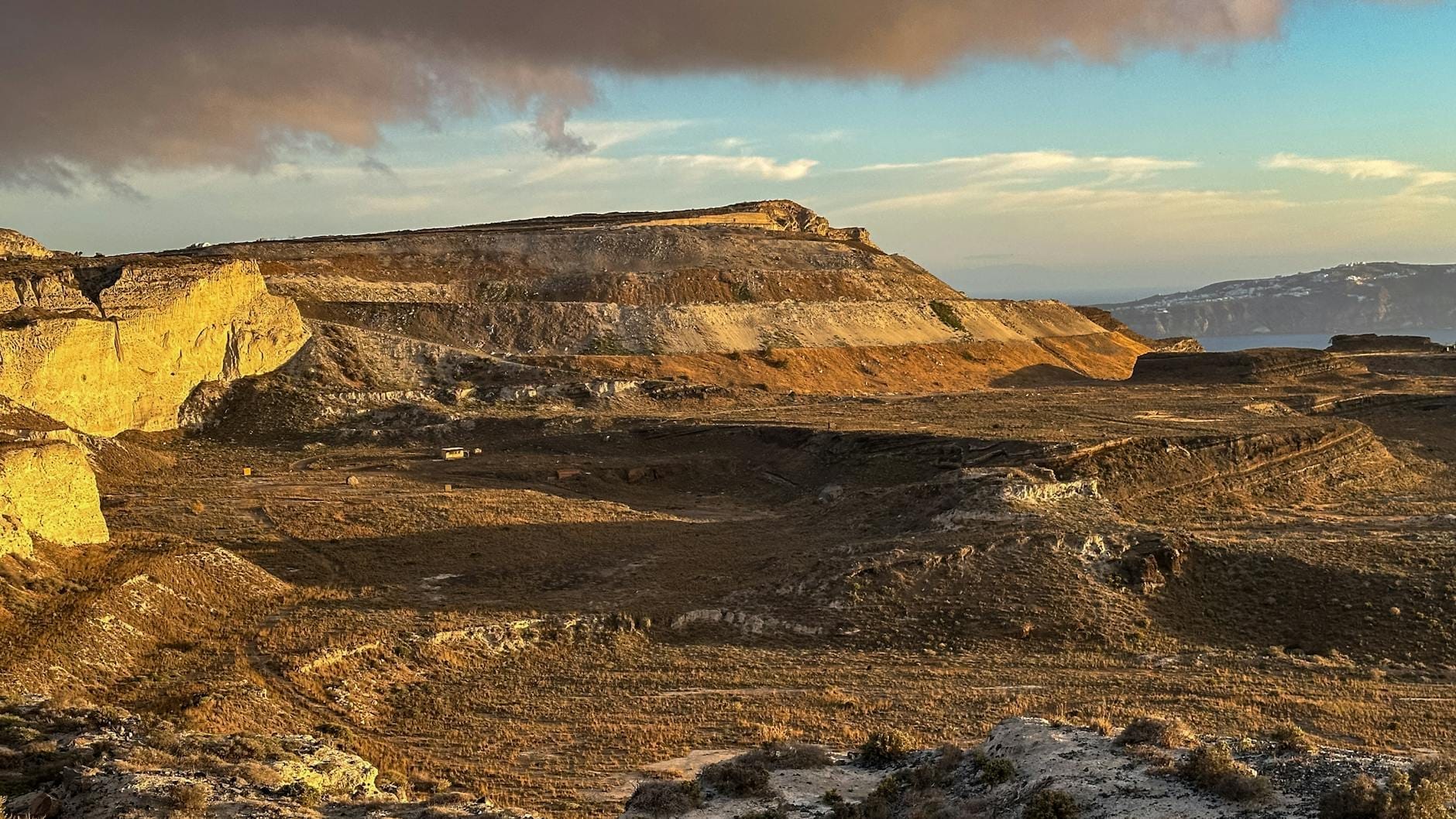
The core premise is straightforward: Santorini sits atop the remnants of one of the most powerful volcanic eruptions in recorded human history, the Minoan eruption estimated to have occurred around 1600 BCE. Some scholars and enthusiasts have long proposed that this catastrophic event, which reshaped the island's geography entirely, could be the real-world basis for Plato's description of a drowned civilisation. The museum takes that hypothesis seriously and builds its entire narrative around it.
ℹ️ Good to know
The museum presents the Atlantis-Santorini connection as a compelling theory, not established historical fact. Expect mythology and spectacle rather than academic archaeology. For verified ancient history on the island, the nearby prehistoric site at Akrotiri offers the real archaeological record.
If you want to pair this with actual archaeological evidence, the Akrotiri Archaeological Site and the Museum of Prehistoric Thera in Fira are your two most authoritative sources for Bronze Age Santorini.
The Exhibits: What You Actually See and Experience
Visitors move through a series of themed zones, beginning with digital panels and interactive displays that walk through Plato's original account of Atlantis in his dialogues Timaeus and Critias, written around 360 BCE. A holographic recreation of Plato himself narrates key passages, which is a gimmick that lands better than expected, particularly for younger visitors who respond to the theatrical presentation.
One of the more visually impressive elements is the large Atlantis diorama, a detailed scale model of what the mythologised city might have looked like before its destruction. The lighting changes during the display to simulate time passing and the eventual catastrophe. The quality of craftsmanship here is notably higher than the surrounding digital content, and visitors who appreciate physical model-making tend to linger longer here than elsewhere.
A holographic geological timeline traces how the Santorini caldera formed over successive eruptions, giving useful visual context for what visitors see when they look out at the caldera from Fira or Oia. This section is genuinely educational and more grounded than the mythological storytelling elsewhere in the museum.
The centrepiece is the 9D experience: a short motion-simulation film where visitors sit in moving seats and feel the effects of earthquake, volcanic eruption, and tsunami. It is loud, physical, and designed for impact. Cameras and mobile phones are not permitted inside this room and must be stored in cabinets beforehand. The simulation runs for several minutes and is the element most likely to be the deciding factor for families considering the visit.
⚠️ What to skip
The 9D simulation involves moving seats, loud sound effects, and simulated shaking. It may not suit visitors with motion sensitivity, young children under 6, or anyone with back or neck conditions. The minimum recommended age is 6 years.
Tickets & tours
Hand-picked options from our booking partner. Prices are indicative; availability and final rates are confirmed when you complete your booking.
Greek dining experience with traditional music and dance
From 180 €Instant confirmationFree cancellation6-Hour Private Best of Santorini Experience
From 350 €Instant confirmationFree cancellationSantorini ATV experience
From 150 €Instant confirmationFree cancellationLuxury Sunset Cruise in Santorini
From 120 €Free cancellation
How the Experience Changes by Time of Day
Being an indoor venue, the Lost Atlantis Experience is largely insulated from the time-of-day dynamics that affect most Santorini attractions. Morning slots, typically between 9:00 and 11:00, tend to be quieter, with fewer tour groups and more space to read exhibit text without being nudged along. This matters more than it sounds: the museum is not enormous, and the 9D theatre has limited capacity, so peak hours can mean waiting between sessions.
Afternoon visits, especially in summer, draw larger numbers partly because visitors use the museum as a cool, shaded alternative to the midday heat outside. The space is air-conditioned, which makes it a genuinely practical choice in July and August when temperatures commonly reach the upper 20s Celsius and shade is scarce on the caldera rim.
On overcast or rainy days, particularly in shoulder season, the museum fills quickly as it is one of the few fully indoor, structured experiences on the island. Arriving early on such days is advisable. The museum's reported hours are typically daily from 09:00 to 21:00 in season, though seasonal adjustments are possible. Confirm current hours on the official site before visiting.
Getting There: Location and Transport
The museum is located in Megalochori, in the southern part of Santorini. This is not walking distance from Fira or Oia. Most visitors arrive by rental car or scooter, private taxi, or as part of an organised tour that includes the museum as one stop. The KTEL public bus network does connect parts of southern Santorini, with the nearest stop being Akrotiri Crossroad near Grigoris Bakery, but schedules are infrequent and vary by season. Check the KTEL timetable at ktel-santorini.gr before relying on this option.
If you are planning a self-guided day in the south of the island, the museum pairs logically with the Akrotiri Archaeological Site, the Red Beach, and the Lighthouse of Akrotiri. Having your own vehicle makes combining these stops practical; without one, taxis or a guided day tour work better than trying to piece together bus connections.
💡 Local tip
Book tickets through GetYourGuide or the official site in advance during July and August. Walk-in availability is often fine in shoulder season, but the 9D theatre books quickly on busy summer days.
Practical Details: Accessibility, Languages, and Photography
The museum offers audio and text content in eight languages: Greek, English, French, German, Italian, Spanish, Turkish, and Chinese. This breadth is unusual for a small private museum and makes it genuinely accessible to a wide range of international visitors without needing a guide.
The building is a single structure on flat ground, which generally suits visitors with mobility limitations better than most of Santorini's cliff-side attractions. However, confirm wheelchair accessibility directly with the venue before visiting, as specific facility details are not extensively documented in publicly available sources.
Photography is permitted in the general exhibit areas but banned inside the 9D theatre. The exhibit lighting is deliberately low and atmospheric, which produces reasonable atmospheric photos on modern smartphone cameras but makes sharp, detailed shots difficult. A phone with a good low-light mode handles the environment better than most compact cameras.
Honest Assessment: Worth It or Not?
The Lost Atlantis Experience is a well-produced private attraction that delivers exactly what it advertises: a theatrical, multimedia interpretation of a myth. It is not a conventional museum in the scholarly sense. There are no artefacts from ancient Thera, no peer-reviewed exhibits, and the Atlantis theory itself remains firmly in the realm of speculation rather than academic consensus. Visitors who arrive expecting rigorous history will leave underwhelmed.
For families with school-age children, mythology enthusiasts, or anyone who wants a structured indoor activity that connects the island's volcanic identity to something imaginative and cinematic, the experience works well. At roughly €12 per person and one hour of your time, it is priced appropriately for what is offered. It is not the most memorable thing you will do in Santorini, but it earns its place in an itinerary that needs variety beyond beaches and sunsets.
Travellers building a broader Santorini itinerary should read the 3-day Santorini itinerary guide for context on how to slot this into a full island schedule without losing time at more iconic stops.
Solo travellers or couples prioritising photography, caldera views, and wine experiences may find this attraction skippable in favour of Oia's sunset viewpoints or a visit to one of the island's caldera-edge wineries.
Insider Tips
- Arrive within the first 30 minutes of opening if you want the 9D theatre largely to yourself. By mid-morning in peak season, small queues can form between sessions.
- The museum's air conditioning is set quite cold, which is welcome on a hot August afternoon but uncomfortable in a light summer outfit on a cooler spring day. Bring a thin layer if you run cold.
- Children between 6 and 12 consistently get the most from this visit. The simulation and holographic Plato hold their attention in ways that conventional museums often do not. Younger children may find the eruption sequence too loud.
- If you are driving in southern Santorini anyway, the museum adds relatively little detour time when combined with Akrotiri and the southwestern beaches. It fits naturally into a half-day loop of the island's south.
- The gift shop at the exit sells Atlantis-themed items ranging from quality prints to standard tourist trinkets. It is small and easy to browse without feeling pressured.
Who Is Lost Atlantis Experience For?
- Families with children aged 6 to 14 looking for structured, engaging indoor time
- Visitors with a genuine interest in ancient mythology and the Plato-Santorini connection
- Rainy or very hot days when outdoor sightseeing is uncomfortable
- First-time visitors to Santorini who want context on the island's volcanic history in an accessible format
- Travellers on multi-day itineraries who want at least one attraction that diverges from beaches and caldera views
Nearby Attractions
Other things to see while in Fira:
- Archaeological Museum of Thera
Set in the heart of Fira, the recently renovated Archaeological Museum of Thera brings together centuries of island history under one roof. The star exhibit is the Kore of Thera, a 2.48-metre Archaic statue carved from Naxian marble and hidden from public view for over two decades. For anyone serious about understanding Santorini beyond its postcard image, this is the clearest starting point.
- Fira–Oia Hiking Trail
The Fira–Oia Hiking Trail is Santorini's most rewarding walk: a 10-kilometre path along the caldera rim connecting the island's capital to its most photographed village. Free to walk, open at all hours, and lined with volcanic cliffs, whitewashed chapels, and sweeping Aegean views, it rewards those who go prepared and go early.
- Fira Town Center
Fira is the administrative and social heart of Santorini, built on the rim of the caldera at roughly 260 meters above the Aegean. Free to enter and walkable from multiple directions, it offers caldera views, museums, restaurants, and a cable car connection to the old port — all within a compact, cliff-top layout that rewards early risers and punishes late arrivals in summer.
- Firostefani
Perched on the caldera rim just north of Fira, Firostefani is a small whitewashed village that blends into Santorini's capital while offering noticeably calmer streets and sweeping volcano views. Its name translates literally as 'Crown of Fira,' and the elevated position earns that title. Entry is free, the caldera path is walkable from Fira in under 15 minutes, and the atmosphere is several degrees quieter than either Fira's main drag or Oia's famous sunset strip.