Three Bells of Fira: Santorini's Most Photographed Church
The Three Bells of Fira, officially the Catholic Church of the Dormition, perches on Fira's caldera cliff with some of the most striking architecture on the island. Built in 1757 and restored after the 1956 earthquake, it draws visitors for its distinctive blue dome, whitewashed bell tower, and unobstructed views across the Aegean. This guide covers what to expect, when to go, and how to get there.
Quick Facts
- Location
- Firostefani (just north of Fira), Santorini — on the caldera cliff edge between Fira and Firostefani
- Getting There
- Walk from Fira town center (~20 min along the caldera path); KTEL buses serve Fira from across the island
- Time Needed
- 20–45 minutes at the site; combine with the Fira–Firostefani cliff walk
- Cost
- Free to view and photograph from outside; interior access may vary
- Best for
- Photography, architecture enthusiasts, caldera views, morning light walks
What the Three Bells of Fira Actually Is
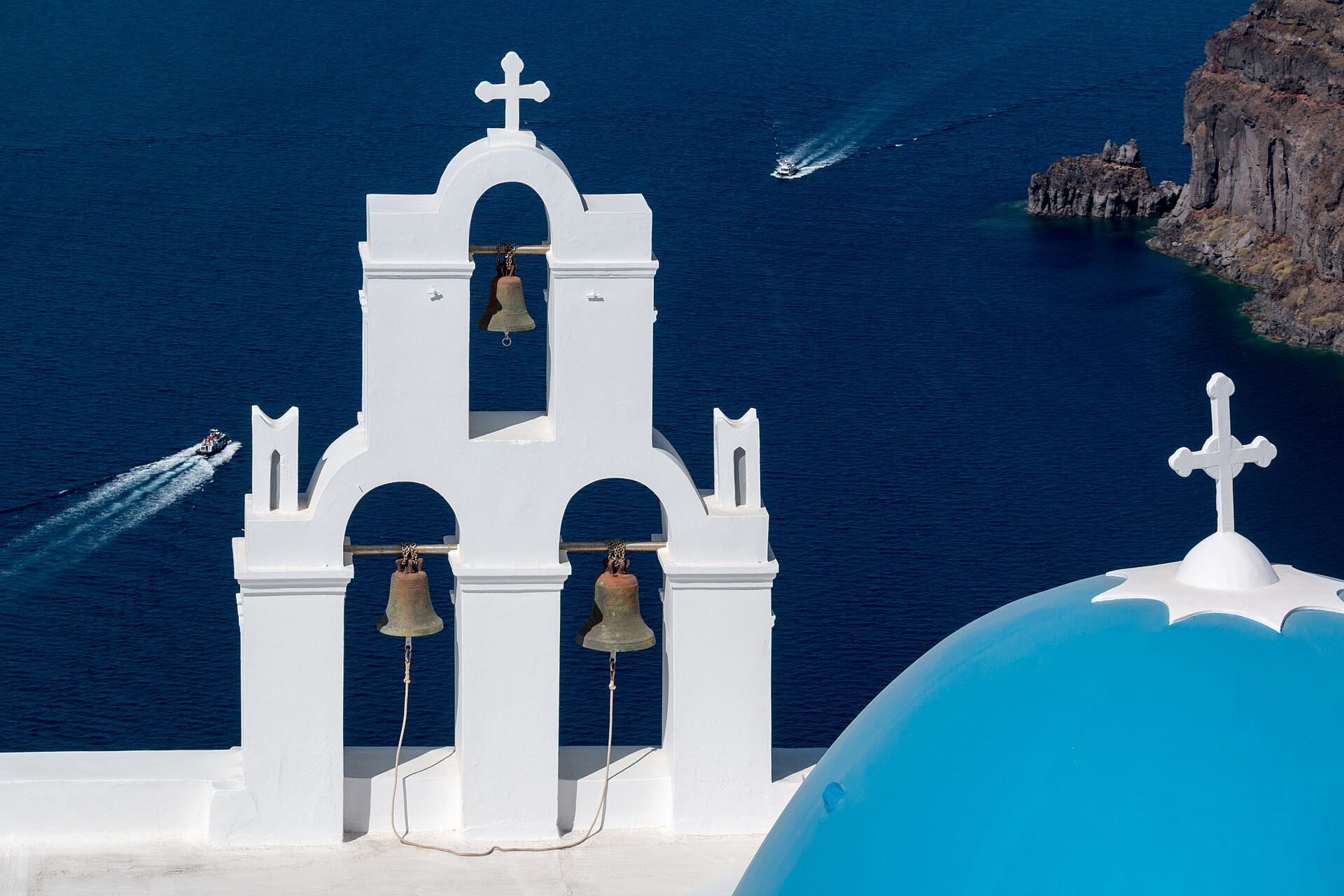
The Three Bells of Fira is the popular name for the Catholic Church of the Dormition, known in Greek as Τρεις καμπάνες των Φηρών. Despite the name, this is a working Catholic church, not a ruin or a purely decorative landmark. It sits on the western cliff of Firostefani, directly above the caldera, and its three-arched bell tower, white walls, and blue dome create the kind of composition that has appeared on more postcards and travel feeds than almost any other structure in Greece.
What makes the church architecturally distinct is not just the color scheme, which is shared by dozens of chapels across the island, but the relationship between the bell tower arches and the sky behind them. When you stand at the right angle, all three bells frame the caldera and the volcanic islands of Nea Kameni and Palea Kameni in the distance. The composition essentially frames itself.
ℹ️ Good to know
The church's official name is the Catholic Church of the Dormition. It was built in 1757, severely damaged in the 1956 Amorgos earthquake, and later restored. Its feast day falls on 15 August, when the church draws local worshippers in addition to the usual stream of visitors.
How the Experience Changes by Time of Day
This is not a place that stays static. The light on the caldera side of Fira shifts dramatically from dawn through midday to late afternoon, and the Three Bells respond to that shift in ways that matter to anyone who cares about what they see or photograph.
In the early morning, roughly from sunrise until 9 AM, the bell tower catches warm, low-angle light from the east while the caldera below remains in partial shade. The contrast is striking, the bells themselves glow faintly, and the crowds are almost nonexistent. By 10 AM, tour groups and independent walkers begin moving along the cliff path between Fira and Firostefani, and the space in front of the church fills with people waiting for their photograph. By midday in peak season (July and August), the area can feel genuinely congested.
Late afternoon, from about 4 PM onward, offers a different quality of light: warmer tones, longer shadows through the bell arches, and the caldera beginning to take on a deeper blue. Sunset draws larger crowds to Oia further north, which means Fira and its cliff-side attractions actually thin out slightly in the final hour before dark. This is a reliable window for a quieter experience with good light.
💡 Local tip
For the clearest photographs of the bells with the caldera behind them, arrive before 8:30 AM or after 4:30 PM. Midday in summer means harsh overhead light, heavy shadows in the arch openings, and a crowd of people working the same angle as you.
Tickets & tours
Hand-picked options from our booking partner. Prices are indicative; availability and final rates are confirmed when you complete your booking.
Santorini catamaran cruise with pick-up, BBQ and drinks from Fira
From 70 €Instant confirmationFree cancellationWalking Tour of Fira town in Santorini
From 49 €Instant confirmationFree cancellationLuxury Sunset Cruise in Santorini
From 120 €Free cancellationCruise of the volcanic islands around Santorini
From 45 €Instant confirmationFree cancellation
Getting There: The Cliff Walk vs. The Road
The Three Bells of Fira sits in Firostefani, roughly between the centers of Fira and Firostefani, making it a natural stop on the caldera-edge walking path that connects the two settlements. From Fira's main square, the walk to the church takes around 20 minutes on foot, following a paved path that hugs the caldera rim. The path involves uneven stone surfaces and, in places, steps, so flat-soled shoes with grip are a practical necessity rather than a suggestion.
Visitors arriving by KTEL bus will alight in Fira, which is well connected to the rest of the island including Kamari, Perissa, Oia, and the airport. From the Fira bus terminal, walk toward the caldera edge and then north along the rim path. If you are combining this stop with a longer walk, the Fira to Oia hiking trail passes directly by the church and continues all the way to Oia, covering roughly 10 kilometers in total.
Accessibility is genuinely limited here. The cliff path involves steps and uneven terrain at multiple points, and there is no formal accessible route to the church from the caldera side. Visitors with mobility restrictions may find it difficult to reach the most photogenic viewpoint directly in front of the bell tower.
The Historical Weight Behind a Famous Facade
The church was constructed in 1757, a period when Fira was already an established settlement on the caldera rim. The Catholic presence on Santorini has roots in the Venetian and Latin occupation of the Aegean during the medieval period, and the island retains a small Catholic community to this day, which is relatively unusual in the Greek islands.
The 1956 Amorgos earthquake, which measured 7.8 in magnitude and caused widespread destruction across Santorini, severely damaged the original church structure. The subsequent restoration preserved the three-arch bell tower form that gives the church its nickname and its visual identity. What visitors see today is therefore partly the original 18th-century construction and partly post-earthquake rebuilding, a layering of history that is easy to overlook when the view dominates every other thought.
For broader context on Santorini's architectural and archaeological past, the Santorini history and ancient ruins guide covers the island's development from the Minoan-era settlement at Akrotiri through Byzantine and Venetian periods to the present.
Photography: What You Can Realistically Capture
The Three Bells of Fira is one of the most photographed spots on an island that already has stiff competition in that department. The composition most people want, the three arched bells with the caldera and volcanic islands behind them, is achievable, but it requires positioning yourself at a specific angle slightly below and to the side of the main bell tower. Most visitors end up shooting straight on from the path in front of the church, which produces a flatter result. For sharper detail on the volcanic islands visible in the background, pairing this visit with a stop at the Imerovigli caldera viewpoints further along the rim gives useful comparison.
The church is also a useful anchor point for anyone working through a broader Santorini photography itinerary. It photographs well in both golden-hour light and overcast conditions, where the white walls retain brightness even without direct sun.
A wide-angle lens or a standard smartphone camera at 1x works well for the full bell tower with caldera. A short telephoto focal length (50–85mm equivalent) isolates individual bells against the sea more effectively. Drone photography is subject to Greek civil aviation regulations and local restrictions; confirm current rules before flying.
⚠️ What to skip
The space directly in front of the church becomes narrow and crowded during peak season. People often queue for a clear shot. If you are visiting in July or August between 10 AM and 3 PM, factor in waiting time or adjust your expectations.
Is It Worth Your Time?
The short answer is: yes, but only if you set realistic expectations. The Three Bells of Fira is a small church on a cliff path. The interior is not a major cultural monument on the scale of, say, a Byzantine cathedral. The exterior, including the bell tower and the caldera view it frames, is genuinely striking and worth ten or fifteen minutes of any visit to Fira.
Where the visit earns its time is when it becomes part of something larger: the cliff walk north from Fira, a stop on the way to Firostefani, or the opening leg of the longer hike toward Oia. Treated as a destination in isolation, it will feel brief. Treated as one of several stops on an afternoon walk along the caldera rim, it fits naturally.
Visitors who are not interested in architecture, photography, or caldera views, and who have limited mobility on uneven cliff paths, will likely find little reason to seek this out specifically. For everyone else, the combination of historical detail, visual payoff, and location makes it a solid addition to a Fira afternoon.
If you are planning a broader Fira itinerary, the Fira town center is the logical starting point before heading north along the caldera path toward the church.
Insider Tips
- The feast day of 15 August draws local Catholic worshippers to the church, which is one of the few times you might see the building functioning as an active place of worship rather than a photography spot. The atmosphere is notably different from a normal tourist day.
- Walk the path from Fira toward Firostefani rather than doubling back: the church is roughly the midpoint, and continuing north rewards you with progressively quieter caldera views and fewer day-trippers.
- The view from the path slightly below the church, looking up at the bells with the caldera stretching behind, is more photogenic than the head-on shot from the path in front of the door. It requires a bit of positioning but the framing is markedly better.
- Overcast days are underrated here. The white walls of the church photograph well in diffuse light, and the caldera takes on a slate-grey tone that reads differently from the standard summer-blue postcard version.
- If you are visiting in July or August and want minimal crowds, 7:30 to 8:30 AM is the most reliably quiet window on the caldera path. Most tour groups do not reach this section until mid-morning.
Who Is Three Bells of Fira For?
- Photographers looking for the classic Santorini caldera composition
- Architecture and history enthusiasts interested in Cycladic Catholic heritage
- Walkers combining the church with the Fira to Firostefani or Fira to Oia cliff path
- Couples or small groups who want a quieter caldera viewpoint outside peak hours
- Travelers wanting a visually rewarding stop that requires no advance booking or entry fee
Nearby Attractions
Other things to see while in Fira:
- Archaeological Museum of Thera
Set in the heart of Fira, the recently renovated Archaeological Museum of Thera brings together centuries of island history under one roof. The star exhibit is the Kore of Thera, a 2.48-metre Archaic statue carved from Naxian marble and hidden from public view for over two decades. For anyone serious about understanding Santorini beyond its postcard image, this is the clearest starting point.
- Fira–Oia Hiking Trail
The Fira–Oia Hiking Trail is Santorini's most rewarding walk: a 10-kilometre path along the caldera rim connecting the island's capital to its most photographed village. Free to walk, open at all hours, and lined with volcanic cliffs, whitewashed chapels, and sweeping Aegean views, it rewards those who go prepared and go early.
- Fira Town Center
Fira is the administrative and social heart of Santorini, built on the rim of the caldera at roughly 260 meters above the Aegean. Free to enter and walkable from multiple directions, it offers caldera views, museums, restaurants, and a cable car connection to the old port — all within a compact, cliff-top layout that rewards early risers and punishes late arrivals in summer.
- Firostefani
Perched on the caldera rim just north of Fira, Firostefani is a small whitewashed village that blends into Santorini's capital while offering noticeably calmer streets and sweeping volcano views. Its name translates literally as 'Crown of Fira,' and the elevated position earns that title. Entry is free, the caldera path is walkable from Fira in under 15 minutes, and the atmosphere is several degrees quieter than either Fira's main drag or Oia's famous sunset strip.