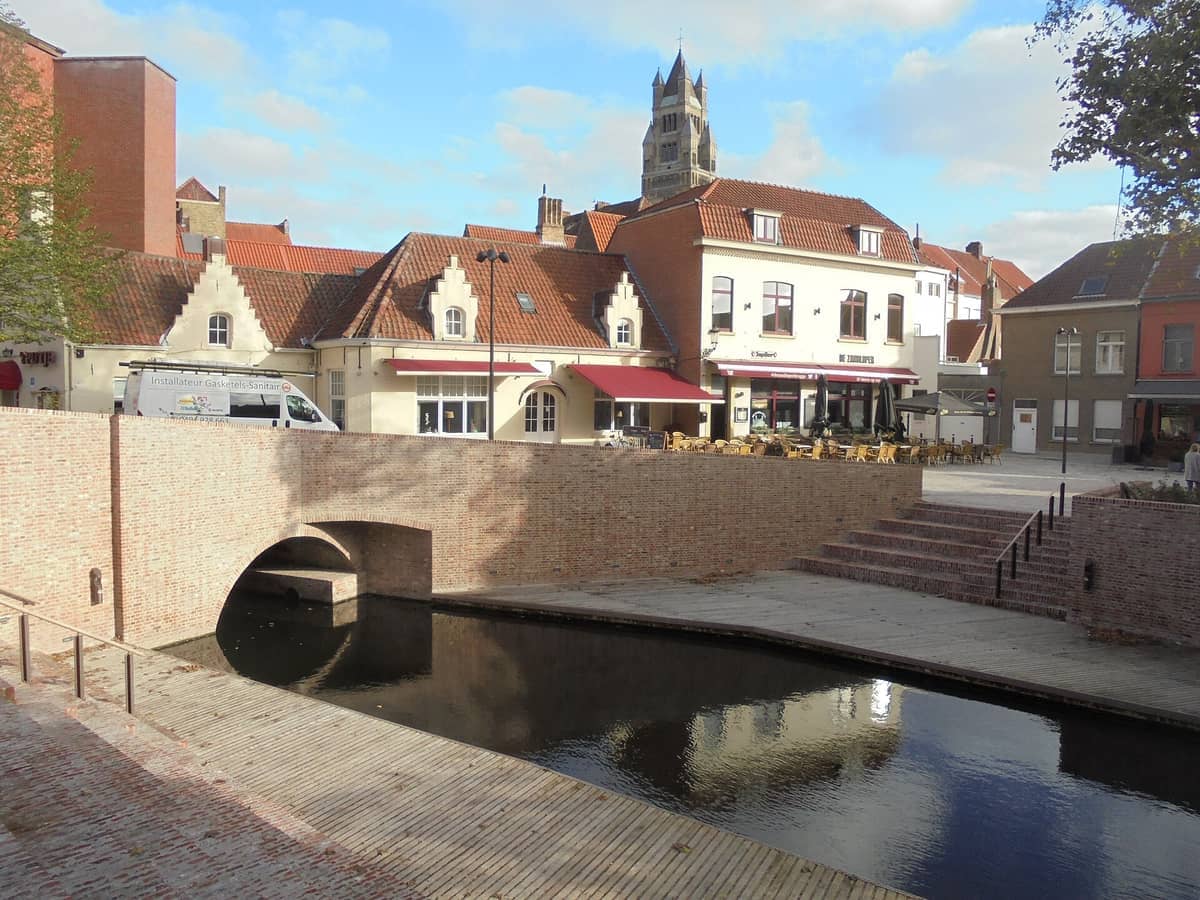
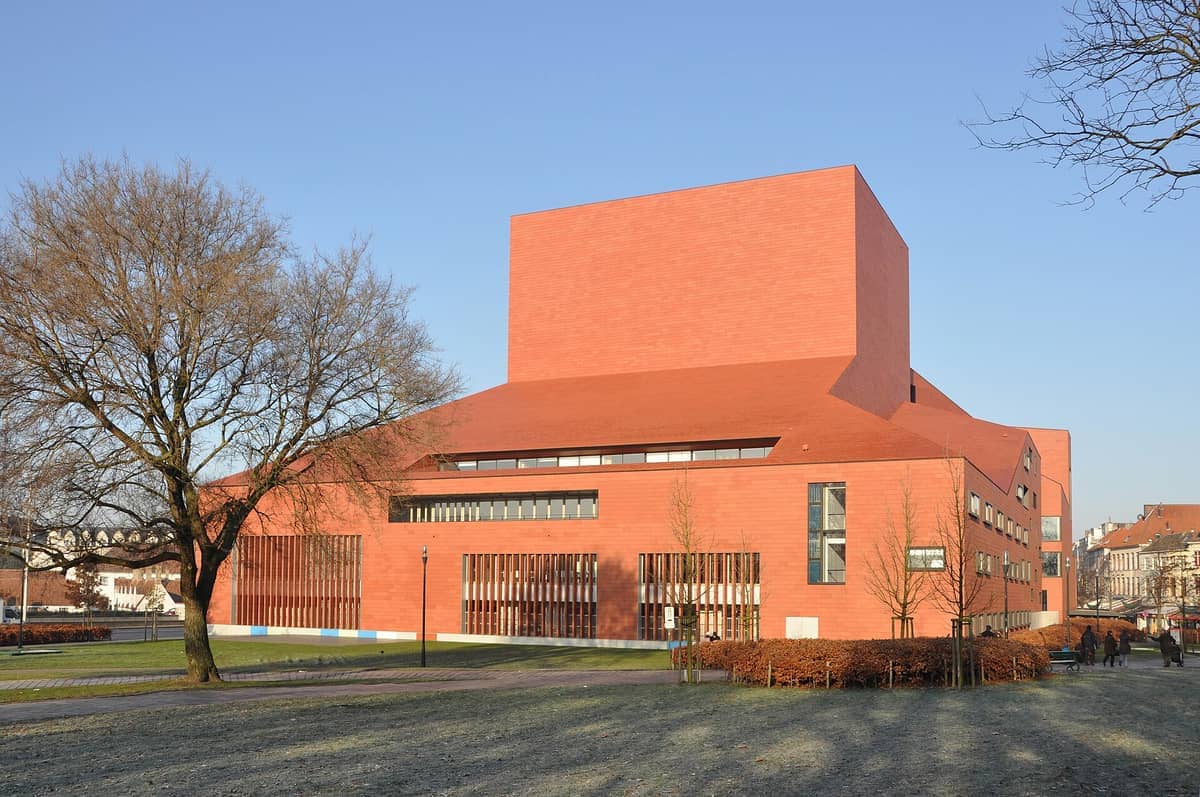
't Zand is Bruges' largest public square and the main western gateway into the medieval city centre. Anchored by the striking Concertgebouw concert hall and a lively Saturday market, this area bridges the train station with the old town and serves as a genuine meeting point for residents and visitors alike.
't Zand is where Bruges begins for most visitors arriving by train: a wide, open square that stands in deliberate contrast to the narrow canal streets just a few minutes' walk east. It is the city's largest public square, a working event space hosting over 200 events a year, and the address of one of Belgium's most architecturally ambitious concert halls.
Orientation
't Zand sits at the western edge of Bruges' historic centre, positioned roughly halfway between the main train station and the Markt square. The square itself covers approximately 12,500 square metres and is integrated with Koning Albert I Park, which extends southward toward the station. To the east, the pedestrianised Zuidzandstraat and Steenstraat lead directly into the heart of the old town. To the north, smaller residential streets connect the area to the Sint-Anna quarter and the older canal network.
Think of 't Zand as the hinge between modern Bruges and medieval Bruges. The train station sits about 10 minutes' walk to the southwest, through the park. The Markt square is about 12 to 15 minutes on foot heading east through the pedestrian shopping streets. This central position makes 't Zand less a destination in itself and more a logical base of operations for exploring the wider city.
The surrounding neighbourhood extends outward from the square along Smedenstraat to the northwest, Boeveriestraat to the south, and the pedestrian shopping axis of Steenstraat to the east. These streets define the character of the area as clearly as the square itself: a mix of commerce, civic function, and the edges of tourist Bruges.
Character & Atmosphere
At seven in the morning on a Saturday, 't Zand belongs to the market workers. Stall frames go up in the grey early light, the smell of bread and coffee drifts from the café terraces beginning to open their shutters, and locals from the surrounding streets arrive with wheeled bags before any tour group has stirred. The Saturday market has been a fixture of Bruges street life for centuries and remains genuinely oriented toward local shoppers: fruit, vegetables, flowers, cheese, bread, and household goods. It wraps up by midday, after which the square transitions back into a general-purpose public space.
By mid-morning on any day, the square fills with the particular energy of a major urban transit point. Horse-drawn carriage tours depart from one end. City buses pull in and out from the De Lijn stop alongside the Concertgebouw. Cyclists lock up in the free underground bicycle parking before continuing on foot into the centre. Families with luggage walk briskly toward the station. It is not a square designed for lingering in the way that the Markt or Burg are — it is too open, too exposed to traffic, too functional — but that honesty is part of its appeal.
In the afternoon, particularly in summer, the café terraces along the southern and eastern edges of the square come into their own. The open aspect that can feel raw on a winter morning becomes an asset when the sun sits low over the western skyline and the Concertgebouw's terracotta facade catches the light. Evenings shift the atmosphere entirely. On nights when the Concertgebouw has a performance, the square takes on a more formal character, with well-dressed concertgoers arriving and the surrounding cafés filling with pre-concert diners. On event nights in summer, outdoor stages and food markets transform the whole space.
ℹ️ Good to know
The Saturday morning market at 't Zand runs until around midday. It is one of the most genuinely local experiences in Bruges and well worth timing your morning around if you are staying in the city over a weekend.
One honest note: 't Zand is not especially atmospheric in the way that the canal quarters are. The scale is too large, the architecture too varied (and partly too recent), and the traffic too present. Its appeal is civic and practical rather than picturesque. Visitors looking for the postcard version of Bruges should walk east. Visitors who want to understand how the city actually functions on a daily basis will find 't Zand more revealing.
What to See & Do
The defining landmark of 't Zand is the Concertgebouw Brugge, the city's major concert hall and arts venue, built for Bruges' tenure as European Capital of Culture in 2002. The building, at 't Zand 34, is a deliberately contemporary piece of architecture in a city known for its medieval fabric. Its terracotta brick exterior and angled roofline were controversial at the time of construction but have since become part of the city's identity. The venue hosts an international programme of classical music, contemporary performance, and visual arts throughout the year, and also opens its rooftop terrace to visitors for views over the western part of the city.
The square itself is the stage for much of what happens here. Over 200 events per year take place at 't Zand, ranging from the weekly Saturday market to outdoor music festivals, seasonal fairs, and temporary installations. The Christmas and New Year period transforms the square significantly, with ice rinks, market stalls, and lighting that give it a warmth the open space lacks during ordinary winter days.
Heading east from 't Zand along Steenstraat and Zuidzandstraat brings you quickly into the historic centre. Within a short walk, you reach Sint-Salvatorskathedraal, Bruges' oldest parish church and one of the city's two major ecclesiastical landmarks. The cathedral's treasury contains Flemish tapestries and paintings that rival the city's major museums in quality but draw far fewer visitors.
A short walk south down Boeveriestraat leads toward the De Halve Maan Brewery, Bruges' last remaining family-operated city brewery, located on Walplein. The brewery produces Brugse Zot and Straffe Hendrik beers and offers guided tours that include a rooftop view over the southern canal belt. It is one of the more rewarding experiences in the city for anyone with an interest in Belgian beer culture.
Saturday market: fresh produce, flowers, local goods (mornings only)
Sint-Salvatorskathedraal: 10-minute walk east via Steenstraat
De Halve Maan Brewery: 10-minute walk south via Boeveriestraat
Smedenpoort: 15th-century city gate, a short walk northwest on Smedenstraat
Horse-drawn carriage tours: depart from the Markt, circuit of the historic centre
💡 Local tip
The Concertgebouw's rooftop terrace ('t Zand 34) is open to visitors independently of concert programming and offers an underrated aerial view of western Bruges. Check the venue's website for access hours, which vary seasonally.
Eating & Drinking
The eating and drinking scene around 't Zand covers a wide price range but skews toward accessible mid-market options rather than fine dining. The café terraces directly on the square are convenient and well-located for people-watching, but like most prime-position spots in a popular Belgian city, they charge a modest premium for their position. Coffee, beer, and simple lunch dishes are what they do well.
For a deeper dive into Belgian beer specifically, the Bruges beer scene extends through the streets south of 't Zand toward the canal quarter, where several smaller bars and brown cafés offer local Flemish ales in settings that feel less focused on tourism. Belgian beer culture in Bruges centres heavily on Trappist and abbey-style ales, seasonal specialities, and the output of De Halve Maan, all of which are widely available throughout the neighbourhood.
The pedestrian shopping streets heading east — Steenstraat in particular — have a concentration of waffle stands, chocolate shops, and snack counters that represent the edible face of tourist Bruges. These are not the worst versions of their kind; Belgian waffles in Bruges are genuinely good, and the Brussels and Liège waffle traditions are both well-represented. For chocolate, the concentration of artisan chocolatiers along this axis is notable, and quality varies considerably between shops. Buying from a maker who produces on the premises rather than a chain retailer is usually the better choice.
For a proper sit-down meal, the side streets branching off Zuidzandstraat and Boeveriestraat offer Belgian brasserie cooking at realistic prices: waterzooi (the local chicken or fish stew), stoofvlees (beef slow-cooked in Belgian ale), and moules-frites when in season. The quality-to-price ratio is generally better one or two streets removed from the square itself.
⚠️ What to skip
The café terraces directly on 't Zand are convenient but not especially distinctive in terms of food or drink quality. If you have an extra few minutes to walk into the side streets, you will generally eat better and spend slightly less.
Getting There & Around
Train is the most practical way to arrive in Bruges from elsewhere in Belgium. Station Brugge, on Stationsplein, is served by direct intercity trains from Brussels (approximately 60 minutes from Brussels-Midi), Ghent (approximately 25 minutes), and Antwerp (approximately 75 minutes, usually with one change). From Brussels Airport (BRU), there are both direct intercity trains and journeys involving a connection at Brussels-Midi or Brussels-Central, typically taking around 90 minutes. The much smaller Ostend-Bruges International Airport (OST), approximately 30 kilometres west, is connected to Bruges by regional bus and train services via Ostend station.
From Station Brugge to 't Zand, the walk through Koning Albert I Park takes approximately 10 minutes on foot — a direct, well-signposted route. The De Lijn bus stop "Brugge 't Zand" is located immediately adjacent to the Concertgebouw and connects the square with the station and other parts of the city, with multiple city bus routes serving this stop. For full details on reaching Bruges and navigating the city, the getting to and around Bruges guide covers all transport options in detail.
Within the neighbourhood, walking is the default mode of movement. The historic centre east of 't Zand is entirely pedestrianised along the main shopping streets. Cycling is practical but requires care on the narrow canal-side streets further into the old town. Parking for cars is available in the underground Parking Centrum–'t Zand beneath the square, accessed from Boeveriestraat and well-signposted from the E40 motorway (exit 8, Bruges). This car park makes 't Zand a logical drop-off point for day visitors arriving by car who then walk into the centre.
Bruges is an excellent city to explore by bicycle, and the flat terrain around 't Zand and the wider western part of the city is particularly suited to it. Free bicycle parking is available in the underground facility beneath the square. For more on cycling routes in and around the city, the cycling in Bruges guide provides practical itineraries and rental information.
Where to Stay
The 't Zand area offers a practical middle ground for accommodation: close enough to the historic centre to walk everywhere, but slightly removed from the most densely touristed streets around the Markt and Burg. Hotels and smaller guesthouses on Boeveriestraat, Smedenstraat, and the streets between 't Zand and the station tend to be priced modestly compared to canal-front properties. This is a reasonable trade-off for travellers who prioritise transit access and budget over atmosphere. For a broader overview of Bruges accommodation options by area, the where to stay in Bruges guide covers the full range of neighbourhoods.
The area suits business travellers, families arriving by train, and anyone who plans to use Bruges as a base for day trips rather than spending long evenings in the old town. The station connection is the key advantage. Travellers who want to fall asleep to the sound of canals or wake up to a church spire outside the window will be better served by properties in the Dijver canal quarter or the Sint-Anna neighbourhood to the north.
One practical note: the Concertgebouw runs evening events regularly, and the square can be noisy on summer evenings when outdoor events are scheduled. If you are a light sleeper, confirm whether your chosen accommodation faces directly onto the square before booking.
Practical Notes
Bruges is generally a very safe city for visitors, and 't Zand is a central, well-frequented public square with regular foot traffic at most hours. Standard urban precautions apply during the Saturday market and other large gatherings: keep bags closed and be aware of your surroundings in crowded areas. The underground car park and bicycle parking beneath the square are regularly used and well-lit.
The square and surrounding streets are part of the broader historic centre of Bruges, inscribed as the "Historic Centre of Brugge" on the UNESCO World Heritage List. This status means that the urban fabric is tightly regulated, which is part of why even modern additions like the Concertgebouw went through extensive review. For anyone interested in the wider context of Bruges' architecture and preservation, the Bruges Gothic architecture guide provides useful background.
Currency in Belgium is the euro. Tap water is safe to drink. Emergency services are reached on 112. Tipping in cafés and restaurants is not obligatory, as service is typically included in the bill, though rounding up is common practice. The city's official language is Dutch, but English is widely spoken throughout the tourist areas and at all major venues including the Concertgebouw.
TL;DR
Location: western edge of Bruges' historic centre, 10 minutes' walk from the train station and 12-15 minutes from the Markt square.
Best for: travellers arriving by train, visitors who want practical transit access with easy walking distance to all major sights, and anyone visiting the Concertgebouw.
Key draws: Saturday morning market, Concertgebouw Brugge, access to Sint-Salvatorskathedraal and De Halve Maan Brewery, underground car and bicycle parking.
Honest drawback: the square lacks the atmospheric canal-side character of the Dijver or Sint-Anna quarters. It is functional and civic rather than picturesque.
Who should skip it: travellers whose primary goal is to be immersed in medieval Bruges at all hours will find the canal quarters or the historic centre proper more rewarding as a base.
Two days is enough time to cover Bruges properly if you plan well. This itinerary walks you through the city's best sights, neighbourhoods, and experiences in a logical order, with a clear take on what to skip, what to prioritise, and how to avoid the worst of the crowds.
Bruges packs an unusually strong museum scene for a city of its size. From world-class Flemish Primitive paintings at the Groeninge to medieval hospital complexes, immersive history attractions, and specialist museums dedicated to lace, beer, and Belgian fries, the city rewards curious visitors at every turn.
Bruges (Brugge) rewards visitors in every season, but timing your trip well makes a real difference. This guide breaks down weather, crowds, prices, and key events month by month so you can decide when to go based on what actually matters to you.
Bruges (Dutch: Brugge) is a serious beer destination for a city of its size. This guide covers the city's working breweries, museum-style experiences, guided tasting walks, and the bars worth your time, with current pricing, opening hours, and practical advice to help you drink well without wasting money.
Bruges is one of Europe's most photogenic canal cities, and a boat ride through its medieval waterways is one of the best ways to take it all in. This guide covers prices, schedules, the best time to go, what the tour actually involves, and how to avoid the longest queues.
Bruges is one of Europe's most serious chocolate cities, with dozens of artisan chocolatiers, a dedicated chocolate museum, and guided tasting tours winding through the medieval centre. This guide covers everything: Choco-Story ticket prices, the best chocolate walks, how to tell craft shops from tourist traps, and the smartest way to plan your visit.
The Bruges Christmas market is part of the city-wide Winter Glow festival, running from late November through early January across multiple locations in the medieval centre. This guide covers every location, practical logistics, ice skating prices, the free light trail, and the best strategies for making the most of a winter visit to Bruges (Brugge), Belgium.
Bruges preserves some of the finest Gothic architecture in northern Europe, from the soaring Belfry on the Markt to the ornate City Hall on Burg Square. This guide covers every major site, explains what makes each one architecturally significant, and gives you the practical details to plan a focused visit.
Bruges rewards those who wander off the main squares. From a family-built replica of a Jerusalem church to almshouse courtyards that feel frozen in the 17th century, these are the places that reveal a quieter, deeper side of the city.
Bruges in winter is a different city entirely. Crowds thin out, the medieval canals take on a quiet atmosphere, and the city's official Winter Glow program transforms the historic centre from late November through February. This guide covers what's on, what's closed, how to get around, and what most visitors get wrong.
Bruges has been synonymous with handmade bobbin lace for centuries. This guide covers the craft's history, where to watch it being made at the Kantcentrum, how to shop for authentic pieces, and what to skip.
Bruges (Dutch: Brugge) has a reputation as a pricey destination, but the reality is more forgiving. Most iconic sights cost nothing, public transport is straightforward, and a single pass covers nearly every major museum. This guide breaks down exactly what things cost, what's genuinely free, and where it's worth spending a little more.
Bruges is one of Europe's most complete medieval cities, and a single day is enough to see its best. This itinerary gives you a logical, time-aware route through the Markt, the canals, the Belfry, and the quieter corners most visitors miss, with real prices and straightforward planning notes throughout.
From the Saturday market at 't Zand to the weekend antique market along the Dijver canal, Bruges rewards shoppers who know where to look. This guide covers the best shopping streets, market schedules, local specialities, and a clear take on what to buy and what to skip.
Not all Belgian waffles in Bruges are created equal. This guide breaks down the two main styles, names the best spots in the city centre, gives real prices, and tells you which tourist-facing counters to skip.
Bruges (Brugge) packs its most spectacular medieval architecture into a walkable 3–4km historic core. This guide covers the classic self-guided loop from the Markt to Minnewater, with practical notes on timings, entrance fees, crowd patterns, and how to adapt the route for your pace.
Bruges (Brugge) is one of Belgium's most rewarding destinations for families. Compact, walkable, and packed with hands-on museums, canal-side exploration, and chocolate around every corner, the medieval city offers real substance for children and parents alike. This guide covers the best kid-friendly attractions, practical logistics, seasonal timing, and a clear take on where the city delivers and where it falls short for families.
Bruges is one of the most cycle-friendly cities in Europe, with a flat historic centre, expanding bike-priority zones, and nearly 930 km of marked routes in the surrounding Brugse Ommeland. This guide covers rental options and prices, the numbered node network, traffic rules, seasonal considerations, and the best routes for day trips beyond the city walls.
Bruges sits at the center of one of Europe's most connected rail networks. From medieval Ghent to the Belgian coast, these are the best day trips from Bruges, with real train times, honest crowd advice, and exactly what to do when you get there.
Bruges holds one of the world's great concentrations of Flemish Primitive painting. This guide covers the three essential venues, what to look for in each, practical logistics, and how to avoid the most common planning mistakes.
Bruges is one of Europe's most photogenic cities, and a surprising amount of it costs nothing to enjoy. From iconic canal viewpoints and medieval squares to peaceful beguinage courtyards and rampart windmills, this guide covers the best free experiences the city has to offer.
Whether you're arriving by train from Brussels, flying into one of Belgium's two main airports, or planning to cycle the medieval streets, this guide covers every practical transport option for reaching Bruges and navigating the city. Includes real fares, parking rates, and local tips.
Bruges (Dutch: Brugge) is one of Europe's most photographed medieval cities, but does it live up to the hype? This guide cuts through the postcard image to tell you exactly what the city delivers, who it suits best, and how to get the most out of a visit.
Bruges (Dutch: Brugge) is one of Europe's most atmospheric cities for couples, with medieval canals, Gothic architecture, world-class chocolate, and a walkable historic centre that rewards slow exploration. This guide covers the best romantic experiences, practical logistics, and straightforward notes on when to visit and what to skip.
Bruges (Brugge) is a UNESCO World Heritage city in northwest Belgium packed with medieval architecture, Flemish masterpieces, canal tours, and craft beer culture. This guide covers the best things to do in Bruges, with real prices, seasonal tips, and honest takes on what's worth your time.
Bruges is one of Europe's great food cities in miniature. This guide covers everything worth eating, from street-food fries to moules-frites season, plus clear notes on avoiding tourist-trap versions of Belgian classics.
Bruges offers accommodation ranging from canal-side boutique hotels to budget hostels and rural B&Bs. This guide breaks down the best areas to stay, what to expect at each price point, and the practical details most booking sites leave out.