Concertgebouw Brugge: Bruges' Concert Hall on 't Zand
Concertgebouw Brugge is an international arts centre for music, contemporary dance, and sound art, housed in a bold contemporary building on 't Zand square. Beyond its packed concert programme, the Concertgebouw Circuit lets visitors explore the architecture and acoustic design on their own terms. Here is everything you need to plan a visit.
Quick Facts
- Location
- 't Zand 34, 8000 Brugge, Belgium
- Getting There
- 10-minute walk from Bruges railway station; buses stop on 't Zand square
- Time Needed
- 45–90 min for the Circuit; 2–3 hrs for an evening concert
- Cost
- Circuit ticket: see current rates at concertgebouw.be; concert tickets vary by event
- Best for
- Classical music lovers, architecture enthusiasts, contemporary dance audiences
- Official website
- www.concertgebouw.be
What Is the Concertgebouw Brugge?
The Concertgebouw Brugge is Bruges' principal venue for classical music, contemporary dance, and sound art. It sits on 't Zand, the broad square at the western edge of the historic centre, about ten minutes' walk from Bruges railway station. The building opened in 2002, commissioned alongside the city's year as European Capital of Culture, and it remains the most architecturally conspicuous structure the city has built in recent decades.
Most visitors to Bruges focus on the medieval core and never look west toward 't Zand. That is their loss. The Concertgebouw is not just a place to attend a concert: the Circuit route transforms the building itself into a destination, letting you move through its spaces, installations, and views without buying a concert ticket.
💡 Local tip
If you are in Bruges on a weekend or during Belgian school holidays, the Concertgebouw Circuit is open without needing to book a concert. Check the schedule at concertgebouw.be before you go, as hours vary during Belgian school holidays.
The Architecture: A Statement in Terracotta and Glass
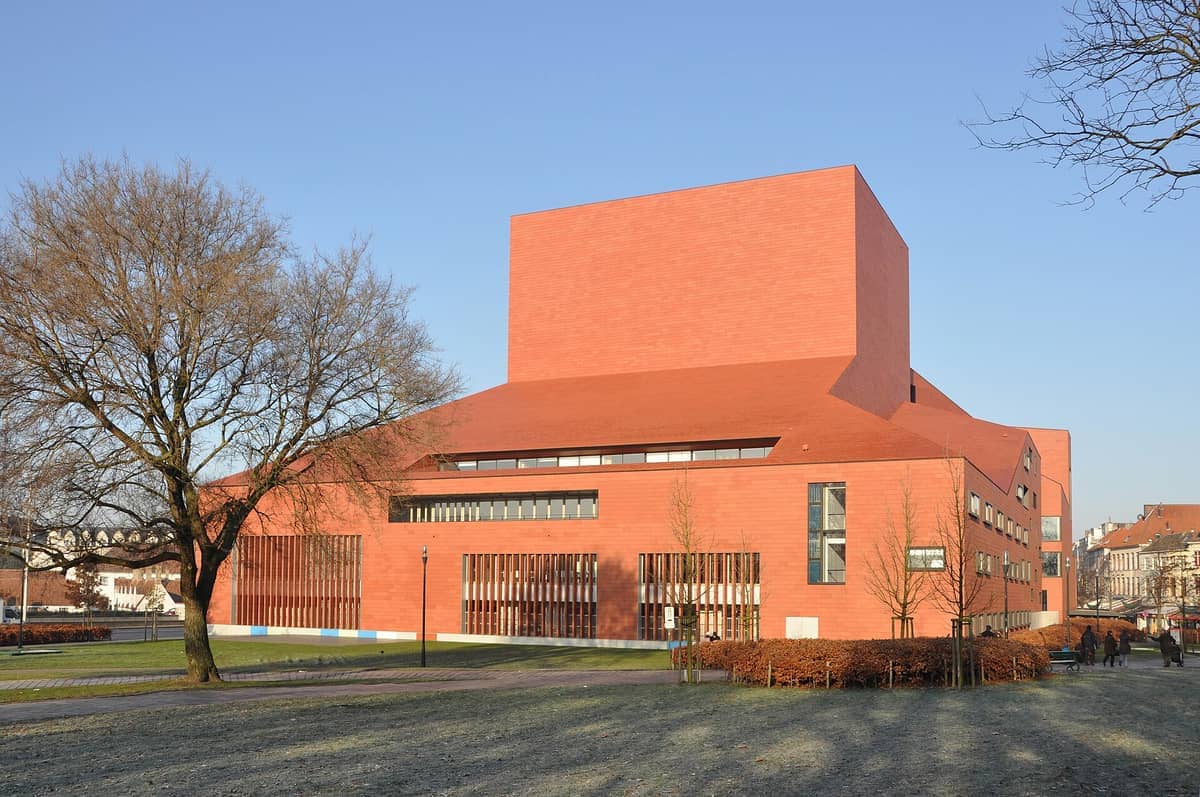
The building was designed by the firm Paul Robbrecht and Hilde Daem. From outside, what strikes you first is the skin: roughly 68,000 terracotta tiles, each glazed in shades running from amber to rust, cover the upper sections of the building. On a grey Flemish morning they glow with an almost warm light. On a clear afternoon they shift colour as the sun moves around the square.
The design deliberately avoids mimicking the Gothic brickwork of Bruges' historic centre. Instead of pointed arches or stepped gables, the Concertgebouw offers flat planes, angled cuts, and a tower element that rises above the roofline of the surrounding buildings. The effect is polarising: some find it an intrusion into a UNESCO-protected cityscape; others see it as an honest acknowledgement that a living city builds in its own era. Either way, it is hard to ignore.
The building occupies a neighbourhood in transition. 't Zand was redesigned as a pedestrian and transport hub in the years around the Concert Hall's construction. For more on how this part of the city fits together, the 't Zand and surroundings area guide gives useful context on what else is worth seeing nearby.
Tickets & tours
Hand-picked options from our booking partner. Prices are indicative; availability and final rates are confirmed when you complete your booking.
Historium Bruges entrance tickets
From 19 €Instant confirmationFree cancellationBruges food tour with full meal
From 139 €Instant confirmationFree cancellationBruges walking audio guided tour
From 9 €Instant confirmationBruges Family Walking Tour
From 259 €Instant confirmationFree cancellation
The Concertgebouw Circuit: Visiting Without a Concert Ticket
The Circuit is a self-guided architectural and art route through the public areas of the building. It is the main reason to visit the Concertgebouw outside of a performance, and it works well as a standalone hour of the day. You move through lobbies, stairwells, and upper galleries, reading about acoustic design choices and encountering a rotating set of sound and visual art installations.
The highlight for most visitors is the view from the upper level, which frames a panorama over 't Zand square and, on clear days, toward the church towers of the historic centre. This vantage point is not accessible any other way: you cannot simply walk into the building and take the lift. The Circuit ticket is the key.
Standard Circuit hours are Wednesday and Saturday from 14:00 to 18:00, and Sunday from 10:00 to 14:00, but these apply mainly at weekends and during Belgian school holidays. During Belgian school holidays, Thursday and Friday openings are added. Hours can shift around major performance days, so confirming on the official website before visiting is genuinely worth the thirty seconds it takes.
ℹ️ Good to know
The Circuit ticket price is listed on the Concertgebouw website and may be updated seasonally. Reduced rates for children and groups may be available. Check concertgebouw.be/en/concertgebouw-circuit for current pricing before you go.
Attending a Concert: What to Expect
The main concert hall seats around 1,200 people and is built around a specific acoustic brief: natural reverberation suited to orchestral and chamber music, without electronic amplification. The ceiling geometry and the placement of wooden surfaces are not decorative choices but functional ones. Sitting in the stalls during a full orchestral programme, the sound is immediate and enveloping without feeling artificially boosted.
The programme spans classical orchestral concerts, early music, chamber recitals, contemporary dance performances, and interdisciplinary sound art events. It is not exclusively a classical venue, although that repertoire dominates. The season typically runs from autumn through spring, with a lighter summer schedule. Browsing the programme at concertgebouw.be gives the clearest picture of what is on during your dates.
Tickets are sold online, by phone, and at the ticket office during opening hours (Monday to Friday, 10:00 to 17:00). For popular performances with well-known ensembles, booking in advance is advisable. For smaller recitals, same-week availability is usually fine. Dress code is smart-casual; there is no formal requirement, but the audience for classical concerts tends to dress up modestly.
💡 Local tip
The underground car park beneath the 't Zand pavilion allows free exit within 15 minutes. If you are being dropped off by car or taxi, there is a designated stop zone directly in front of the main entrance.
Practical Details: Getting There and Accessibility
The Concertgebouw sits at 't Zand 34. From Bruges railway station, the walk takes under ten minutes along a direct westward route. Multiple De Lijn bus lines stop on 't Zand square itself, making this one of the easier major venues in the city to reach without a car.
Accessibility is taken seriously here. The building has lifts, ramps, and adapted toilets throughout. Wheelchair spaces are available in the concert hall, and some seating areas, including rear parterre rows Y and Z, are reachable without climbing steps. Visitors with specific mobility requirements are encouraged to contact the venue in advance by email or phone so that suitable arrangements can be confirmed.
If you are planning a broader day in this part of Bruges, 't Zand connects easily to Simon Stevinplein, the shopping streets around Steenstraat, and the western edge of the canal quarter. A Bruges walking tour that starts from the station naturally passes 't Zand, making it simple to fold the Concertgebouw into a morning of exploring before an afternoon concert.
How the Experience Changes by Time of Day
In the morning, 't Zand is a working square: buses pull in and out, locals cross on their way to the market or the station, and the Concertgebouw sits quietly in the background. The Circuit's Sunday morning slot (10:00 to 14:00) catches this calmer energy: fewer people, softer light through the upper windows, and a more contemplative mood than the afternoon sessions.
Wednesday and Saturday afternoons bring a different crowd: tourists who have picked up the Circuit as part of a cultural afternoon, architecture students sketching in the lobbies, and local regulars who treat it as a weekly ritual. The atmosphere is unhurried but noticeably more sociable.
Concert evenings transform the building entirely. The square fills with concertgoers arriving from around 19:00. The glass surfaces of the ground-floor foyer glow outward into the square, and the ceramic facade catches the warm spill of the interior lights differently than it does in daylight. If you are not attending the concert, it is still worth walking past 't Zand on a concert evening just to see the building in this state.
Bruges in winter has a particular quality that suits the Concertgebouw well. The concert season is in full swing, the square is less crowded with day-trippers, and an evening of music in a warm, acoustically precise hall is a reasonable argument for a cold-weather visit. The guide to Bruges in winter covers what else the city offers during the quieter months.
Photography and Visual Interest
The facade is best photographed in the hour before sunset, when the ceramic discs shift toward deep amber and the contrast against the sky is sharpest. The east-facing entrance works well in morning light if you want the square in the foreground. Inside, photography during the Circuit is generally permitted in public areas; during concerts, photography and recording are prohibited.
The upper-level view through the Circuit is the most rewarding interior shot: the framing of 't Zand below, with the fountain sculpture visible and the roofline of the historic centre in the background. A wide-angle lens or a phone camera in panorama mode handles the space well. Tripods are impractical in the narrow stairwells.
⚠️ What to skip
Photography and audio/video recording are not permitted during performances. Front-of-house staff enforce this consistently. Store your camera before entering the hall.
Insider Tips
- The Sunday morning Circuit slot (10:00 to 14:00) is consistently quieter than the afternoon sessions and gives you the upper-level view with almost no one else around. If you are in Bruges over a weekend, this is the slot to prioritise.
- The building's main entrance faces 't Zand, but there is also direct access from the underground car park, which is useful in wet weather. The car park exit timer (15 minutes free) makes quick drop-offs genuinely practical.
- If you want to attend a concert but the main programme feels expensive, check the Concertgebouw's own smaller-scale and lunchtime events, which sometimes carry reduced pricing and use the chamber spaces rather than the main hall.
- The terracotta facade tiles were produced in many glazes to achieve the colour gradation. Looking at the surface from an angle rather than straight on reveals the depth of the variation more clearly than photos suggest.
- The Concertgebouw box office is staffed Monday to Friday 09:00 to 17:00. If you are arriving on a weekend without a pre-booked ticket, check online availability the day before rather than counting on walk-up availability for popular events.
Who Is Concertgebouw Bruges For?
- Classical music and contemporary dance audiences looking for a serious, acoustically well-designed venue
- Architecture enthusiasts interested in how a contemporary public building navigates a UNESCO World Heritage cityscape
- Visitors spending more than one day in Bruges who want to go beyond the medieval core
- Travellers visiting in autumn or winter when the full concert season is running
- Anyone wanting a quiet, unhurried indoor cultural experience outside the main tourist circuit of the historic centre