Sint-Salvatorskathedraal: Bruges' Cathedral in Full
Saint Saviour's Cathedral is among the oldest surviving parish churches in Bruges and the city's only cathedral. Rising roughly 79 metres above Steenstraat, its Romanesque tower and Gothic nave contain centuries of Flemish art, medieval tapestries, and a treasury that most visitors walk past entirely.
Quick Facts
- Location
- Sint-Salvatorskerkhof/Zand area, 8000 Brugge, Belgium – Historic Centre
- Getting There
- 15–20-minute walk from Bruges train station; 5 minutes on foot from Markt square
- Time Needed
- 45–90 minutes (nave only: 30 min; with treasury: 75–90 min)
- Cost
- Cathedral nave: free; treasury admission fee applies (verify current price on-site)
- Best for
- Architecture, Flemish art history, quiet reflection, rainy-day culture
- Official website
- www.sintsalvatorskathedraal.be
What Sint-Salvatorskathedraal Actually Is
Sint-Salvatorskathedraal – known in English as Saint Saviour's Cathedral – is the oldest surviving parish church in Bruges and the city's sole cathedral. It stands just off Steenstraat, one of the main pedestrian arteries connecting the Markt to the train station, which means thousands of people walk within 20 metres of it every day without stepping inside. That is their loss.
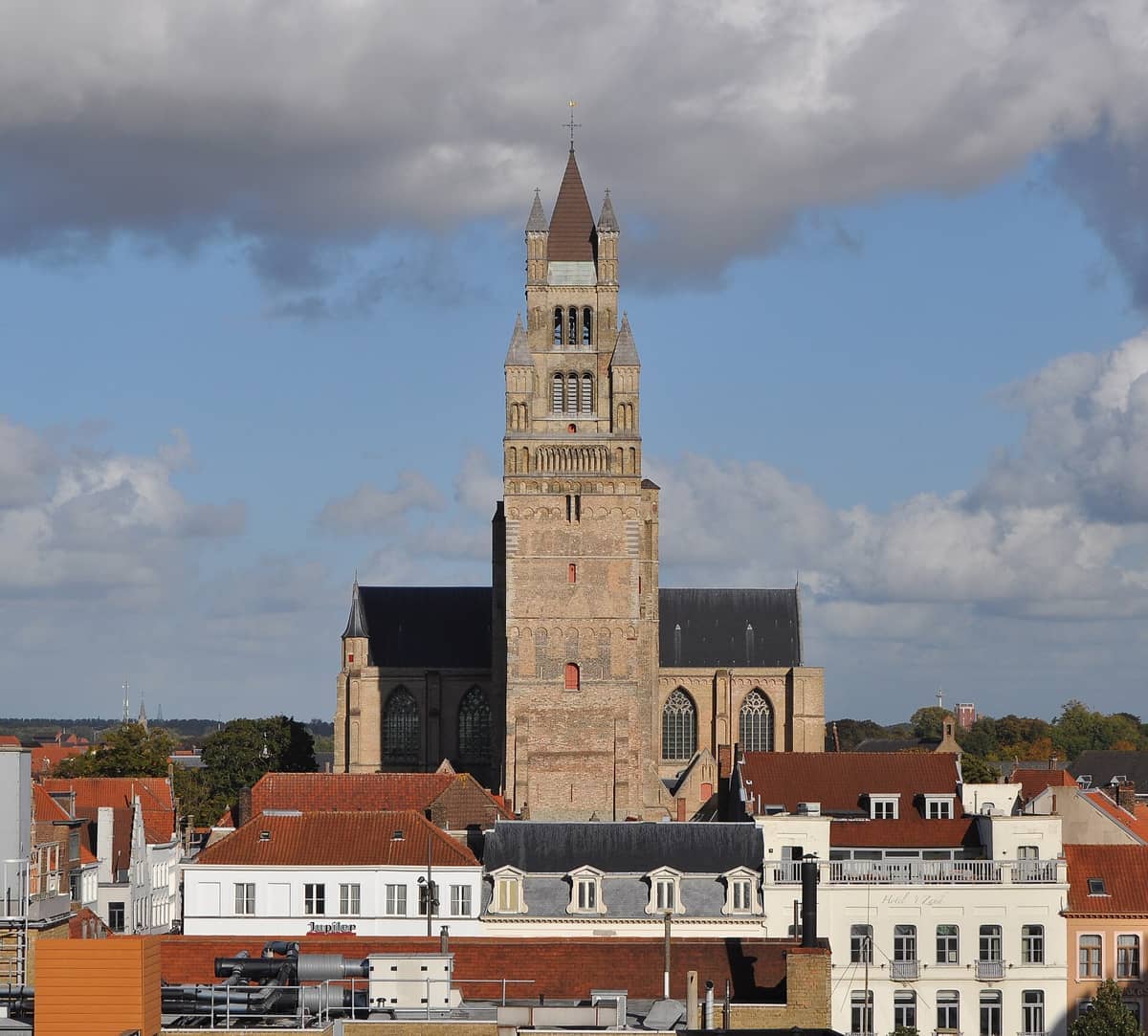
The building is enormous by any measure: close to 100 metres long, around 50 metres wide, and topped by a tower that climbs to roughly 79 metres. From the street, the tower reads as dark, heavy Romanesque stone at its base, transitioning upward into a lighter neo-Gothic spire added in the 19th century. The contrast is not always elegant, but it is honest: this is a building that has been modified, damaged, repaired, and rebuilt across more than eight centuries.
Visitors focused on Gothic church architecture in Bruges typically head straight for Onze-Lieve-Vrouwekerk and its Michelangelo Madonna, overlooking Sint-Salvator entirely. But the two churches reward different things, and this one is considerably quieter.
💡 Local tip
The cathedral closes between 13:00 and 14:00 Monday through Saturday. Arrive before noon or after 14:00 to avoid a wasted trip.
A History Longer Than the Current Building
The origins of a Christian place of worship on this site go back at least to the 9th century, though the earliest documented references are contested by historians. What is clear is that by the 10th century, Sint-Salvator served as the main parish church for the growing settlement that would become Bruges. It predates the city's medieval commercial peak – the church was already old when Bruges was making money trading cloth across Europe.
The current Gothic nave was constructed primarily between the 13th and 15th centuries, which places its building period squarely within Bruges' golden age as a North Sea trading hub. The cathedral suffered badly during the iconoclasm of the mid‑16th century, when religious statuary and decoration were systematically destroyed across the Low Countries. Further damage came in 1839, when a fire gutted sections of the interior and prompted the major 19th-century restoration campaign that added the current spire.
Sint-Salvator became a cathedral – technically the seat of the Bishop of Bruges – only in 1834, following the suppression of Sint-Donaaskathedraal, which was demolished during the French Revolutionary period. Sint-Donaas had stood on the Burg square for centuries; its foundations are still visible beneath the pavement outside the Crowne Plaza hotel nearby. Sint-Salvator inherited the cathedral status almost by default, which gives its interior an interesting layered quality: the building feels like a parish church that was handed greater ceremonial responsibilities.
Understanding the cathedral's position alongside Bruges' other major churches adds context. The Basilica of the Holy Blood on the Burg is smaller but more visited; Sint-Salvator is larger, older as a parish, and architecturally more complex, yet consistently underrated in most travel itineraries.
Tickets & tours
Hand-picked options from our booking partner. Prices are indicative; availability and final rates are confirmed when you complete your booking.
Historium Bruges entrance tickets
From 19 €Instant confirmationFree cancellationBruges food tour with full meal
From 139 €Instant confirmationFree cancellationBruges walking audio guided tour
From 9 €Instant confirmationBruges Family Walking Tour
From 259 €Instant confirmationFree cancellation
Inside the Cathedral: What to Look For
The first impression when entering the nave is one of controlled austerity. The stone is grey-brown, the lighting is diffused and slightly dim, and the scale becomes apparent slowly as your eyes adjust. The nave is broad rather than narrowly soaring, giving it a different spatial rhythm than many French Gothic cathedrals of a similar period.
The choir stalls deserve close attention. Dating from the late 15th century, they are carved in oak and decorated with the heraldic arms of knights of the Order of the Golden Fleece, one of the most prestigious chivalric orders of medieval Europe. Bruges hosted several chapters of the Order, and these stalls are a direct physical record of that connection. The detail in the carved armrests and misericords – the small ledges under the folding seats that allowed clergy to rest during long services – is precise and varied.
Six large Flemish tapestries hang in the choir. Woven in Brussels in the early 18th century, they depict scenes related to the life of Christ. Tapestries of this scale are fragile and expensive to maintain, which is why many churches no longer have them; these examples are in remarkably good condition, their colours faded to warm ochres and blues that suit the stone interior. Standing beneath them and looking upward is one of the more arresting visual moments the cathedral offers.
The painted triptychs and altarpieces in the side chapels represent a further layer of the building's art history. Attribution and dating varies; if this is a priority for you, the cathedral's own published guide (available inside) provides more detail than any online source currently does.
For deeper context on Flemish painting in Bruges more broadly, the Groeningemuseum holds the city's most important collection of Flemish Primitives and is a 10-minute walk from Sint-Salvator. Visiting both in the same half-day creates a coherent picture of how art functioned in medieval Bruges.
The Treasury: The Case for the Separate Ticket
The cathedral treasury is housed in a dedicated museum space within the building. It holds a collection of medieval reliquaries, gold and silver liturgical objects, embroidered vestments, and paintings that were either created for the cathedral or accumulated by it over centuries. The collection is not enormous, but its quality is high.
Among the standout pieces are paintings attributed to Flemish masters of the 15th and 16th centuries, as well as carved ivory objects and illuminated manuscripts. Religious objects made in this period in the Southern Netherlands were often technically sophisticated, and the treasury makes a credible case for Sint-Salvator as a place of considerable wealth and cultural production during Bruges' peak.
ℹ️ Good to know
The treasury is accessed separately from the nave and requires a ticket. Verify the current admission price at the cathedral entrance, as it is not consistently published across third-party websites.
When to Visit and What to Expect by Time of Day
The cathedral is noticeably quieter than most major Bruges attractions. Morning visits between 10:00 and noon have the lightest footfall. Light through the clerestory windows angles differently at different times, and the late afternoon slot between 14:00 and 17:30 on weekdays tends to catch warmer tones in the stone.
Sunday visiting hours are reduced: the cathedral is typically open to visitors from 14:00 to 17:00, after morning services. If you arrive on a Sunday morning expecting to visit, you will find the building closed to tourists. The Saturday midday closure at 13:00, with a shorter afternoon opening until 15:30 (compared to 17:30 on weekdays), also catches visitors off guard. Check hours before building your day around a visit.
On grey or rainy days, the interior actually reads better than in bright sun. The stone textures are more visible in overcast natural light, and the tapestries appear richer. Bruges has well over 150 rainy days per year; Sint-Salvator is a sensible wet-weather option with genuine substance rather than a fallback choice.
If you are planning a full day around the historic centre, the Bruges one-day itinerary positions Sint-Salvator usefully alongside the Burg, the Markt, and the southern canal quarter so you are not retracing steps.
Practical Notes: Getting There, Photography, and Dress Code
Sint-Salvatorskathedraal stands just off Steenstraat, Bruges' main pedestrian shopping street. From the Markt (the central market square with the Belfort tower), it is a five-minute walk southwest. From Bruges train station, it is roughly 15–20 minutes on foot, making it one of the most accessible major monuments in the city for visitors arriving by rail.
Photography inside the cathedral is generally permitted for personal use, though flash and tripods are typically prohibited. The choir stalls and tapestries are the most photogenic elements in standard light; a wide-angle lens helps with the nave given the limited open floor space. The treasury has separate photography policies – check at the ticket desk.
As a functioning place of worship, modest dress is expected: no bare shoulders, and a quiet tone throughout. Services and special liturgical events may close the nave to tourists at short notice. The cathedral website (sintsalvatorskathedraal.be) lists upcoming services, and a brief check before visiting avoids disruption.
⚠️ What to skip
Religious services can temporarily close the nave to visitors at any time. If you arrive during a service, you can wait in the entrance area or return in 30–45 minutes.
Who Should Skip This
If you are in Bruges for one day and prioritising outdoor canal scenery, a boat trip, and the Markt, Sint-Salvator will feel like a detour. It rewards visitors who slow down, are curious about ecclesiastical art and architecture, or who want to step away from the crowds that cluster at the Rozenhoedkaai and around the Belfort. It is not a quick selfie stop – the exterior is not particularly photogenic from street level, and the best things inside require a few minutes of adjustment to appreciate.
Families with very young children may find the strict quiet atmosphere limiting. Visitors who have already thoroughly explored Sint-Janshospitaal and the Groeningemuseum may find some thematic overlap in the treasury, though the building itself is a different experience entirely.
Insider Tips
- The misericords on the 15th-century choir stalls are small carved figures tucked under each folding seat. Most visitors scan the stalls from a distance and miss them entirely – walk along the choir enclosure and look beneath the seat rails.
- The heraldic shields of the Golden Fleece knights in the choir are individually different. Identifying specific historical figures from the coats of arms is a slow, rewarding exercise for anyone with an interest in late medieval Burgundian history.
- If you visit on a weekday and the nave feels crowded (rare, but possible during peak summer), the side chapels are almost always empty and contain some of the cathedral's most interesting smaller-scale paintings.
- The tower is visible from several streets in the area south of the Markt. For the best exterior photograph, walk to the corner of Steenstraat and Zuidzandstraat, which gives you enough distance to frame the full tower against the sky without telephone lines cutting across it.
- Saturday mornings before 13:00 are unusually quiet despite being a busy day in the city generally – most tourists are still on the Markt or the canal at that hour, and Sint-Salvator has the feel of a building to yourself.
Who Is St. Salvator's Cathedral For?
- Architecture and medieval history enthusiasts who want more than a surface view of Bruges' Gothic heritage
- Art history travellers connecting Flemish tapestry and painting to their original liturgical context
- Visitors looking for a serious cultural experience that is not crowded, even in high season
- Rainy-day visitors wanting genuine substance rather than a gift shop detour
- Returning visitors to Bruges who have already covered the headline attractions and want to go deeper
Nearby Attractions
Other things to see while in Historic Centre:
- Basilica of the Holy Blood
The Basilica of the Holy Blood (Basiliek van het Heilig Bloed) stands on Burg Square in Bruges' historic centre, housing a relic venerated since the Middle Ages. Entry to the basilica is free; the treasury costs €5. With two architecturally distinct chapels stacked on top of each other, it rewards visitors who take time to explore both levels.
- Belfry of Bruges (Belfort)
Standing 83 metres above the Markt, the Belfry of Bruges has dominated the city's skyline since the 13th century. The climb is steep and the staircase narrow, but the rooftop view over the canal network, church spires, and Flemish rooftops rewards the effort. Here is everything you need to know before you go.
- Burg Square
Burg Square, known locally as the Burg or Burgplein, is the political and ceremonial core of Bruges, framed by some of the finest medieval and Renaissance civic architecture in Belgium. Free to enter at any hour, it rewards careful exploration and rewards visitors who stay long enough to watch the light shift across its stone facades.
- Choco-Story Bruges
Choco-Story Bruges traces the story of chocolate from Maya and Aztec cacao rituals to the artisan praline shops lining today's Bruges streets. Located on Wijnzakstraat in the historic centre, it combines genuine cultural history with live chocolate demonstrations that make it one of the more substantive stops on the city's well-worn tourist circuit.