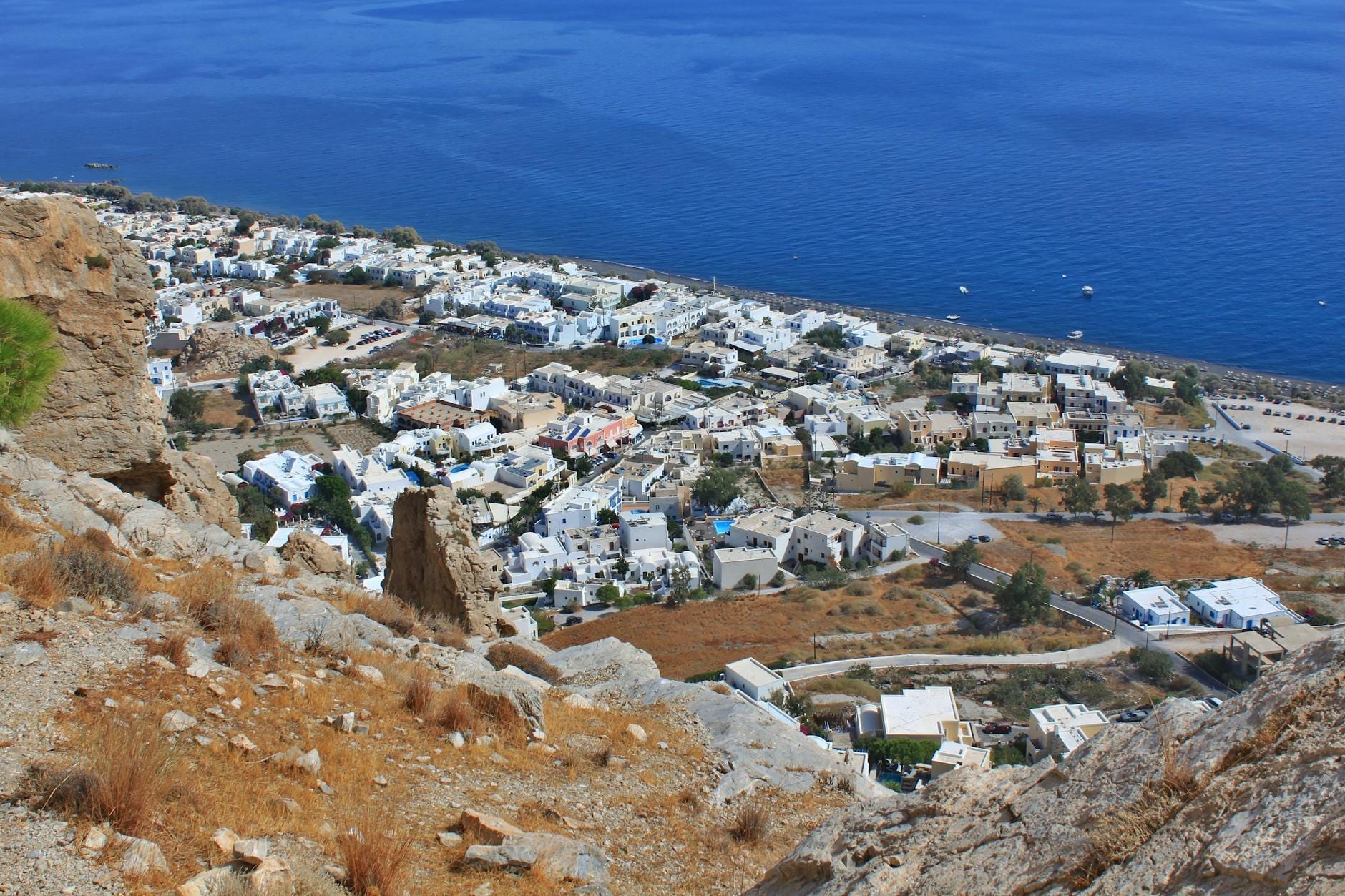
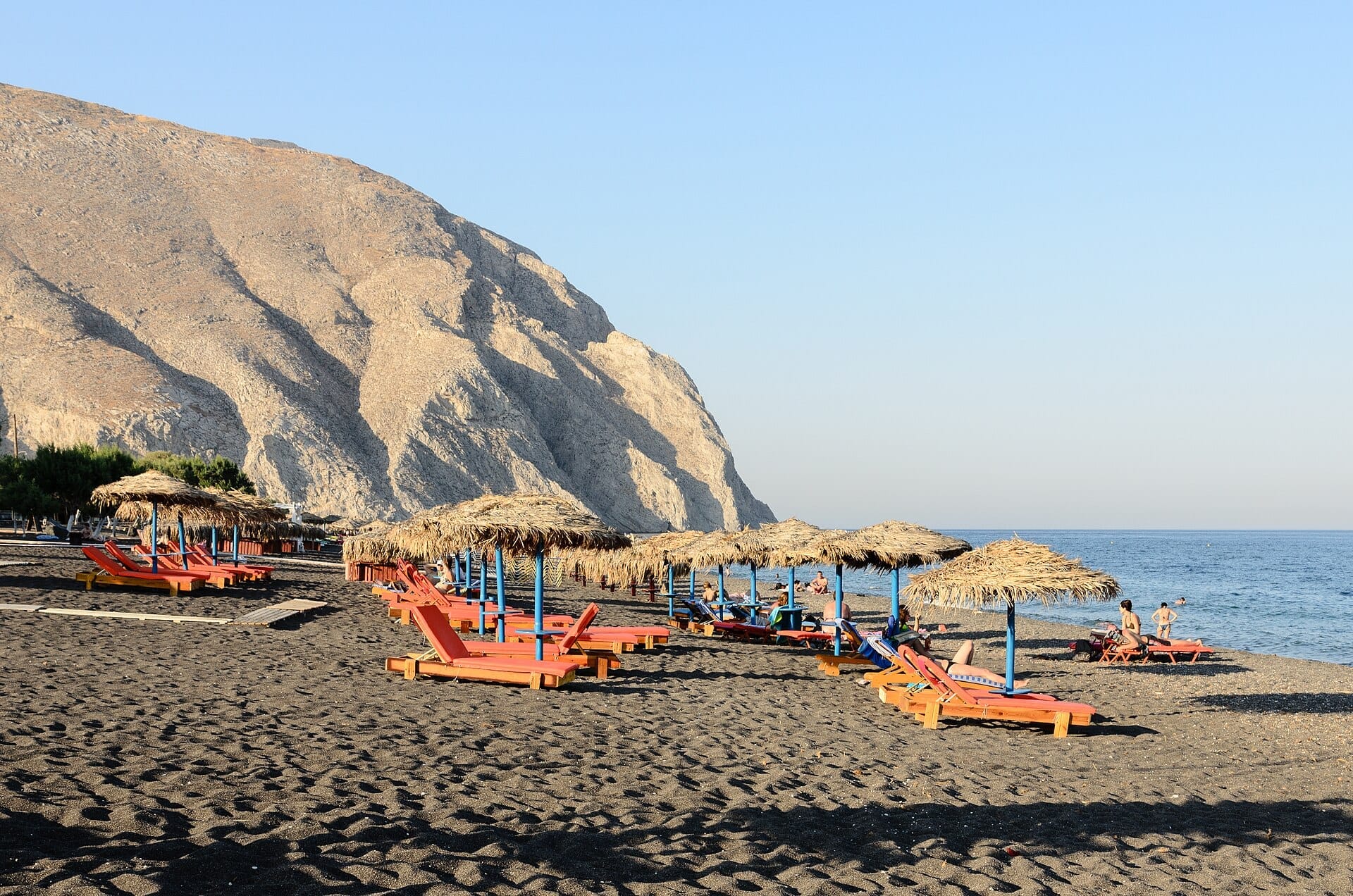
Perissa sits on Santorini's southeastern coast, anchored by a long stretch of black volcanic sand at the foot of Mesa Vouno mountain. It trades caldera glamour for a more relaxed, beach-resort pace, with a long promenade of tavernas, bars, and budget-friendly accommodation making it one of the island's most accessible coastal bases.
Perissa is where Santorini slows down. No caldera-edge infinity pools or queues for sunset photos here: just a long arc of black volcanic sand, the hulking silhouette of Mesa Vouno rising behind the village, and a promenade built almost entirely around the act of spending a day at the beach.
Orientation
Perissa occupies part of the southeastern coast of Thira, the main island of the Santorini archipelago. The village is hemmed in on its western side by Mesa Vouno, the rocky massif that juts out of the island's southern interior and effectively separates Perissa from the beach resort of Kamari on the eastern coast. This is not a coincidence of geography: the mountain creates two entirely different resort towns that face different directions and barely interact, despite being only a few kilometres apart as the crow flies.
The beach itself runs roughly north to south, and as you walk south from the main village centre, the resort area transitions through Perivolos and then Agios Georgios, three settlements that share the same volcanic sand coastline with almost no visual break between them. This entire southeastern strip is sometimes referred to collectively as the Perissa coast. The promenade road runs parallel to the beach for the length of it, lined on the inland side with hotels, studios, and the occasional supermarket.
Perissa sits roughly 11 to 13 kilometres from Fira, Santorini's capital, and about 9 to 10 kilometres from Athinios Port, where most ferries arrive. The airport at Monolithos is only about 6 to 7 kilometres to the north, making Perissa one of the more convenient areas to reach on first arrival. For a broader sense of how all of Santorini's areas connect, the getting around Santorini guide covers inter-village logistics in detail.
Character & Atmosphere
The first thing most visitors notice about Perissa is that it feels immediately less performative than the caldera towns. There are no donkeys carrying luggage up steep paths, no photographers jostling for position at a viewpoint, and no dramatic drops to the sea. Instead, there is flat ground, direct beach access, and a village infrastructure built around making beach holidays work rather than around making photographs look good.
Mornings are genuinely quiet. By eight or nine, the beach is available with almost no competition for space. The black sand absorbs heat fast, so early mornings are the best time for a walk along the shoreline before the surface becomes uncomfortable underfoot. The water is calm and clear close to shore, with good visibility for snorkelling, though there are rocky sections scattered along the beach that reward some attention before you wade in.
By midday, the promenade road hums with the kind of low-level activity that defines a functional beach resort: people moving between their accommodation and the beach, tavernas filling up for lunch, the occasional scooter hire returning with a couple heading to Akrotiri for the afternoon. The crowd here skews younger and more budget-conscious than in Fira or Oia. That is not a criticism: it gives Perissa an easier, more sociable energy that suits groups of friends and backpackers as much as it suits families.
After dark, the atmosphere shifts along the main beach promenade, where a cluster of bars keeps things going reasonably late in high season. This is not the all-night intensity of a Greek party island, but it is lively enough to make Perissa feel meaningfully different from the early-closing village tavernas you find further inland. Quieter corners of the accommodation zone, a block or two back from the beach, are noticeably calmer once you are away from the main strip.
⚠️ What to skip
The black sand heats up significantly by late morning in summer. Bring beach shoes or sandals you can wear into the water: walking barefoot on the sand at midday can be genuinely painful, and the rocky patches near the waterline are easier to navigate with footwear.
What to See & Do
The beach is the primary reason to come to Perissa, and it earns its reputation. The volcanic black sand has an unusual texture: coarser and more granular than typical Mediterranean beaches, with a grey-black colour that contrasts sharply with the clear turquoise water. The beach is long enough that it never feels truly overcrowded, particularly if you walk south toward Perivolos, where the crowd thins and the atmosphere becomes slightly less resort-heavy.
The most significant cultural draw in the area is just above the village. Ancient Thera sits on the ridge of Mesa Vouno at around 360 metres above sea level, accessible via a paved road from Kamari that reaches near the site, or via a roughly 2- to 3‑kilometre hike from the base of the mountain on the Perissa side. The site preserves ruins of a Hellenistic, Roman, and Byzantine settlement with remarkable views over both the Perissa coast and Kamari, effectively letting you see both sides of the mountain from a single vantage point.
Water sports rentals are available along the beach promenade: kayaks, paddleboards, and boat excursions operate from the beach area in high season. For visitors interested in Santorini's wider volcanic history, the Nea Kameni volcano and Palea Kameni hot springs are accessible on day trips by boat, with departures typically from Athinios Port or organised through accommodation and tour operators.
Perissa also sits within easy reach of Akrotiri, the ancient Minoan settlement preserved under volcanic ash on the island's southwestern tip. The Akrotiri archaeological site is one of Santorini's most significant historical attractions. It is around 9 to 11 kilometres from Perissa by road, making it a realistic half-day trip combined with a stop at the nearby Red Beach or a look at the lighthouse at the cape.
Swimming and snorkelling at Perissa Black Sand Beach, particularly in the calmer morning hours
Hiking or driving to Ancient Thera on the Mesa Vouno ridge
Walking or cycling south along the promenade to Perivolos and Agios Georgios
Water sports rentals along the beach strip in season
Day trips to Akrotiri archaeological site and Red Beach
Boat tours to the volcanic islands and hot springs, organised from the area
💡 Local tip
If you plan to hike to Ancient Thera from Perissa, start early in the morning before heat builds. Carry more water than you think you need. The trail is manageable but exposed, and the midday sun on the open rock face is intense in summer.
Eating & Drinking
The Perissa food scene runs along the promenade and the street immediately behind it, concentrated in a strip of tavernas, cafés, and beach bars that covers most eating needs without much ambition beyond reliability and value. The price point here is noticeably lower than in Fira or Oia, and the portions tend to be generous. Greek staples, salads, grilled fish, souvlaki, and pasta dishes dominate the menus, aimed at a clientele that wants to refuel between beach sessions rather than linger over a long dinner.
Breakfast is easy to find anywhere along the strip: cafés open early and serve coffee, pastries, eggs, and fresh juice. Lunch crowds the seafront tables around midday. For dinner, the busier tavernas fill up from around eight in the evening, particularly in July and August. Booking ahead is not generally necessary in Perissa the way it is at well-known Oia restaurants, but the most popular spots can get a queue on weekend evenings in peak season.
Santorini has a distinct local food culture worth exploring beyond the standard taverna menus. The island is known for cherry tomatoes, capers, white aubergine, and Assyrtiko wine, all of which appear in local dishes if you look for them. For a fuller picture of what the island produces and where to find it at its best, the Santorini food guide and the Santorini wine guide are useful references.
The bar scene along the beach strip picks up after dinner. Beach bars with outdoor seating and music are concentrated near the centre of the Perissa promenade. The crowd is younger and more casual than you find at cocktail bars in Imerovigli, and the vibe is closer to a Mediterranean beach party than a rooftop lounge experience. If late evenings are not your preference, the side streets behind the promenade are quiet by comparison.
Getting There & Around
KTEL buses connect Perissa with Fira, the island's main transport hub, with reasonably regular services in high season. The bus journey takes roughly 30 to 40 minutes depending on route and traffic. Fira is where you connect onward to Oia, Kamari, Akrotiri, and the port. Bus timetables change by season, and services reduce significantly outside of the main summer period, so checking the current KTEL Santorini schedule before planning transport around buses is strongly advised.
Taxis are available but cannot always be hailed on the street in smaller villages: calling ahead or asking your accommodation to arrange one is the standard approach. Pre-booked private transfers are commonly used for airport arrivals, and given that the airport is only about 6 to 7 kilometres from Perissa, this is one of the more straightforward and affordable airport connections on the island.
Renting a car, ATV, or scooter gives you the most flexibility for the Perissa area, particularly if you want to visit Ancient Thera by road, explore the Akrotiri peninsula, or cross to Kamari. Note that there is no short through-road over Mesa Vouno directly linking the two resorts: most drivers route via the island’s interior or use the longer paved road from Kamari toward Ancient Thera, adding distance despite the two beaches being geographically close. ATV and scooter hire shops are visible along the main promenade strip.
ℹ️ Good to know
Perissa and Perivolos share the same stretch of beach and are essentially continuous. If you are staying in one and walking to the other, there is no clear dividing line: just keep following the promenade south from Perissa and you will reach Perivolos naturally.
Where to Stay
Perissa is one of the more affordable places to stay in Santorini, and it covers a wider range of accommodation types than the caldera towns. Budget studios and small guesthouses cluster on the streets set back one or two blocks from the beach, where prices are lower and it is quieter at night. Beachfront and near-beachfront options command a premium but still sit below comparable properties in Oia or Imerovigli. For a full breakdown of Santorini's accommodation zones and how they compare, the where to stay in Santorini guide covers the trade-offs clearly.
The best-positioned accommodation for beach access is along or just behind the promenade road. Properties at the northern end of the village are slightly closer to the main village centre, with more walking options for restaurants and shops. The southern end, toward Perivolos, is quieter and more suited to travellers who want direct beach access with less noise from the bar strip.
Perissa suits travellers who prioritise beach time over caldera views, prefer lower prices over prestige, and are comfortable with a resort rather than a village atmosphere. It is a particularly good fit for groups of friends, younger couples, and families with children who want easy beach access and reliable accommodation options. For travellers whose main goal is the caldera view experience, Perissa will feel like a different island: the trade-off is real, and worth understanding before booking. The Santorini on a budget guide is a useful companion if value is a priority.
Honest Assessment: Who Perissa Is For
Perissa is one of the most straightforwardly functional places to stay in Santorini. It delivers beach access, affordable food, simple accommodation, and a reasonable base for day trips without any of the visual drama that makes the caldera towns famous. If you are arriving expecting whitewashed clifftop architecture and Aegean panoramas, you will find instead a flat beach resort with volcanic sand and a mountain backdrop, which is a genuinely different experience.
The beach itself is one of the longest and most swimmable in Santorini, and the access to Ancient Thera and the Akrotiri area makes Perissa a better base than it might appear for those interested in Santorini's archaeological sites. The Perissa beach and Perivolos beach together form one of the island's best stretches of swimmable coastline.
What Perissa cannot offer is the caldera experience: no sunset views over the volcano, no cliffside paths between villages, and none of the architectural concentration that makes Fira and Oia so photographed. Visitors who have come to Santorini specifically for those things should base themselves on the western ridge and treat Perissa as a day trip destination rather than a home base.
TL;DR
Perissa is a beach resort village on Santorini's southeastern coast, built around a long stretch of black volcanic sand at the base of Mesa Vouno mountain.
It is best suited to travellers who prioritise beach access, affordable accommodation, and a relaxed resort atmosphere over caldera views and village character.
The area offers direct access to Ancient Thera, the Akrotiri archaeological site, and the continuous Perivolos and Agios Georgios coastline, making it a practical base for the southern part of the island.
Transport connections to Fira by KTEL bus are reliable in high season; car or scooter hire is strongly recommended for flexibility, particularly for reaching sites on the western side of the island.
Not recommended as a base for travellers whose primary goal is the caldera view experience: the flat resort setting is a fundamentally different Santorini from the clifftop villages.
Santorini's beaches are unlike anywhere else in Greece. Volcanic geology means most are black or dark-pebbled, with a handful of dramatic color exceptions. This guide covers every beach worth visiting, from the popular to the genuinely quiet.
Santorini rewards visitors differently depending on when they arrive. This guide breaks down every season by weather, crowd levels, prices, and what's actually open so you can pick the timing that matches your priorities.
Santorini rewards visitors who look beyond the caldera rim. This guide covers the best day trips from Santorini, from hiking to Oia and cruising the volcanic islets to hopping across to Folegandros, with full logistics, seasonal notes, and practical booking advice.
Santorini has no metro, no trains, and surprisingly limited taxis. This guide breaks down every transport option on the island — KTEL buses, rentals, taxis, rideshare, and ferries — with real fares, route details, and practical advice on what works best by season.
Santorini polarises travellers. The caldera views are genuinely spectacular, the volcanic landscape is unlike anywhere else in Greece, and the archaeology rivals anything in the Aegean. But the crowds are real, the prices are steep, and the hype can outpace the reality. Here is what you actually need to know before you book.
Santorini's black sand beaches are unlike anything else in the Aegean. Formed by volcanic eruptions and shaped by centuries of erosion, they come with their own rules, quirks, and logistics. This guide covers the main beaches, practical access, seasonal timing, and what first-timers always get wrong.
Santorini is far more than the famous blue domes and caldera selfies. This guide takes you beyond Oia and Fira to the island's medieval villages, wild volcanic beaches, serious wine caves, and ancient ruins that most visitors walk straight past.
Santorini rewards hikers with caldera rim panoramas, ancient ruins, volcanic craters, and medieval villages. This guide covers the island's best trails, from the classic Fira–Oia walk to off-the-beaten-path routes most visitors never find.
Santorini's history stretches back more than 3,600 years, from a sophisticated Bronze Age city buried by volcanic ash to Hellenistic temples, Venetian fortresses, and Byzantine monasteries. This guide covers every significant historical site on the island, with practical advice on when to visit and what to expect.
Santorini's caldera views, volcanic beaches, and world-class sunsets make it one of the most sought-after honeymoon destinations in Europe. This guide breaks down exactly where to stay, what to do, and what to skip so you can plan a trip that lives up to the hype.
September is arguably the smartest month to visit Santorini. The sea is warm, the light is golden, the harvest is underway, and the worst of the summer crowds have thinned. This guide covers everything from weather and pricing to what actually changes as the month progresses.
Three days is enough to cover Santorini's essentials without burning out. This itinerary balances the iconic caldera villages, the volcanic south, ancient ruins, and the island's wine country — with specific timing, realistic costs, and straight talk on where the crowds aren't worth it.
Santorini's luxury scene runs deep, from cliffside suites with direct caldera views in Oia and Imerovigli to upscale beach resorts along the black-sand coast. This guide breaks down where to stay, when to book, what to expect across price tiers, and which high-end experiences are actually worth it.
Santorini has a reputation for luxury prices, and that reputation is partly earned. But with the right timing, accommodation choices, and a few practical strategies, the island is far more accessible than most people expect. This guide breaks down real costs and shows you where to cut spending without sacrificing the experience.
Santorini is one of the world's most photographed destinations, but knowing exactly where to stand, when to arrive, and which lesser-known angles to seek out separates good photos from great ones. This guide covers 23 of the island's best photography locations, from the iconic caldera rim to wild volcanic beaches and medieval hilltop villages.
From semi-private catamaran cruises to full-day private charters, Santorini's boat tour market is crowded and easy to overpay on. This guide breaks down every major format, what each actually includes, real price ranges for 2025-2026, and the questions to ask before you book.
Santorini's sunsets are legendary, but not all viewpoints are equal. This guide covers the best spots across the island, from the famous to the overlooked, with practical advice on when to arrive, how to avoid the worst crowds, and which locations suit different styles of traveler.
Santorini's caldera is one of the most dramatic natural amphitheaters on the planet, and knowing where to stand makes all the difference. This guide covers the island's finest vantage points, from iconic sunset spots to quiet hilltops most visitors never find.
The Santorini caldera holds one of the Mediterranean's most dramatic geological stories. This guide covers the volcano's history, how to visit Nea Kameni and the Palea Kameni hot springs, how to choose a boat tour, and what most visitors get wrong before they arrive.
Two of Greece's most iconic Cycladic islands, but they deliver very different trips. This guide breaks down the real differences between Santorini and Mykonos across beaches, atmosphere, costs, food, and logistics, so you can choose the one that fits your travel style.
Santorini's Mediterranean climate shifts dramatically across the year, from bone-dry summers with 12 hours of daily sunshine to mild, stormy winters. This guide breaks down Santorini weather by month, covering temperatures, rainfall, sea conditions, and crowd patterns so you can choose exactly the right time to visit.
Santorini produces some of Greece's most distinctive wines, shaped by volcanic soils, searing heat, and ancient vines trained in basket shapes against the Aegean wind. This guide covers every wine style, the best wineries to visit, how to book tastings, and what to order with your food.
Santorini is famous for romantic sunsets and honeymoon hotels, but it genuinely works for families too. This guide covers the best beaches for kids, family-friendly activities, where to base yourself, and the practical details that actually matter when you're traveling with children.
Santorini rewards visitors who go beyond the postcard shots. This guide covers the best things to do in Santorini across every interest and budget, from ancient ruins and caldera hikes to sailing tours and wine tasting, with candid assessments of what is actually worth your time.
Santorini's cuisine is shaped by volcanic soil, Bronze Age agriculture, and a seafaring tradition. This guide covers every local dish worth ordering, the ingredients that make them unique, how much to expect to pay, and when to visit for the freshest seasonal produce.
Santorini's accommodation landscape splits cleanly between cliffside caldera villages and laid-back beach towns on the east coast. This guide breaks down every major area by cost, crowd level, and practicality so you can match your base to your actual travel style.