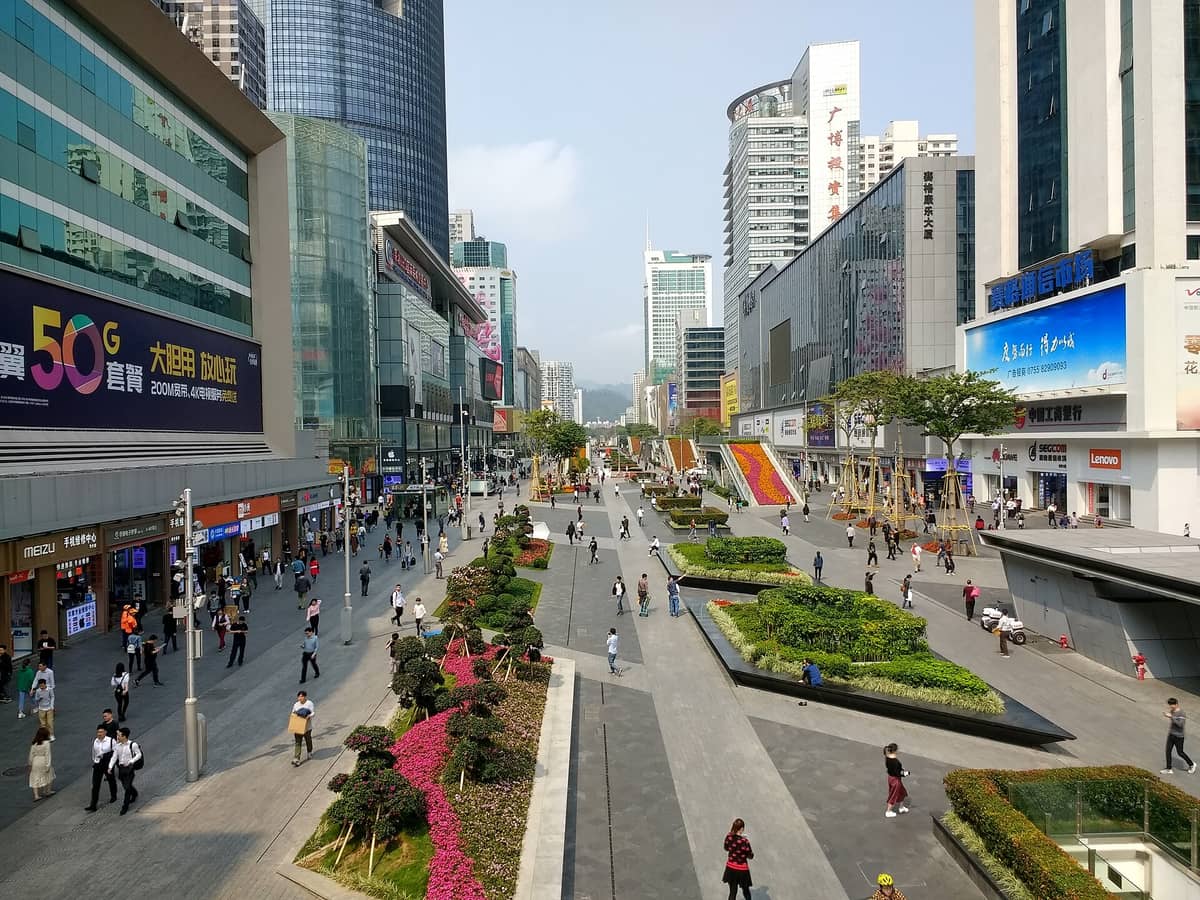
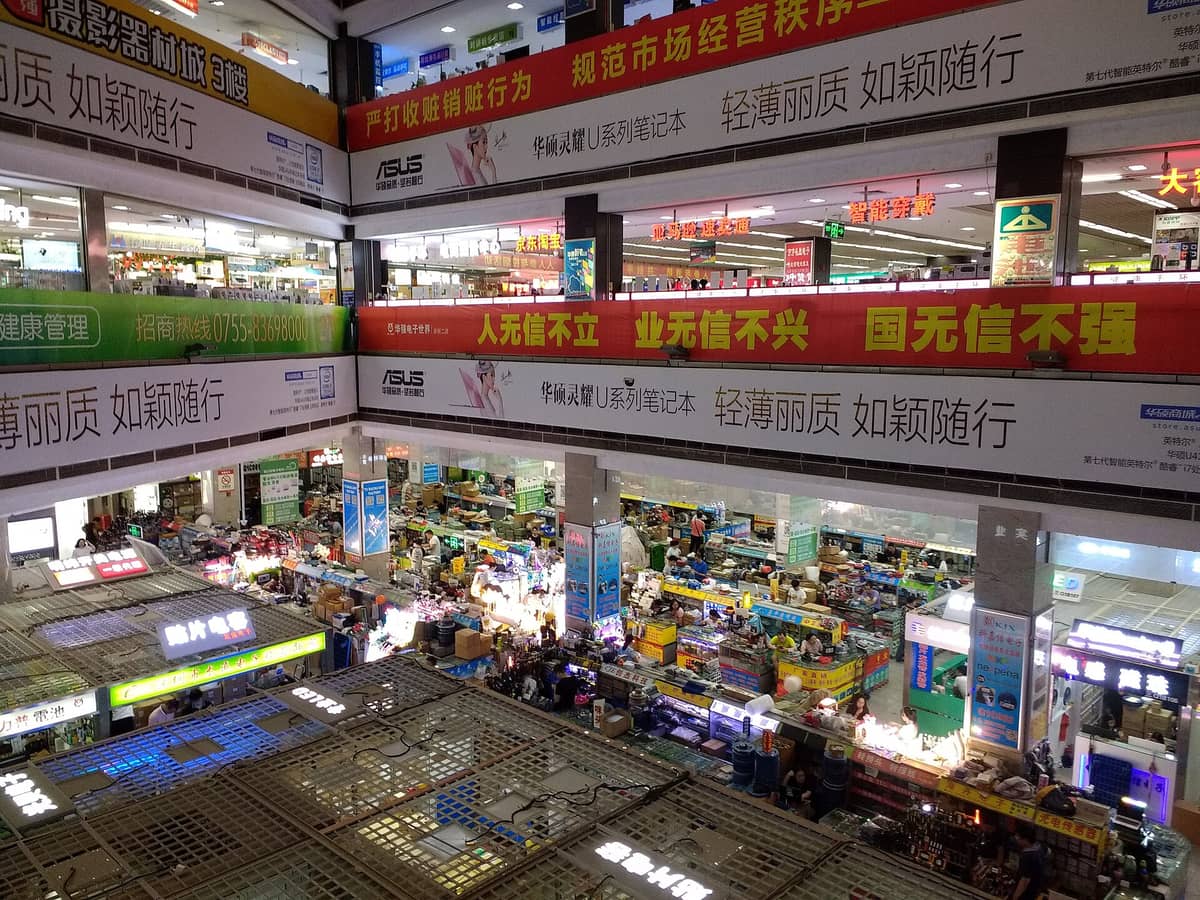
Huaqiangbei is Shenzhen's most concentrated commercial district, where multi-story electronics markets, fashion malls, and street food stalls compete for space across a tight grid of pedestrian and commercial streets. It sits in Futian District, within easy metro reach of the city center, and draws everyone from hardware engineers sourcing components to curious travelers who want to understand why Shenzhen became the world's electronics capital.
Huaqiangbei is where Shenzhen's identity as a technology and manufacturing powerhouse becomes tangible at street level. Covering less than three square kilometers in Futian District, this subdistrict packs more electronics markets, component vendors, and wholesale traders into a single walkable grid than almost anywhere else on the planet. It is loud, relentless, and genuinely unlike any shopping district you have seen before.
Orientation
Huaqiangbei occupies 2.96 square kilometers in the northern part of Futian District, Shenzhen's central administrative district. The boundaries are clearly defined: Hongling Middle Road to the east, Shennan Middle Road to the south, Hongli Road to the north, and Huafu Road to the west. If you can picture a tight rectangle just north of Shennan Middle Road, the main commercial thoroughfare that bisects the city east to west, you have the basic shape of Huaqiangbei.
The commercial spine of the district runs along Huaqiang North Road and Huaqiang Road, which form a continuous north-south corridor through the center. Cross streets including Zhenzhong Road, Zhenhua Road, and Zhenxing Road divide this corridor into distinct blocks, each with its own character. Huafa Road runs parallel to the east, connecting quieter sections of the district. SEG Plaza anchors the southern end of the commercial strip near the metro, while the Pavilion Hotel sits toward the northern edge. The Huaqiang Road pedestrian section, roughly in the center, is where foot traffic is heaviest.
Huaqiangbei borders Futian's wider commercial and civic core. Walking south past Shennan Middle Road puts you within range of Futian's government quarter. To the west, the district transitions toward the Futian CBD, while Luohu District, home to the old border crossing with Hong Kong, lies to the east. The geographic compactness of Huaqiangbei is part of what makes it work: everything relevant to the electronics trade is reachable on foot within about fifteen minutes.
Character & Atmosphere
Early mornings in Huaqiangbei belong to the professionals. By 8 AM, vendors are stacking boxes, freight carts are weaving through the smaller alleys, and the loading bays of the major market buildings are already processing the day's stock. The sound is trolley wheels on tile, Cantonese spoken at pace, and the hum of ventilation systems in buildings that never fully power down. It does not feel like a tourist district waking up; it feels like a factory floor at shift change.
By mid-morning the pedestrian street fills with a mixed crowd: engineers with component lists, small business owners from across Southeast Asia, mainland Chinese shoppers browsing the fashion floors, and a smaller number of international visitors who have heard about this place and want to understand it firsthand. The afternoon light flattens over the dense block-form buildings, and the covered market interiors take on a fluorescent permanence where time becomes irrelevant. You can spend three hours in SEG Plaza moving between floors dedicated to phones, motherboards, cables, and security systems without noticing the light change outside.
After dark, the character shifts. The wholesale component floors thin out as serious traders leave, and the ground-floor shops pivot toward retail customers, phone repair, and accessories. The pedestrian street around the central section of Huaqiang Road gets younger: mobile phone case vendors light up their displays, and the surrounding food stalls extend their hours. It is not a nightlife district in any conventional sense, but it is far from dead after 9 PM, particularly on weekends.
ℹ️ Good to know
Huaqiangbei operates on a largely B2B rhythm during weekday mornings and afternoons. If you are coming purely to browse as a traveler, weekday evenings or weekend afternoons are when the retail energy is highest and the wholesale crowds have thinned.
What to See & Do
The anchor attraction of the district is the Huaqiangbei Electronics Market, a cluster of large multi-story market buildings along Huaqiang North Road. SEG Plaza is the most iconic of these: a towering building whose lower floors are given entirely to stall-based electronics trading, with escalators carrying you through floors dedicated to specific product categories. The scale often surprises first-time visitors. You are not browsing a market; you are navigating a vertical city of commerce.
Beyond SEG Plaza, the surrounding blocks contain dozens of other specialized market buildings. Some focus on surveillance and security equipment. Others deal in raw components, cables, LEDs, or audio hardware. The density means that nearly any electronic product category is represented somewhere within a ten-minute walk. For travelers with a background in technology or manufacturing, this is where you understand concretely why Shenzhen became the city it is.
The Huaqiang Road pedestrian street provides a different experience: wider sidewalks, more fashion and accessories retailers, and a generally more relaxed pace than the interior market floors. It is also where you begin to see the district's non-electronics commercial layer, including cosmetics, clothing, and mobile phone accessories aimed at local shoppers rather than trade buyers. If you want to understand Huaqiangbei in the context of Shenzhen's broader commercial evolution, pair it with a visit to the Dongmen Pedestrian Street in Luohu, which offers a more traditional shopping street experience.
For travelers wanting to understand how Shenzhen's tech identity extends beyond retail, the district works well as a complement to a Shenzhen tech tour that might also take in Nanshan's corporate campuses, including Tencent's headquarters on the western side of the city. Huaqiangbei represents the manufacturing and distribution layer of the tech economy; Nanshan represents the corporate and software layer.
Walk the full length of Huaqiang North Road from Shennan Middle Road north to Zhenhua Road to get a complete picture of the district's market buildings
Enter at least one of the large multi-story markets and take the escalators to the upper floors, where the more specialized component trading happens
Browse the Huaqiang Road pedestrian section in the late afternoon when local shoppers are most active
Look up: the architecture of the market buildings, packed with signage and external cabling, is a visual document of how fast this district was built and how intensively it is used
💡 Local tip
If you are interested in purchasing electronics, do basic research on current retail prices for items you want before you arrive. Prices in Huaqiangbei are not always lower than legitimate online retailers, and the advantage lies more in variety, immediacy, and access to components that are hard to find elsewhere.
Eating & Drinking
The food scene in Huaqiangbei is built for volume and speed rather than culinary tourism, which is exactly what you would expect from a district whose primary visitors are here to trade. Street food stalls concentrate along and near the Huaqiang Road pedestrian section, with the usual southern Chinese offerings: congee stalls in the morning, noodle shops running through lunch, and skewer vendors firing up as the afternoon moves toward evening.
The surrounding streets have a dense layer of small Cantonese and Sichuan restaurants occupying ground-floor units in the commercial buildings. Pricing is practical: a full lunch at a sit-down noodle or rice shop in the side streets runs in the low tens of yuan per person. The market buildings themselves contain food courts and smaller stalls on designated floors, which are crowded with traders and vendors at noon and slightly quieter at other times. The food is straightforward and functional rather than refined.
For a more considered meal, the edges of the district, particularly toward the southern boundary near Shennan Middle Road, have more variety including tea houses and cafes catering to the district's younger office workers. If you want a broader overview of what to eat in the city, the Shenzhen food guide covers the full range across neighborhoods. Huaqiangbei specifically is not the place to plan your best dinner in Shenzhen, but it is entirely possible to eat well and cheaply if you are willing to walk half a block off the main commercial strip and look for where the workers are eating.
Congee and dim sum around the market buildings in the early morning
Cantonese noodle shops on the side streets for lunch under 30 CNY
Skewer and street food stalls along the pedestrian section from late afternoon
Sichuan and Hunan restaurants in the surrounding blocks for heartier evening meals
Tea shops and milk tea chains throughout the district for a break from the sensory intensity of the markets
Getting There & Around
Huaqiangbei is well connected by metro. Huaqiang Road Station on Shenzhen Metro Line 1 sits at the southern edge of the district and is the primary entry point for most visitors. Huaqiang North Station on Lines 2, 7, and 10 provides a second metro access point toward the northern part of the commercial corridor. Both stations are within easy walking distance of the main market buildings.
From the Luohu border crossing with Hong Kong, Huaqiang Road Station is approximately ten minutes by metro on Line 1, making this one of the most accessible Shenzhen neighborhoods for day visitors crossing from Hong Kong. For more detail on that journey, the Hong Kong to Shenzhen guide covers crossing options and onward transit. From Futian's civic core and the Shenzhen Civic Center area, the district is reachable in two to three metro stops or a short taxi ride.
Within the district itself, everything is walkable. The commercial core is compact enough that you can cover the main market buildings and the pedestrian street in a half-day without transport. Bus services also serve the area, with stops including Shanghai Hotel East on the surrounding roads. Taxis and Didi ride-hailing are practical for reaching the district from other parts of Shenzhen, particularly from Nanshan or the western districts. For a full overview of how to move around Shenzhen, the getting around Shenzhen guide has all transit options covered.
⚠️ What to skip
The main pedestrian areas and market interiors become heavily congested on weekend afternoons. If you are navigating with luggage or have mobility considerations, weekday mornings are considerably easier to move through.
Where to Stay
Huaqiangbei is primarily a commercial district rather than a hotel district, and the accommodation options here reflect that. There are business hotels in and immediately around the subdistrict, including properties along and near the Pavilion Hotel area to the north of the commercial strip. These suit travelers whose primary reason for being in Shenzhen is related to trade, sourcing, or business in the markets. Room rates are generally competitive compared to Futian CBD or Nanshan hotels.
For leisure travelers, staying in Huaqiangbei makes sense if you want immediate access to the electronics markets and do not mind noise. The district does not quiet down quickly in the evenings, and lower floors of hotels facing the commercial streets can be disruptive. Travelers who want a calmer base with easy metro access to Huaqiangbei might be better placed in the adjacent Futian CBD area. The where to stay in Shenzhen guide maps out the options across neighborhoods and what type of traveler each suits.
Know Before You Go
Huaqiangbei operates primarily on WeChat Pay and Alipay for transactions, particularly within the smaller stalls and market vendors. Cash in CNY is accepted, but having a mobile payment method set up before you visit smooths the process considerably. Credit cards are less reliable in this context. The Shenzhen on a budget guide has practical payment and spending tips relevant across the city.
Bargaining practices vary by vendor type. The large established market buildings with clearly priced stalls tend to have firmer prices, especially for retail customers. Smaller vendors in the lower floors and street-facing stalls are more flexible. The key risk in the district is not personal safety, which is not a documented concern in the available official sources, but rather transaction clarity: verify specifications, packaging, and return policies before completing any purchase, especially for higher-value electronics.
For travelers combining a visit here with broader Shenzhen exploration, Huaqiangbei pairs well with a day in Futian's civic and cultural district, which includes the Shenzhen Civic Center and the Lianhuashan Park a short metro ride to the north. The contrast between Huaqiangbei's relentless commercial density and the open civic scale of Futian's planned center captures something essential about how Shenzhen was built.
TL;DR
Huaqiangbei is Shenzhen's electronics and wholesale commerce district, covering 2.96 km² in Futian and centered on Huaqiang North Road and the Huaqiang Road pedestrian street
Best for: technology enthusiasts, sourcing travelers, business visitors, and anyone who wants to understand Shenzhen's identity as a manufacturing and electronics hub
Served by two metro stations: Huaqiang Road Station (Line 1) and Huaqiang North Station (Lines 2, 7, and 10), with fast connections to Luohu, Futian CBD, and Nanshan
Not ideal for travelers seeking a relaxed or scenic neighborhood experience: the district is dense, commercially intense, and does not slow down significantly during daylight hours
Allow half a day to walk the main corridor and explore the market buildings; combine with Futian's civic district or a broader tech tour for a full day's itinerary
Two days in Shenzhen is enough to move through its most distinct neighbourhoods, from the electronics labyrinth of Huaqiangbei to the coastal parks of Nanshan and the art spaces of OCT Loft. This itinerary is built around the metro, keeps mornings efficient, and leaves room for the food and nightlife that most guides gloss over.
Shenzhen's climate is subtropical and unforgiving in summer. This guide breaks down every season clearly, from the ideal October–December window to the typhoon risks of July–September, so you can plan your trip around real conditions rather than brochure weather.
Shenzhen sits at the centre of one of the most connected corners of Asia. Within a few hours, you can reach Hong Kong, Guangzhou, Zhuhai, Macau, and the coastal villages of Dapeng. This guide covers the best day trips from Shenzhen with realistic travel times, transport logistics, and clear assessments of what each destination actually offers.
Shenzhen delivers far more than its reputation as a tech-and-shopping city. From coastal greenways and hilltop parks to art districts and Ming Dynasty fortresses, a remarkable amount of the city costs nothing to explore. This guide covers the best free attractions across every district.
Shenzhen has one of the most extensive metro systems in China, plus buses, taxis, and ride-hailing to fill the gaps. This guide breaks down every transport option, from airport arrival to cross-city metro trips, so you can move around confidently from day one.
Getting from Hong Kong to Shenzhen is straightforward once you know which crossing suits your itinerary. This guide covers every route — high-speed rail, MTR foot crossings, and 24-hour options — with realistic queue times, operating hours, and practical advice for first-timers.
Shenzhen is one of China's most misunderstood cities. It's not just a tech showcase or a shopping stopover from Hong Kong. This guide cuts through the clichés to help you decide if Shenzhen belongs on your itinerary, and what to prioritize if it does.
Shenzhen built more supertall skyscrapers in 40 years than most cities manage in a century. This guide covers the key landmarks, the best districts for architectural exploration, observation decks, design culture, and practical tips for getting around the skyline.
Chinese New Year in Shenzhen is neither a ghost town nor a nonstop party — it's something more interesting than either. This guide covers the real rhythm of the city during Spring Festival: which events are worth your time, how crowds shift, what actually closes, and how to make the most of one of China's most distinctive holiday periods.
Shenzhen has built one of China's most serious contemporary art ecosystems in under four decades. This guide covers the key museums, gallery districts, and creative spaces — from OCAT Shenzhen to Dafen Oil Painting Village — with practical details on getting there, what to expect, and when to visit.
Huaqiangbei is the world's largest electronics market district, but navigating it without a plan is a recipe for overpaying or leaving empty-handed. This guide covers which buildings to visit, realistic price expectations, negotiation strategy, payment methods, and practical advice on what is cheap versus what only looks like a deal.
Shenzhen's food scene reflects its identity as a migrant city: no single ancient cuisine, but an extraordinary range of Cantonese, Hakka, Teochew, Hunan, Sichuan, and international cooking all under one roof. This guide covers the dishes worth seeking out, the neighborhoods to find them in, and the practical details that make eating here genuinely easy.
Shenzhen is far more than tech malls and theme parks. This guide takes you to the ancient fortresses, artist communities, coastal trails, and architectural wonders that most visitors walk straight past.
Shenzhen surprises most visitors with the quality and variety of its hiking. Within the city limits you'll find a 944-meter mountain summit, a 15-kilometer coastal greenway, dramatic clifftop sea trails, and forested urban parks. This guide covers the best of all of them.
Shenzhen at night is more varied than most visitors expect. This guide breaks down the city's top nightlife districts by vibe and budget, covering rooftop bars, live music venues, megaclubs, and late-night food streets — with metro directions, realistic price ranges, and clear notes on what's worth your time.
Shenzhen is one of the most affordable major cities in Asia for travelers who know where to look. This guide breaks down realistic daily costs, the cheapest transport options, free and low-cost attractions, and the neighborhoods that give you the best value without sacrificing convenience.
Shenzhen takes its reputation as a City of Parks seriously. This guide covers the best parks in Shenzhen across every type, from hilltop viewpoints and wetland boardwalks to beach trails and sprawling botanical gardens.
Shenzhen is China's most concentrated hub of consumer tech, hardware manufacturing, and innovation showrooms. This guide covers the best stops, realistic routes, logistics, and practical advice for planning your own tech tour across Nanshan, Futian, and Huaqiangbei.
Shenzhen is far more than a tech hub. It has world-class theme parks, wildlife reserves, natural history museums, and coastal beaches that make it a genuinely rewarding destination for families. This guide covers the best of it, organized by what works for different ages and energy levels.
Shenzhen is one of Asia's great shopping cities, but it rewards those who know where to go. This guide breaks down the best markets, malls, and districts by category, with clear advice on prices, bargaining, and what's worth buying.
Shenzhen rewards visitors who look beyond the shopping malls. This guide covers the city's best experiences across parks, coastlines, heritage districts, and skyline viewpoints — organized by what kind of traveler you are, with practical details on getting there, what to expect, and what to skip.
Shenzhen has 10 districts and no single obvious center, which makes choosing where to stay genuinely confusing. This guide breaks down the best neighborhoods by trip type, with clear price ranges, metro access notes, and practical trade-offs for each area.