Huaqiangbei Electronics Market: Shenzhen's Global Electronics Capital
Huaqiangbei is a dense cluster of electronics malls in Futian District where components, gadgets, and consumer tech are traded at a scale found nowhere else on earth. It rewards curious visitors who come prepared, but can overwhelm those expecting a casual browse.
Quick Facts
- Location
- North Huaqiang Road, Futian District, Shenzhen
- Getting There
- Huaqiang Road Station (Line 1) or Huaqiangbei Station (Lines 2 & 7)
- Time Needed
- 2–5 hours, depending on purpose
- Cost
- No admission fee; open shopping district
- Best for
- Tech enthusiasts, electronics sourcing, urban explorers
- Official website
- www.szft.gov.cn/en/life/shopping/content/post_4428024.html
What Huaqiangbei Actually Is
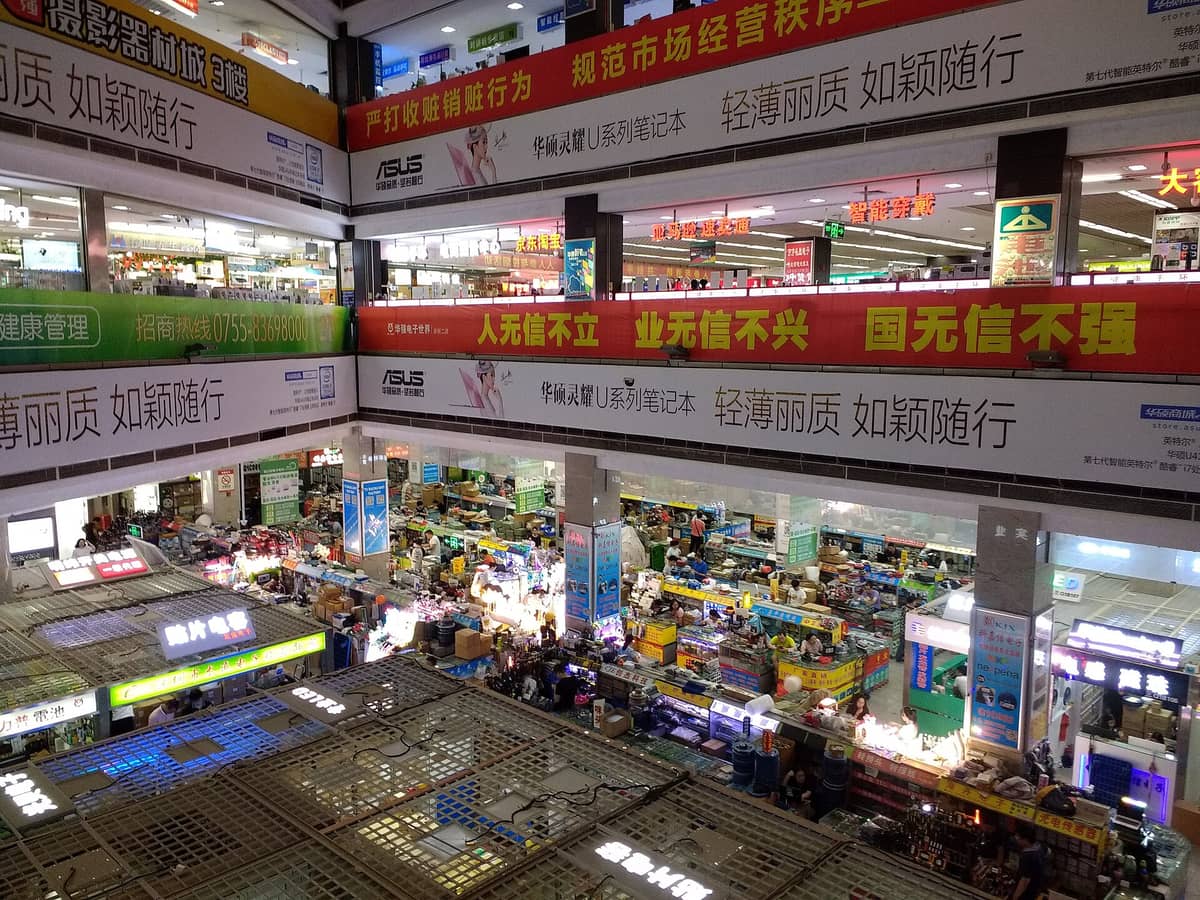
Huaqiangbei is not a single market. It is an entire subdistrict of Futian District given over almost completely to electronics trading, spanning dozens of multi-story buildings and malls packed from ground floor to rooftop with stalls, wholesale counters, and retail shops. The density is extraordinary: mobile phone components, surveillance cameras, LED strips, computer modules, circuit boards, cables, and finished consumer gadgets occupy floors that would hold office buildings anywhere else.
The district's best-known address is SEG Electronics Market (赛格电子市场), one of the oldest and most iconic buildings in the cluster, with reported trading hours of approximately 09:30 to 18:30. Huaqiang Electronic World operates on a similar schedule, roughly 09:30 to 18:00. These are anchor points, but dozens of surrounding buildings operate on their own schedules, many extending into early evening. The district functions as a free-access shopping area with no admission charge anywhere.
ℹ️ Good to know
Huaqiangbei is primarily a trade district. Most stalls cater to wholesalers, resellers, and electronics manufacturers. Retail tourists are welcome, but prices and vendor behavior reflect a commercial-first culture rather than a leisure-shopping one.
The Experience Floor by Floor
Walking into one of the main buildings for the first time is sensory overload in the best sense. The ground floor of a major mall like SEG typically holds the most competitive stalls, where vendors call out prices and phone screens glow in towers of shrink-wrapped product. The smell is a combination of plastic, circuit board soldering, and cold air conditioning running at full capacity regardless of the season outside. Fluorescent lighting runs uninterrupted across ceilings crowded with hanging signs in Chinese.
Upper floors tend to specialize. You might find an entire floor dedicated to drone components, another to CCTV equipment, another to phone repair parts and tools. This specialization is one of Huaqiangbei's useful qualities: if you know what you need, there is almost certainly a floor and a corridor for it. If you don't, wandering with a specific curiosity in mind, a new camera sensor, a custom LED controller, an obscure connector type, is far more productive than general browsing.
Smaller alleyways between the major buildings host outdoor and semi-covered stalls selling second-hand phones, stripped components, and counterfeit goods. These alleys are part of the Huaqiangbei experience, but buyers should know that consumer protection here is minimal and quality verification is the buyer's responsibility entirely.
Best Time to Visit and How the District Changes by Hour
The most active trading period is mid-morning to early afternoon, roughly 10:00 to 14:00 on weekdays. Wholesale buyers and resellers are moving through the corridors with carts and bags, vendors are engaged in rapid transaction cycles, and the energy in the main malls is at its highest. This is the best time to observe the market in full commercial operation and to find vendors most willing to negotiate or show product ranges.
By late afternoon, some smaller stalls begin packing up and the pace slows noticeably. Arriving after 17:00 risks finding a thinned-out version of the experience, especially in the component-focused upper floors. Weekends bring more retail-oriented visitors and a slightly more relaxed vendor atmosphere, though prices do not necessarily drop.
💡 Local tip
Come on a Tuesday or Wednesday morning for the most authentic wholesale atmosphere. Weekday mornings see the district at its operational peak, with resellers, hardware developers, and bulk buyers moving through at pace.
Shenzhen's October to December window, when humidity drops and temperatures become genuinely comfortable, makes navigating the outdoor alleys and walking between buildings much more pleasant. Mid-summer visits are hot and humid outside the air-conditioned mall floors, and the rainy season can make the uncovered sections uncomfortable.
Historical Context: How Huaqiangbei Got Here
Huaqiangbei's role in global electronics cannot be separated from Shenzhen's broader history as a Special Economic Zone established in the early 1980s. The city's manufacturing ecosystem, particularly its proximity to Pearl River Delta component factories, made the Futian area a natural gathering point for electronics trading. What began as industrial warehousing gradually evolved into a market district as traders clustered to reduce transaction costs and buyers learned they could source almost any component in one trip.
By the 2000s, Huaqiangbei had become a significant node in the global supply chain for consumer electronics. Small manufacturers worldwide source components here. Independent hardware developers have long treated it as a physical version of a component library. The rise of the so-called Shanzhai (山寨) manufacturing culture, the rapid iteration of consumer electronics outside official brand channels, was closely tied to the component availability and low barriers to entry that Huaqiangbei made possible.
For visitors interested in this broader context of Shenzhen as a technology and manufacturing hub, theShenzhen tech tour guidecovers the district alongside other significant sites in the city's innovation landscape.
Practical Navigation: Getting There and Getting Around
The most direct metro access is Huaqiang Road Station on Line 1, which deposits you a short walk from the heart of the market cluster. Line 2 and Line 7 also serve the area via Huaqiangbei Station, which exits directly into the commercial zone. The Shenzhen Metro is clean, inexpensive, and entirely manageable for visitors without Mandarin, as signage is bilingual throughout the system.
If you are combining Huaqiangbei with a broader Shenzhen day, theguide to getting around Shenzhenexplains metro fare structures, transit cards, and how to navigate between districts efficiently.
Once inside the district, physical navigation relies on accepting that you will get lost, at least briefly. Building entrances connect to labyrinthine stall corridors, escalators do not always serve all floors, and identical-looking corridors branch without obvious landmarks. A useful strategy is to orient yourself by the major named buildings: SEG Electronics Market and Huaqiang Electronic World are the two clearest anchor points, and most other significant malls are within a five-minute walk of one or the other.
⚠️ What to skip
Mobile data or a downloaded offline map is essential. Most signage inside buildings is in Chinese only, and verbal directions from vendors will often assume you already know the general layout.
Shopping Here: What's Worth Buying and What to Watch Out For
Huaqiangbei is competitive on price for electronic components, phone accessories, cables, small gadgets, and hobbyist electronics. Visitors with a specific technical need, a replacement charging board, a custom LED controller, a bulk buy of a particular sensor type, are likely to find better pricing here than almost anywhere else. The selection for these categories is unmatched.
Consumer electronics such as finished smartphones and laptops, however, are not necessarily cheaper than online retailers, and the risk of receiving counterfeit or substandard product is real. The outdoor alley stalls and certain upper-floor vendors operate with no returns policy and limited accountability. Paying with cash is standard and leaves no recourse if product quality disappoints after leaving the stall.
Visitors interested in the broader consumer electronics shopping landscape in Shenzhen, including newer retail options and official brand stores, will find useful comparisons in theShenzhen electronics shopping guide.
Bargaining is expected at small stalls but not at fixed-price counters inside larger mall buildings. The baseline rule: if there is no price tag displayed, the opening figure is negotiable. Asking for a lower price politely and directly is normal practice. Aggressive or theatrical bargaining is not necessary and rarely productive.
Who Should Probably Skip This
Huaqiangbei is not a comfortable browsing experience for visitors with no specific interest in electronics. The overwhelming density of product, the commercial-first energy, and the lack of English-language vendor support means casual tourists often leave underwhelmed after thirty minutes. If your goal is an interesting afternoon out in Shenzhen rather than a targeted electronics purchase or industry observation, there are more rewarding options nearby.
TheOCT Loft creative districtis a short taxi or metro ride away and offers a completely different atmosphere centered on design, galleries, and food. For a broader look at what Shenzhen offers beyond its commercial side, theShenzhen things to do guidecovers a wider range of experiences across the city.
Visitors with mobility limitations should be aware that the district involves significant walking across uneven surfaces, crowded corridors, and escalators that may not serve all floors. No official accessibility statement exists for the market area, and the physical environment is not consistently adapted for wheelchairs or strollers.
Insider Tips
- Bring a printed or screenshot list of the specific components or product names you want, ideally with the Chinese characters if possible. Showing a vendor a visual reference closes the language gap faster than any translation app.
- The basement levels of several major buildings are worth checking specifically for bulk cable, connector, and passive component suppliers. They are less visited by tourists and often hold the most competitive wholesale pricing.
- WeChat Pay and Alipay are the dominant payment methods at most stalls. Cash is universally accepted, but having one of the digital payment apps set up before you arrive saves significant friction at smaller vendors.
- If a vendor quotes a price immediately without any hesitation, that price almost certainly has room. Pausing, making a counter-offer of roughly 70% of the opening price, and being prepared to walk away is a reliable starting point.
- The rooftop or upper viewing areas of taller market buildings occasionally offer a perspective across the district's sheer scale, which is striking. Ask at the building entrance whether upper-floor access is unrestricted.
Who Is Huaqiangbei Electronics Market For?
- Hardware developers and engineers sourcing components at scale
- Tech enthusiasts wanting to observe global electronics supply chains firsthand
- Travelers interested in Shenzhen's manufacturing and innovation history
- Resellers and small-batch electronics buyers
- Curious urban explorers comfortable navigating dense commercial environments