Lianhuashan Park: Shenzhen's Civic Green Heart
Lianhuashan Park sits at the geographic and symbolic center of Futian, Shenzhen's administrative core. Free to enter and open from early morning to late evening, it draws everyone from tai chi practitioners at dawn to families flying kites on weekend afternoons, all beneath a hilltop view of one of China's most recognizable modern skylines.
Quick Facts
- Location
- No. 6030 Hongli Road, Futian District, Shenzhen
- Getting There
- Line 4 to Children's Palace Station (Exit B) for the south entrance; Line 4 to Lianhua Village Station for the north entrance; or Line 2 to Lianhua West Station (Exit A1)
- Time Needed
- 1.5 to 3 hours for a full walk including the summit
- Cost
- Free admission, no ticket required
- Best for
- Morning walkers, families, skyline photography, and cultural landmarks
What Lianhuashan Park Actually Is
Lianhuashan Park, known in Chinese as 莲花山公园 (Liánhuāshān Gōngyuán), is a 150-hectare public green space at the northern end of Shenzhen's Futian Central Business District. Opened in 1997, it was designed not just as a recreational park but as a deliberate counterpoint to the office towers and government buildings that line Shennan Avenue below. The hill at its center, Lotus Mountain (莲花山), rises to give unobstructed views south across the CBD, making this the single best vantage point in central Shenzhen that requires no elevator ticket and no reservation.
The park is free of charge and open daily from 06:00 to 23:00. It functions as a genuine neighborhood park in the way that many Chinese city parks do: less manicured showcase, more active civic space. You will find retirees playing chess, aerobics groups moving through synchronized routines, grandparents pushing strollers along wide paved paths, and teenagers photographing each other near the summit. The atmosphere is relaxed and inclusive in a way that paid attractions rarely manage.
💡 Local tip
The south entrance near Children's Palace Station (Metro Line 4, Exit F1) deposits you closest to the main formal plaza and the Deng Xiaoping statue. If you want a gentler slope and a quieter start, use the north entrance via Lianhua Village Station instead.
The Deng Xiaoping Statue: Why It Matters Here
The park's most significant landmark is a large bronze statue of Deng Xiaoping positioned on the upper slope, facing south toward the skyline he set in motion. Deng's economic reforms in the early 1980s designated Shenzhen as China's first Special Economic Zone, transforming what was a small border town into the city of skyscrapers visible from this exact hillside. The statue is not incidental decoration; standing in front of it and turning around to look at the Ping An Finance Centre and the rest of the Futian CBD is one of the more legible moments of historical compression you can find in any Chinese city.
For visitors who want deeper context on Shenzhen's physical transformation, theShenzhen architecture guidetraces how the city's built environment evolved from the reform era to the present. The view from Lianhuashan Park is a good place to orient yourself before exploring the buildings up close.
The Summit View: What You Actually See
The hill is not tall by any technical standard, but its position within the flat urban grid makes it disproportionately effective as a viewpoint. From the upper terrace, the Shenzhen skyline fans out to the south and southeast. On a clear day, the Ping An Finance Centre dominates the right side of the frame at 599.1 meters, and the stacked geometry of Futian's office district fills the middle ground. On hazy days, which are common in summer and early autumn, the towers blur into a photogenic grey wash that can actually produce strong images if you shoot toward the light.
ThePing An Finance Centrehas its own observation deck if you want to reverse the perspective and look down at the park from above. The contrast between the two experiences, one free and grounded, one ticketed and aerial, is worth considering when planning your Futian day.
Photography from the summit works best in the early morning when there is less atmospheric haze and the low sun angle catches the tower facades. Late afternoon light from the west can produce warm tones on the Ping An tower, though you will be shooting into the light if you stand at the standard summit overlook. Sunset from the hill is popular with locals but should be managed with realistic expectations: Shenzhen's air quality varies considerably, and a dramatic sunset is not guaranteed.
How the Park Changes by Time of Day
Before 08:00, Lianhuashan Park operates almost entirely on local rhythms. The main paths fill with older residents power-walking in purposeful circuits, groups practicing tai chi in the paved clearings near the lower sections, and occasional joggers finishing early runs. The air carries the smell of damp stone and freshly cut grass in the cooler months, and the ambient noise is almost entirely birdsong and the shuffle of feet. This is the best time to walk the park if you want the experience without the crowds.
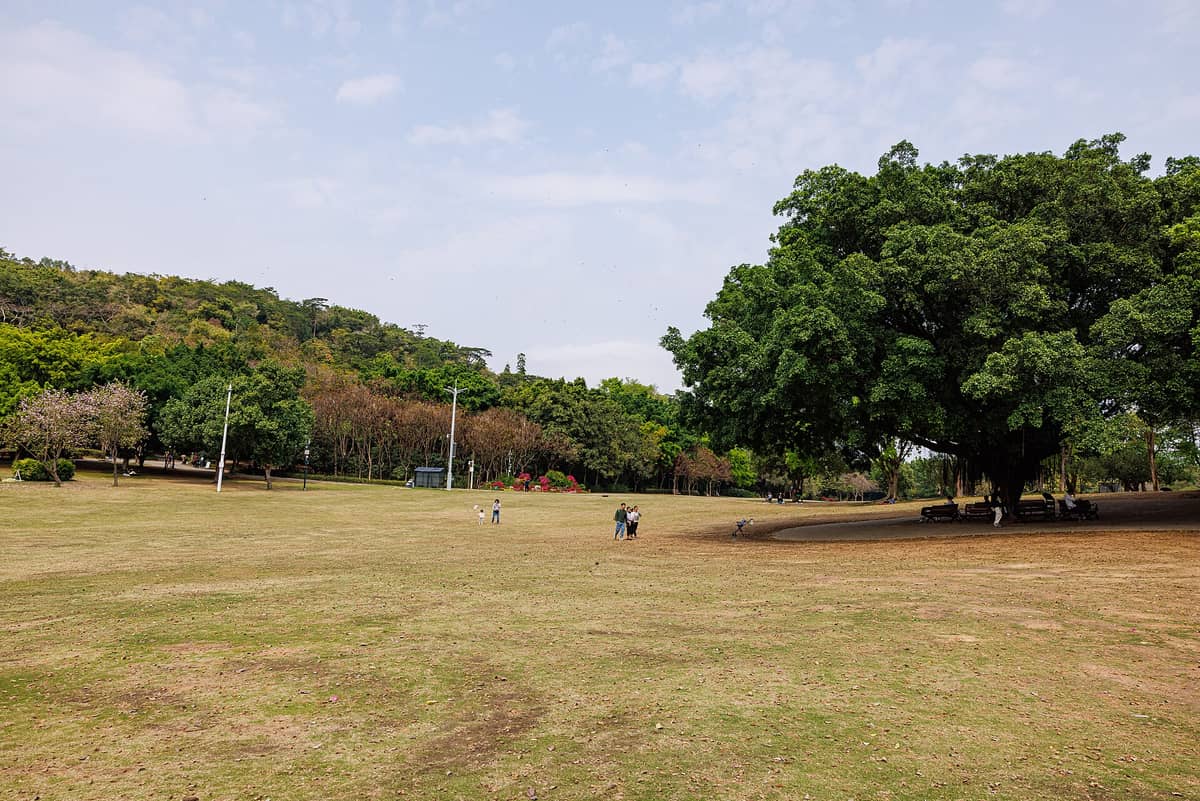
From mid-morning onward, families with children take over the lower meadow areas. The large open lawn at the base of the hill is one of the most popular kite-flying locations in Shenzhen, and on weekend mornings you can count dozens of kites in the air simultaneously. Vendors near the entrance sell kites at accessible prices if you arrive without one. The atmosphere at this hour is cheerful and slightly chaotic, with children running across the grass and parents calling after them.
Midday in summer is genuinely uncomfortable. Shenzhen's subtropical climate makes the 11:00 to 14:00 window on a July or August day punishing, and the hilltop paths offer little shade. The park does not close, but foot traffic drops sharply and you will be walking in direct sun. Weekday afternoons in the cooler months, October through December especially, are when the park achieves its most pleasant balance of temperature, crowd size, and light quality.
⚠️ What to skip
Summer visits (June to September) require serious sun protection. Bring a hat, sunscreen, and water. The ascent to the summit is short but fully exposed at the top, and humidity at midday can be severe. The rainy season also means sudden downpours with little warning.
Walking the Park: A Practical Route
From the south entrance, the main paved path leads north through formal garden sections before the gradient begins to increase as you approach the hill proper. The ascent to the summit takes roughly 10 to 15 minutes at a moderate pace and involves broad steps and paved switchbacks rather than any technical terrain. Wheelchairs and strollers can reach the intermediate terraces, though the final summit approach is steeper and less accessible.
A complete circuit of the park, including the summit visit, covers several kilometers depending on which paths you take. The eastern and western sides of the park are quieter than the central axis and have larger tree cover, making them worth detours on warmer days. There are public restrooms at several points along the main path, including near the south entrance plaza and at an intermediate terrace below the summit.
Lianhuashan Park fits naturally into a broader exploration of Futian's civic spaces. TheShenzhen Civic Centersits directly south along the main urban axis and is a short walk from the park's south entrance. Together, the two sites form a coherent half-day itinerary through the city's planned administrative core.
Kite Flying, Festivals, and Cultural Events
The large open lawn at Lianhuashan Park is one of Shenzhen's most established kite-flying sites, and on weekends the sky above the meadow is rarely empty. This is not a scheduled attraction but an organic local tradition that has developed because the hill provides reliable cross-breezes and the lawn gives enough open space for kite lines to extend safely. For families with younger children, this alone can be a compelling reason to visit.
During major Chinese public holidays, the park sees significantly elevated visitor numbers. National Day in early October and the Lunar New Year period in particular bring large crowds, with special lighting and decorations installed around the main paths. If you are visiting during the Lunar New Year period, the park has a different energy than on a typical weekday. For planning purposes, theShenzhen Chinese New Year guidecovers what to expect across the city during that period.
Getting There and Practical Notes
The most straightforward approach is Metro Line 4 to Children's Palace Station, which puts you at the south entrance on foot in a few minutes. Line 4 connects directly to several central Shenzhen stations and is the line most visitors use for this area. Alternatively, Lianhua Village Station on Line 4 serves the quieter north entrance, which some visitors prefer for a less crowded start. Line 2 to Lianhua West Station (Exit A1) provides another option from the west.
If you are planning a full day in the area, the park works well as a morning opener before heading to theShenzhen Museumor walking south toward the commercial districts. For a broader overview of how to structure your time in the city, the2 days in Shenzhen itinerarysuggests how Lianhuashan Park fits alongside other Futian landmarks.
There is no official park website. Admission is free with no ticket, gate check, or registration required. The park is wheelchair accessible along the main lower paths and intermediate terraces, though full summit access may be difficult for some mobility requirements. Bring your own water; while there are vendors near the main entrance, options on the upper paths are limited.
Who Should Reconsider This Attraction
Visitors expecting a formal botanical garden or a curated cultural experience may find Lianhuashan Park underwhelming. The planting is attractive but not specialized, and aside from the Deng Xiaoping statue there are no historical artifacts or interpretive displays. If your interest is purely in skyline photography, the summit view is worthwhile, but it is not dramatically superior to what you can see from street level on a clear day along Shennan Avenue. Travelers with very limited time in Shenzhen who are focused on specific cultural or entertainment attractions may not need to allocate a dedicated visit.
Insider Tips
- Arrive before 07:30 on a weekday if you want the summit nearly to yourself. The tai chi groups occupy the lower terraces, not the top, so early morning is unusually quiet up there.
- The best skyline photographs are taken from the left side of the main upper terrace, where the Ping An Finance Centre appears above the treeline without obstruction. Experiment with slightly lower angles by crouching or sitting on the terrace wall.
- A folding kite purchased from entrance vendors is usually inexpensive and needs no assembly. The southern edge of the main lawn catches better wind than the center on most days.
- If you visit in October or November, the golden-hour light arrives around 17:30 and hits the Futian skyline almost directly from the west, giving the tower facades a warmth that is rare in summer haze.
- The north entrance path, accessed from Lianhua Village Station, passes through denser tree cover and tends to be noticeably cooler than the main central route. It is the smarter choice on warm days even if it takes a few minutes longer.
Who Is Lianhuashan Park For?
- Early morning walkers and joggers looking for a green circuit in the city center
- Families with children who want open lawn space for kite flying and outdoor activity
- Architecture and photography enthusiasts seeking the best free viewpoint of the Futian skyline
- Visitors interested in modern Chinese history who want to see the Deng Xiaoping statue in geographic context
- Travelers building a half-day Futian itinerary around the civic axis
Nearby Attractions
Other things to see while in Futian:
- Ping An Finance Centre
The Ping An Finance Centre is Shenzhen's tallest tower and one of the tallest buildings on Earth, rising 599.1 metres across 115 floors in the Futian district. Its Free Sky observation deck offers a panoramic sweep of the Pearl River Delta on clear days. Here is everything you need to decide if the climb is worth it.
- Shenzhen Civic Center
Shenzhen Civic Center (深圳市民中心) is the administrative and symbolic centerpiece of Futian District, combining a striking modernist building with a vast public square open around the clock. Free to visit and easily reached by metro, it offers a compelling window into how Shenzhen deliberately designed itself as a city from scratch.
- Shenzhen Museum of Contemporary Art and Urban Planning (MoCAUP)
The Shenzhen Museum of Contemporary Art and Urban Planning (MoCAUP) occupies one of the most architecturally distinctive buildings in Futian, combining a contemporary art museum with a detailed urban planning exhibition under a single free-entry roof. It is one of the few places in the city where Shenzhen's rapid transformation is presented as both data and art.
- Shenzhen Museum
Shenzhen Museum, located at the Civic Center in Futian District, is one of the city's main public museums covering ancient history, folk culture, and modern urban development. Admission is free, the permanent collections are substantial, and it offers a grounding in Shenzhen's past that no theme park or shopping district can provide.