Shenzhen Civic Center: The Architectural Heart of Futian
Shenzhen Civic Center (深圳市民中心) is the administrative and symbolic centerpiece of Futian District, combining a striking modernist building with a vast public square open around the clock. Free to visit and easily reached by metro, it offers a compelling window into how Shenzhen deliberately designed itself as a city from scratch.
Quick Facts
- Location
- Fuzhong 3rd Road, Futian District, Shenzhen, Guangdong Province
- Getting There
- Civic Center Station (市民中心站), Lines 2 and 4
- Time Needed
- 45 minutes to 1.5 hours for the square and exterior
- Cost
- Free (public square and exterior)
- Best for
- Architecture lovers, urban observers, evening walkers, photography
- Official website
- www.sz.gov.cn/en
What Is the Shenzhen Civic Center?
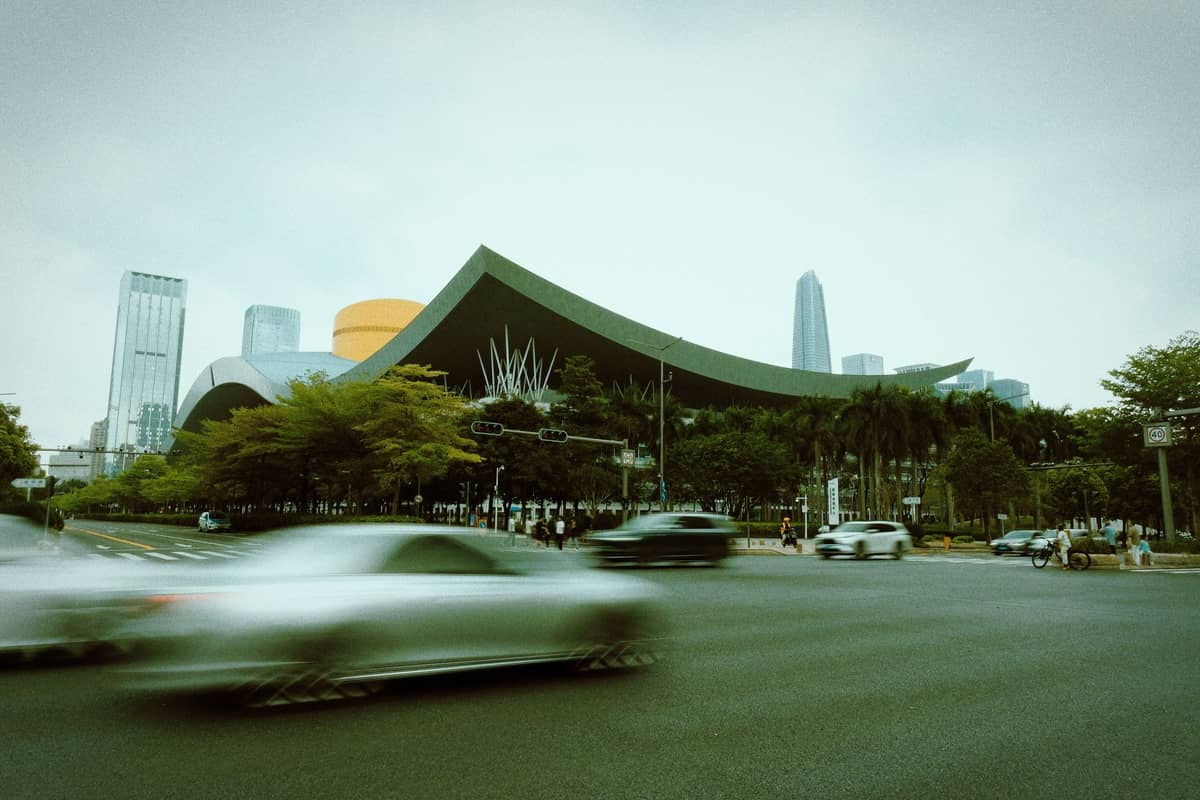
Shenzhen Civic Center (深圳市民中心) is the seat of Shenzhen's municipal government and one of the most recognizable landmarks in the entire Pearl River Delta region. Opened on May 31, 2004, the building sits at the geographic and symbolic center of Futian District, the city's planned administrative core. The adjacent Civic Center Square was opened to the public in 2006 and has since become one of the largest and most-used public plazas in southern China.
Unlike older Chinese cities where government buildings are walled off from public life, Shenzhen Civic Center was designed with openness as a guiding principle. The square in front of the building flows without barriers into the surrounding park belt, connecting to Lianhuashan Park to the north and the CBD boulevard to the south. That deliberate integration of civic architecture with public green space says something meaningful about Shenzhen's self-image as a city built for the future.
💡 Local tip
The public square and exterior are free to access 24 hours a day, year-round. Government offices and interior facilities have their own access rules and are generally not open to general visitors.
The Architecture: A Bird With Spread Wings
The building was designed by the Lei + Mann architectural firm and is commonly described as resembling a giant bird spreading its wings. The roof sweeps upward at both ends above the central hall, creating a dramatic silhouette that reads well from a distance, particularly from the elevated viewing point at the top of Lianhuashan Park to the north. That view, with the Civic Center in the mid-ground and the CBD towers behind it, is one of the most photographed urban panoramas in Shenzhen.
Up close, the building impresses through scale more than fine detail. The main facade is composed of glass curtain walls and pale stone cladding, with covered walkways along the lower levels. The sheer length of the structure means that walking across its full frontage takes several minutes. The proportions feel deliberately monumental, which is fitting for a building that was meant to signal that Shenzhen had arrived as a mature city and not just an industrial export zone.
For travelers who want to understand how Shenzhen thinks about urban space and civic identity, pairing a visit here with the nearbyShenzhen Stock Exchangebuilding in the CBD gives a richer picture. The Stock Exchange, designed by Rem Koolhaas, represents a later and more experimental phase of Shenzhen's architectural ambitions. Together the two buildings illustrate two decades of the city's evolving design language.
The Square: How It Feels at Different Times of Day
Early morning is the most local hour here. By 7am, the square is occupied by retirees doing tai chi, groups running synchronized fan dances, and individuals practicing calligraphy on the stone paving using large brushes dipped in water. The characters fade within minutes in the dry air, creating a quiet and repetitive ritual that plays out across the stone entirely without an audience. It is one of those small, unhurried scenes that feels rooted in the place.
By midday, the square empties noticeably. The hard paving radiates heat in summer, and without much shade at the center, it becomes uncomfortable to linger. If you are visiting between June and September, treat midday as a transit moment rather than a time to explore. Bring water, wear a hat, and keep your time outside brief.
Evening is when the square transforms most dramatically. After 6:30pm, families arrive with children on scooters, couples walk the perimeter, and the building itself is lit from below with shifting colored lights that make the roofline glow against the night sky. On weekends and public holidays, outdoor performances and community events are occasionally staged at the square's main platform. The atmosphere is relaxed rather than spectacular, but the scale and the light make for genuinely good photography.
ℹ️ Good to know
For photography, the golden hour before sunset produces the best light on the building's western facade. Night shots work well from the southern end of the square looking north, with the building lit and the CBD towers visible on either side.
Cultural and Historical Context
Shenzhen was designated a Special Economic Zone in 1980, and for its first two decades it was defined primarily by factories, dormitories, and rapid population growth rather than civic monuments. The construction of the Civic Center in the early 2000s represented a deliberate shift: the city was building institutions that communicated permanence and governance, not just economic output. The Civic Center is part of a broader Futian civic axis that includes the Shenzhen Concert Hall and the Shenzhen Library, all arranged along a north-south green corridor.
That corridor connects directly toLianhuashan Parkat its northern end, where a prominent statue of Deng Xiaoping overlooks the city skyline from the hilltop. The pairing of the Civic Center below and the Deng Xiaoping statue above is not accidental. It frames Futian as a place where the political origins of Shenzhen's transformation are acknowledged alongside its contemporary institutional life.
Travelers interested in the broader sweep of Shenzhen's development should also consider visitingShenzhen Museum, which is located nearby in Futian and provides detailed historical exhibits on the city's evolution from fishing village to metropolitan center.
Getting There and Getting Around
The most straightforward way to arrive is via Civic Center Station (市民中心站) on Shenzhen Metro Lines 2 and 4. The station exits open directly toward the square's southern approach, so there is no navigation required. The metro system in Shenzhen is clean, frequent, and well-signed in English, making it a reliable option for most visitors.
If you are combining the Civic Center with a broader Futian itinerary, it fits naturally with a walk north through Lianhuashan Park and then back south into the CBD. Allow two to three hours for that loop. For more on how to structure time in Shenzhen efficiently, the2-day Shenzhen itineraryincludes the Civic Center as part of a Futian half-day route.
The square and exterior pathways are flat and wide, making them accessible for visitors using wheelchairs or strollers. The main challenge in summer is heat exposure on the open paving, which has limited shaded areas. Covered walkways along the building's lower levels provide some relief.
⚠️ What to skip
Government office areas within the Civic Center building are not open to general visitors. If you are visiting for official business, check requirements in advance. Security staff are present at building entrances.
Who Will Get the Most From This Visit
The Shenzhen Civic Center is worth visiting if you have any interest in urban planning, modern Chinese architecture, or the broader story of how Shenzhen was constructed as a deliberate city. As a free, open-access site that takes under an hour to explore properly, the entry cost in time and money is low. It also serves as a practical hub connecting several worthwhile nearby attractions.
That said, visitors expecting a historical monument, an interactive cultural experience, or something visually immersive will likely feel underwhelmed. The Civic Center is a government building and a public plaza, not a museum or a park. There are no exhibits, no guided tours for general visitors, and no particular reason to linger beyond absorbing the space and the architecture. Travelers on a tight schedule who are not drawn to modernist civic design should probably prioritizeLianhuashan Parkor theShenzhen Museumover a dedicated stop at the Civic Center itself.
For a wider view of what Shenzhen's Futian district offers, theFutian neighborhood guidecovers the district's full range of attractions, dining, and transit connections.
Insider Tips
- Walk the full perimeter of the square rather than just the central axis. The eastern and western flanks have better shade, quieter seating areas, and closer views of the building's wing structures.
- The rooftop viewing terrace of Lianhuashan Park, about 800 meters north of the Civic Center, gives the best elevated view of the building within the skyline. Go there first if photography is a priority.
- On National Day (October 1st) and other major public holidays, the square hosts large-scale public gatherings and is significantly more crowded than usual. It can be impressive spectacle or an obstacle to movement depending on your preference.
- The Shenzhen Concert Hall and Shenzhen Library are immediately adjacent to the Civic Center and share the same green corridor. Both are architecturally interesting and free to enter during their open hours, making the whole zone a worthwhile architectural circuit.
- Bring a portable charger and comfortable shoes. The square is large, the nearest cafes are a few minutes' walk away, and if you combine this stop with Lianhuashan Park you will cover more distance than expected.
Who Is Shenzhen Civic Center For?
- Architecture and urban design enthusiasts who want to understand Shenzhen's planned city model
- Evening walkers looking for a well-lit, safe, and atmospheric public space
- Photographers aiming for skyline shots and architectural geometry
- Visitors combining multiple Futian sights in a single half-day
- Travelers interested in modern Chinese civic planning and governance symbolism
Nearby Attractions
Other things to see while in Futian:
- Lianhuashan Park
Lianhuashan Park sits at the geographic and symbolic center of Futian, Shenzhen's administrative core. Free to enter and open from early morning to late evening, it draws everyone from tai chi practitioners at dawn to families flying kites on weekend afternoons, all beneath a hilltop view of one of China's most recognizable modern skylines.
- Ping An Finance Centre
The Ping An Finance Centre is Shenzhen's tallest tower and one of the tallest buildings on Earth, rising 599.1 metres across 115 floors in the Futian district. Its Free Sky observation deck offers a panoramic sweep of the Pearl River Delta on clear days. Here is everything you need to decide if the climb is worth it.
- Shenzhen Museum of Contemporary Art and Urban Planning (MoCAUP)
The Shenzhen Museum of Contemporary Art and Urban Planning (MoCAUP) occupies one of the most architecturally distinctive buildings in Futian, combining a contemporary art museum with a detailed urban planning exhibition under a single free-entry roof. It is one of the few places in the city where Shenzhen's rapid transformation is presented as both data and art.
- Shenzhen Museum
Shenzhen Museum, located at the Civic Center in Futian District, is one of the city's main public museums covering ancient history, folk culture, and modern urban development. Admission is free, the permanent collections are substantial, and it offers a grounding in Shenzhen's past that no theme park or shopping district can provide.