Dongmen Pedestrian Street: Shenzhen's Oldest Shopping District
Stretching across 176,000 square metres in Luohu District, Dongmen Pedestrian Street is Shenzhen's oldest commercial area, tracing its roots to the mid-Ming Dynasty. Free to enter and open daily, it layers street food stalls, fashion markets, and local snack culture on top of centuries of trading history.
Quick Facts
- Location
- Cross of Renmin Road North and Jiefang Road, Luohu District, Shenzhen
- Getting There
- Laojie Station, Metro Line 1 or Line 3 (Exit A or E)
- Time Needed
- 2 to 4 hours depending on shopping appetite
- Cost
- Free entry; budget CNY 100–500 for shopping and food
- Best for
- Budget shoppers, street food lovers, local culture seekers
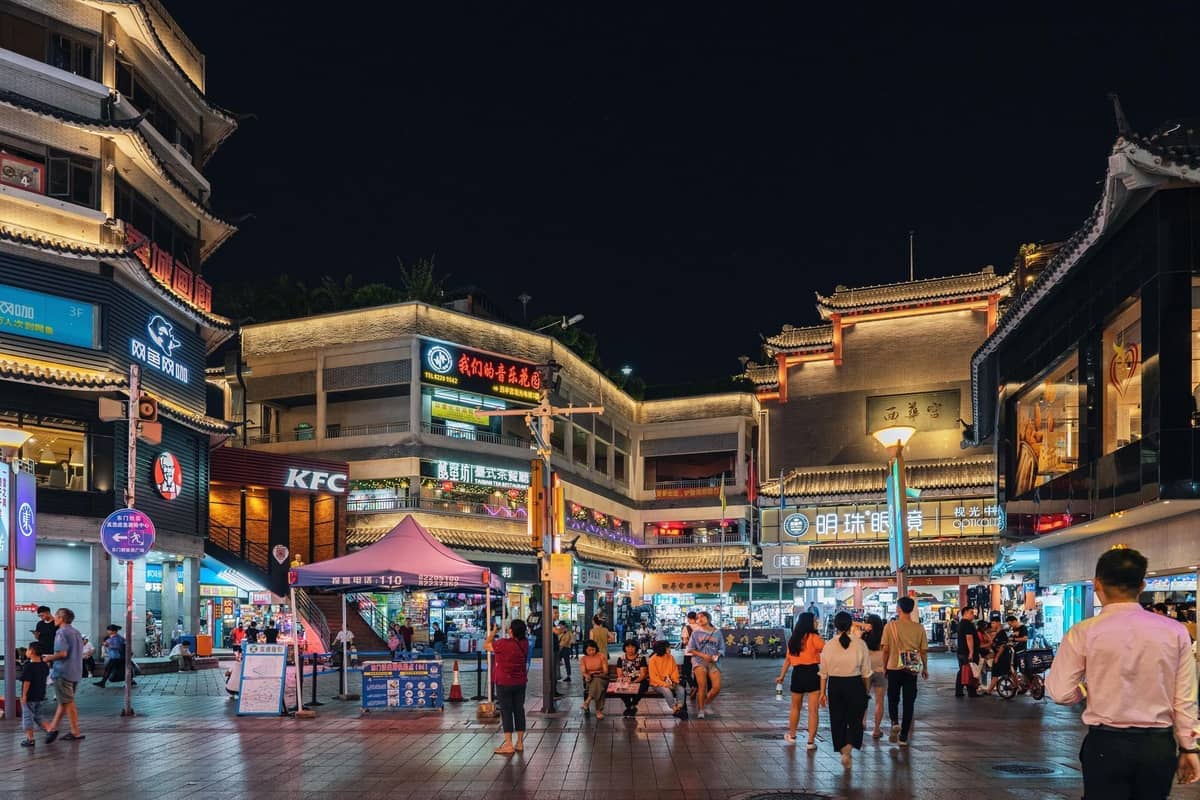
What Dongmen Actually Is
Dongmen Pedestrian Street, officially known in Chinese as 东门步行街 (Dōngmén Bùxíngjiē), is the commercial and cultural heart of Luohu District and the oldest continuously active trading area in Shenzhen. While the rest of the city was built largely from scratch after 1980, Dongmen's commercial roots trace back to the mid-Ming Dynasty, over 300 years ago. The street was already a market hub when Shenzhen was still a small border town.
The pedestrian zone covers approximately 176,000 square metres, making it one of the largest car-free shopping districts in southern China. It isn't a single street but a network of linked pedestrian corridors, plazas, and covered arcades spreading out from the central axis. The sheer density of shops, snack vendors, and foot traffic is what defines the experience here, more than any single landmark or building.
ℹ️ Good to know
The street itself is technically accessible around the clock, but most shops open around 10:00 and close by 22:00. Food stalls and some street vendors run later into the evening.
How the Experience Changes Through the Day
Mornings at Dongmen are comparatively quiet. Before 10:30, the area takes on a different character: delivery workers unload goods, shopkeepers roll up metal shutters, and the few visitors who arrive early can actually see the bones of the place, older tile-work, faded shopfront characters, and the mid-century arcade architecture that survives between newer retail blocks. This is the best time to photograph the streetscape without crowds filling every frame.
By noon, the energy shifts completely. Workers from nearby office buildings filter in for lunch, and the food lanes around the central plaza fill with the smell of stinky tofu, grilled skewers, and hand-pulled noodles. The sound level rises noticeably, with recorded music from competing storefronts overlapping, and the narrow alleys between clothing stalls get tight with foot traffic.
Evenings from around 19:00 to 21:00 represent the peak of the Dongmen experience. Neon signs brighten, young shoppers dominate the lanes, and the food vendors pull out their largest crowds. The ambient noise at peak evening hours is substantial; if sensory overload is a concern, a morning visit is a more comfortable choice.
💡 Local tip
Weekday afternoons are the sweet spot for shopping: shops are fully open, crowds are lighter than weekends, and vendors are more relaxed about browsing and bargaining.
What You'll Find There: Shopping and Food
The dominant draw is affordable fashion. Dongmen is packed with multi-storey malls and standalone street stalls selling clothing, shoes, accessories, and cosmetics at prices well below what you'd pay in Shenzhen's newer commercial districts. The stock skews toward youth fashion, with a heavy influence from Korean and Japanese streetwear trends alongside Chinese domestic brands. Quality varies significantly from stall to stall, so checking seams and fabric before purchasing is worth the thirty seconds it takes.
If electronics are on your list, Dongmen is not the right destination for that. Head instead to theHuaqiangbei Electronics Marketin Futian, which handles tech goods at a completely different scale.
Food is taken seriously here. Beyond the familiar chain restaurants anchoring the malls, the street-level snack culture is genuinely local: roasted oysters with garlic sauce, sugar-coated hawthorn skewers, Cantonese-style rice rolls, and large cups of fresh fruit juice from vendors who will fill them on the spot. The variety reflects Shenzhen's mixed population, with influences from across Guangdong province and beyond.
One section of Dongmen preserves older-style arcade shophouses with narrow frontages and deep interiors. These tend to carry more unusual goods: traditional Chinese herbal products, custom chops (name seals), and fabric by the metre. They are easy to miss if you stay on the main pedestrian artery, but worth a short detour.
Historical and Cultural Context
The name Dongmen means 'East Gate', a reference to its position relative to the old Shenzhen Xu town settlement. The area functioned as a local market centre through the Qing Dynasty and into the Republican era. When Shenzhen was designated a Special Economic Zone in 1980 and began its rapid expansion, Dongmen became one of the first areas to see a surge in commercial activity, essentially functioning as the city's main shopping district through the 1990s.
Today, Dongmen sits withinLuohu District, the older commercial core of the city that borders Hong Kong. The district retains a grittier, less polished quality than Futian or Nanshan, which some visitors find refreshing and others find off-putting. Dongmen itself has been partially modernised with new paving, public art installations, and updated mall facades, but the underlying character of a working-class trading district persists beneath the upgrades.
For historical Shenzhen context at a deeper level, the nearby Shenzhen Museum in Futian covers the city's development from prehistoric settlement through the SEZ era, which makes for a useful companion visit if you want to place Dongmen's age in perspective.
Getting There and Navigating the Area
Dongmen is one of the most straightforward attractions in Shenzhen to reach by metro. TakeShenzhen MetroLine 1 (Luobao Line) or Line 3 (Longgang Line) to Laojie Station. Both lines serve this station. Exit A or Exit E will place you on the edge of the pedestrian zone within a two-minute walk.
Once inside the zone, navigation is intuitive because the area is pedestrian-only. The main axis runs roughly north-south, with side lanes and covered arcades branching off it. Signage is primarily in Chinese, but the layout is compact enough that getting lost is more of a feature than a problem. Allocate at least two hours for a thorough pass through the main area, and up to four hours if you plan to stop for a meal and explore the side alleys.
⚠️ What to skip
Dongmen gets packed on weekends and public holidays, particularly during the Chinese New Year shopping period. If you are visiting during a national holiday, expect very heavy foot traffic throughout the day and evening.
Photography and Practical Notes
Dongmen offers strong material for street photography, particularly in the morning before crowds build. The mix of older shophouse facades, neon signage, and food vendor setups creates a visually layered environment. Wide-angle lenses suit the cramped alley sections well; a standard 35mm or 50mm equivalent works for food and portrait shots at vendor stalls. Vendors generally don't object to being photographed while working, but a nod of acknowledgement before shooting goes a long way.
Payment at most stalls and even mid-range shops is handled almost exclusively through WeChat Pay or Alipay. Foreign visitors should set up at least one of these payment apps before arrival, as cash acceptance has become inconsistent even at small vendors. Major mall-format stores within Dongmen are more likely to accept cards, but do not rely on this outside of those branded retail environments.
Dongmen is a useful base for exploring the broader Luohu area. TheLuohu Commercial Citymall, known for tailored clothing and goods at the border crossing, is a short distance away. Combining both in a single Luohu day itinerary works well.
Accessibility: the pedestrian street itself has flat, even paving along the main corridors, and the metro station has lift access. However, some of the older side alleys and market buildings have uneven surfaces and narrow entrances that would be difficult for wheelchair users. The central shopping areas are reasonably manageable, but the more characterful back lanes are not.
Who Should Consider Skipping It
Dongmen is not a polished tourist attraction and makes no effort to be one. Visitors expecting the curated retail environment of a modern shopping mall, or the heritage atmosphere of a preserved historic district, are likely to find it neither one thing nor the other. The historical significance is real, but it is not presented in any interpretive way; there are no English-language plaques, no guided routes, and no museum component.
Travellers with only a day or two in Shenzhen who want to see the city's defining modern face may find their time better spent in other districts. For a more focused picture of Shenzhen's development story, theShenzhen tech tourcircuit through Nanshan and Futian is more representative of what sets the city apart from other Chinese cities. Dongmen's strength is specifically local texture, not Shenzhen's headline identity.
Insider Tips
- Arrive before 10:30 on a weekday to see the street at its calmest and photograph the older shophouse architecture without crowds. By 11:30 the volume of foot traffic changes the character entirely.
- Set up WeChat Pay or Alipay before visiting. Many small vendors no longer keep change for cash transactions, and trying to pay with a card at a street stall is not realistic.
- The side alleys running parallel to the main pedestrian artery contain the most interesting older-style shops, including fabric merchants, traditional snack makers, and custom seal carvers. These are easy to miss if you stay on the central corridor.
- If you are bargaining at clothing stalls, starting at roughly 50 to 60 percent of the first asking price is a reasonable opening position. Vendors expect negotiation and the opening price reflects this.
- Combine Dongmen with Luohu Commercial City in the same visit to cover two very different shopping experiences in a single Luohu afternoon. Both are walkable from Laojie Station.
Who Is Dongmen Pedestrian Street For?
- Budget-conscious shoppers hunting for affordable fashion and accessories
- Food explorers interested in Cantonese and pan-Chinese street snacks
- Travellers curious about Shenzhen's pre-SEZ commercial history
- Photographers looking for layered, unposed urban street scenes
- Visitors who want a local neighbourhood experience rather than a tourist circuit
Nearby Attractions
Other things to see while in Luohu:
- Dafen Oil Painting Village
Dafen Oil Painting Village (大芬油画村) is a compact art district in Shenzhen's Longgang District where hundreds of studios produce oil paintings at every scale and price point. Founded in 1989, it grew into one of the world's largest commercial painting centers. Entry is free, the atmosphere is unlike anywhere else in China, and the experience raises genuine questions about art, labor, and value.
- Luohu Commercial City
Luohu Commercial City (罗湖商业城) is a five-story shopping complex directly above Shenzhen's Luohu border crossing, packed with hundreds of vendors selling clothing, accessories, tailored goods, electronics, and more. It's the most convenient shopping destination for day-trippers from Hong Kong, though it demands patience, a tolerance for persistent sales tactics, and solid bargaining skills.
- Fairy Lake Botanical Garden
Spread across 588 hectares in Liantang, Luohu District, Fairy Lake Botanical Garden is one of the largest botanical gardens in southern China.
- Wutong Mountain
At 943.7 meters, Wutong Mountain (梧桐山) is the tallest peak in Shenzhen and one of the few places in the city where the urban grid genuinely disappears. A free, well-maintained scenic area spanning Luohu, Yantian, and Longgang districts, it rewards hikers with dense forest cover, cool air, and panoramic views that stretch toward Hong Kong on clear days.