Wutong Mountain: Hiking Shenzhen's Highest Peak
At 943.7 meters, Wutong Mountain (梧桐山) is the tallest peak in Shenzhen and one of the few places in the city where the urban grid genuinely disappears. A free, well-maintained scenic area spanning Luohu, Yantian, and Longgang districts, it rewards hikers with dense forest cover, cool air, and panoramic views that stretch toward Hong Kong on clear days.
Quick Facts
- Location
- 2076 Luosha Road, Luohu District, Shenzhen
- Getting There
- Bus 211 to Wutongshan Community
- Time Needed
- 4 to 6 hours for a full summit hike; 2 hours for lower trails
- Cost
- Free admission
- Best for
- Hikers, nature seekers, early risers, photographers
What Wutong Mountain Actually Is
Wutong Mountain Scenic Area, known officially as both Wutong Mountain National Forest Park and by its Chinese name 梧桐山, is Shenzhen's highest natural point at 943.7 meters above sea level. That elevation might sound modest by mountain standards, but consider where it sits: inside one of the world's most densely developed megacities, accessible by public bus, and free to enter. The scenic area straddles three districts, with the main entrance used by most visitors falling within Luohu.
The park is not a manicured tourist attraction with souvenir stalls and audio guides. It is a working forest park with marked hiking trails, seasonal wildflowers, bird populations that attract serious ornithologists, and a summit that requires genuine physical effort to reach. That combination is relatively rare within a Chinese city of this size, which explains why locals treat it as a genuine escape rather than a weekend photo stop.
ℹ️ Good to know
Opening hours: The official Shenzhen government page lists 6:00–19:00.
The Hike: What to Expect on the Trail
Most visitors enter via the Luohu-side trailhead near the Wutongshan Community stop on Bus 211. From the gate, a paved path leads into the lower forest before splitting into several route options. The main summit trail involves sustained climbing across stone steps and natural rock paths. The gradient is moderate for most of the ascent but steepens noticeably in the upper section. Fit hikers in good conditions typically reach the summit in around two to three hours from the main entrance.
The trail surface alternates between concrete steps, granite slabs, and compacted earth. Sections near the top can be slippery when wet, which is a real consideration given Shenzhen's humid subtropical climate and its rainy season running roughly from late spring through summer. Footwear with grip is more than a precaution here.
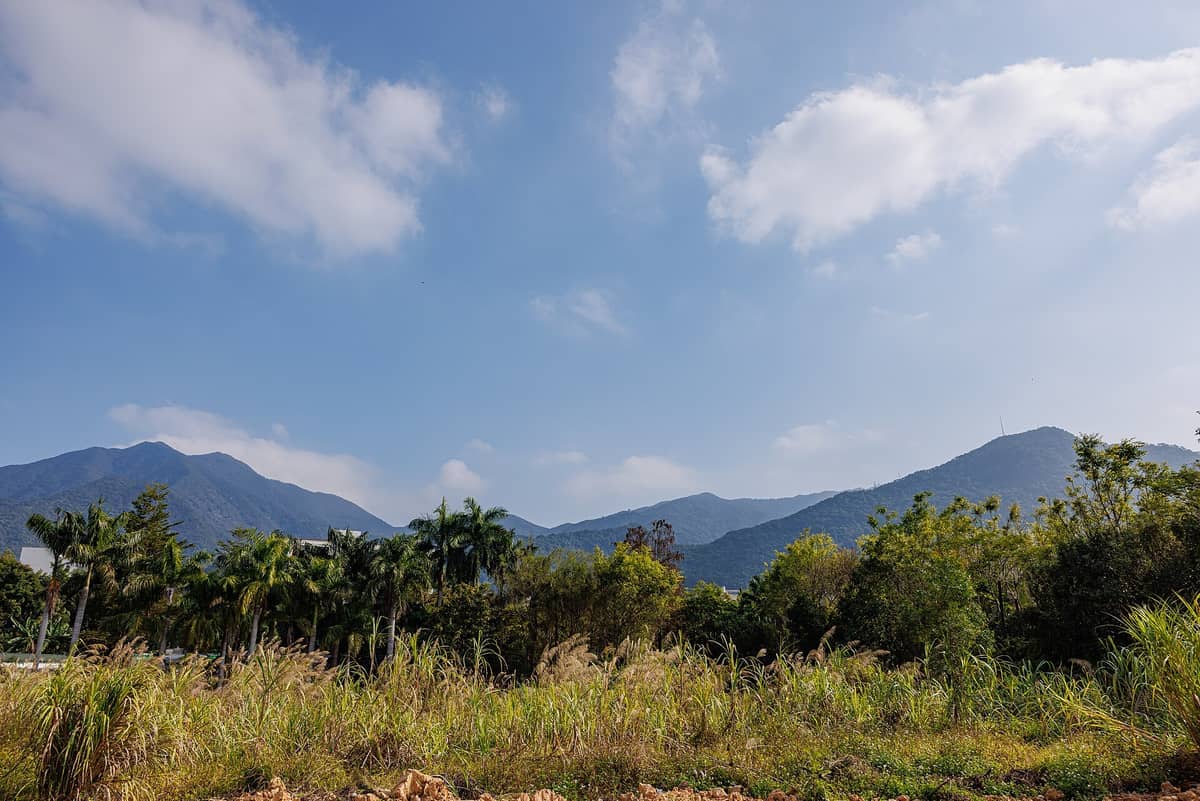
At the summit on a clear day, the views extend south toward the hills of Hong Kong's New Territories. The skyline of Shenzhen's urban core is visible to the west, framed by the forest canopy below. On misty mornings, the landscape is more atmospheric than panoramic. The summit area itself is open and exposed, with a significant temperature drop compared to the city below, sometimes several degrees cooler.
⚠️ What to skip
Typhoon season runs from May through November, with peak activity in July to September. The scenic area may close or restrict access during typhoon warnings. Check local weather forecasts and official park notices before hiking in these months.
How the Mountain Changes Through the Day
The lower trails near the entrance are busiest on weekend mornings, typically drawing local residents who start early and aim to complete the ascent before the midday heat sets in. By 7:00 on a Saturday, steady foot traffic is already moving up the main path. Weekday mornings are noticeably quieter, with the forest largely returning to birdsong and the rustle of undergrowth.
Midday in summer is the one time to avoid. Shenzhen's summer temperatures are high, the humidity is high, and the exposed upper sections of the trail offer no shade. The combination makes midday ascents uncomfortable and, in the peak of summer, potentially unsafe for anyone not acclimatized. Arrive early, or visit in the cooler months between October and December when conditions are considerably more forgiving.
Late afternoon brings a different quality of light through the canopy. The forest smells of damp earth and leaf litter, and the trail cools noticeably as the sun drops. Some hikers time their descent to catch sunset views from the upper trail, though this requires careful planning to ensure you are off the upper mountain before darkness, especially given the 19:00 official closing time.
Ecology and Natural Character
The forest on Wutong Mountain is subtropical broadleaf woodland, dense enough that the city noise fades within the first twenty minutes of walking. The mountain gives its name to the Chinese parasol tree (梧桐, wutong), though the vegetation on the slopes is a mix of native subtropical species. During spring, wild azaleas bloom on the upper slopes, adding patches of color to the otherwise green-dominant landscape.
The park sits within an ecologically sensitive zone. Birdwatchers have recorded a significant number of resident and migratory species here, making it one of the more productive birding sites in the Pearl River Delta region. Mornings in the lower forest, away from the main trail, are the most rewarding time for observation. The combination of varied habitat types, including stream valleys, dense canopy, and open rocky summit, supports more ecological diversity than the immediate surroundings of Shenzhen would suggest.
For broader context on Shenzhen's green spaces and how Wutong Mountain compares to other parks in the city, theShenzhen parks guideprovides a useful framework.
Getting There and Practical Logistics
The official transit guidance directs visitors to take Bus 211 to Wutongshan Community. The main entrance address is 2076 Luosha Road, Luohu District. Luohu is one of Shenzhen's older central districts, well served by the Shenzhen Metro, and most visitors coming from central Shenzhen or from the Hong Kong border crossing at Luohu will find this the most convenient approach.
If you are entering Shenzhen from Hong Kong and heading directly to the mountain, theHong Kong to Shenzhen crossing guidecovers the border options and transit connections in detail.
Ride-hailing via Didi is an alternative for those who prefer a direct journey from their accommodation, particularly useful for early morning starts when bus frequency may be lower. The drop-off point at the main entrance is straightforward to specify.
💡 Local tip
Bring at least 1.5 liters of water per person for a summit attempt. There are no reliable water refill points on the trail. Tap water in Chinese cities is not recommended for drinking without boiling or filtration, so carry commercial bottled water from your accommodation or a convenience store before you enter the park.
Accessibility at Wutong Mountain is limited by the nature of the terrain. No official accessibility statement has been confirmed, and the combination of steep gradients, uneven stone steps, and natural rock surfaces makes the main summit trail unsuitable for wheelchair users or visitors with significant mobility limitations. The very lowest sections of the paved path near the entrance are more manageable, but the mountain overall is not a step-free environment.
Who This Mountain Is Not For
Visitors expecting a cable car, a restaurant at the top, or any of the usual infrastructure of a commercialized scenic area will not find it here. Wutong Mountain is a forest park, and the experience is defined by walking, physical effort, and the absence of the city rather than by amenities. There is no air-conditioned rest area halfway up, and the summit is a rocky exposed point, not a viewing platform with guardrails and an admission booth.
Travelers on tight itineraries who want a quick urban highlight will find the time commitment significant. A proper summit hike takes the better part of a half-day. If your schedule allows only an hour or two in a natural setting, the lower forest trails near the entrance provide some of the atmosphere without the full physical commitment, though the payoff is proportionally lower.
For a city-scale overview of what Shenzhen offers beyond urban attractions, the guide onhiking in Shenzhenplaces Wutong Mountain in the context of other trail options across the city.
Photography on Wutong Mountain
The most photogenic sections are not at the summit. The lower and mid-trail forest, where light filters through the canopy in the early morning, offers the kind of layered woodland shots that require no special equipment. The trail itself, with its stone steps disappearing into the green, works well in overcast light. At the summit, clear mornings produce the best long-range views; the post-rain clearing is particularly worth timing, when visibility extends sharply and the light has a clean quality.
Smartphone cameras handle the trail well. A zoom lens helps at the summit for compressing the distance to Hong Kong's hillsides. If you carry a tripod, sunrise on the upper trail is the reward for an early start, but confirm park access times before attempting a pre-dawn arrival.
Insider Tips
- Start no later than 7:30 on summer weekdays to complete the summit before the heat peaks. The trail is significantly more pleasant in the first two hours after dawn.
- The Luohu entrance is the most commonly used, but the scenic area spans into Yantian and Longgang districts. If you have a vehicle or are willing to research bus routes, alternative entry points offer different trail experiences with noticeably fewer other hikers.
- Carry a light waterproof layer even on clear days. Cloud and mist move quickly over the upper mountain, and the temperature drop near the summit can be surprising after a warm climb.
- Local hikers often bring small gas stoves and cook instant noodles at the summit. It is a practical tradition worth adopting: hot food at the top after a long climb is more satisfying than it sounds.
- Autumn, roughly October to November, combines the most reliable weather with occasional morning mist that gives the lower forest a particularly atmospheric quality without the risk of typhoon disruption.
Who Is Wutong Mountain For?
- Hikers and trail walkers looking for a genuine mountain experience within a major city
- Nature and wildlife observers, particularly birdwatchers active in the Pearl River Delta region
- Early risers who want to escape the urban density of Shenzhen for a half-day
- Photographers seeking forest light and elevated city-to-countryside views
- Budget travelers, since the park is entirely free to enter
Nearby Attractions
Other things to see while in Luohu:
- Dafen Oil Painting Village
Dafen Oil Painting Village (大芬油画村) is a compact art district in Shenzhen's Longgang District where hundreds of studios produce oil paintings at every scale and price point. Founded in 1989, it grew into one of the world's largest commercial painting centers. Entry is free, the atmosphere is unlike anywhere else in China, and the experience raises genuine questions about art, labor, and value.
- Dongmen Pedestrian Street
Stretching across 176,000 square metres in Luohu District, Dongmen Pedestrian Street is Shenzhen's oldest commercial area, tracing its roots to the mid-Ming Dynasty. Free to enter and open daily, it layers street food stalls, fashion markets, and local snack culture on top of centuries of trading history.
- Luohu Commercial City
Luohu Commercial City (罗湖商业城) is a five-story shopping complex directly above Shenzhen's Luohu border crossing, packed with hundreds of vendors selling clothing, accessories, tailored goods, electronics, and more. It's the most convenient shopping destination for day-trippers from Hong Kong, though it demands patience, a tolerance for persistent sales tactics, and solid bargaining skills.
- Fairy Lake Botanical Garden
Spread across 588 hectares in Liantang, Luohu District, Fairy Lake Botanical Garden is one of the largest botanical gardens in southern China.