Dafen Oil Painting Village: Shenzhen's Extraordinary Art District
Dafen Oil Painting Village (大芬油画村) is a compact art district in Shenzhen's Longgang District where hundreds of studios produce oil paintings at every scale and price point. Founded in 1989, it grew into one of the world's largest commercial painting centers. Entry is free, the atmosphere is unlike anywhere else in China, and the experience raises genuine questions about art, labor, and value.
Quick Facts
- Location
- Dafen Community, Buji Subdistrict, Longgang District, Shenzhen
- Getting There
- Dafen Station (大芬站), Metro Line 3, Exit A1 — approx. 500m walk southwest
- Time Needed
- 2–3 hours for a comfortable visit; half a day if you browse seriously or commission a piece
- Cost
- Free entry; paintings range from a few dozen yuan to several thousand
- Best for
- Art enthusiasts, collectors on a budget, curious travelers, photographers
What Dafen Oil Painting Village Actually Is
Dafen Oil Painting Village is not a museum and not a theme park. It is a working commercial art district covering roughly 0.4 square kilometers, where more than 1,200 studios and galleries operate side by side along narrow lanes and open courtyards. The majority of output is oil painting reproductions: Van Gogh sunflowers, Monet water lilies, Da Vinci portraits, and Klimt gold-leafed compositions, produced in staggering volume by painters who work with practiced, almost mechanical fluency. But that description only tells half the story. Original works, portraiture commissions, and genuinely experimental canvases exist here too, if you know where to look.
The village began in 1989 when a Hong Kong art entrepreneur leased space in what was then a quiet Hakka settlement on Shenzhen's eastern fringe. He brought in a small group of painters and began fulfilling overseas orders for affordable oil paintings. Word spread. Artists arrived from across Guangdong and beyond. By the 2000s, Dafen was reportedly supplying a significant share of the world's commercial oil painting market, with finished canvases shipped to hotels, interior designers, and retailers across Europe, North America, and Southeast Asia.
ℹ️ Good to know
Opening hours: 9:30–17:30, closed on Mondays (except public holidays). Entry is free. Most individual studios set their own hours, so some remain open later or on Mondays.
The Experience: Walking the Village
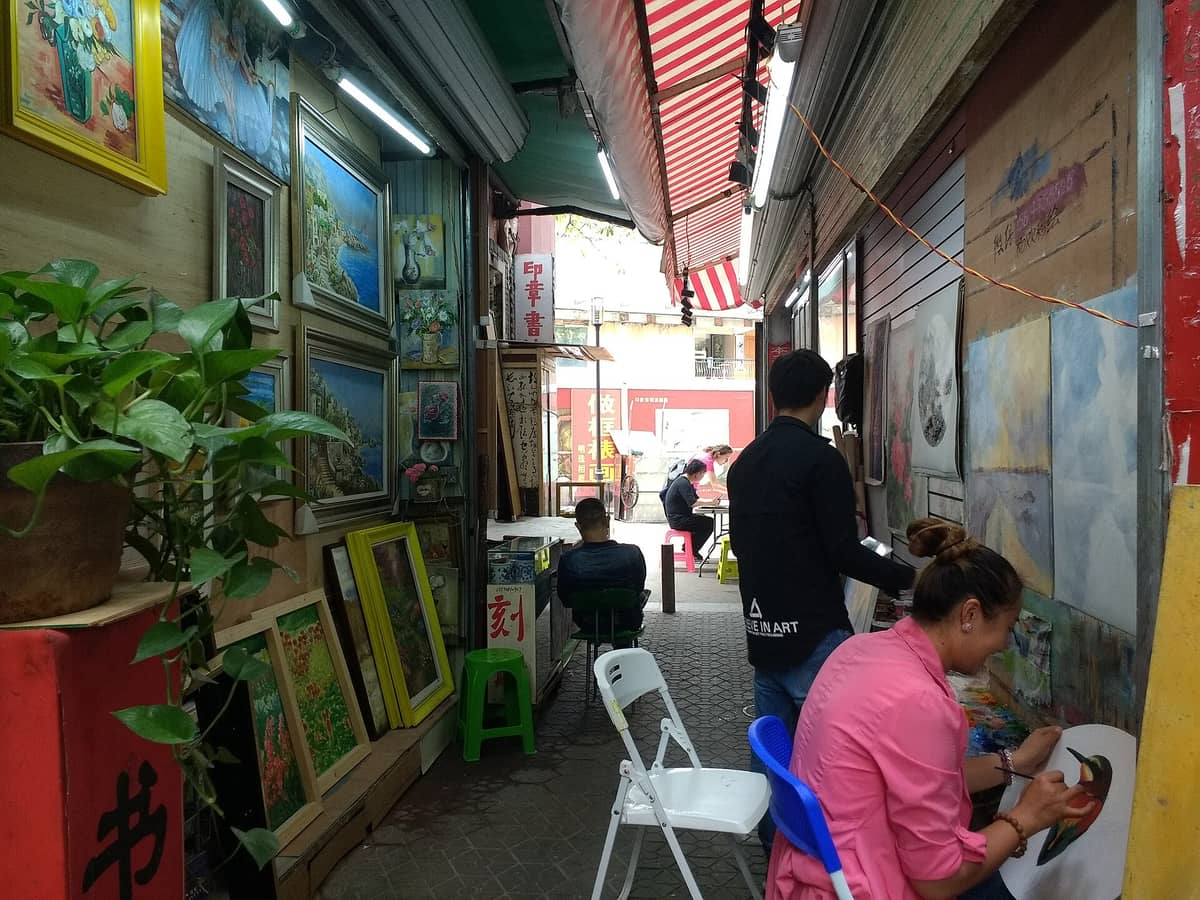
Arriving at Dafen Station on Line 3 and walking the 500 meters southwest, the transition from generic Shenzhen streetscape to art district is abrupt. A ceremonial gateway marks the main entrance, and within a few steps the smell of linseed oil and turpentine becomes noticeable. Canvases line the walls of every storefront, stacked three and four deep. Painters sit on low stools working in natural light or under bare bulbs, their brushes moving with speed that feels at odds with the romantic image of the lone artist.
The layout is loosely grid-like, with a main commercial street running through the center and smaller alleys branching off into quieter courtyards. The central street is more polished and tourist-oriented, with larger galleries, bilingual signage, and higher prices. The alleys are where the actual production happens. Walk past a doorway at the right moment and you might see a painter completing ten nearly identical versions of the same composition simultaneously, working across canvases lined up on an assembly-line rack.
Photography is generally welcomed, though it is courteous to ask before pointing a camera directly at a painter at close range. Natural light is best in the morning before midday, when the sun angle illuminates the alley walls and the colors of stacked canvases are vivid. By mid-afternoon, parts of the village fall into shadow and the atmosphere shifts slightly.
How the Village Changes by Time of Day
Arrive around 10:00 on a Tuesday through Sunday and you will find the village at its most functional. Painters are at work, shop owners are arranging displays, and delivery staff move through with trolleys of rolled or framed canvases. The commercial activity is unself-conscious at this hour, which makes it more interesting to observe. If you want to negotiate on price or discuss a commission, mornings are when gallery owners are least rushed.
Lunchtime between 12:00 and 14:00 sees a partial slowdown. Some studios close temporarily or reduce activity. The small restaurants and noodle shops tucked into the village fill up with painters and local workers. This is actually a good time to eat affordably and eavesdrop on the social fabric of the place.
Late afternoon, particularly from 15:00 onward, brings a different crowd: students from nearby schools, local families, and weekend visitors during Saturdays and Sundays. The village can feel noticeably more crowded on weekend afternoons, and gallery owners shift into a more transactional mode. If you want a quieter experience with more room to look carefully at work, a weekday morning visit is substantially better.
💡 Local tip
Best visit strategy: Arrive when it opens on a weekday morning. Spend the first hour walking the alleys before the main street, get a sense of the full range of work available, then return to negotiate or commission in the second hour.
Replicas, Originals, and the Art Market Question
Dafen's reputation rests almost entirely on its replica trade, and that reputation comes loaded with cultural baggage. Western art critics have periodically used the village as a shorthand for the commodification of art, or as evidence of something troubling about Chinese economic practice. Those arguments tend to ignore the skill involved in producing technically accomplished oil paintings at speed, and they also overlook the long tradition of copying as a legitimate training method in European academies.
The more honest observation is that Dafen contains multitudes. At one end, you have painters completing twelve copies of Van Gogh's Starry Night per week for export orders, working from photographic references with no particular artistic engagement. At the other end, there are trained artists who live and work in the village by choice, whose original compositions hang alongside replicas in gallery spaces that would not embarrass a mid-tier city in Europe. The challenge for the visitor is learning to read which studios are which.
For context on how Shenzhen's creative districts compare, theOCT Loft creative district in Nanshanoffers a more conventional contemporary art scene, while Dafen remains uniquely focused on painting production at commercial scale. Both are worth seeing if you want to understand the range of Shenzhen's creative economy.
Buying Paintings: What to Know Before You Negotiate
Prices vary enormously and are not fixed. A small replica of a famous work might start at 80–150 CNY and be brought down further with negotiation. A large, framed, high-quality reproduction of a masterwork might be priced at 1,500 CNY or more. Original works by resident artists with genuine portfolios can go much higher. The key variables are size, complexity, frame quality, and the gallery's position in the village: studios on the main tourist corridor charge more than those in the back alleys.
Commissioned portraits are a popular option. Bring a clear photograph and discuss dimensions, medium, and timeline. Many studios accept WeChat Pay for payment, and some larger galleries have experience shipping internationally, though you should confirm packaging and logistics details directly. If you are carrying a painting home as hand luggage, rolled canvases are easier than framed ones.
One practical note: bargaining is standard and expected on unframed prints and smaller works. On original works from established painters, aggressive bargaining can be seen as disrespectful. Read the room. If a gallery owner shows you a portfolio of their own work and explains their artistic background, treat the interaction accordingly.
⚠️ What to skip
Avoid buying anything that claims to be a historically significant or antique original. Dafen produces contemporary works. Any claim of genuine historical provenance should be treated with skepticism.
The Dafen Art Museum and Wider Context
The village includes a dedicated Dafen Art Museum (大芬美术馆), which showcases original works by resident artists. The building's architecture is noticeably more formal than the surrounding streets, with clean exhibition spaces and periodic shows. Opening hours align with the village schedule: 9:30–17:30, closed Mondays. Entry is free. It is not a major museum by any global standard, but it gives context to the village's official ambition to transition from pure reproduction toward original art production.
If your interest in Shenzhen art extends beyond Dafen, theShenzhen Contemporary Art Museumin Futian presents a very different institutional vision of what art in the city can be.
Getting There and Practical Notes
Dafen Station on Metro Line 3 is the correct stop. Take Exit A1 and walk approximately 500 meters southwest. The route is straightforward and signs for the village appear along the way. Line 3 runs through Luohu and connects to central Shenzhen, making the journey from Luohu Station or Futian district direct without requiring a transfer.
The village sits in Longgang District, which is geographically further from central Shenzhen than areas like Nanshan or Futian. Factor in 30–45 minutes of travel time from the city center. If you are combining the visit with other Luohu attractions, note thatDongmen Pedestrian Streetis accessible on the same Metro Line 3 corridor.
The village streets are paved and generally flat, making walking comfortable. Dedicated wheelchair accessibility information is not officially documented for the site, so visitors with mobility requirements should assess individual studio and gallery access on arrival. The main corridor is open and wide; some alleyways are narrower.
For a fuller picture of how to plan your time in Shenzhen around visits like this one, thecomplete guide to things to do in Shenzhencovers the city's major districts and how to connect them efficiently.
Who Should Skip This
Dafen is not for everyone. If the idea of watching paintings being produced at high speed for commercial export strikes you as depressing rather than fascinating, this is probably not a meaningful stop. The village has no major architectural drama, no singular spectacle, and no immersive experience beyond the accumulation of paint, canvas, and human skill. Visitors expecting a conventional art gallery experience or a carefully curated cultural attraction will likely find it underwhelming. It rewards curiosity and patience, not passive sightseeing.
Travelers with young children may find the village less engaging than purpose-built family attractions. For family-oriented Shenzhen options,Shenzhen with kidscovers better-suited destinations across the city.
Insider Tips
- The alleys behind the main commercial street are where production-scale studios operate. Watching a painter work simultaneously across multiple canvases is more instructive about Dafen's real character than any gallery visit.
- If you want to commission a portrait, bring a high-resolution printed photograph rather than just a phone image. Painters work better from print, and the result is usually more accurate.
- WeChat Pay is widely accepted throughout the village and is the fastest payment method. Have it set up before arriving, especially for smaller purchases where owners may not want to handle cash.
- The Dafen Art Museum at the center of the village is worth a short visit, particularly if there is a temporary exhibition running. Check the entrance board when you arrive.
- Prices on the main tourist street are typically 30–50% higher than identical work in the back alleys. Do a full circuit before committing to a purchase.
Who Is Dafen Oil Painting Village For?
- Art lovers curious about the economics and labor behind commercial painting production
- Budget collectors looking for affordable oil paintings, including reproductions of Western masters
- Photographers interested in documentary street photography of artisans at work
- Travelers combining a Shenzhen visit with an interest in its economic development story
- Anyone wanting to commission a custom oil painting at a fraction of Western studio prices
Nearby Attractions
Other things to see while in Luohu:
- Dongmen Pedestrian Street
Stretching across 176,000 square metres in Luohu District, Dongmen Pedestrian Street is Shenzhen's oldest commercial area, tracing its roots to the mid-Ming Dynasty. Free to enter and open daily, it layers street food stalls, fashion markets, and local snack culture on top of centuries of trading history.
- Luohu Commercial City
Luohu Commercial City (罗湖商业城) is a five-story shopping complex directly above Shenzhen's Luohu border crossing, packed with hundreds of vendors selling clothing, accessories, tailored goods, electronics, and more. It's the most convenient shopping destination for day-trippers from Hong Kong, though it demands patience, a tolerance for persistent sales tactics, and solid bargaining skills.
- Fairy Lake Botanical Garden
Spread across 588 hectares in Liantang, Luohu District, Fairy Lake Botanical Garden is one of the largest botanical gardens in southern China.
- Wutong Mountain
At 943.7 meters, Wutong Mountain (梧桐山) is the tallest peak in Shenzhen and one of the few places in the city where the urban grid genuinely disappears. A free, well-maintained scenic area spanning Luohu, Yantian, and Longgang districts, it rewards hikers with dense forest cover, cool air, and panoramic views that stretch toward Hong Kong on clear days.