Buenos Aires Architecture Guide: Landmarks, Styles, and Walking Routes
Buenos Aires spans more than three centuries of architectural history, from the Spanish colonial Cabildo on Plaza de Mayo to the sweeping art nouveau interiors of El Ateneo Grand Splendid and the glass towers of Puerto Madero. This guide breaks down the city's key styles, neighborhoods, and buildings worth seeking out, with practical tips on timing, logistics, and what to skip.
Tickets & tours
Live prices and dates from our booking partner. If you book, we may earn a commission at no extra cost to you.
TL;DR
- Buenos Aires architecture spans colonial, neoclassical, art nouveau, art deco, Beaux-Arts, and contemporary styles, often within a single city block.
- The most concentrated architecture walking is in Microcentro and Monserrat, around Plaza de Mayo, and along Avenida de Mayo.
- Spring (September to November) and autumn (March to May) offer the most comfortable conditions for long outdoor walking routes.
- Free and low-cost entry is available at many civic landmarks; check current hours via the official Turismo Buenos Aires website before visiting, as prices and schedules change frequently. See our free things to do in Buenos Aires guide for more options.
- The city is not just Haussmann-style European blocks: colonial relics, brutalist cultural centres, and ambitious modernist towers all coexist here.
Why Buenos Aires Is an Architectural Anomaly
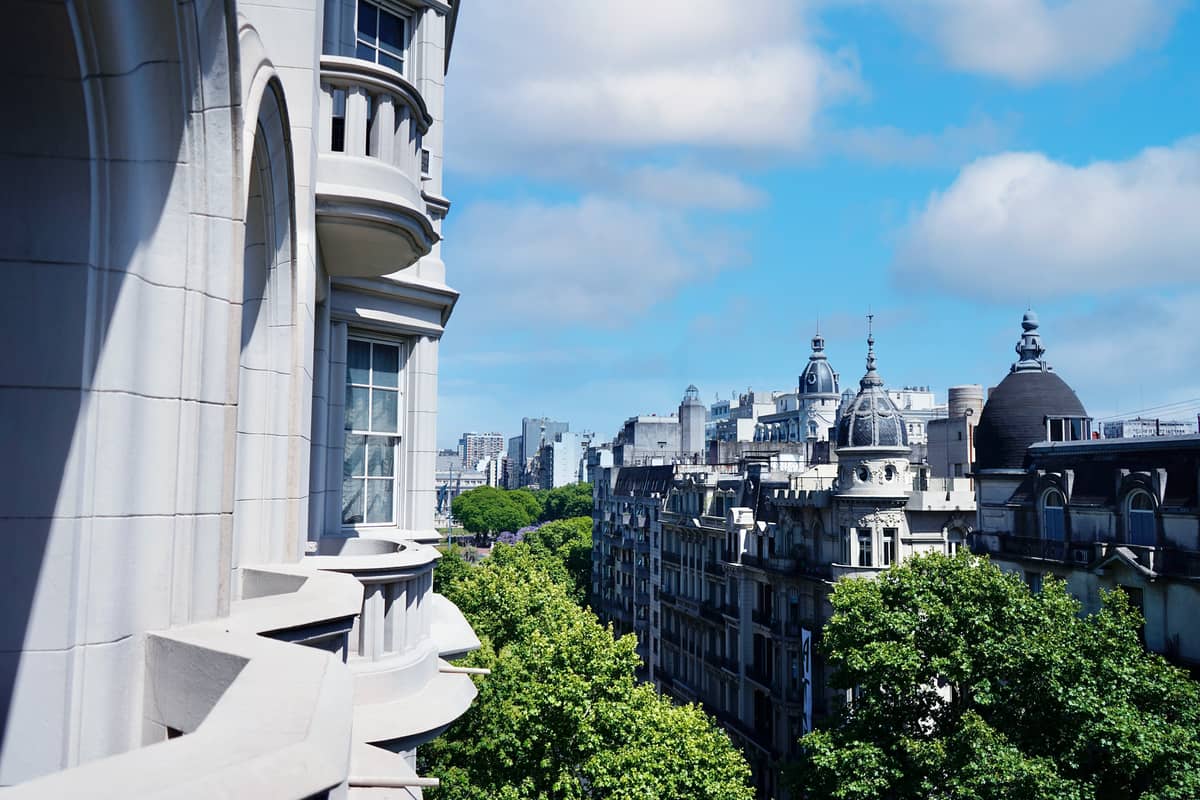
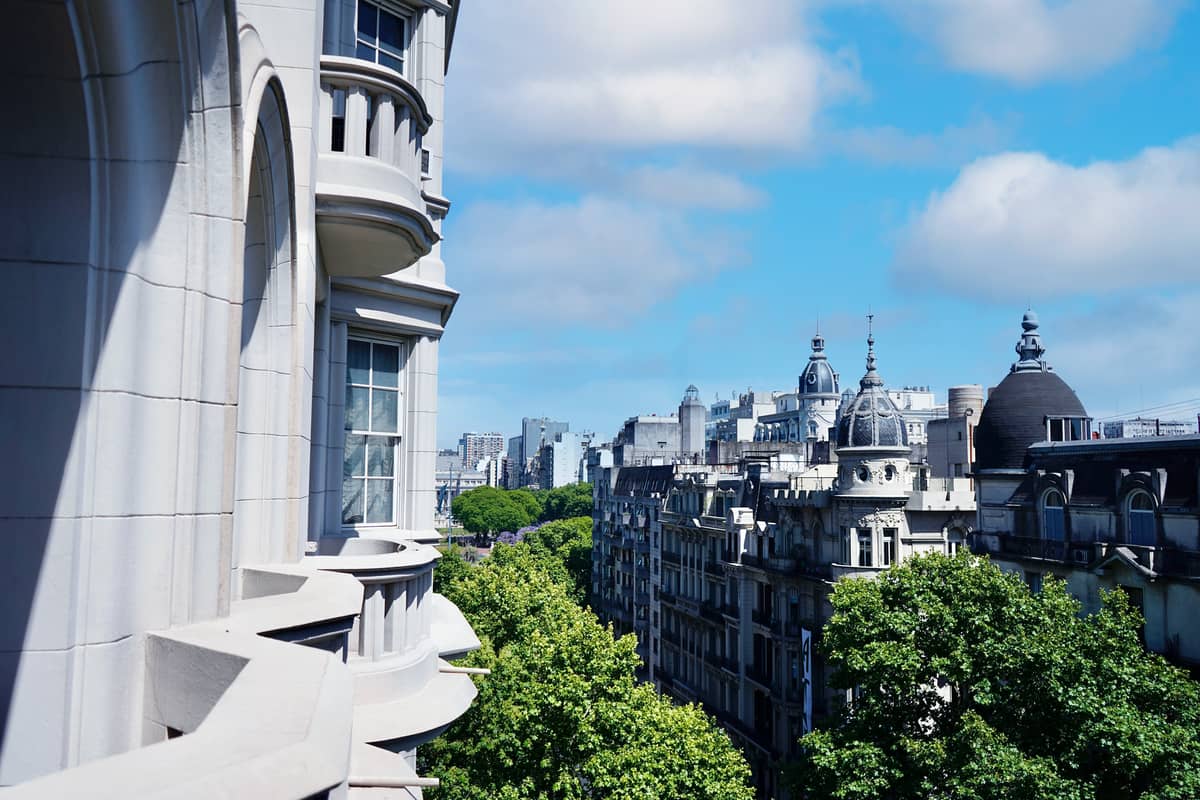
Few cities in South America pack such a density of architectural ambition into a relatively compact urban core. Buenos Aires was founded by the Spanish in 1580, rebuilt and expanded through the 18th and 19th centuries, then radically transformed by successive waves of European immigration and economic booms between roughly 1880 and 1930. That fifty-year window produced an extraordinary collection of Beaux-Arts government buildings, art nouveau apartment facades, and neo-Gothic churches, most of which are still standing and in active use today.
The result is a city that looks, in places, like Paris, Vienna, or Barcelona, but functions unmistakably as a South American capital. Ornate 19th-century facades sit directly alongside functionalist 1970s office blocks. A city block near the Casa Rosada can contain a colonial-era cloister, a neoclassical bank, and a postmodern glass tower within a few dozen metres of each other. Understanding this layered quality is essential to reading the city well.
ℹ️ Good to know
Buenos Aires is officially the Ciudad Autónoma de Buenos Aires (CABA), covering around 203 km² at near sea level on the western shore of the Río de la Plata. The city's architectural density is highest in the central barrios of Monserrat, San Nicolás, and Retiro, which developed most rapidly during the economic boom years of 1880–1930.
Architectural Styles to Know Before You Go
Recognizing the major styles makes walking the city significantly more rewarding. Buenos Aires does not follow a single dominant aesthetic — it is a city of architectural arguments between eras and economic phases.
- Spanish Colonial The oldest surviving layer, visible in the Cabildo on Plaza de Mayo and the Manzana de las Luces complex. Characterized by whitewashed walls, arcaded facades, and interior courtyards. Very little pure colonial architecture survives given the scale of 19th-century demolition.
- Neoclassical and Beaux-Arts The dominant style of the late 19th and early 20th centuries. The Congreso Nacional, the Teatro Colón, the Catedral Metropolitana, and the Palacio de Aguas Corrientes all fall broadly into this category. Hallmarks include monumental scale, symmetrical facades, columns, pediments, and elaborate stone decoration.
- Art Nouveau Concentrated in residential apartment buildings and commercial facades from around 1900–1920. The Galería Güemes on Florida Street is one of the most complete examples. Look for organic curved lines, ceramic tile details, ironwork balconies, and stained glass in building entrances.
- Art Deco Prominent from the 1920s through the 1940s. The Edificio Kavanagh (1936), at the time of its completion reportedly the tallest reinforced concrete building in South America, is the landmark example. Geometric ornamentation, stepped silhouettes, and polished stone facades are the signature elements.
- Rationalism and Modernism Mid-20th-century civic and residential building brought European modernist influences to Buenos Aires. The Biblioteca Nacional Mariano Moreno, completed in the 1990s after decades of construction, is a striking brutalist example in Recoleta.
- Contemporary Puerto Madero's redevelopment from the 1990s onward brought glass towers and signature projects including the Puente de la Mujer bridge, designed by Santiago Calatrava. The neighborhood represents the city's most deliberate break with its historic fabric.
The Core Route: Plaza de Mayo to Avenida de Mayo
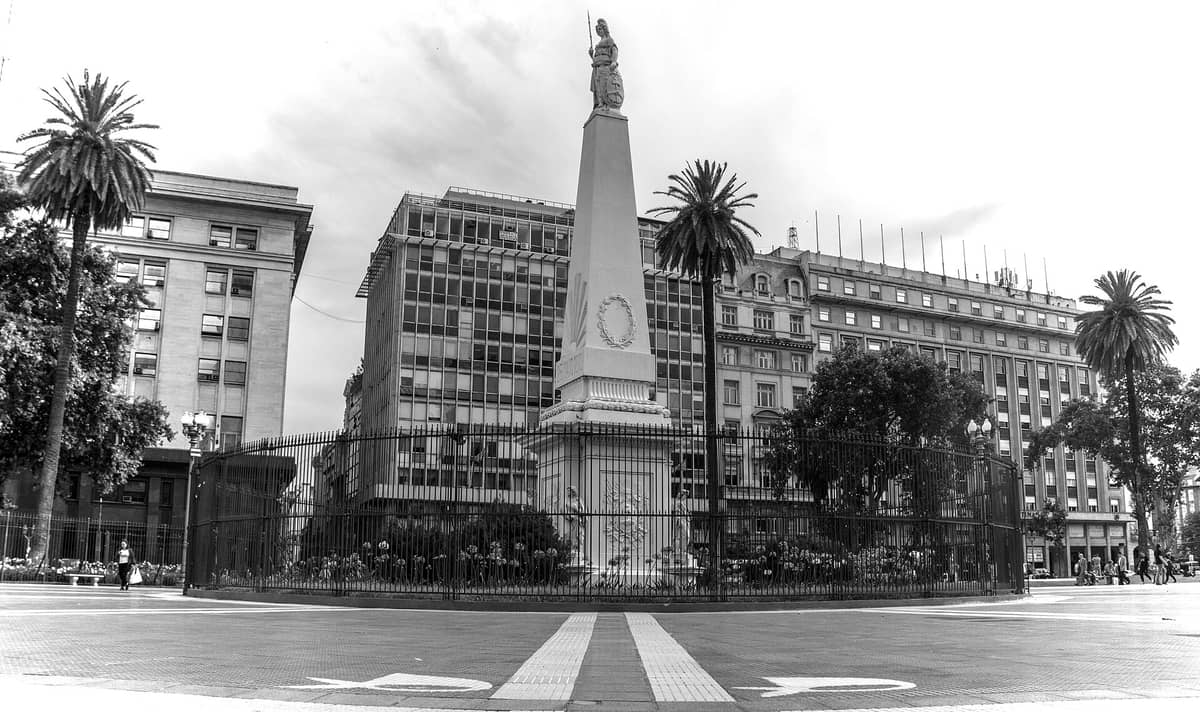
The single most architecturally rewarding walk in Buenos Aires starts at Plaza de Mayo and moves west along Avenida de Mayo toward the Congreso Nacional. This roughly 1.5-kilometre corridor contains a higher concentration of historically significant buildings than almost any other street in the city.
At the east end of the plaza sits the Casa Rosada, the presidential palace, whose distinctive pink facade dates from an 1890s redesign merging two earlier structures. The building faces the Cabildo on the western side of the plaza, a Spanish colonial building originally completed in 1764 and reconstructed multiple times since. The Cabildo is one of the few genuine colonial-era civic buildings surviving in central Buenos Aires. Admission is free; it is typically open Wednesday to Sunday and closed Monday and Tuesday. Confirm current hours before visiting.
The Catedral Metropolitana occupies the north side of Plaza de Mayo. Its neoclassical portico with twelve columns representing the apostles was added in the 1860s to a structure with far older origins; the interior contains the mausoleum of José de San Martín. Walking west from the plaza, Avenida de Mayo is lined with buildings commissioned during the late 19th-century modernization: ornate Beaux-Arts hotels, the former El Molino café (a landmark art nouveau building currently undergoing restoration), and the Palacio Barolo at number 1370, one of the city's most distinctive pre-skyscraper towers.
✨ Pro tip
The Palacio Barolo at Avenida de Mayo 1370 offers guided tours that take visitors up to the lighthouse at the top for panoramic views over central Buenos Aires. The building was completed in 1923 and its design references Dante's Divine Comedy in its floor count and proportions. Book tours in advance, especially on weekends.
The walk terminates at the Congreso Nacional, completed in 1906, whose copper dome is modelled loosely on the US Capitol. The surrounding Congreso neighborhood is worth exploring for its mix of civic grandeur and slightly faded residential streets. For a detailed route with timing, the city's Buenos Aires walking tours guide covers this corridor in depth.
Landmark Buildings Worth Seeking Out
Beyond the Plaza de Mayo axis, several individual buildings reward a detour. The Teatro Colón on Libertad Street is widely considered one of the great opera houses of the world. Completed in 1908 after two decades of construction, the Italianate exterior gives way to an interior of exceptional acoustic engineering and decorative craftsmanship. Guided tours run daily and provide access to areas not visible during performances, including the rehearsal rooms and workshops beneath the stage.
The Palacio de Aguas Corrientes on Avenida Córdoba is one of Buenos Aires's most surprising buildings: a late 19th-century water pumping station clad in roughly 130,000 decorated glazed tiles imported from England, with facades designed in a Flemish Renaissance style. It now houses a small museum. The Edificio Kavanagh near Plaza San Martín in Retiro is the definitive Buenos Aires art deco statement, its stepped concrete form rising 120 metres from a narrow street-level footprint.
For contemporary architecture, Puente de la Mujer in Puerto Madero is the most photographed single structure from the post-1990 era: a 170-metre rotating pedestrian bridge by Santiago Calatrava, completed in 2001, whose asymmetric white mast has become an emblem of the waterfront redevelopment. The Centro Cultural Kirchner, housed in a restored Beaux-Arts former post office on Avenida Corrientes, is a case study in adaptive reuse done at impressive scale.
- El Ateneo Grand Splendid A former 1919 theatre converted into a bookshop, with the original stage, boxes, and frescoed ceiling intact. On Avenida Santa Fe in Recoleta. One of the most-photographed interiors in the city, busiest on weekend afternoons.
- Galería Güemes An art nouveau commercial gallery on Florida Street in Microcentro, completed around 1915. The interior arcade is open to the public; the upper floors host a tango show venue with a separately ticketed observation gallery.
- Biblioteca Nacional Mariano Moreno A brutalist concrete structure in Recoleta completed in the 1990s, raised on pilotis above the ground. Architecturally polarizing, it sits on land that was once the residence of Juan and Eva Perón.
- Palacio Paz A private palace on Plaza San Martín built for the Paz family between 1902 and 1914, modelled in part on the Louvre and Château de Chantilly. Now home to the Círculo Militar. Guided tours are available on select days.
Architecture by Neighborhood
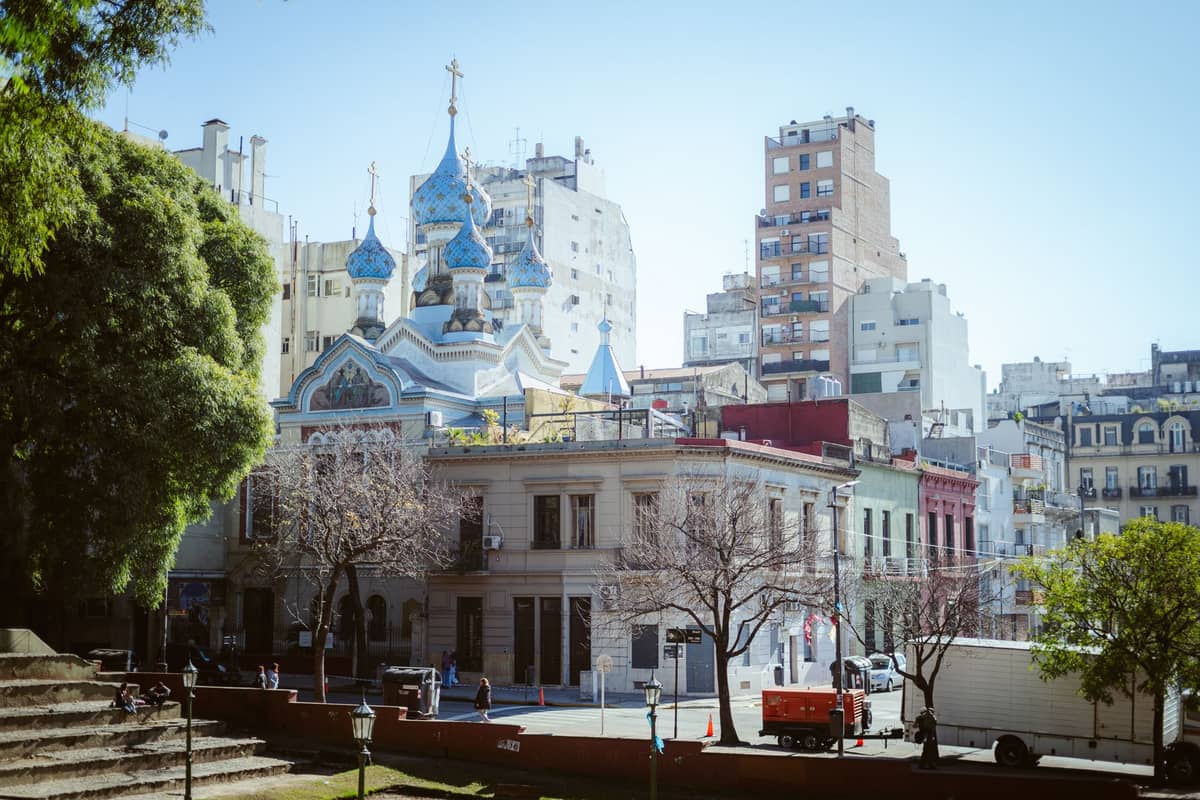
Different neighborhoods offer very different architectural experiences. San Telmo is the place to see what 19th-century residential Buenos Aires looked like before the Beaux-Arts boom: single-storey colonial-era houses, iron-railed balconies, and the remarkable Mercado de San Telmo, an 1897 iron-and-glass market hall still operating as a food and antiques market.
Recoleta is the neighborhood most associated with the Parisian model of Buenos Aires: wide tree-lined boulevards, Haussmann-scale apartment buildings with ornate stone facades, and the extraordinary Recoleta Cemetery, a walled city of mausoleums spanning every revival style from neoclassical to art deco, laid out in a grid of named streets. The cemetery is genuinely worth two hours of careful attention as an open-air museum of funerary architecture.
Puerto Madero is architecturally interesting in a different way: it shows the city's 21st-century ambitions and the tension between spectacular individual projects and a somewhat sterile urban fabric between them. The red-brick 19th-century dock buildings (the diques) have been converted into restaurants and offices, while glass towers rise behind them. It is worth an hour for the contrasts, but it is not the heart of Buenos Aires architectural history.
⚠️ What to skip
La Boca's Caminito street is heavily touristed and the painted buildings, while photogenic, are largely a 20th-century artistic intervention rather than original architecture. The neighborhood itself has authentic working-class architectural character in streets beyond Caminito, but tourist infrastructure is concentrated in a small, often crowded pedestrian area. Go in the morning on a weekday if you visit, and stay aware of your surroundings in the blocks beyond the main tourist zone.
Practical Tips for Exploring Buenos Aires Architecture
The best months for architecture walking in Buenos Aires are March to May and September to November. Summer (December to February) brings temperatures regularly above 30°C with high humidity, which makes long outdoor routes uncomfortable and reduces the appeal of lingering on exposed plazas. Winter (June to August) is mild by South American standards, averaging 7 to 15°C, but some days bring persistent drizzle. Spring and autumn offer temperatures in the 13 to 26°C range that suit extended walking.
Most exterior architectural sightseeing is free. Interiors with admission charges include the Teatro Colón (guided tours) and some private palaces; the Cabildo museum is free. The Museo de Arquitectura y Diseño (MARQ), run by the Society of Architects, is open most afternoons (typically from around 1:00pm; verify current hours before visiting as schedules are subject to change). Several civic buildings offer free entry on specific days; check the official Turismo Buenos Aires website for up-to-date information.
- Wear comfortable walking shoes: cobblestone streets in San Telmo and Monserrat are uneven and tiring after an hour.
- Many interiors are accessible only via guided tours; book Teatro Colón tours and Palacio Barolo tours in advance, especially for weekend slots.
- Morning light is better for photographing the east facades of Plaza de Mayo buildings; afternoon light suits Avenida de Mayo heading west.
- The Subte (metro) covers the main architectural corridors well: Line A runs under Avenida de Mayo, Line D connects Recoleta, and Line C links the central stations. A SUBE card is needed for public transport.
- Guided architectural tours run by local operators often cover buildings whose interiors are not otherwise accessible to the public; several reputable operators offer thematic tours focused on art deco or Beaux-Arts periods specifically.
For those who want to combine architecture with broader sightseeing planning, the 3 days in Buenos Aires itinerary covers how to sequence the main neighborhoods efficiently. If your interest extends to the relationship between architecture and political history, the Buenos Aires Evita guide covers several buildings directly tied to the Perón era, including the former presidential residence site in Recoleta.
FAQ
What architectural style is Buenos Aires known for?
Buenos Aires is most commonly associated with its Beaux-Arts and French neoclassical buildings from the late 19th and early 20th centuries, which give central neighborhoods like Recoleta and Microcentro a Parisian character. However, the city also has significant Spanish colonial remnants, art nouveau and art deco buildings, mid-century modernist structures, and contemporary landmarks like the Calatrava bridge in Puerto Madero.
What is the most famous building in Buenos Aires?
The Teatro Colón is widely regarded as the city's most architecturally significant and internationally recognized building, celebrated for both its Italianate exterior and its exceptional acoustics. The Casa Rosada is the most symbolically famous building, while El Ateneo Grand Splendid is currently the most photographed interior.
Can you visit the inside of architectural landmarks in Buenos Aires?
Many can be visited. The Teatro Colón offers daily guided tours that access areas not seen during performances. The Cabildo operates as a free museum, typically Wednesday to Sunday around 10:30–17:40, and is closed Monday and Tuesday. The Palacio Barolo offers tours including roof access. The Centro Cultural Kirchner is free to enter. Always verify current hours and admission prices via the official Turismo Buenos Aires website before visiting.
Which neighborhood has the best architecture in Buenos Aires?
For historical and civic architecture, Microcentro and Monserrat around Plaza de Mayo offer the highest concentration. Recoleta is best for residential Beaux-Arts streets and the cemetery. San Telmo provides the most intact 19th-century residential fabric. Puerto Madero is the place for contemporary architecture. Most serious architecture itineraries cover all four areas across two or three days.
Is there an architecture museum in Buenos Aires?
Yes. The Museo de Arquitectura y Diseño (MARQ), operated by the Society of Architects of Argentina, is dedicated to Argentine architecture and design history. It is located on Av. del Libertador in Recoleta and generally opens in the afternoon; admission is generally low-cost, but you should verify current hours and fees directly with the museum before visiting.
Tickets & tours
Live prices and dates from our booking partner. If you book, we may earn a commission at no extra cost to you.
Planning a trip? Discover personalized activities with the Nomado app.