Plaza de Mayo: The Heart of Buenos Aires History
Plaza de Mayo is the oldest public square in Buenos Aires, a vast open space whose origins trace back to the city’s second founding in 1580 and subsequent colonial-era reforms. Flanked by the Casa Rosada, the Cabildo, and the Metropolitan Cathedral, it remains the civic and symbolic center of the nation — free to visit during all normal hours.
Quick Facts
- Location
- Av. Hipólito Yrigoyen s/n, Monserrat, Buenos Aires
- Getting There
- Subte Line A (Plaza de Mayo) or Line D (Catedral); multiple colectivo routes nearby
- Time Needed
- 30–60 minutes for the square itself; 2–4 hours including surrounding landmarks
- Cost
- Free — open at all normal public hours, no ticket required
- Best for
- History enthusiasts, architecture lovers, first-time visitors to Buenos Aires
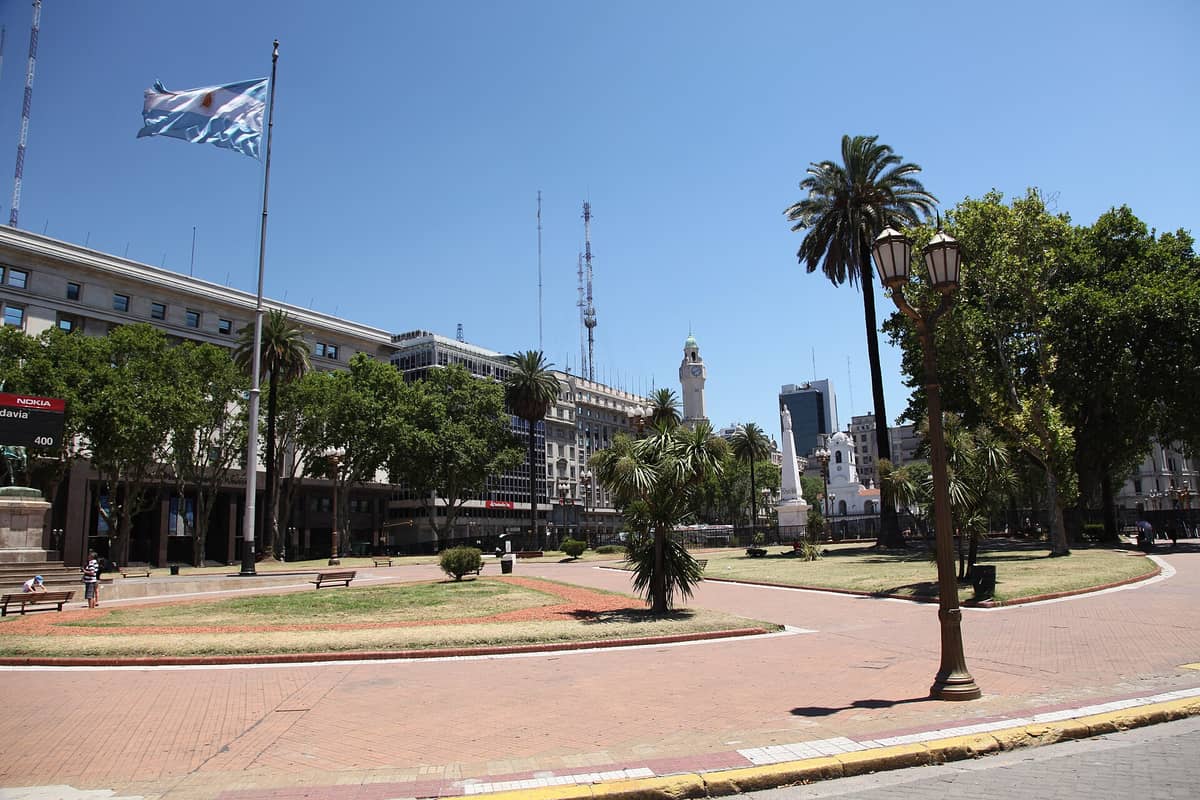
What Plaza de Mayo Actually Is
Plaza de Mayo is a 23,665-square-metre public square in the heart of Buenos Aires, first established at the time of the city's second founding in 1580. That makes it the oldest public square in the city, and arguably the most consequential open space in all of Argentina. Five of the country's most historically significant buildings look directly onto it: the Casa Rosada (the presidential palace), the Cabildo (the colonial seat of government), the Metropolitan Cathedral, the Buenos Aires City Hall, and the National Bank. Standing in the middle of the square, you are surrounded on every side by architecture and institutions that shaped the republic.
The square itself is not especially ornate by European standards. There are neat paths of pink granite, palm trees arranged in rows, flower beds that vary with the season, and the Pirámide de Mayo at its center — a white obelisk completed and inaugurated in 1811 to mark the first anniversary of the May Revolution. What gives Plaza de Mayo its weight is context, not decoration. This is where independence was declared in spirit, where Juan Perón addressed millions of supporters, where the Mothers of the Plaza de Mayo circled silently every Thursday during the military dictatorship of the 1970s and 1980s. To understand Argentine political life, you start here. For more on the city's layered history and architecture, the Buenos Aires architecture guide offers useful background before you visit.
💡 Local tip
The white headscarves painted on the pavement around the Pirámide de Mayo are an enduring tribute to the Mothers of the Plaza de Mayo. Take a moment to read about them before your visit — it transforms what looks like abstract street art into something genuinely moving.
How the Square Changes Through the Day
Early morning, between 7 and 9am, is the most peaceful window. Office workers cut through without stopping. Pigeons have the fountain to themselves. The light is low and soft, raking across the facade of the Casa Rosada in a way that makes it look almost peachy rather than the vivid salmon-pink you see in photographs. If you want photographs without crowds or phone-waving tour groups, this is your moment.
By mid-morning, school groups arrive in clusters. Tour buses park along Hipólito Yrigoyen. Guides speak in multiple languages over the low hum of traffic on Avenida de Mayo. The square fills steadily until early afternoon, when it can feel genuinely congested near the Cabildo and the cathedral entrance. Vendors with Argentine flags and souvenir pins position themselves near the main pathways.
Late afternoon brings a shift in character. Government workers emerge from the surrounding buildings. The golden hour light on the Casa Rosada is the best photography condition of the day. By dusk, the square quiets significantly. The buildings are illuminated at night, and while the area is generally busy enough to feel safe, note that Monserrat after dark is primarily a transit zone rather than a nightlife destination. The square remains technically accessible all night, but there is little reason to linger after 9 or 10pm unless there is a rally or public event.
Tickets & tours
Live prices and dates from our booking partner. If you book, we may earn a commission at no extra cost to you.
Walking private tour of Plaza de Mayo and San Telmo
From 38 €Instant confirmationFree cancellationMadero Tango Show tickets with optional dinner
From 32 €Instant confirmationFree cancellationBuenos Aires small-group city tour with optional lunch and cruise
From 25 €Instant confirmationFree cancellationPiazzolla Tango Show VIP tickets with transfer and optional dinner
From 112 €Instant confirmationFree cancellation
The Buildings That Frame the Square
The Casa Rosada is the most photographed element of Plaza de Mayo. The presidential palace's distinctive pink facade — the exact shade varies with the paint batch and the light conditions — is immediately recognizable. The balcony facing the square is where Argentine presidents have historically addressed the crowds below, from Perón to Kirchner. The building itself is a composite of two older structures joined in the late 19th century, and the uneven rhythm of its arches betrays this layered origin if you look carefully.
The Cabildo, on the western side, is the oldest surviving building on the square and one of the few genuine colonial-era structures remaining in the city. It now houses the Museo Histórico Nacional del Cabildo, with exhibits on the May Revolution and the colonial period. Entrance is free, and the interior courtyard alone is worth a few minutes. On the opposite side, the Catedral Metropolitana presents a neoclassical facade that looks more like a Greek temple than a South American church — twelve columns representing the twelve apostles, topped by a frieze added in the 19th century. Inside, the mausoleum of General José de San Martín, Argentina's liberator, is the most visited element.
The Political Dimension You Should Know About
No public square in Latin America carries a heavier political charge than this one. Since the 18th century, Plaza de Mayo has been the default venue for both state celebrations and popular uprisings. The May Revolution of 1810 that set Argentina on the path to independence from Spain began with assemblies in and around this square. The building now known as the Casa Rosada was the backdrop for Juan Perón's mass rallies in the 1940s and 1950s, drawing crowds that filled the square and the surrounding streets.
The Mothers of the Plaza de Mayo began their weekly Thursday marches in April 1977, during Argentina's military dictatorship, as a silent protest against the enforced disappearance of their children. They wore white headscarves and walked in circles around the Pirámide de Mayo when gathering was technically forbidden. Their movement became internationally recognized as a symbol of resistance, and the white headscarves painted on the pavement around the pyramid are a permanent acknowledgment of that history.
Political demonstrations still take place here regularly. If you visit on a Thursday afternoon, you may see the Mothers — now an older generation, sometimes accompanied by the Grandmothers of the Plaza de Mayo — continuing their march. Visitors are welcome to observe respectfully. On other occasions, union marches, government rallies, and protest encampments can partially close off sections of the square. This is not a problem, but it is something to factor into your timing.
ℹ️ Good to know
Political gatherings at Plaza de Mayo are common and can be large. Check local news before visiting if you want to avoid congestion, or lean into it — witnessing Argentine civic life in action is itself a significant experience.
Getting There and Navigating the Area
Plaza de Mayo sits at the eastern end of Avenida de Mayo, one of Buenos Aires' great ceremonial boulevards. The square is directly served by two Subte (metro) stations: Line A stops at Plaza de Mayo on its western approach, and Line D stops at Catedral. Both are a short walk from the square's perimeter. Dozens of colectivo bus routes stop on nearby streets, making this one of the most accessible points in the city. If you are using a SUBE card for public transport, it covers both the Subte and the buses.
From Plaza de Mayo, the surrounding area is eminently walkable. Avenida de Mayo stretches west toward the Congreso de la Nación and is lined with early 20th-century buildings, old cafes, and the famous Palacio Barolo. Puerto Madero is a ten-minute walk east. San Telmo begins just south. This central position makes Plaza de Mayo a natural anchor for a morning walk through the historic core of the city.
The square is largely flat and paved throughout, making it broadly accessible for wheelchairs and pushchairs, though there are occasional curbs and level changes around planters and edges. Entry to surrounding buildings varies — check individual venues for accessibility details.
Photography and Practical Details
The Casa Rosada is best photographed from the square's central axis in the late afternoon, when the sun is behind you and the facade is fully illuminated. Morning light, coming from the east over Puerto Madero, hits the back of the building and leaves the main facade in partial shadow. For the full-frontal shot most people are looking for, afternoon is clearly better. The Pirámide de Mayo frames well from a low angle with the Casa Rosada behind it.
The square is free to enter and photograph, including the exterior of all surrounding buildings. Interior photography rules vary by institution. The Cabildo museum may restrict photography or flash in certain rooms. The cathedral permits quiet photography inside. Security guards are present throughout the area — carry your ID as a precaution, as it is standard practice in Buenos Aires to be asked for identification near government buildings.
⚠️ What to skip
Be alert to pickpockets in crowded conditions, particularly when tour groups converge near the Cabildo and the Casa Rosada fence. Keep bags in front of your body and avoid displaying expensive camera equipment conspicuously in the thickest crowds. For general safety guidance across Buenos Aires, the city's safety guide has current practical advice.
Who Should Skip This — Assessment
Plaza de Mayo is not a scenic garden or a tranquil retreat. If you are looking for green space, shade, and somewhere to sit quietly, the square can feel exposed and concrete-heavy, especially in the summer heat of January and February when midday temperatures regularly exceed 30°C. The surrounding streets are also heavy with traffic noise. Travelers prioritizing natural beauty or relaxation should pair a brief visit here with time in Palermo's parks afterward.
The square is also not especially engaging if you arrive without any prior knowledge of Argentine history. The physical space alone — paths, a central monument, some trees — is not enough to hold attention for long. The experience scales directly with how much context you bring. Read about the Mothers, the May Revolution, and Peronism beforehand, and Plaza de Mayo becomes one of the most affecting places in the city. Arrive without that background and it can feel like a busy traffic island.
Insider Tips
- Visit on a Thursday afternoon to observe the Mothers of the Plaza de Mayo continuing their historic march — a decades-long tradition of remembrance that still takes place regularly.
- The gap in the fence along the Casa Rosada's northern side, on Paseo Colón, offers a closer look at the building's architecture and the commemorative plaques without the crowd pressure of the main square.
- The Cabildo museum is often overlooked by visitors focused on the larger landmarks. The interior courtyard and the colonial-era maps on the upper floor are worth 30 minutes and the small entrance fee.
- If you want a higher perspective, the rooftop terrace of certain buildings along Avenida de Mayo offers oblique views over the square — some cafes and cultural spaces occasionally open their terraces to visitors.
- Morning visits on weekdays (Tuesday through Thursday) avoid both the weekend tourist peak and the heavier Friday foot traffic from government workers finishing their week.
Who Is Plaza de Mayo For?
- First-time visitors to Buenos Aires who want to orient themselves in the city's historic and civic center
- History and politics enthusiasts with background knowledge of Argentine 20th-century history
- Architecture lovers interested in the layered colonial, neoclassical, and 19th-century eclectic styles surrounding the square
- Photographers seeking iconic Buenos Aires imagery, especially in afternoon light
- Travelers combining a morning walk with visits to the Cabildo, the Cathedral, and Avenida de Mayo
Nearby Attractions
Other things to see while in Microcentro & Monserrat:
- Avenida Corrientes
Avenida Corrientes is the cultural backbone of central Buenos Aires, a long avenue lined with independent bookshops, mid-century theatres, and late-night pizzerias. Free to walk at any hour, it rewards visitors who linger past midnight as much as those who arrive at noon.
- Avenida de Mayo
Stretching 1.35 km through the heart of Buenos Aires, Avenida de Mayo connects the seat of government at Plaza de Mayo to the National Congress. Inaugurated in 1894 and declared a National Historic Site in 1997, it remains the city's most architecturally dense corridor — free to walk, open at all hours, and best explored at a deliberate pace.
- Cabildo de Buenos Aires
Standing at the western end of Plaza de Mayo, the Cabildo de Buenos Aires is where Argentina's independence process began in May 1810. Today it operates as the Museo Nacional del Cabildo de Buenos Aires y de la Revolución de Mayo, offering free admission and a carefully curated look at colonial-era governance and revolutionary history. Few buildings in the country carry this much political and architectural weight.
- Café Tortoni
Founded in 1858 on Avenida de Mayo, Gran Café Tortoni is the oldest continuously operating café in Buenos Aires. Its marble counters, stained-glass ceilings, and literary history make it one of the city's most photographed interiors — though the lines outside and tourist-oriented service mean expectations need calibrating before you walk in.
Planning a trip? Discover personalized activities with the Nomado app.