Café Tortoni: Buenos Aires' Oldest Café
Founded in 1858 on Avenida de Mayo, Gran Café Tortoni is the oldest continuously operating café in Buenos Aires. Its marble counters, stained-glass ceilings, and literary history make it one of the city's most photographed interiors — though the lines outside and tourist-oriented service mean expectations need calibrating before you walk in.
Quick Facts
- Location
- Av. de Mayo 825, Microcentro/Monserrat, Buenos Aires
- Getting There
- Subte Line A – Piedras or Perú stations (2-minute walk)
- Time Needed
- 45–90 minutes for coffee and a look around
- Cost
- No entry fee; prices are menu-based (verify current rates on-site)
- Best for
- Architecture lovers, history enthusiasts, first-time visitors to Buenos Aires
- Official website
- www.cafetortoni.com.ar
What Is Café Tortoni?
Gran Café Tortoni, located at Av. de Mayo 825 in the Monserrat district, is the oldest café in Buenos Aires, founded in 1858. It is a well-documented fact — it predates Argentina's modernization era by decades and has outlasted every political upheaval, economic crash, and architectural fashion shift the city has experienced. What stands today is a layered artifact: part working café, part cultural monument, part time capsule.
It sits along Avenida de Mayo, the ceremonial boulevard that connects the Casa Rosada to Congress. The avenue itself is worth understanding before you arrive — it was laid out in the 1890s as a Parisian-style boulevard (Madrid's Gran Vía came later, from 1910), lined with Beaux-Arts and Spanish Renaissance buildings. Tortoni fits seamlessly into this streetscape, its bronze lettering and long glass facade giving little away about the world inside.
💡 Local tip
Arrive before 9:30 AM on weekdays to walk in without waiting. By mid-morning, a line typically forms at the door and can stretch to 20-30 people by noon. Weekends are significantly more crowded throughout the day.
The Interior: What You Actually See
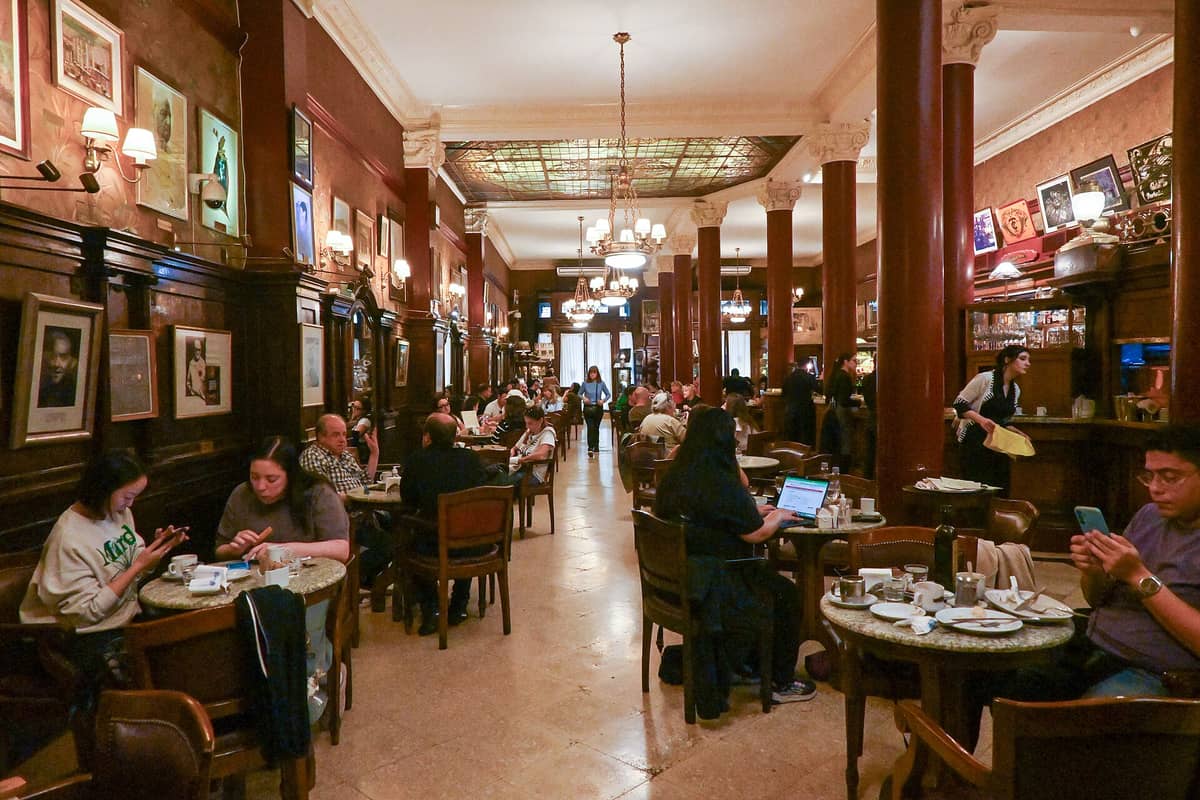
Walking through the entrance on a quiet morning, the first thing that registers is the smell: roasted coffee mixing with old wood, faint cleaning wax on marble surfaces, the particular mustiness of a space that has been continuously occupied for over 160 years. The ceiling is high, with stained-glass panels that filter soft light across rows of dark wooden booths. Brass fixtures, framed portraits, and a long mahogany bar anchor the main room.
The booths are narrow and the tables small — this was designed for two-person conversations, not group dining. Along the back wall, display cases hold memorabilia connected to the literary and political figures who made the café their regular haunt: writers including Jorge Luis Borges and Alfonsina Storni, artists, tango musicians, and various presidents are all woven into the venue's documented history.
A second room, separated from the main hall, hosts live tango and jazz performances in the evenings (check the official site for current scheduling, as events vary). The performance space is intimate — perhaps 40 seats — with much closer sightlines than a dedicated theatre. Tickets for these shows are separate from any food or drink order and tend to sell in advance.
ℹ️ Good to know
Café Tortoni is open daily from 08:00 to 21:00 (Monday to Sunday). There is no entry fee — you pay for what you order from the menu. Tango show tickets, if attending a performance, are priced separately. Verify current show schedules and prices directly with the café before visiting.
Tickets & tours
Live prices and dates from our booking partner. If you book, we may earn a commission at no extra cost to you.
Private city tour of Buenos Aires including breakfast at Cafe Tortoni
From 84 €Instant confirmationFree cancellationCafe de Los Angelitos tango show with skip-the-line tickets
From 56 €Instant confirmationFree cancellationBuenos Aires Cafe De Los Angelitos tango show with optional dinner
From 63 €Instant confirmationFree cancellationCafe De Los Angelitos tango show with private transfers
From 71 €Instant confirmationFree cancellation
How the Experience Changes by Time of Day
Early morning, roughly 8:00 to 10:00, is the most accurate version of Café Tortoni. Local office workers from the surrounding Microcentro stop in, the noise level is low, and the waitstaff move at a relaxed pace. This is when the interior is easiest to appreciate: you can take time with the tiling, examine the photographs on the walls, and sit in a booth without feeling the pressure of a line forming behind you.
By late morning, the tourist traffic builds steadily. Tour groups arrive in organized waves, often timed to coordinated itineraries in the Microcentro. Photography becomes frantic near the bar and at the signature mirrored corners. The noise level changes completely — not unpleasantly, but notably. If you are looking for a contemplative coffee experience, this window has closed.
Afternoons are the most crowded period. The café fills to capacity and wait times at the door are common. The quality of service holds reasonably well given the volume, but expect slower table turnover. Late afternoons, around 17:00 to 18:00, offer a slight lull before the evening shift as the café prepares for performances. If you missed the morning window, this is the second-best option for a quieter visit.
The Food and Coffee: Assessment
Café Tortoni serves traditional Argentine café fare: espresso, cortado, café con leche, medialunas (the local croissant, slightly sweeter than the French version), and a range of hot chocolates. The coffee is competent rather than exceptional — this is not a specialty-coffee destination, and it does not position itself as one. The hot chocolate, served thick in a small ceramic cup, is frequently cited as a highlight and represents the café's culinary identity better than the espresso does.
Prices are higher than a comparable order at an unmarked neighborhood café — a premium that reflects the location and heritage status. This is not a place to complain about. What you are paying for, in part, is the right to sit inside one of the most significant café interiors in South America. If that trade-off doesn't appeal, there are dozens of excellent cafés in the surrounding Microcentro and Monserrat neighborhoods that will serve better coffee at lower prices.
⚠️ What to skip
Do not arrive expecting a quick order. Even when not crowded, table service follows a traditional pace. If you are between appointments or on a tight schedule, the wait for service alone may frustrate you.
Historical and Cultural Context
Founded in 1858 by Frenchman Jean Touan, Café Tortoni took its name from a celebrated Paris café of the same era. Its history mirrors the trajectory of Buenos Aires as a city shaped by European immigration and cultural aspiration. By the early 20th century, it had become the meeting point for the Agrupación de Gente de Artes y Letras (known informally as La Peña), an intellectual circle that gathered regularly in the back rooms. This is documented history, not folklore: the walls carry photographs and plaques that place specific figures in specific booths. Understanding this context changes the experience — you are not just looking at a handsome old room, you are in a space where Argentine literary modernism took some of its first steps. For broader context on how café culture shaped the city, the Buenos Aires café culture guide covers this history across multiple venues.
Avenida de Mayo, where Tortoni stands, was itself part of a grand civic vision. The boulevard connects the executive power at Casa Rosada to the legislative power at Congreso de la Nación — and Tortoni, positioned at street number 825, sits almost exactly midway. This is not coincidental. It occupied the social center of the avenue during its most politically and culturally active decades.
Getting There and Getting Around
The closest Subte stations are Piedras and Perú, both on Line A, which runs directly beneath Avenida de Mayo a short walk from the café. Line A is one of the oldest underground railways in the Americas, and the stations themselves — particularly Perú — carry original tilework worth pausing to examine. If you are coming from Palermo or Recoleta, Line D connects to Line A at Catedral, at the eastern end of Avenida de Mayo; from San Telmo, the walk along the avenue is approximately 15 minutes.
Public transport in Buenos Aires uses the SUBE card, a rechargeable fare card available at kiosks and metro stations. For comprehensive guidance on moving around the city, the getting around Buenos Aires guide covers Subte lines, bus routes, and fare details. Taxis and ride-hailing apps are also readily available in this area of the city.
The Microcentro location means Café Tortoni sits within walking distance of a cluster of significant buildings. Palacio Barolo, the 1923 Dante-inspired tower, is three blocks along the same avenue. The Cabildo and Plaza de Mayo are a 10-minute walk northeast. A visit to Tortoni integrates logically into a morning spent covering this architectural corridor rather than as a standalone destination.
Photography Notes and Accessibility
The interior photographs beautifully under available light, particularly in the main hall where the stained-glass ceiling creates diffuse, warm tones in the morning hours. The bar counter, framed by large mirrors and brass fixtures, is the most commonly photographed element. If this is a priority, arrive early and move quickly — by 10:00, other visitors will be moving through the same frame.
Wide-angle lenses suit the long hall; the booths are tight and poorly lit by flash, which tends to flatten the patina that makes them interesting. The entrance facade, with its bronze signage and street-level awning, reads well in the late afternoon light coming from the west along the avenue.
No official accessibility statement was available at the time of writing. The entrance level is at street grade, but the narrow booth layout and potentially uneven historical flooring may present challenges for wheelchair users. It is recommended to contact the café directly in advance if accessibility is a concern.
Who Should Consider Skipping This
Café Tortoni's reputation sometimes sets expectations it cannot meet. If you are looking for excellent coffee by specialty standards, the café does not compete with the third-wave coffee shops now operating in Palermo and San Telmo. If you want an immersive local experience with neighborhood regulars, the mid-day crowds lean heavily tourist. If you have visited atmospheric historic cafés elsewhere — Café de Flore in Paris, Café Central in Vienna, A Brasileira in Lisbon — Tortoni fits that category but does not surpass them.
None of this makes the visit a mistake. It means the visit rewards those who go for the right reasons: the architecture, the documented history, the specific sensory experience of a room that has been continuously used since 1858. Approached with accurate expectations, Café Tortoni delivers exactly what it is.
Insider Tips
- Weekday mornings before 10:00 AM are the clear window for low crowds and unhurried service. Set this as your first stop before exploring the Avenida de Mayo corridor.
- Ask for the hot chocolate (chocolate caliente) rather than espresso — it is the menu item most closely tied to the café's historical identity and the one that most visitors report as the standout.
- The side entrance on Rivadavia street occasionally has a shorter queue than the main Avenida de Mayo entrance. Worth checking if the main door line is long.
- If attending a tango show in the back room, book in advance through the official website. Walk-in availability is unreliable on weekends and during holiday periods.
- Combine the visit with a walk the full length of Avenida de Mayo — the architecture on both sides of the boulevard is cohesive and largely intact, and Tortoni anchors the midpoint of that experience logically.
Who Is Café Tortoni For?
- First-time visitors to Buenos Aires wanting to connect with the city's Belle Époque period
- Architecture and interior design enthusiasts drawn to preserved late-19th-century café design
- Travellers following Buenos Aires' literary or tango heritage trails
- Couples looking for an atmospheric morning stop with historical depth
- Anyone building an itinerary around the Microcentro and Avenida de Mayo corridor
Nearby Attractions
Other things to see while in Microcentro & Monserrat:
- Avenida Corrientes
Avenida Corrientes is the cultural backbone of central Buenos Aires, a long avenue lined with independent bookshops, mid-century theatres, and late-night pizzerias. Free to walk at any hour, it rewards visitors who linger past midnight as much as those who arrive at noon.
- Avenida de Mayo
Stretching 1.35 km through the heart of Buenos Aires, Avenida de Mayo connects the seat of government at Plaza de Mayo to the National Congress. Inaugurated in 1894 and declared a National Historic Site in 1997, it remains the city's most architecturally dense corridor — free to walk, open at all hours, and best explored at a deliberate pace.
- Cabildo de Buenos Aires
Standing at the western end of Plaza de Mayo, the Cabildo de Buenos Aires is where Argentina's independence process began in May 1810. Today it operates as the Museo Nacional del Cabildo de Buenos Aires y de la Revolución de Mayo, offering free admission and a carefully curated look at colonial-era governance and revolutionary history. Few buildings in the country carry this much political and architectural weight.
- Casa Rosada
Standing at the eastern edge of Plaza de Mayo, Casa Rosada houses the offices of Argentina's national executive. Admission to the Museo Casa Rosada is free, guided tours are available, and the exterior alone is worth a dedicated visit.
Planning a trip? Discover personalized activities with the Nomado app.