Avenida de Mayo: Buenos Aires' Grand Boulevard Between Power and History
Stretching 1.35 km through the heart of Buenos Aires, Avenida de Mayo connects the seat of government at Plaza de Mayo to the National Congress. Inaugurated in 1894 and declared a National Historic Site in 1997, it remains the city's most architecturally dense corridor — free to walk, open at all hours, and best explored at a deliberate pace.
Quick Facts
- Location
- Monserrat / central Buenos Aires, linking Plaza de Mayo (east) to Plaza del Congreso (west)
- Getting There
- Subte Line A (Piedras, Sáenz Peña stations) and Line C (Avenida de Mayo station)
- Time Needed
- 45 minutes to walk end-to-end; 2–3 hours if stopping at cafés and buildings
- Cost
- Free to walk. Individual buildings and tours have separate fees
- Best for
- Architecture lovers, history readers, photographers, slow walkers
What Avenida de Mayo Actually Is
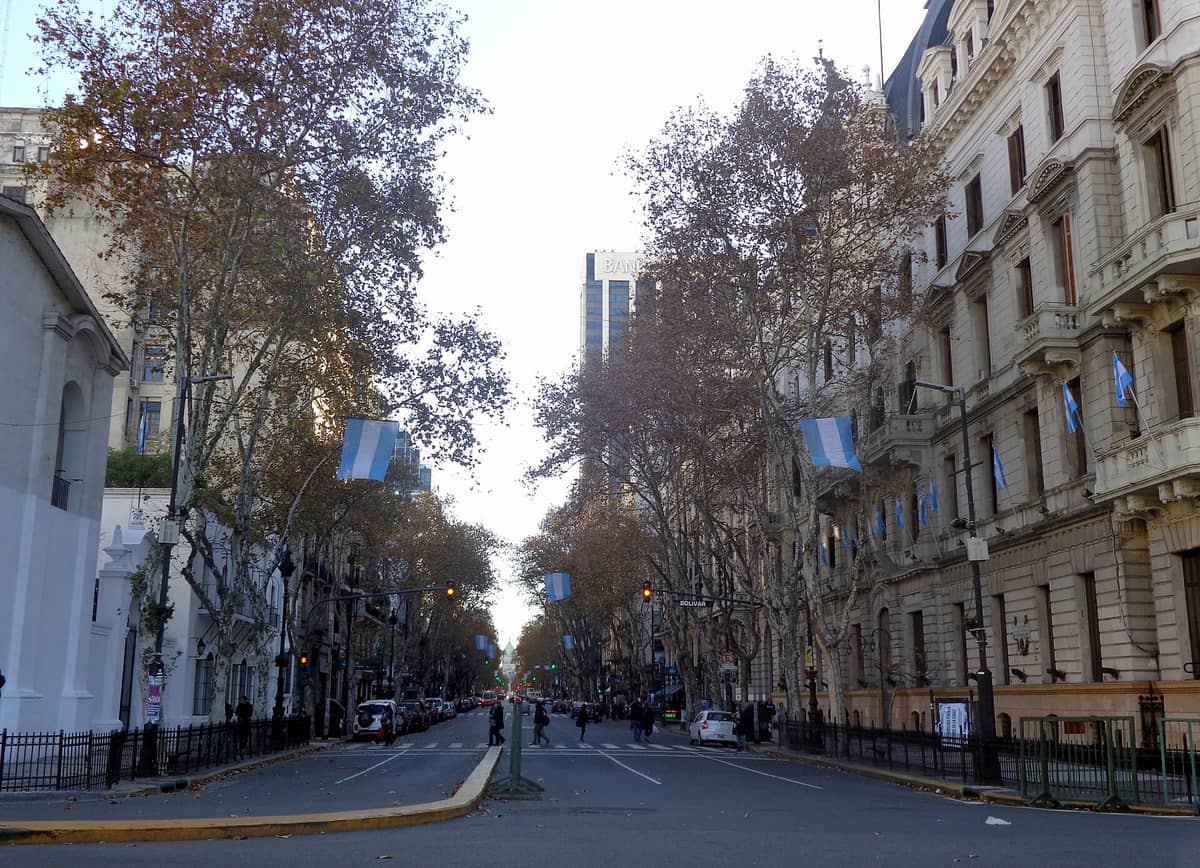
Avenida de Mayo is a 1.35-kilometer east-west boulevard cutting through the Monserrat district of central Buenos Aires. At one end sits Plaza de Mayo, the city's oldest square, flanked by the Casa Rosada and the Metropolitan Cathedral. At the other end, the dome of the National Congress closes the visual axis like a punctuation mark. The avenue was inaugurated on 9 July 1894, under Mayor Federico Pinedo (the project had been initiated by Torcuato de Alvear), and was the first boulevard ever built in Buenos Aires. It commemorates the May Revolution of 1810, the political upheaval that set Argentina on the path toward independence.
This is not a manicured tourist zone. It is a working city street: commuters use the Subte stations underneath it, office workers eat lunch at its café counters, and vendors wheel carts along its wide sidewalks. The preserved Belle Époque and Baroque Revival facades overhead tell a story most people walking below barely notice. That gap between the grandeur above and the ordinary life below is part of what makes this walk interesting.
💡 Local tip
Look up more than you look straight ahead. Most of the architectural detail on Avenida de Mayo — carved stone figures, ornate cornices, tiled lobbies visible through open doors — sits above eye level and is easy to miss if you're watching the pavement.
The Architecture: What You're Actually Looking At
In 1997, Avenida de Mayo was declared a National Historic Site, placing strict controls on facade alterations and certain types of advertising. This legal protection is the reason the street still looks the way it does. Without it, the commercial pressure of a central Buenos Aires block would have stripped or rebuilt much of what survives.
The defining building along the avenue is the Palacio Barolo, completed in 1923 and designed by Mario Palanti. Its structure is said to reflect the three-part division of Dante's Divine Comedy — Inferno, Purgatory, Paradise — with the lighthouse at the crown representing Paradise. Guided tours run regularly and are worth booking in advance. The views from the top across the Monserrat rooftops are among the more unusual perspectives available in central Buenos Aires.
Other architectural landmarks along the route include the Hotel Castelar, the Majestic Building, and the Palacio Vera. Most facades display a confident mix of French academicism and Spanish colonial revival styles — reflecting the tastes of the large immigrant population that shaped Buenos Aires around the turn of the 20th century. For a broader sense of this building tradition across the city, the Buenos Aires architecture guide provides useful context before you walk.
Tickets & tours
Live prices and dates from our booking partner. If you book, we may earn a commission at no extra cost to you.
Walking private tour of Plaza de Mayo and San Telmo
From 38 €Instant confirmationFree cancellationMadero Tango Show tickets with optional dinner
From 32 €Instant confirmationFree cancellationBuenos Aires small-group city tour with optional lunch and cruise
From 25 €Instant confirmationFree cancellationPiazzolla Tango Show VIP tickets with transfer and optional dinner
From 112 €Instant confirmationFree cancellation
How the Avenue Changes by Time of Day
Early morning, roughly 7–9 AM, is when the street shows its working character most clearly. The cafés fill with office workers standing at zinc counters drinking cortados. The sidewalks are busy with people heading toward Subte entrances. The light, particularly in the cooler months of autumn and spring, catches the stone facades at low angles and produces clean shadows on the carved details. This is the best time for photography without crowds in the frame.
Midday brings more foot traffic, street vendors, and the lunchtime rush at the traditional restaurants and cafés along the block. The Café Tortoni, on the avenue at number 825, draws long queues of tourists. If you want to sit inside rather than join the queue, consider going at opening time or on a weekday afternoon.
Late afternoon and early evening, especially on weekdays, bring a second wave of activity as offices empty. The avenue takes on a slower pace after 7 PM, when the tourist-facing businesses quiet down but the bars and traditional cafés stay open. Political demonstrations occasionally start or finish at either end of the avenue — Plaza de Mayo in particular is a traditional gathering point for protests and public events. If you see a march forming, the avenue itself generally remains passable.
The Café Tortoni and the Café Culture of the Avenue
No walk along Avenida de Mayo is complete without acknowledging the Café Tortoni, which opened in 1858 and is one of the oldest operating cafés in Buenos Aires. It sits on the south side of the avenue near the Plaza de Mayo end. The interior — dark wood, marble tables, stained glass — has been used as a set piece by writers, tango musicians, and political figures for over a century. The experience today is very much shaped by its fame: there are queues, staff manage tourist throughput, and prices reflect the location. That said, an afternoon coffee inside is still worth the trip, if only to understand why the café culture of Buenos Aires is considered a defining part of the city's identity.
Beyond the Tortoni, several less prominent café-bars along the avenue serve the same traditional menu of medialunas, café con leche, and tostados without the wait. These spots — identifiable by their older signage and regulars nursing a coffee at the counter — offer a more unperformed version of the same tradition.
ℹ️ Good to know
Café Tortoni is technically a Café Notable, a protected category in Buenos Aires that recognizes historic cafés of cultural significance. There are around 70 such cafés in the city, and the Avenida de Mayo area has a concentration of them.
Walking the Route: A Practical Walkthrough
The most logical direction is west to east: start at the National Congress on Plaza del Congreso, where you can take in the full length of the boulevard stretching ahead of you with the Casa Rosada visible in the far distance on clear days. The Congress building itself is open for free guided tours on weekdays — worth checking current schedules directly with the institution.
Walking east, the blocks between Congreso and the halfway point contain most of the historic residential and commercial architecture. The Palacio Barolo is approximately at the midpoint. Past it, the street character becomes more administrative, with government ministries and official buildings replacing the mixed-use blocks near Congreso.
The walk ends at Plaza de Mayo, where the Casa Rosada faces the square. The square itself is historically significant as the site of major political events in Argentine history, and the layout of the surrounding buildings — including the Cabildo and the Metropolitan Cathedral — rewards a slower look before moving on.
⚠️ What to skip
The Subte stations beneath Avenida de Mayo (Line A in particular) have limited step-free access. Visitors with mobility impairments should check current accessibility status for specific stations before relying on them as entry or exit points.
Weather, Seasonality, and What to Bring
Buenos Aires has a humid subtropical climate. Summers (December to February) bring temperatures that regularly reach 28–30°C with high humidity. Walking the length of Avenida de Mayo in direct midday sun in January is uncomfortable; the shade provided by the avenue's taller buildings offers some relief, but mornings and evenings are a significantly better choice in summer months.
Spring (September to November) and autumn (March to May) offer the most comfortable walking conditions, with temperatures generally in the 15–25°C range and lower humidity. These are also the months with the most consistent light for photography. For more on timing a visit to Buenos Aires, the best time to visit Buenos Aires guide covers the trade-offs in detail.
Wear flat, comfortable shoes: the paving stones in the older sections of the sidewalk are uneven and can catch heels. Bring water, particularly in summer. A light rain jacket is worth carrying in autumn and early spring, when afternoon showers arrive with little warning.
Insider Tips
- The Galería del Pasaje, a covered arcade within one of the historic buildings near the Palacio Barolo end of the avenue, is usually overlooked by visitors focused on the street-level experience. Step inside for a look at the original tilework and the internal skylight structure.
- The upper floors of the Palacio Barolo are accessible on guided tours, but the building also has a ground-floor lobby open during business hours. Even without booking a tower tour, the lobby alone — with its detailed stonework and the scale of the internal spaces — is worth five minutes of your time.
- For a clear view back down the full length of the avenue toward the Congress dome, position yourself at the Plaza de Mayo end near the fountain and face west in the late afternoon. The low sun illuminates the facade details on the south side of the street particularly well.
- Line A of the Subte (the oldest underground railway in Latin America, opened 1913) runs directly beneath Avenida de Mayo. If you ride it between the Plaza de Mayo and Congreso stations, the original station architecture at stops like Perú and Piedras is itself worth seeing — Line A of the Subte (the oldest underground railway in Latin America, opened 1913) runs directly beneath Avenida de Mayo. If you ride it between the Plaza de Mayo and Congreso stations, the original station architecture at stops like Perú and Piedras is itself worth seeing.
- Several of the traditional restaurants along the avenue serve a weekday lunch menu (menú del día) at significantly lower prices than the à la carte menu. If you're planning to eat on the avenue, arrive between 12:30 and 1:30 PM and ask specifically for the menú.
Who Is Avenida de Mayo For?
- Architecture enthusiasts who want to read a building's history in its facade
- First-time visitors to Buenos Aires wanting a single walk that connects the city's key civic landmarks
- Photographers working in morning light or looking for Belle Époque street scenes
- Travellers interested in Argentine political and social history, for whom the axis between government and legislature is itself a subject
- Anyone who wants a structured 90-minute walk that can be done independently, at no cost, and extended or shortened depending on energy
Nearby Attractions
Other things to see while in Microcentro & Monserrat:
- Avenida Corrientes
Avenida Corrientes is the cultural backbone of central Buenos Aires, a long avenue lined with independent bookshops, mid-century theatres, and late-night pizzerias. Free to walk at any hour, it rewards visitors who linger past midnight as much as those who arrive at noon.
- Cabildo de Buenos Aires
Standing at the western end of Plaza de Mayo, the Cabildo de Buenos Aires is where Argentina's independence process began in May 1810. Today it operates as the Museo Nacional del Cabildo de Buenos Aires y de la Revolución de Mayo, offering free admission and a carefully curated look at colonial-era governance and revolutionary history. Few buildings in the country carry this much political and architectural weight.
- Café Tortoni
Founded in 1858 on Avenida de Mayo, Gran Café Tortoni is the oldest continuously operating café in Buenos Aires. Its marble counters, stained-glass ceilings, and literary history make it one of the city's most photographed interiors — though the lines outside and tourist-oriented service mean expectations need calibrating before you walk in.
- Casa Rosada
Standing at the eastern edge of Plaza de Mayo, Casa Rosada houses the offices of Argentina's national executive. Admission to the Museo Casa Rosada is free, guided tours are available, and the exterior alone is worth a dedicated visit.
Planning a trip? Discover personalized activities with the Nomado app.