Avenida Corrientes: Buenos Aires' Street That Never Sleeps
Avenida Corrientes is the cultural backbone of central Buenos Aires, a long avenue lined with independent bookshops, mid-century theatres, and late-night pizzerias. Free to walk at any hour, it rewards visitors who linger past midnight as much as those who arrive at noon.
Quick Facts
- Location
- Microcentro, Buenos Aires (runs east–west through the city centre)
- Getting There
- Subte Line B (Florida, Uruguay, Callao) and Line C (Diagonal Norte); multiple colectivo routes
- Time Needed
- 1–3 hours for a leisurely walk; longer if you browse bookshops or catch a show
- Cost
- Free (public street); theatre tickets and bookshop purchases vary
- Best for
- Night owls, book lovers, theatre-goers, tango history enthusiasts
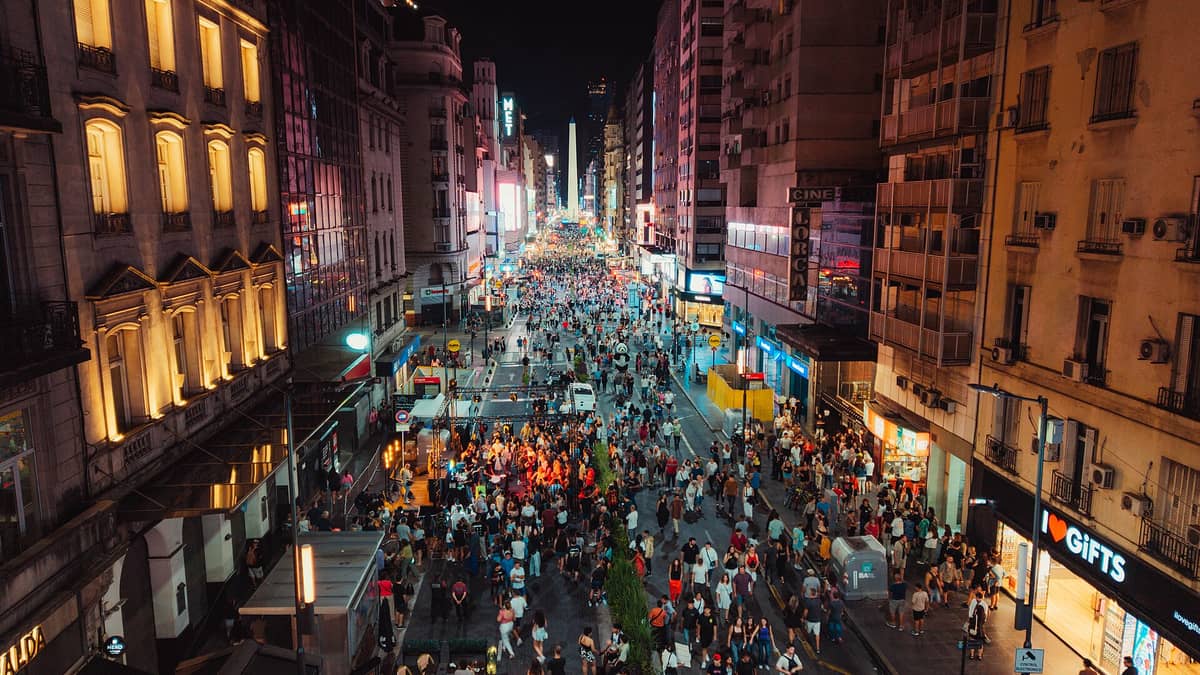
What Avenida Corrientes Actually Is
Avenida Corrientes is a broad, straight avenue that cuts west–northwest through the heart of Buenos Aires, running from the eastern end near Puerto Madero all the way out to the western barrios beyond the Abasto neighbourhood. At its most concentrated stretch, roughly between the Obelisco, Callao, and the Abasto district, it functions as the city's cultural main street: a dense corridor of independent bookshops, traditional pizzerias, old-school cafes, and theatre marquees that have barely changed their typography since the 1950s.
The street is a public avenue, open at all hours with no admission. Its significance is not architectural in the grand sense. There is no single monument to photograph. What makes Corrientes worth your time is the accumulated texture of it: the smell of old paper drifting from shop doorways, the way neon signs reflect off wet pavement after rain, the low hum of conversation from tables spilling onto sidewalks at 1am. It is one of the few streets in the world that genuinely changes character by the hour rather than just by day or night.
💡 Local tip
The stretch between the Subte stations Callao and Diagonal Norte (Lines B and C) is the densest for bookshops and theatres. Start there if your time is limited.
A Street Shaped by the 1930s and 1940s
Corrientes reached its cultural peak during the golden age of Argentine tango in the 1930s and 1940s. Milongas, theatres, and cabarets lined the avenue during this period, drawing musicians, writers, and working-class porteños who stayed out until dawn. The avenue was widened between 1931 and 1936 to accommodate the growth of the city, and the widening prompted a wave of construction that left behind the art deco and rationalist facades still visible today.
Tango lyricists specifically referenced Corrientes as shorthand for Buenos Aires nightlife. The phrase 'la calle Corrientes' carried connotations of sophisticated leisure and creative energy that the city's political and financial avenues never had. That association between the street and late-night cultural life has proved remarkably durable. The theatres have changed their programmes, the bookshops have survived economic crises that shuttered most retail, and the pizzerias have outlasted several generations of owners, but the underlying rhythm of the avenue remains consistent with its mid-century identity.
For deeper context on how tango shaped the city's geography and social life, the tango guide for Buenos Aires covers the historical milieu that gave Corrientes much of its character.
Tickets & tours
Live prices and dates from our booking partner. If you book, we may earn a commission at no extra cost to you.
Madero Tango Show tickets with optional dinner
From 32 €Instant confirmationFree cancellationBuenos Aires small-group city tour with optional lunch and cruise
From 25 €Instant confirmationFree cancellationPiazzolla Tango Show VIP tickets with transfer and optional dinner
From 112 €Instant confirmationFree cancellationBuenos Aires shopping tour
From 15 €Instant confirmationFree cancellation
How the Avenue Changes Hour by Hour
In the late morning, Corrientes is a working street. Office workers move quickly along the wide pavements, newsstand vendors stack periodicals, and the cafes fill with people ordering cortados and medialunas at the counter. The bookshops are quiet at this hour, and you can browse without pressure. The light is flat and the pace is transactional.
By late afternoon, the avenue shifts gear. Theatre boxes open for advance ticket sales, producing loose queues of people studying the programme boards mounted outside each venue. The smell of empanadas and pizza by the slice becomes more persistent. Street vendors set up folding tables. Around 6–7pm, the Subte stations disgorge a second wave of pedestrians, and the pavement fills to the point where walking at speed is no longer possible.
After 10pm is when Corrientes earns its reputation. Buenos Aires dining culture runs late by most international standards, and Corrientes is later still. The classic pizzerias, some of which have been serving at the same counter since the mid-twentieth century, are at full capacity well past midnight. Bookshops that close during the afternoon heat reopen in the evening and stay open until 1am or later. Theatre audiences spill out between midnight and 1am and immediately reconvene at nearby restaurants. The avenue is genuinely more alive at midnight than at noon.
ℹ️ Good to know
Buenos Aires theatres typically hold their main performances from Thursday through Sunday. If you want to experience the avenue at peak energy, a Friday or Saturday night is the clearest illustration of what makes Corrientes distinct.
The Bookshops: A Specific Kind of Institution
The independent bookshops on Corrientes are not curated lifestyle boutiques. They are dense, floor-to-ceiling operations where Argentine literature sits alongside translated fiction, academic texts, political philosophy, and discounted art books. Many also stock used volumes alongside new stock without making a clear distinction in the shelving. Browsing requires patience and some tolerance for mild disorder, but the depth of stock at even mid-sized shops is genuinely impressive.
Several shops have operated continuously for decades. The staff at the older establishments tend to have opinions and are willing to share them if you ask in Spanish. English-language stock is limited but present. For visitors who read Spanish, Corrientes is one of the better streets in South America for buying Argentine literature, political history, and philosophy at reasonable prices.
If you want a more theatrical bookshop experience in the same general area, El Ateneo Grand Splendid is a converted theatre operating as a bookshop a short distance north, in Recoleta. It is visually extraordinary but functions differently from the street-level shops on Corrientes.
Getting There and Walking the Avenue
Corrientes is well served by the Subte. Line B runs directly beneath part of the avenue with stops at Florida, Uruguay, and Callao, all of which place you within a short walk of the densest section. Line C's Diagonal Norte station also provides access at the eastern end, near the intersection with Avenida 9 de Julio and the Obelisco.
The Obelisco, formally the Obelisco de Buenos Aires, sits at the intersection of Corrientes and 9 de Julio, the city's widest avenue. This crossing functions as the de facto centre of Buenos Aires and is a logical starting point for a walk west along Corrientes toward the Congreso district.
The full cultural stretch from the Obelisco to the Abasto area takes roughly 40 minutes at a walking pace, not accounting for stops. Most visitors find the section between the Obelisco and Callao sufficient for a single visit. Buses run along Corrientes as well, with multiple colectivo routes stopping on or adjacent to the avenue. A SUBE card is required for both Subte and bus payment; single-use tickets are not available on most Buenos Aires public transport, so confirm current fare arrangements before travel.
⚠️ What to skip
The avenue can feel overwhelming during the evening rush, roughly 5:30–7:30pm on weekdays. If you want to walk at a comfortable pace, arrive before 4pm or after 8pm.
The Theatres: Independent and Commercial
Buenos Aires has a theatre culture that rivals any city of comparable size, and Corrientes is its geographic centre. The avenue and its immediate cross-streets hold dozens of venues ranging from 80-seat independent spaces to mid-sized commercial theatres programming national and international productions. Argentine theatre spans the full range from classical European drama in Spanish translation to original political satire and experimental dance-theatre.
Most productions run in Spanish only, which limits accessibility for non-Spanish speakers unless the production is dance-heavy or the visitor has strong reading comprehension. Ticket prices vary considerably. The programme boards outside each theatre list current shows and showtimes; the box offices typically open in the afternoon. Booking in advance through official theatre websites is advisable for popular productions on weekends.
Buenos Aires has additional major cultural venues beyond Corrientes worth noting, including the Teatro Colón, one of the world's most significant opera houses, a short walk from the avenue's eastern section, and the Centro Cultural Kirchner near the waterfront end of the avenue.
Photography and Practical Notes
Corrientes photographs best at night. The neon theatre signage, the warm light from bookshop windows, and the density of pedestrians produce images that communicate the avenue's character more effectively than daytime shots of a crowded commercial street. A wide-angle lens or a phone with a capable night mode handles the low light adequately. The intersection with 9 de Julio at the Obelisco is a standard wide shot; less photographed but equally good is the stretch near Callao where older art deco facades are more concentrated.
The avenue is fully paved and flat, which makes it accessible to visitors with mobility considerations. The pavement is wide. The Subte stations have lift access at some locations, though not all; check current station accessibility status before relying on specific stops. During rainfall, the street stays navigable, though the bookshop doorways make for good shelter. Summer heat (January–February) can make a long midday walk uncomfortable; the evening hours are significantly more pleasant in those months.
For broader orientation around the city centre, the Buenos Aires walking tours guide covers several routes that pass through or near Corrientes.
Who Will Not Enjoy This
Visitors expecting a visually cohesive, photogenic boulevard in the European style will be disappointed. Corrientes is not beautiful in an obvious way. The signage is sometimes garish, the street-level retail is variable, and stretches away from the cultural core become unremarkable commercial strips. Families with young children will find little specifically targeted at them, and the avenue's real energy does not begin until well past most children's bedtimes. Visitors who do not read Spanish will get less from the bookshops and theatre programmes, though the sensory experience of the street itself does not require language.
Insider Tips
- Many Corrientes bookshops reopen in the evening after a midday pause, sometimes staying open past 1am. If a shop appears closed in the afternoon, check back after 8pm.
- The classic Buenos Aires pizzerias on and near Corrientes (look for establishments that have been open since the mid-twentieth century) serve pizza al molde, a thick-crusted, heavily-cheesed style quite different from Italian or North American versions. Ordering at the counter is faster and often cheaper than table service.
- Theatre ticket prices on Corrientes often drop for midweek performances. If you have flexibility, a Tuesday or Wednesday show costs noticeably less than the same production on Saturday.
- The intersection of Corrientes and Callao, marked by several bookshops clustering together, is a useful landmark if you get disoriented. The Callao Subte station (Line D, one block west on Av. Córdoba) provides a quick exit from the area if needed.
- On significant football match days, the Obelisco end of Corrientes fills with supporters regardless of the time of day or night. The atmosphere is intense and generally celebratory, but be prepared for crowds that make walking slow near the intersection with 9 de Julio.
Who Is Avenida Corrientes For?
- Book readers who want to browse Argentine literature and political history without tourist markup
- Night owls who prefer to start dinner at 10pm and walk home at 2am
- Theatre-goers curious about Spanish-language contemporary and classical drama
- Visitors interested in the tango era's physical traces in mid-century facades and old cafe interiors
- Anyone spending several days in Buenos Aires who wants to understand how porteños actually spend their evenings
Nearby Attractions
Other things to see while in Microcentro & Monserrat:
- Avenida de Mayo
Stretching 1.35 km through the heart of Buenos Aires, Avenida de Mayo connects the seat of government at Plaza de Mayo to the National Congress. Inaugurated in 1894 and declared a National Historic Site in 1997, it remains the city's most architecturally dense corridor — free to walk, open at all hours, and best explored at a deliberate pace.
- Cabildo de Buenos Aires
Standing at the western end of Plaza de Mayo, the Cabildo de Buenos Aires is where Argentina's independence process began in May 1810. Today it operates as the Museo Nacional del Cabildo de Buenos Aires y de la Revolución de Mayo, offering free admission and a carefully curated look at colonial-era governance and revolutionary history. Few buildings in the country carry this much political and architectural weight.
- Café Tortoni
Founded in 1858 on Avenida de Mayo, Gran Café Tortoni is the oldest continuously operating café in Buenos Aires. Its marble counters, stained-glass ceilings, and literary history make it one of the city's most photographed interiors — though the lines outside and tourist-oriented service mean expectations need calibrating before you walk in.
- Casa Rosada
Standing at the eastern edge of Plaza de Mayo, Casa Rosada houses the offices of Argentina's national executive. Admission to the Museo Casa Rosada is free, guided tours are available, and the exterior alone is worth a dedicated visit.
Planning a trip? Discover personalized activities with the Nomado app.