Casa Rosada: Inside Argentina's Presidential Palace
Standing at the eastern edge of Plaza de Mayo, Casa Rosada houses the offices of Argentina's national executive. Admission to the Museo Casa Rosada is free, guided tours are available, and the exterior alone is worth a dedicated visit.
Quick Facts
- Location
- Av. Paseo Colón 100, Microcentro/Monserrat, Buenos Aires (C1064)
- Getting There
- Subte Line A (Plaza de Mayo) or Line D (Catedral); multiple colectivo routes on Av. de Mayo
- Time Needed
- 45–90 minutes for the museum; 10–15 minutes for a quick exterior visit
- Cost
- Free admission; passport required for guided tours (advance booking needed)
- Best for
- History enthusiasts, architecture admirers, and first-time visitors to Buenos Aires
- Official website
- www.casarosada.gob.ar
What Casa Rosada Actually Is
Casa Rosada, formally the Palacio de Gobierno, is the executive mansion and working office of the President of Argentina. It is not a museum in the way that word typically implies: government business continues inside, and access is genuinely limited. What visitors can explore is the Museo Casa Rosada, a permanent exhibition occupying part of the building's lower levels, plus the exterior and central courtyard on guided visits.
The building occupies a historically loaded site. Beneath and around it lie the foundations of the colonial-era Fort of Buenos Aires, and archaeological remains from that period are incorporated into the museum's display. This layering of colonial fort, 19th-century customs house, and the current neo-Renaissance structure gives the palace a physical depth that its pink facade only hints at.
The building faces Plaza de Mayo, the historic square where Argentina's most consequential political moments have played out, from the May Revolution of 1810 to the rallies of the Mothers of the Plaza de Mayo during the dictatorship years. Standing between the two, you are effectively at the center of the country's political memory.
ℹ️ Good to know
The Museo Casa Rosada is open Wednesday to Sunday, 11:00–18:00 (last entry 17:30). It is closed Monday and Tuesday. Admission is free. Guided tours require advance booking through the official site and a valid passport for entry.
The Facade: Why It Is Pink
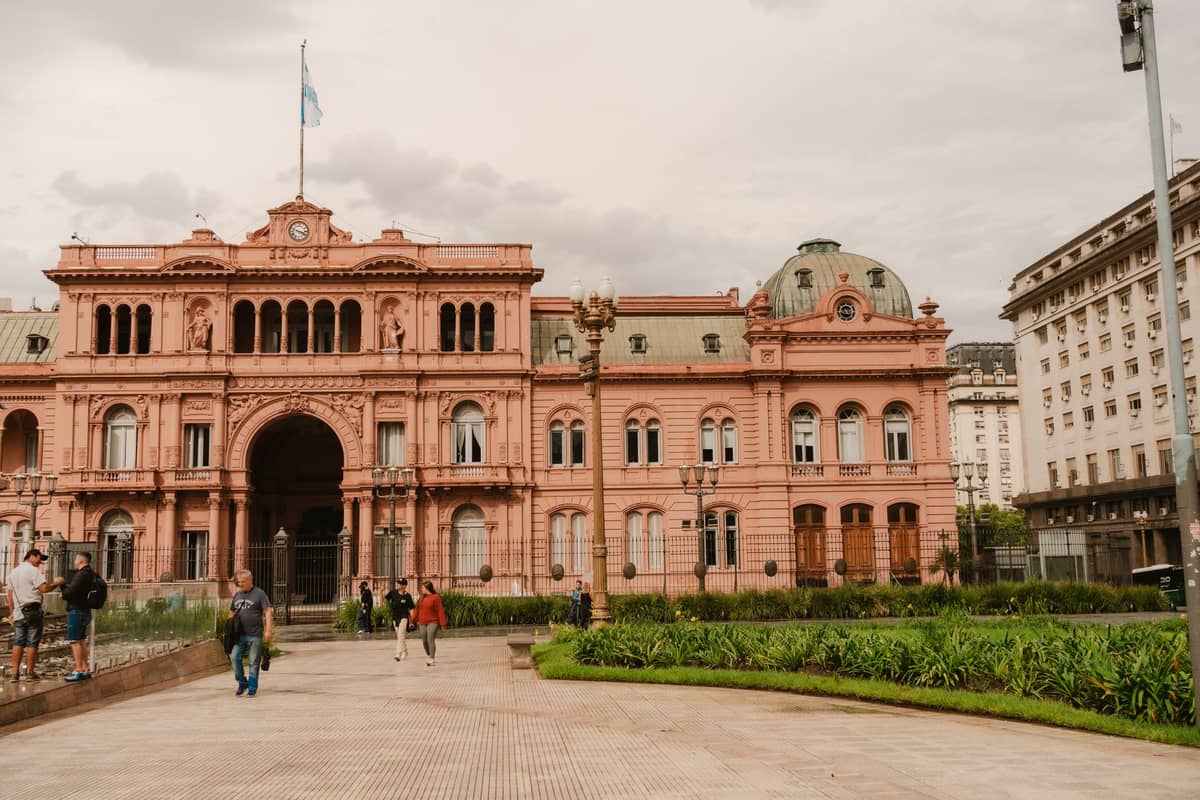
The pink color is the first thing anyone asks about. The most commonly cited explanation is that the original paint was a mixture of lime and ox blood, which gave it a reddish tone, though historians debate how much of that is legend versus documented fact. The current shade, a salmon-to-dusty-rose depending on the quality of light, is maintained as part of its official identity. In direct morning sun, the facade reads almost terracotta. In the flat light of an overcast afternoon, it softens considerably.
The building's current form dates primarily from the late 19th century, completed around 1898 under architect Francesco Tamburini, who unified two previously separate wings. The Italianate detailing, arched windows, and central loggia give it a grandeur that reads well from the plaza, though up close the scale is more modest than photographs suggest. The famous balcony above the central arch, from which presidents have addressed crowds below, is visible from street level.
Tickets & tours
Live prices and dates from our booking partner. If you book, we may earn a commission at no extra cost to you.
Madero Tango Show tickets with optional dinner
From 32 €Instant confirmationFree cancellationBuenos Aires small-group city tour with optional lunch and cruise
From 25 €Instant confirmationFree cancellationPiazzolla Tango Show VIP tickets with transfer and optional dinner
From 112 €Instant confirmationFree cancellationBuenos Aires shopping tour
From 15 €Instant confirmationFree cancellation
The Museum: What You Actually See Inside
The Museo Casa Rosada covers two distinct themes: the political history of the Argentine presidency and the archaeology of the colonial fort site. The archaeological section is the more surprising of the two. Display areas reveal original masonry from the 17th and 18th centuries, and the display cases contain everyday objects recovered during excavations: ceramics, trade goods, navigational instruments. For a building that looks entirely 19th century from the outside, this subterranean layer is genuinely interesting.
The presidential history section covers successive administrations through documents, photographs, personal objects, and official gifts received from foreign governments. The presentation is formal and institutional in tone. If you have some background in Argentine political history, particularly the turbulent 20th century, the exhibits provide useful context. If you are arriving with no prior knowledge, some displays may feel opaque without explanation.
Room sizes are relatively compact, and the museum does not attempt to overwhelm. A thorough self-guided visit takes around 45 minutes. Signage is in Spanish, with partial English translations in some areas, so visitors who do not read Spanish may find the guided tour (available in Spanish) more rewarding than walking through independently.
💡 Local tip
Book the guided tour in advance on the official argentina.gob.ar museum page. Bring your passport, not just a photocopy. Without it, you will not be admitted on tour days.
Visiting by Time of Day
The exterior of Casa Rosada is worth approaching at different hours. Early morning, before the plaza fills with office workers and tour groups, the building sits relatively quietly against the sky. The light from the east, coming off the Río de la Plata, hits the facade directly and gives photographers the best color saturation, usually between 8:00 and 10:00. By mid-morning on weekends, tour groups begin arriving in earnest and the plaza in front becomes active with organized visits, flag ceremonies on certain days, and the regular presence of local vendors.
The museum itself opens at 11:00. Arriving at opening time on a weekday means smaller crowds inside and more relaxed access to the exhibition rooms. Weekend afternoons are busier, and the last hour before closing can feel rushed as staff begin preparing to close.
Political events can affect access without warning. On days when demonstrations are scheduled in Plaza de Mayo, or during national commemorations, entry to the museum may be disrupted or the immediate area may be cordoned. This is worth checking if you are planning the visit around a specific national date.
⚠️ What to skip
Political demonstrations in Plaza de Mayo are common and can close surrounding streets or restrict access to the palace exterior. Check local news if visiting around major national dates (May 25, July 9, October 17).
Getting There and Practical Logistics
Casa Rosada is easy to reach by Subte. Line A stops at Plaza de Mayo, placing you directly in front of the building. Line D's Catedral stop deposits you at the Cathedral on the opposite side of the plaza, a two-minute walk. The Bolivar stop on Line E is also close. Multiple colectivo lines run along Av. de Mayo and connecting streets. Using a SUBE card (the rechargeable transit card required for public transport in Buenos Aires) is by far the easiest way to manage fares.
If you are combining this visit with other Monserrat landmarks, the Catedral Metropolitana is directly across the plaza, the Cabildo de Buenos Aires is on the same square's western side, and the Avenida de Mayo begins from the plaza's western end, lined with Beaux-Arts buildings worth seeing on foot.
Accessibility at the Museo Casa Rosada is meaningfully addressed. The official information lists an accessible entrance, ramps at bathrooms and the mural entrance, an elevator, a wheelchair available at the information desk, guide dogs welcome, and guided visits for visually impaired visitors, along with tours interpreted in Argentine Sign Language. This level of provision is above average for historic buildings in Buenos Aires.
Photography and What to Expect Visually
The most photographed angle is from the center of Plaza de Mayo looking east, with the obelisk-like Pirámide de Mayo in the foreground and the facade behind. A wide-angle lens or smartphone panorama captures the full building comfortably from this distance. Up close, the texture of the facade, the iron detailing around the windows, and the scale of the arched entrance are worth examining.
Inside the museum, photography is generally permitted in the exhibition areas, though this may vary by room. The archaeological section, with its glass floor panels and illuminated foundations, offers the most distinctive interior shots. Flash photography and tripods are typically not allowed in heritage spaces of this kind, though you should confirm current rules at the information desk on arrival.
Who This Is For, and Who Might Skip It
Casa Rosada rewards visitors with some interest in Argentine political history or South American architecture. It fits naturally into any first-day walk through Monserrat that includes the historic city center. The free admission and central location make it a low-risk addition to an itinerary even if you are uncertain whether it will hold your interest.
That said, if you have no background in Argentine history and are not interested in presidential palaces or archaeology as a category, the museum may feel dry. The exhibitions are informative rather than immersive, and there is no audio guide in English available at the time of writing. Visitors primarily motivated by seeing the famous balcony up close may also be disappointed: interior access does not extend to the upper floors used for official functions, and the balcony is not accessible to public visitors.
For travelers focused on contemporary culture, design, or Buenos Aires's art scene, time might be better spent at the Centro Cultural Kirchner, also free and a short walk away in the Microcentro.
Insider Tips
- Book the guided tour at least a few days ahead, particularly on weekends. Slots fill up, and walk-ins without a booking are turned away even when admission is otherwise free.
- The glass floor panels in the archaeological section are easy to walk past without noticing. Slow down in the basement level and look at your feet, not just the walls.
- Flag-changing ceremonies and official events occasionally take place on the building's exterior esplanade. If you time it right, these are worth watching, but they are not scheduled for regular tourist hours, so treat them as a bonus if you happen to encounter one.
- The view of the building from the northeastern corner of Plaza de Mayo, near the fountain, gives a cleaner sightline than the straight-on center shot and avoids having other tourists in your frame.
- Combine the visit with the Catedral Metropolitana directly across the plaza. Both are free, both take under an hour, and together they cover the political and religious axes of Argentine civic life from the same starting point.
Who Is Casa Rosada For?
- First-time visitors wanting to orient themselves in Argentine political history
- Architecture enthusiasts interested in 19th-century neo-Renaissance civic buildings
- Travelers drawn to the archaeology of colonial Buenos Aires
- Anyone spending a morning in Monserrat and walking the historic center
- Accessible travel: one of the better-equipped historic sites in the city for visitors with mobility needs
Nearby Attractions
Other things to see while in Microcentro & Monserrat:
- Avenida Corrientes
Avenida Corrientes is the cultural backbone of central Buenos Aires, a long avenue lined with independent bookshops, mid-century theatres, and late-night pizzerias. Free to walk at any hour, it rewards visitors who linger past midnight as much as those who arrive at noon.
- Avenida de Mayo
Stretching 1.35 km through the heart of Buenos Aires, Avenida de Mayo connects the seat of government at Plaza de Mayo to the National Congress. Inaugurated in 1894 and declared a National Historic Site in 1997, it remains the city's most architecturally dense corridor — free to walk, open at all hours, and best explored at a deliberate pace.
- Cabildo de Buenos Aires
Standing at the western end of Plaza de Mayo, the Cabildo de Buenos Aires is where Argentina's independence process began in May 1810. Today it operates as the Museo Nacional del Cabildo de Buenos Aires y de la Revolución de Mayo, offering free admission and a carefully curated look at colonial-era governance and revolutionary history. Few buildings in the country carry this much political and architectural weight.
- Café Tortoni
Founded in 1858 on Avenida de Mayo, Gran Café Tortoni is the oldest continuously operating café in Buenos Aires. Its marble counters, stained-glass ceilings, and literary history make it one of the city's most photographed interiors — though the lines outside and tourist-oriented service mean expectations need calibrating before you walk in.
Planning a trip? Discover personalized activities with the Nomado app.