Catedral Metropolitana de Buenos Aires: What to See, Know, and Expect Before You Go
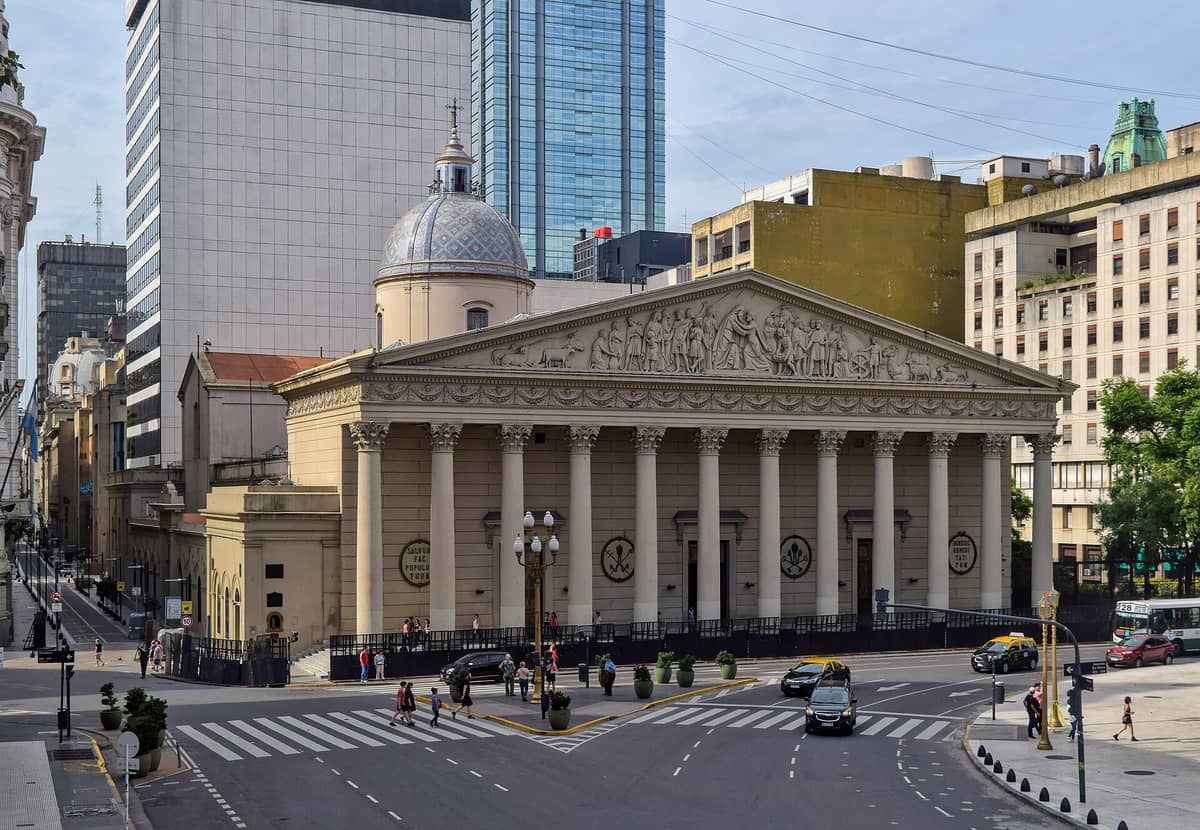
Standing on the northern edge of Plaza de Mayo, the Catedral Metropolitana de Buenos Aires is Argentina's most important Catholic church and the former archdiocese of Pope Francis. Entry is free, the interior holds the mausoleum of independence hero General José de San Martín, and the neoclassical colonnade makes it one of the most photographed facades in the country.
Quick Facts
- Location
- San Martín 27, San Nicolás (Centro), Buenos Aires (facing Plaza de Mayo)
- Getting There
- Subte Line A (Plaza de Mayo), Line D (Catedral), Line E (Bolívar)
- Time Needed
- 30–60 minutes for independent visit; up to 90 minutes with a guided tour
- Cost
- Free entry; donations welcome. Third-party guided tours are priced separately.
- Best for
- History enthusiasts, architecture admirers, travellers interested in religion and Argentine identity
- Official website
- catedralprimadabue.wixsite.com/buenosaires
What the Catedral Metropolitana Actually Is
The Catedral Metropolitana de Buenos Aires is not simply a church. It is the seat of the Archdiocese of Buenos Aires, the national mausoleum of General José de San Martín, and the place where Jorge Bergoglio led Mass as Archbishop before becoming Pope Francis in 2013. Those three facts alone place it in a category well above most religious buildings in South America.
It sits on the northern edge of Plaza de Mayo, sharing that foundational square with the Casa Rosada and the Cabildo. For Argentina, this is the symbolic center of the republic. The cathedral has faced the plaza since the colonial era, though the building you see today reflects centuries of reconstruction and refinement. The current neoclassical facade, with its triangular pediment supported by twelve Corinthian columns representing the twelve apostles, was completed in the early 19th century and remains one of the most recognizable architectural silhouettes in Buenos Aires.
ℹ️ Good to know
Opening hours reported as of 2025: Monday to Friday approximately 8:00–19:00, Saturday around 9:00–19:00, Sunday around 9:00–19:30. Hours on holidays may be reduced to around 10:00–15:00. Confirm locally before visiting, as these can shift without notice.
The Facade: What You See Before You Enter
Approaching from Plaza de Mayo, the cathedral does not announce itself with towers or spires the way most South American cathedrals do. The absence of a bell tower is intentional, a legacy of its neoclassical redesign, and it gives the building an unusually horizontal presence. The colonnade stretches across the entire width of the facade, and above the frieze runs a bas-relief carved in the early 19th century depicting the biblical meeting of Jacob and Esau, a detail most visitors walk past without noticing.
Morning light falls directly on the facade between roughly 9:00 and 11:00, making that window ideal for photography. By midday the facade is in partial shadow depending on season, and afternoon light shifts to the sides. The columns photograph well from a slight diagonal angle from the plaza, which also captures the surrounding streetscape of Microcentro.
The plaza itself provides natural context for the cathedral visit. Combining both in a single morning walk is straightforward, and the Plaza de Mayo is directly in front of you as you exit, with the Casa Rosada visible to the east. Allow time for both.
Tickets & tours
Live prices and dates from our booking partner. If you book, we may earn a commission at no extra cost to you.
Buenos Aires small-group city tour with optional lunch and cruise
From 25 €Instant confirmationFree cancellationBuenos Aires shopping tour
From 15 €Instant confirmationFree cancellationBuenos Aires private city tour with lunch in Puerto Madero
From 90 €Instant confirmationFree cancellationPrivate city tour of Buenos Aires including the Old Underground Tunnels
From 314 €Instant confirmationFree cancellation
Inside the Cathedral: Light, Silence, and San Martín
Stepping through the main doors, the interior is cooler than the street by several degrees, a noticeable relief in Buenos Aires summers when temperatures can reach above 30°C. The nave is long and relatively narrow, lined with side chapels, and lit by tall arched windows that flood the central aisle with diffused white light in the morning hours. The faint smell of incense is almost always present, particularly near the side altars where candles burn through the day.
The dominant feature is the mausoleum of General José de San Martín, positioned to the right as you enter. San Martín is one of the few figures revered across multiple South American nations, having led liberation campaigns in Argentina, Chile, and Peru. His remains were transferred here in 1880, and the marble sarcophagus is guarded by soldiers of the Regiment of Grenadiers on Horseback, dressed in period uniform. An eternal flame burns at the entrance to the mausoleum. The ceremony of the changing of the guard takes place periodically and is worth pausing for if you happen to be present.
The high altar at the far end of the nave is gilded and ornate, a contrast to the relatively restrained exterior. Side chapels hold paintings and sculptures dating back several centuries, including pieces that predate the current building's facade. Guided audio tours in multiple languages are available and provide considerably more context than the sparse in-room labeling, particularly for the smaller chapels and historic artworks.
💡 Local tip
The changing of the guard at San Martín's mausoleum draws brief clusters of onlookers but is short. Position yourself near the mausoleum entrance rather than behind the crowd if you want an unobstructed view.
How the Experience Changes by Time of Day
Weekday mornings between 8:00 and 10:00 are the quietest. Worshippers attend early Mass, tourists have not yet arrived in numbers, and the interior feels genuinely contemplative. The light through the nave windows is at its best in this window. If you want the cathedral largely to yourself, this is the time.
Between 11:00 and 14:00, the space fills with tour groups, many arriving as part of broader circuits of the Microcentro historic center. The nave can become congested near the mausoleum, and the ambient noise level rises considerably. Late afternoon, particularly on weekdays after 16:00, sees a second quieter period as day-trippers and business lunch crowds thin out. Weekend mornings are busier than equivalent weekday mornings due to a mix of Mass-goers and tourists, but weekend afternoons are calmer.
Summer (December through February) brings the largest tourist volumes to Buenos Aires overall, and the cathedral reflects this. Spring and autumn visits, particularly in April, May, October, and November, offer a more relaxed pace both inside the cathedral and around the plaza.
Historical and Cultural Context
The site of the cathedral has been used as a place of Catholic worship since the late 16th century, with the first permanent structure documented in that period. The building has been substantially rebuilt multiple times over the centuries due to structural failures and aesthetic ambition, with major phases of construction in the 17th and 18th centuries. The current neoclassical exterior, which replaced earlier Baroque elements, reflects the architectural tastes of the post-independence elite who sought to associate the new republic with European rationalism rather than colonial religious excess.
The connection to Pope Francis gives the cathedral an ongoing global relevance. Bergoglio served as Archbishop of Buenos Aires from 1998 until his election as pope in 2013, and he celebrated Mass here regularly during that period. For visitors interested in the broader Peronist and Catholic dimensions of Argentine political history, the story of Evita Perón also intersects with religious and state ceremony in this same plaza.
The Microcentro and Monserrat neighborhoods that surround the cathedral contain a dense concentration of historic architecture from the 19th and early 20th centuries. The nearby Cabildo de Buenos Aires and the Avenida de Mayo together form a walkable historic circuit that takes roughly two to three hours at an unhurried pace.
Getting There and Practical Notes
The cathedral is among the most accessible attractions in the city by public transport. Subte Line A stops directly at Plaza de Mayo station, Line D stops at Catedral station, and Line E at Bolívar station; all three form an interconnected complex next to the cathedral. Numerous bus lines also stop along Avenida de Mayo and Avenida Rivadavia, both of which border the plaza.
Entry is free. There is no queue to enter, no security checkpoint equivalent to what you would find at some major European cathedrals, and no dress code enforced at the door, though modest attire is appropriate. Bare shoulders and very short clothing may draw looks from other visitors but are not formally prohibited. Photography inside is generally permitted without flash, though this should be confirmed at the entrance as policies can be adjusted during services.
⚠️ What to skip
The area around Plaza de Mayo attracts pickpockets, particularly during political demonstrations, which occur with some regularity on and around the plaza. Keep bags zipped and close to your body when navigating the square in busy periods.
Wheelchair and mobility access details are not clearly documented in publicly available sources; contact the cathedral directly or check with your accommodation before visiting if this is a concern. For a broader look at the Microcentro area and what else to combine with this visit, see the Microcentro and Monserrat neighborhood guide.
Is the Cathedral Worth Your Time?
The short answer depends on what you are looking for. As a piece of sacred architecture, the interior is impressive but not extraordinary by world-cathedral standards. The nave lacks the soaring drama of, say, Buenos Aires' own Basílica del Santísimo Sacramento, and the decoration is more formal than emotionally overwhelming.
What makes the Catedral Metropolitana genuinely significant is its layered historical weight: the site of continuous Catholic presence since the city's founding, the resting place of Argentina's most revered independence figure, and the former pulpit of a man who would become pope. For anyone interested in Argentine history, national identity, or the intersection of church and state in Latin America, this building rewards a visit and careful attention. For travellers focused purely on colonial Baroque interiors or spectacular ecclesiastical art, it is less of a priority.
Travellers with very limited time who are already visiting Plaza de Mayo for the Casa Rosada should simply walk in, as it requires almost no detour and adds meaningful context to the neighborhood. Those who are not visiting Plaza de Mayo and have no interest in Argentine history may reasonably prioritize other city attractions.
Insider Tips
- The bas-relief frieze above the colonnade depicting Joseph and his brothers is almost universally ignored by visitors. Step back to the center of the plaza and look up at it before entering.
- If you are visiting on a weekday, the 8:00 Mass draws a small, local congregation and is a completely different atmosphere from midday tourist traffic. The space during Mass is quiet enough to hear footsteps on stone.
- Audio guides are available in multiple languages and are significantly more informative than any free signage inside. If you want to understand the side chapels and their artworks, the audio guide is worth the small cost.
- The mausoleum guard change happens at specific intervals rather than on a published hourly schedule. Ask a cathedral attendant when you arrive if you want to time your visit around it.
- Combine the cathedral with a walk down Avenida de Mayo toward the Congreso building. The architectural quality of that corridor is high, and it takes you past Café Tortoni, one of the oldest cafés in South America.
Who Is Catedral Metropolitana de Buenos Aires For?
- History travellers interested in Argentine independence and the legacy of San Martín
- Catholic visitors or those curious about Pope Francis and his Buenos Aires years
- Architecture enthusiasts studying neoclassical design in a Latin American context
- First-time visitors to Buenos Aires who want to understand the symbolic center of the city
- Travellers already visiting Plaza de Mayo who want to add depth to the surrounding area
Nearby Attractions
Other things to see while in Microcentro & Monserrat:
- Avenida Corrientes
Avenida Corrientes is the cultural backbone of central Buenos Aires, a long avenue lined with independent bookshops, mid-century theatres, and late-night pizzerias. Free to walk at any hour, it rewards visitors who linger past midnight as much as those who arrive at noon.
- Avenida de Mayo
Stretching 1.35 km through the heart of Buenos Aires, Avenida de Mayo connects the seat of government at Plaza de Mayo to the National Congress. Inaugurated in 1894 and declared a National Historic Site in 1997, it remains the city's most architecturally dense corridor — free to walk, open at all hours, and best explored at a deliberate pace.
- Cabildo de Buenos Aires
Standing at the western end of Plaza de Mayo, the Cabildo de Buenos Aires is where Argentina's independence process began in May 1810. Today it operates as the Museo Nacional del Cabildo de Buenos Aires y de la Revolución de Mayo, offering free admission and a carefully curated look at colonial-era governance and revolutionary history. Few buildings in the country carry this much political and architectural weight.
- Café Tortoni
Founded in 1858 on Avenida de Mayo, Gran Café Tortoni is the oldest continuously operating café in Buenos Aires. Its marble counters, stained-glass ceilings, and literary history make it one of the city's most photographed interiors — though the lines outside and tourist-oriented service mean expectations need calibrating before you walk in.
Planning a trip? Discover personalized activities with the Nomado app.