El Ateneo Grand Splendid: Inside Buenos Aires' Most Spectacular Bookstore
Once a grand theater, El Ateneo Grand Splendid on Avenida Santa Fe is now a working bookstore where the original stage, balconies, and painted dome have been preserved in full. Entry is free, the café sits where performers once stood, and the sheer scale of the space stops first-time visitors in their tracks.
Quick Facts
- Location
- Av. Santa Fe 1860, Recoleta/Barrio Norte, Buenos Aires
- Getting There
- Subte Line D (Callao station), multiple bus lines along Av. Santa Fe
- Time Needed
- 45–90 minutes to browse properly; add 20 min for café
- Cost
- Free entry to bookstore; paid interactive exhibition on 3rd floor (ticketed, check current price on site)
- Best for
- Architecture lovers, book enthusiasts, photographers, and anyone with an hour to spare in Recoleta
- Official website
- www.yenny-elateneo.com
What El Ateneo Grand Splendid Actually Is
El Ateneo Grand Splendid is a working bookstore inside a fully preserved early 20th-century theater on Avenida Santa Fe, in the Recoleta and Barrio Norte area of Buenos Aires. The official name is Librería El Ateneo Grand Splendid, and the distinction matters: this is not a museum with books as props, nor a cafe with shelves on the walls. It is a serious retail bookstore, well-stocked across multiple floors, that happens to occupy one of the most architecturally remarkable interiors in South America.
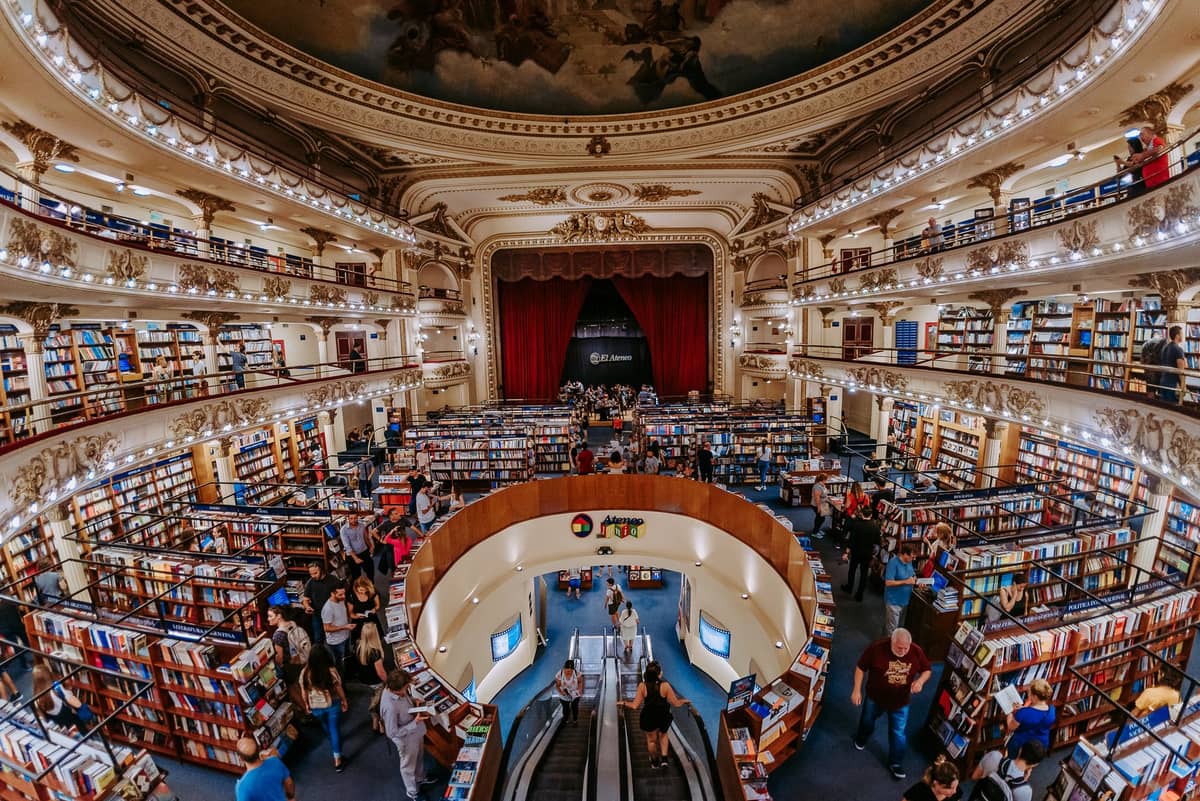
The theater opened in 1919 as the Grand Splendid, hosting opera, tango performances, and radio broadcasts in an era when Avenida Santa Fe was the cultural spine of the city. The stage, painted ceiling dome, gilded balcony tiers, and decorative side boxes were all retained when the El Ateneo chain converted the space into a bookstore. The stage itself now houses a cafe, where you can order coffee and sit on the exact boards where performers once stood.
ℹ️ Good to know
Entry to the main bookstore is completely free. You can walk in, explore all public floors, sit in the balcony reading areas, and admire the dome without spending a peso. A paid interactive exhibition is now open on the third floor — verify the current ticket price at the venue or on the official website before visiting.
The Architecture: What to Look at and Where to Stand
The impact of the space hits you at the entrance, not gradually. Walking in from the relatively ordinary Avenida Santa Fe streetfront, you step into a full theater volume — with a central stalls area and four encircling balcony levels, all of it open to the painted dome above. The proportions are theatrical in the literal sense: designed to impress from the moment you enter.
The best single vantage point is the second-level balcony, reached by the internal stairs at either side of the ground floor. From there you can take in the dome, the painted ceiling fresco, the curve of the ornamental boxes, and the cafe stage below in a single view. This is where most photographers position themselves, and for good reason. The ground floor between the original stall rows is where most of the bookshelves sit, and it tends to be more crowded and harder to appreciate architecturally.
The preserved theatrical boxes along the side walls have been converted into reading alcoves and specialty sections. Each one has a curtain, original gilded trim, and enough space for a chair. If you find one unoccupied, sitting in one and looking across at the opposite side of the theater gives a completely different sense of the scale of the interior.
For context on how El Ateneo fits into Buenos Aires' broader tradition of ambitious civic architecture, the Buenos Aires architecture guide covers the city's Belle Époque and early 20th-century building heritage in detail.
Tickets & tours
Live prices and dates from our booking partner. If you book, we may earn a commission at no extra cost to you.
Madero Tango Show tickets with optional dinner
From 32 €Instant confirmationFree cancellationBuenos Aires small-group city tour with optional lunch and cruise
From 25 €Instant confirmationFree cancellationPiazzolla Tango Show VIP tickets with transfer and optional dinner
From 112 €Instant confirmationFree cancellationBuenos Aires shopping tour
From 15 €Instant confirmationFree cancellation
How the Experience Changes by Time of Day
Weekday mornings, roughly 9:00 to 11:30, are when the bookstore functions most like a bookstore. The tour groups have not yet arrived, the light through the dome is soft and even, and you can browse the shelves without navigating crowds. Locals come in to buy specific titles, the cafe on the stage is quieter, and the balcony seats are genuinely available for sitting and reading.
From midday onward, and heavily on weekends, the flow shifts toward visitors rather than browsers. The ground floor can feel congested between noon and 3pm on Saturdays, with groups pausing to photograph the dome from the center of the stalls. The experience does not become unpleasant, but it changes character. If you are there primarily for the architecture rather than the books, early afternoon on a weekday still works well, and Friday evenings (the bookstore is open until midnight on Fridays and Saturdays) offer a surprisingly calm alternative to the weekend rush.
Evening visits have a different mood entirely. The interior lighting shifts from natural dome light to warm artificial illumination, which changes the color palette of the painted ceiling and gives the space a more intimate, theatrical quality. The cafe on the stage tends to be busy Friday and Saturday evenings, but the upper balconies empty out considerably after 9pm.
💡 Local tip
For photography: arrive before 10am on a weekday for the best dome light and an empty central floor. Bring a wide-angle lens or use your phone's ultra-wide mode — a standard focal length cannot capture the full height of the interior from the ground floor.
The Cafe on the Stage
The cafe occupying the former stage is one of those conceptual details that sounds gimmicky until you are actually sitting there. The original stage boards and proscenium arch have been retained, and seating fills the stage area with small tables. Looking out from a seat on the stage, you see the bookshelf-lined stalls, the rising balcony tiers, and the dome — the same view an actor or musician would have had facing an audience in 1919.
The food and drink are straightforward cafe fare: coffee, pastries, sandwiches, and medialunas. This is not a destination cafe on culinary merit, but the setting makes it worth a coffee and a pause. Service can be slow during peak hours, which is worth factoring in if you have a timed itinerary.
💡 Local tip
If the stage cafe has a long wait, note that there is a second, smaller cafe area on one of the upper levels. It is less dramatic as a setting but often has immediate seating.
Getting There and Practical Logistics
The bookstore is at Av. Santa Fe 1860, between Callao and Riobamba, in the Recoleta and Barrio Norte area. The nearest Subte station is Callao on Line D, within a few minutes' walk. Numerous bus routes run along Avenida Santa Fe and connect the area to the wider city. The neighborhood is safe, well-lit, and easy to navigate on foot.
Recoleta as a whole rewards a longer visit. The Recoleta Cemetery is around a 10-minute walk south, and the Museo Nacional de Bellas Artes is in the same direction. Combining El Ateneo with an afternoon in Recoleta makes for a logical and manageable half-day.
Opening hours as listed by the official Buenos Aires tourism authority: Monday to Thursday 9:00 to 22:00, Friday and Saturday 9:00 to midnight, Sunday 12:00 to 22:00. Hours can change on public holidays, so if you are visiting around a national holiday, check the official website or call ahead. There is no coat check or bag storage.
⚠️ What to skip
The bookstore's collection skews heavily toward Spanish-language titles. The English-language section is small. If you are looking for specific English books to buy, manage expectations before visiting — El Ateneo is worth visiting for the space, not the English-language stock.
Accessibility and Who Might Want to Skip This
The bookstore occupies multiple levels connected by internal stairs. Detailed information about elevator access and mobility-specific facilities is not consistently available in public sources, so visitors with reduced mobility should contact the venue directly before visiting to confirm what is accessible.
El Ateneo Grand Splendid is genuinely worth visiting, but it helps to calibrate expectations. The architectural experience is real and impressive. The bookstore itself is a functional retail space, not a curated cultural institution with editorial depth. If you have no interest in architecture or theater history, and you are only going because it appears on a list, you may find 20 minutes sufficient. The space works best for people who want to slow down, sit somewhere beautiful, and absorb the detail of the interior.
Those planning a broader cultural day in the area might also consider the Centro Cultural Recoleta, which often hosts free contemporary art exhibitions a short walk away.
The Third-Floor Interactive Exhibition
In 2026, a paid interactive exhibition was introduced on the third floor, featuring themed stations and a video room dedicated to Carlos Gardel, the tango icon closely associated with Buenos Aires. This is separate from the main bookstore floors and requires a ticket. Prices are not listed publicly and may be updated seasonally, so check at the venue or via the official website before visiting. The exhibition is optional and does not affect access to the rest of the building.
Insider Tips
- The ornamental side boxes along the theater walls have been converted into reading alcoves — if you find one free, step inside and sit for a moment. The view across the theater from inside a box is one of the best perspectives in the building and most visitors walk straight past them.
- Weekday mornings before 10:30am are reliably uncrowded. If your schedule is flexible, this is when the space functions best as both an architectural experience and a bookstore visit.
- The upper balconies have seats and reading chairs intended for use. You can pick up a book, sit in a balcony seat with the dome above you, and read for as long as you like — no purchase required.
- Friday and Saturday evenings (the store stays open until midnight) are an underused window for visitors who want the dramatic evening lighting without weekend afternoon crowds.
- If you are using the Subte, note that Line D runs directly along Avenida Santa Fe and connects this area to Palermo in one direction and the Microcentro in the other, making it easy to chain El Ateneo into a longer route across the city.
Who Is El Ateneo Grand Splendid For?
- Architecture and design enthusiasts who want to understand how Buenos Aires' early 20th-century building ambition translated into public space
- Photographers looking for a dramatic interior that does not require a ticket or special access
- Book lovers who read Spanish fluently and want a genuinely well-stocked general bookstore in a remarkable setting
- Travelers who want a quieter, slower stop between outdoor sights in Recoleta
- Couples looking for somewhere to sit, have a coffee on a former theater stage, and linger without a fixed agenda
Nearby Attractions
Other things to see while in Recoleta:
- Basílica Nuestra Señora del Pilar
Standing directly beside the Recoleta Cemetery, the Basílica Nuestra Señora del Pilar is one of the oldest churches in Buenos Aires. Built in the 18th century as part of a Franciscan convent complex, it offers free entry, a small cloister museum, and a rare moment of quiet in one of the city's most visited corners.
- Biblioteca Nacional Mariano Moreno
The Biblioteca Nacional Mariano Moreno is Argentina's main national library, a striking Brutalist landmark in Recoleta that has safeguarded the country's literary and documentary heritage since its founding in 1810. Entry is free, the building is architecturally significant, and the reading rooms offer a rare window into Buenos Aires intellectual life.
- Cementerio de la Recoleta
The Cementerio de la Recoleta is a 13-hectare open-air monument to Argentina's political elite, military heroes, and cultural icons, mapped out in streets of carved marble, wrought iron, and crumbling Art Deco grandeur. It is where Eva Perón is buried, but the cemetery rewards those who wander beyond her tomb. Few attractions in Buenos Aires deliver this much history, beauty, and quiet drama in a single visit.
- Centro Cultural Recoleta
The Centro Cultural Recoleta is a large public cultural center in Recoleta, Buenos Aires, offering rotating contemporary art exhibitions, film screenings, and live performances across 27 rooms and additional dedicated spaces. Entry is free for Argentine residents and low-cost for international visitors, making it one of the most accessible cultural institutions in the city.
Planning a trip? Discover personalized activities with the Nomado app.