Cementerio de la Recoleta: Argentina's Most Extraordinary Cemetery
The Cementerio de la Recoleta is a 13-hectare open-air monument to Argentina's political elite, military heroes, and cultural icons, mapped out in streets of carved marble, wrought iron, and crumbling Art Deco grandeur. It is where Eva Perón is buried, but the cemetery rewards those who wander beyond her tomb. Few attractions in Buenos Aires deliver this much history, beauty, and quiet drama in a single visit.
Quick Facts
- Location
- Junín 1760, Recoleta, Buenos Aires (C1113), near Plaza Francia
- Getting There
- Multiple city bus lines stop on Av. del Libertador and Av. Las Heras; no direct Subte station, but taxis and ride-hailing apps drop off at the gate
- Time Needed
- 1.5 to 3 hours for self-guided; up to 4 hours with a guided tour
- Cost
- Free for Argentine residents with DNI. Foreign visitors pay an entrance fee (AR$ 24,030 as of mid-2026, card payment only — verify current rate before visiting as prices are inflation-indexed)
- Best for
- History enthusiasts, architecture lovers, photography, solo travelers, cultural immersion
What the Cementerio de la Recoleta Actually Is
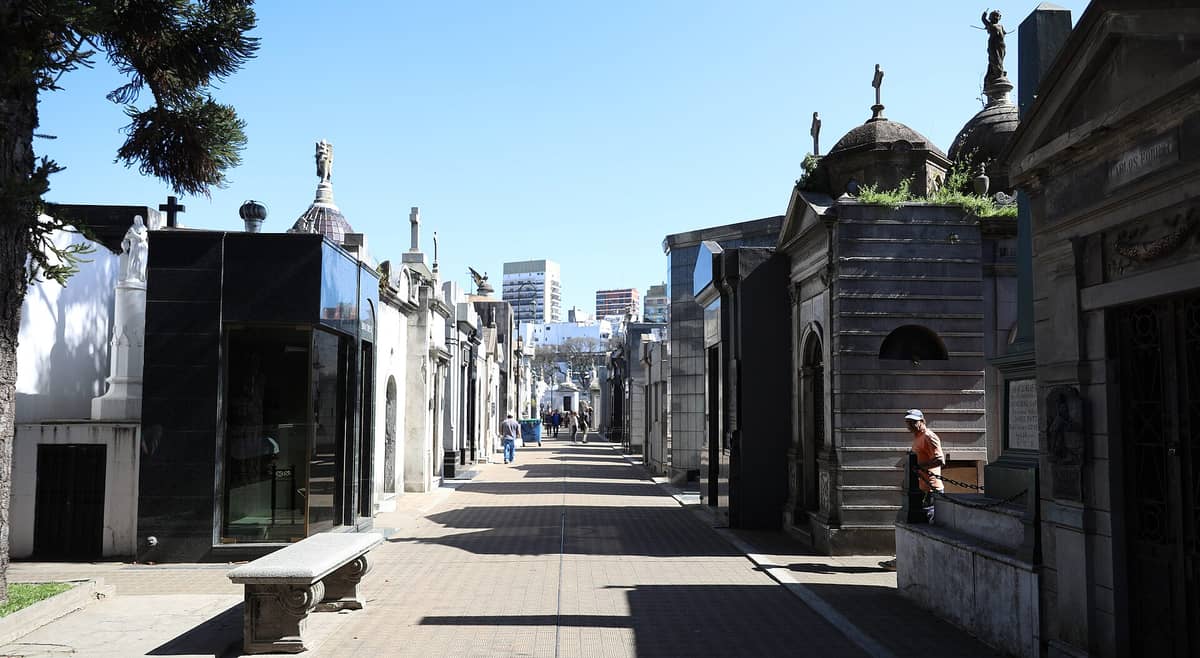
The Cementerio de la Recoleta is not a garden cemetery in the European pastoral tradition. It is a city within a city: a dense grid of streets lined with family mausoleums that range from neoclassical temples to crumbling Art Nouveau chambers, from polished black granite to sun-bleached limestone streaked with Buenos Aires' subtropical rains. Cats sleep on ledges. Pigeons roost under bronze angels. Somewhere in here, behind a simple slab of black marble, lies Eva Perón.
Opened in 1822 on land that once served as the orchard of the adjacent Recollect monks' convent and the Basílica Nuestra Señora del Pilar, Recoleta Cemetery was Buenos Aires' first public burial ground. From its earliest decades it became the resting place of the country's governing class: presidents, generals, Nobel laureates, industrialists, and founding families whose surnames still appear on street signs throughout the city. The result is a single 13-hectare block that compresses two centuries of Argentine political and cultural history into walkable lanes.
ℹ️ Good to know
Opening hours: daily 8:00–18:00 (tourist visiting hours typically 9:00–17:00). Foreign visitors pay by credit or debit card only at the entrance — cash is not accepted. Verify current fees before your visit, as prices are adjusted for inflation.
How the Experience Changes by Time of Day
Arrive at 9:00 on a weekday and you will often have the central avenues almost to yourself. The light at this hour cuts low through gaps between mausoleums, catching the faces of marble saints and the corroded green of bronze doors in a way that mid-day sun simply flattens. The air smells faintly of cut stone and old flowers, with the occasional whiff of incense from the basilica next door. The cats that live semi-wild inside the cemetery are active and visible; by noon they have retreated into shade.
By mid-morning, tour groups begin arriving in earnest, clustering tightly at Eva Perón's tomb in the Duarte family vault. The narrow lane leading there can feel genuinely crowded between 10:30 and 13:00. If you want a quiet moment at her grave, either arrive when the cemetery opens or come after 15:00, when groups thin out. The rest of the cemetery, even on busy days, absorbs visitors easily. The interior blocks away from the main entrance path remain calm even at peak hours.
Late afternoon brings a different quality. The shadows lengthen, the tourist buses depart, and the place settles into something more genuinely contemplative. On overcast days, the grey stone and dark ironwork take on a Gothic weight that photographs cannot quite capture but is immediately felt. Rain intensifies everything: the smell of the stone, the drip from stone eaves, the moss on older vaults. A light drizzle is not a reason to skip the visit.
Tickets & tours
Live prices and dates from our booking partner. If you book, we may earn a commission at no extra cost to you.
Recoleta and Palermo Bike Tour in Buenos Aires
From 43 €Instant confirmationFree cancellationMadero Tango Show tickets with optional dinner
From 32 €Instant confirmationFree cancellationBuenos Aires small-group city tour with optional lunch and cruise
From 25 €Instant confirmationFree cancellationPiazzolla Tango Show VIP tickets with transfer and optional dinner
From 112 €Instant confirmationFree cancellation
Navigating the Cemetery: What to Look For
The cemetery is organized into numbered lots accessible via named avenues, but most visitors navigate by feel rather than map. That is a reasonable approach, but a few reference points help orient you. The main entrance on Junín opens onto a central avenue that runs straight to the back of the cemetery. The Eva Perón / Duarte family vault is located in a lateral section roughly two-thirds of the way in from the entrance; follow the small signs or, more reliably, the cluster of other visitors.
Beyond Evita, the cemetery rewards those who turn off the main path. Look for the tomb of Rufina Cambaceres, a young woman buried in 1902 who, according to a story that has become part of Buenos Aires folklore, may have been interred alive after being mistaken for dead. Her life-size marble effigy stands at her mausoleum door, one hand on the handle as if caught mid-step, and the detail of her carved dress and expression is extraordinary by any standard of funerary art.
The architectural range across the cemetery is genuinely striking. There are Egyptian Revival obelisks, French Baroque chapels with stained glass, severe Modernist concrete slabs from the 1950s, and family vaults so old that the inscriptions have worn to near-illegibility. Some are immaculately maintained, their brass fittings polished and fresh flowers inside. Others are in various states of decay, doors rusted open, interiors visible, plaster fallen from walls. Both states are part of the experience.
💡 Local tip
Pick up a free map at the entrance. The main paths are easy to follow, but the interior grid can disorient. If you want to find specific tombs beyond Evita's, a guided tour or downloaded map with lot numbers is worth having.
Eva Perón's Tomb: Context and Reality
No mention of this cemetery is complete without addressing what most visitors come to see. Eva Perón, known across Argentina as Evita, died in 1952 at age 33. Her body was embalmed, subsequently stolen during a military coup, lost for 16 years, returned to Argentina, and finally interred in the Duarte family vault at Recoleta Cemetery in October 1976. The vault itself is unassuming relative to its neighbors: a polished black granite structure with a small plaque and, usually, fresh flowers. For Argentine visitors, particularly older ones, it is a place of real emotion. For foreign visitors unfamiliar with her story, the full account of Evita's life and legacy provides essential context before the visit.
The tomb is not grand. Visitors who arrive expecting a monument on the scale of her cultural significance often find the simplicity disorienting. That contrast — the modesty of the marker against the weight of the history — is arguably the most interesting thing about it. There is usually a queue of 10 to 20 people waiting to photograph or stand at the vault. Respectful behavior is expected and generally observed.
Photography, Access, and Practical Details
Photography is permitted throughout the cemetery and the open-air lanes offer exceptional material at almost any hour. For architectural detail shots, morning and late afternoon light works best. The cemetery's narrow passages create strong directional shadows in mid-morning that suit black-and-white photography particularly well. If you are shooting for color, overcast light produces even, saturated tones on the marble and bronze without the harsh contrasts of direct midday sun.
The entrance on Junín 1760 is the only public access point. Foreign visitors pay by credit or debit card; there is no cash option at the gate. Argentine nationals with a DNI enter free. The admission fee for foreign visitors fluctuates with inflation, so treat any specific figure here as approximate and confirm the current rate through the official Buenos Aires city tourism portal before your visit.
Accessibility is partial. The cemetery has ramps and is technically wheelchair accessible at the entrance and along the main central avenues. However, many of the interior paths are laid with uneven stone, and the side passages between vaults can be narrow and difficult to navigate in a wheelchair or with a mobility aid. Visitors with significant mobility limitations should focus on the central lanes and plan accordingly. The Basílica Nuestra Señora del Pilar immediately adjacent to the cemetery entrance is a worthwhile stop with better general accessibility.
⚠️ What to skip
Wear comfortable flat shoes. The stone paths throughout the cemetery are uneven, and the narrow lanes between vaults can be slippery after rain. Heels and thin-soled sandals are a poor choice here.
The Surrounding Recoleta Neighborhood
The Cementerio de la Recoleta sits at the center of one of Buenos Aires' most architecturally coherent neighborhoods. The area around Plaza Francia and Plaza Alvear, immediately outside the cemetery gates, is lined with Haussmann-influenced apartment buildings, French-style mansions, and institutions that reflect the wealth this district accumulated in the late 19th century. The weekend artisan fair on Plaza Francia draws local families and is a natural pre- or post-cemetery stop. The Centro Cultural Recoleta shares the same block as the cemetery and regularly hosts free contemporary art exhibitions — worth checking what is on during your visit.
A short walk east connects you with the green lung of the city at the Museo Nacional de Bellas Artes, Argentina's main fine arts collection, which is free to enter. North along Av. del Libertador leads toward Palermo's parks and gardens. The neighborhood as a whole is worth half a day rather than a rushed cemetery visit alone. For a deeper look at what Recoleta offers beyond the cemetery, the surrounding streets reward slow walking.
Guided Tours vs. Self-Guided Visits
Self-guided visits work perfectly well if you have a basic map and an interest in wandering. The cemetery rewards curiosity rather than a checklist approach. However, a good guided tour adds substantial value if Argentine history is genuinely interesting to you. Guides who specialize in the cemetery explain the political contexts behind specific tombs, tell the stories behind the funerary sculpture choices, and navigate you to lesser-known mausoleums that most self-guided visitors walk past entirely.
The city of Buenos Aires periodically offers official guided visits through the cemetery; check the Buenos Aires government tourism portal for current schedules. Several private operators offer English-language guided tours, typically lasting 90 minutes to 2 hours. These can be booked independently of the entrance ticket. Free walking tour operators in Buenos Aires also cover the cemetery as part of broader Recoleta neighborhood tours.
If you are building a broader itinerary, the cemetery fits naturally into a walking morning that also takes in the nearby basilica, the Centro Cultural Recoleta, and lunch in the neighborhood. See the Buenos Aires walking tours guide for suggested route combinations.
Insider Tips
- The cats that live inside the cemetery are semi-feral but habituated to humans. They tend to cluster near the older, more overgrown sections toward the back and sides of the cemetery. If you are there in the morning, look for them on elevated ledges catching the early sun.
- Payment for foreign visitor tickets is card-only at the entrance. Do not arrive with only cash expecting to get in. If your card fails, the entrance staff have seen this before — having a backup card is worth it.
- The Duarte family vault (Evita's tomb) is signed from the main avenue, but the sign is small. Instead, simply follow the only dense cluster of other visitors and you will find it within two minutes of entering.
- The weekend artisan fair on Plaza Francia, immediately outside the cemetery's main gate, runs on Saturdays and Sundays (and public holidays). Arriving mid-morning gives you both the fair and a less crowded cemetery in one morning.
- Some of the most photographically interesting vaults are not famous ones. Walk the peripheral lanes near the back corners of the cemetery, where older, more decayed mausoleums sit largely unvisited. The ironwork on 19th-century doors in these sections is exceptional.
Who Is Cementerio de la Recoleta For?
- History and politics enthusiasts who want to read Argentine 19th and 20th century history through architecture and biography
- Architecture and design travelers drawn to the full range of funerary styles from neoclassical to Art Deco to brutalist
- Photography-focused visitors who want strong compositional material in natural light
- Solo travelers who prefer self-paced exploration without tour group timing pressures
- Anyone with an interest in Eva Perón who wants to connect her story to a physical place
Nearby Attractions
Other things to see while in Recoleta:
- Basílica Nuestra Señora del Pilar
Standing directly beside the Recoleta Cemetery, the Basílica Nuestra Señora del Pilar is one of the oldest churches in Buenos Aires. Built in the 18th century as part of a Franciscan convent complex, it offers free entry, a small cloister museum, and a rare moment of quiet in one of the city's most visited corners.
- Biblioteca Nacional Mariano Moreno
The Biblioteca Nacional Mariano Moreno is Argentina's main national library, a striking Brutalist landmark in Recoleta that has safeguarded the country's literary and documentary heritage since its founding in 1810. Entry is free, the building is architecturally significant, and the reading rooms offer a rare window into Buenos Aires intellectual life.
- Centro Cultural Recoleta
The Centro Cultural Recoleta is a large public cultural center in Recoleta, Buenos Aires, offering rotating contemporary art exhibitions, film screenings, and live performances across 27 rooms and additional dedicated spaces. Entry is free for Argentine residents and low-cost for international visitors, making it one of the most accessible cultural institutions in the city.
- El Ateneo Grand Splendid
Once a grand theater, El Ateneo Grand Splendid on Avenida Santa Fe is now a working bookstore where the original stage, balconies, and painted dome have been preserved in full. Entry is free, the café sits where performers once stood, and the sheer scale of the space stops first-time visitors in their tracks.
Planning a trip? Discover personalized activities with the Nomado app.