Museo Nacional de Bellas Artes: Argentina's Greatest Art Collection, Free to Enter
The Museo Nacional de Bellas Artes holds the most significant fine arts collection in Argentina, spanning European masters and Latin American artists across dozens of rooms in Recoleta. Admission to the permanent collection is free, making it one of the best-value cultural experiences in Buenos Aires.
Quick Facts
- Location
- Av. del Libertador 1473, Recoleta, Buenos Aires
- Getting There
- Subte Line H – Facultad de Derecho station (approx. 200 m walk); multiple bus lines including 10, 37, 41, 60, 67, 93 (SUBE card or contactless bank card/payment methods accepted).
- Time Needed
- 1.5 to 3 hours depending on pace
- Cost
- Free (permanent collection); some temporary exhibitions may charge a fee in ARS
- Best for
- Art enthusiasts, budget travelers, architecture admirers, cultural explorers
- Official website
- www.bellasartes.gob.ar
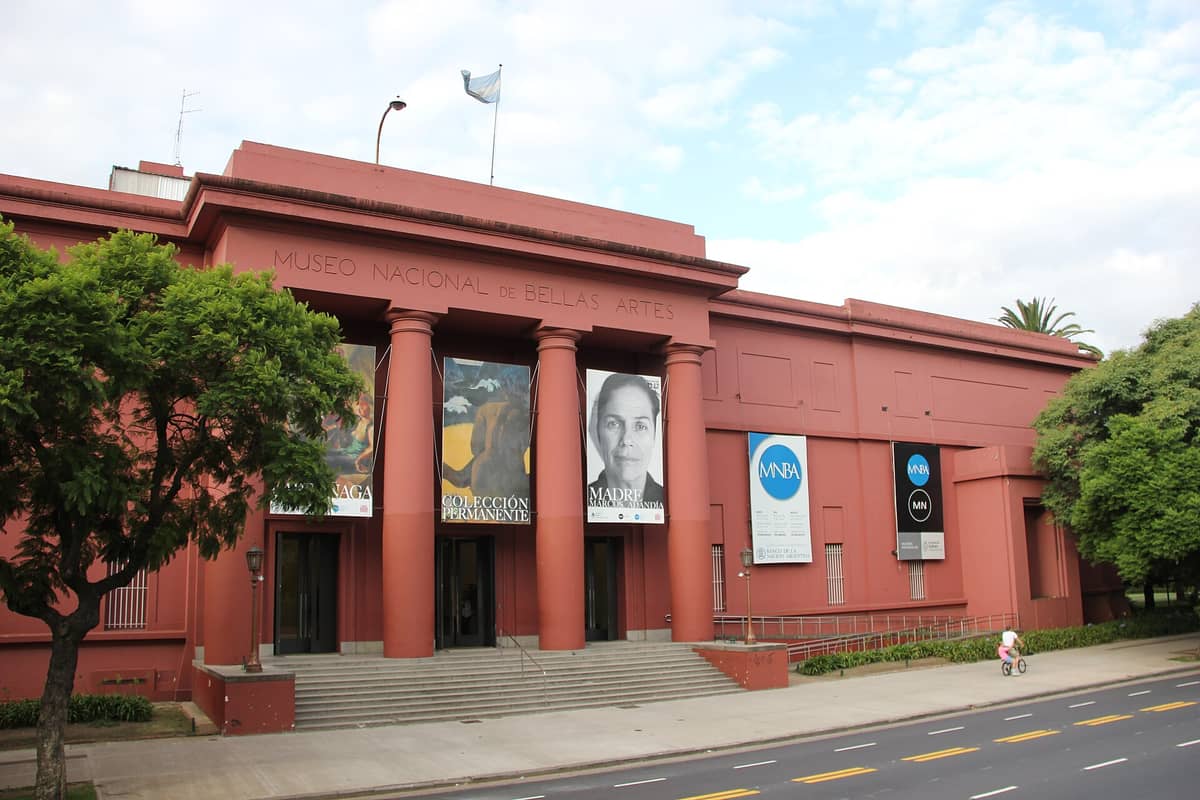
What the Museo Nacional de Bellas Artes Actually Is
The Museo Nacional de Bellas Artes, known in English as the National Museum of Fine Arts, is the most important fine arts institution in Argentina. It is a federal museum, administered under the national government, and houses a permanent collection that covers European painting from the medieval period through to early modernism, plus an extensive and often underappreciated Latin American collection. Unlike many great art museums around the world, entry to the permanent galleries is completely free.
The building sits on Avenida del Libertador in the Recoleta neighborhood, facing Plaza Intendente Alvear and positioned just a few minutes' walk from the landmark Recoleta Cemetery. The structure itself is modest from the outside compared to the grandeur of some European equivalents, but the interior is genuinely impressive in scale, with high ceilings, naturally lit galleries, and enough floor space to feel uncrowded even on busy afternoons.
ℹ️ Good to know
Opening hours: Tuesday to Friday, 11:00–19:30 (last entry); Saturday and Sunday, 10:00–19:30 (last entry). Closed Mondays and on certain public holidays including January 1, May 1, June 27, December 24, 25, and 31. Verify the current schedule at bellasartes.gob.ar before visiting.
The Collection: What You Will Actually See
The permanent collection spans around 12,000 works, though only a portion is displayed at any given time. European holdings include paintings by El Greco, Rubens, Rembrandt, Goya, and key Impressionist and Post-Impressionist figures including Monet, Renoir, Degas, and Van Gogh. For anyone who studies art history, walking these rooms feels immediately familiar yet surprising: works you have seen in textbooks appear here without the usual crowds or velvet ropes.
The Argentine and Latin American rooms are where the museum earns genuine authority. Artists like Prilidiano Pueyrredón, Eduardo Sívori, and Benito Quinquela Martín are well represented, and these galleries tend to be quieter and more contemplative than the European sections. If you arrive knowing nothing about Argentine art history, you will leave with a clear picture of how the country's artistic tradition developed from colonial-era portraiture through to 20th-century abstraction.
The sculpture garden on the museum's exterior grounds is easy to miss but worth five minutes of your time before or after your main visit. Several significant bronzes are installed in the open air, and the contrast between the sculptures and the tree-lined boulevard creates a good photograph regardless of season.
The museum's temporary exhibition programme changes throughout the year and may occasionally require a separate paid ticket in Argentine pesos. Check the schedule on the official website before your trip. If you plan to explore other major museums during your stay, the MALBA in Palermo and the Museum of Modern Art Buenos Aires offer complementary collections focused on Latin American and contemporary work.
Tickets & tours
Live prices and dates from our booking partner. If you book, we may earn a commission at no extra cost to you.
Boca Juniors Museum skip-the-line tickets
From 17 €Instant confirmationFree cancellationTour to La Boca Jrs and River Plates Stadiums and museums
From 99 €Instant confirmationFree cancellationRiver Stadium and Museum Official Guided Tour
From 33 €Instant confirmationFree cancellationParque de la Costa amusement park tickets with transfer
From 79 €Instant confirmationFree cancellation
When to Visit and How the Experience Changes
Tuesday to Friday mornings between 11:00 and 13:00 are the quietest windows. The galleries feel genuinely calm at this time: footsteps echo slightly on the stone floors, the air smells faintly of wax and climate-controlled wood paneling, and you can stand in front of major works without anyone else in the room. Weekend afternoons attract significantly more visitors, including local families and school groups, and the atmosphere shifts toward something noisier and more social.
Late afternoon on weekdays, from around 17:00, brings a second wave of visitors: students from the nearby Facultad de Derecho (the UBA Law School), local residents, and occasional tour groups. The natural light in the main upper galleries shifts noticeably at this time, becoming warmer and lower through the skylight sections. If you care about photography, the golden-hour light between 17:30 and 18:30 can be genuinely beautiful in the European painting rooms.
💡 Local tip
Photography is permitted in the permanent collection galleries without flash. Tripods are not allowed. The lighting in the upper-floor European rooms is best in the mid-afternoon when ambient natural light supplements the artificial lighting.
Buenos Aires has a humid subtropical climate, with summers (December to February) reaching above 30°C. On hot summer afternoons, the museum's air conditioning makes it a practical refuge as well as a cultural one. Winter visits (June to August) involve temperatures around 7 to 15°C outdoors, and the museum stays comfortable throughout.
Getting There and Navigating the Area
The most straightforward public transit option is Subte Line H to the Facultad de Derecho station, which leaves you approximately 200 metres from the museum entrance on Avenida del Libertador. The walk takes about three minutes along a well-maintained pavement past university buildings. Numerous bus lines also serve the area, including routes 10, 37, 38, 41, 59, 60, 67, 92, 93, 95, 102, 108, 110, 118, 124, 128, and 130. Buenos Aires buses require a SUBE card, the city's rechargeable transit smartcard, available at kiosks and some pharmacies.
The museum sits within easy walking distance of several other Recoleta landmarks. The Recoleta Cemetery is roughly five minutes on foot to the southwest. The Centro Cultural Recoleta is directly adjacent to the cemetery complex, making it practical to combine all three in a single half-day loop through the neighborhood.
The museum entrance on Avenida del Libertador has a ramp to the right of the main steps for step-free access. The interior has an elevator connecting floors, ramps in multiple sections, and Braille markings on stairways. Service dogs are permitted inside. If you have specific accessibility needs, the official website lists current facilities.
Architecture and Historical Context
The building on Avenida del Libertador was adapted for museum use and has undergone several renovations over the decades. It is not an original purpose-built gallery in the way of, for example, the Prado or the Louvre, and this shows in some of the internal circulation: corridors can feel slightly uneven in proportion, and some gallery connections are not immediately intuitive. Pick up a floor plan at the entrance information desk rather than trying to navigate by instinct.
Recoleta as a neighborhood has historically been associated with political and cultural institutions, upscale residential buildings, and French-influenced architecture from the late 19th and early 20th centuries. A visit to the Bellas Artes fits naturally into a broader exploration of Recoleta as a district, and those interested in Buenos Aires's architectural legacy will find additional context in the Buenos Aires architecture guide.
Practical Walkthrough: Making the Most of Your Visit
Plan to spend at least 90 minutes if you want to cover the main European and Argentine permanent galleries at a reasonable pace. Two to three hours is more comfortable if you intend to read room notes and spend time in front of individual works. The museum does not have a formal audio guide system as a standard offering, but free guided tours in Spanish are sometimes available on specific days: check the current schedule on the museum website or inquire at the front desk on arrival.
The museum has a small café area and a bookshop near the entrance. The bookshop carries a reasonable selection of art history titles in Spanish, exhibition catalogues, and prints. It is worth a look even if you are not buying, as the catalogue selection reflects the museum's current programmatic focus and occasionally includes out-of-print Argentine art history texts.
⚠️ What to skip
The museum is closed on Mondays and on key public holidays including New Year's Day, Labor Day (May 1), Christmas Eve, Christmas Day, and New Year's Eve. Always verify current holiday closures at bellasartes.gob.ar before planning your visit, as the schedule can change year to year.
There is no bag check size restriction explicitly noted at the entrance, but large backpacks are sometimes asked to be carried in front or stored. Standard museum rules apply: no food or drink in galleries, no touching artworks, no selfie sticks. The security staff are generally courteous and the overall atmosphere is relaxed rather than formal.
Visitors who find themselves disappointed should understand the museum's real strength is breadth and context rather than a handful of iconic blockbuster works. If you come expecting a single masterpiece that justifies the visit, you might leave underwhelmed. If you come to understand Argentine art and its European influences in one logical sequence, the layout and collection depth reward that kind of engagement.
Insider Tips
- Tuesday and Wednesday mornings between 11:00 and 13:00 are consistently the quietest periods. You can stand in front of the Van Gogh or the Goya works without another visitor in the room, which rarely happens at equivalent museums elsewhere in the world.
- The Argentine art rooms on the upper floor are the collection's most underappreciated section. Most international visitors spend the bulk of their time in the European galleries and rush through or skip the local holdings entirely. The works by Pueyrredón and Sívori offer context for understanding how Buenos Aires saw itself in the 19th century.
- The museum's exterior sculpture garden on the Avenida del Libertador side is unlabeled and easy to walk past. Walk the perimeter of the building before entering and you will find several significant bronzes installed in the open air.
- If a temporary exhibition is running, ask at the front desk whether it requires a separate ticket. Some are included with standard (free) entry; others have a fee in Argentine pesos. The distinction is not always clearly marked at the entrance.
- The Facultad de Derecho station on Line H is the closest Subte stop, but if you are coming from the city center via other lines, it may be faster to take a bus directly along Avenida del Libertador and alight at the museum stop rather than transferring underground.
Who Is Museo Nacional de Bellas Artes For?
- Art history enthusiasts who want to understand Latin American artistic tradition alongside European influences in a single visit
- Budget travelers: the free permanent collection makes this one of the most substantial no-cost cultural experiences in Buenos Aires
- Visitors on a hot afternoon looking for a serious air-conditioned destination rather than a casual refuge
- Architecture and design readers interested in how a repurposed civic building functions as a major national gallery
- Families with older children or teenagers with an interest in art: the scale is manageable and the galleries are calm enough for focused looking
Nearby Attractions
Other things to see while in Recoleta:
- Basílica Nuestra Señora del Pilar
Standing directly beside the Recoleta Cemetery, the Basílica Nuestra Señora del Pilar is one of the oldest churches in Buenos Aires. Built in the 18th century as part of a Franciscan convent complex, it offers free entry, a small cloister museum, and a rare moment of quiet in one of the city's most visited corners.
- Biblioteca Nacional Mariano Moreno
The Biblioteca Nacional Mariano Moreno is Argentina's main national library, a striking Brutalist landmark in Recoleta that has safeguarded the country's literary and documentary heritage since its founding in 1810. Entry is free, the building is architecturally significant, and the reading rooms offer a rare window into Buenos Aires intellectual life.
- Cementerio de la Recoleta
The Cementerio de la Recoleta is a 13-hectare open-air monument to Argentina's political elite, military heroes, and cultural icons, mapped out in streets of carved marble, wrought iron, and crumbling Art Deco grandeur. It is where Eva Perón is buried, but the cemetery rewards those who wander beyond her tomb. Few attractions in Buenos Aires deliver this much history, beauty, and quiet drama in a single visit.
- Centro Cultural Recoleta
The Centro Cultural Recoleta is a large public cultural center in Recoleta, Buenos Aires, offering rotating contemporary art exhibitions, film screenings, and live performances across 27 rooms and additional dedicated spaces. Entry is free for Argentine residents and low-cost for international visitors, making it one of the most accessible cultural institutions in the city.
Planning a trip? Discover personalized activities with the Nomado app.