Museo MALBA: Buenos Aires' Definitive Latin American Art Museum
The Museo de Arte Latinoamericano de Buenos Aires (MALBA) anchors Palermo's cultural strip with one of the continent's most significant collections of 20th-century Latin American art. From Frida Kahlo to Antonio Berni, the permanent collection rewards slow looking, while a bold rotation of temporary exhibitions keeps the experience fresh for repeat visitors.
Quick Facts
- Location
- Av. Figueroa Alcorta 3415, C1425CLA, Buenos Aires
- Getting There
- Bus lines along Av. del Libertador and Av. Figueroa Alcorta serve the area; no Subte stop is directly adjacent
- Time Needed
- 2 to 3 hours for the permanent collection; half a day if temporary exhibitions are on
- Cost
- ARS 12,000 general admission (verify current price before visiting); discounted rates available for students, teachers, seniors, and other eligible categories
- Best for
- Art lovers, architecture enthusiasts, solo travellers, and anyone with a genuine interest in Latin American cultural history
- Official website
- malba.org.ar/en
What MALBA Actually Is
The Museo de Arte Latinoamericano de Buenos Aires, universally known as MALBA, is the most focused and rigorously curated institution of Latin American art in Argentina. Founded on the private collection of entrepreneur Eduardo Costantini, the museum opened in 2001 in a purpose-built building on Avenida Figueroa Alcorta, in the northern stretch of Palermo. It does not try to be encyclopedic. Instead, it presents roughly 200 works from the permanent collection, drawing from across the continent and spanning the late 19th century through the 1990s, selected for quality and coherence rather than sheer volume.
The collection's heaviest concentration falls on the first half of the 20th century, when Latin American artists were wrestling simultaneously with European modernism and their own political and social realities. Tarsila do Amaral, Antonio Berni, Diego Rivera, Frida Kahlo, Wifredo Lam, and Xul Solar all appear in the permanent galleries. These are not minor works shuffled into a regional footnote; several pieces are considered defining examples of each artist's output.
ℹ️ Good to know
Hours: Monday 12:00–20:00; Tuesday closed; Wednesday 11:00–20:00; Thursday, Friday, Saturday, and Sunday 12:00–20:00. The museum closes at 18:00 on December 24 and 31, and is shut entirely on December 25 and January 1. Always check the official website before visiting, as hours and holiday schedules can change.
The Building: Architecture as Statement
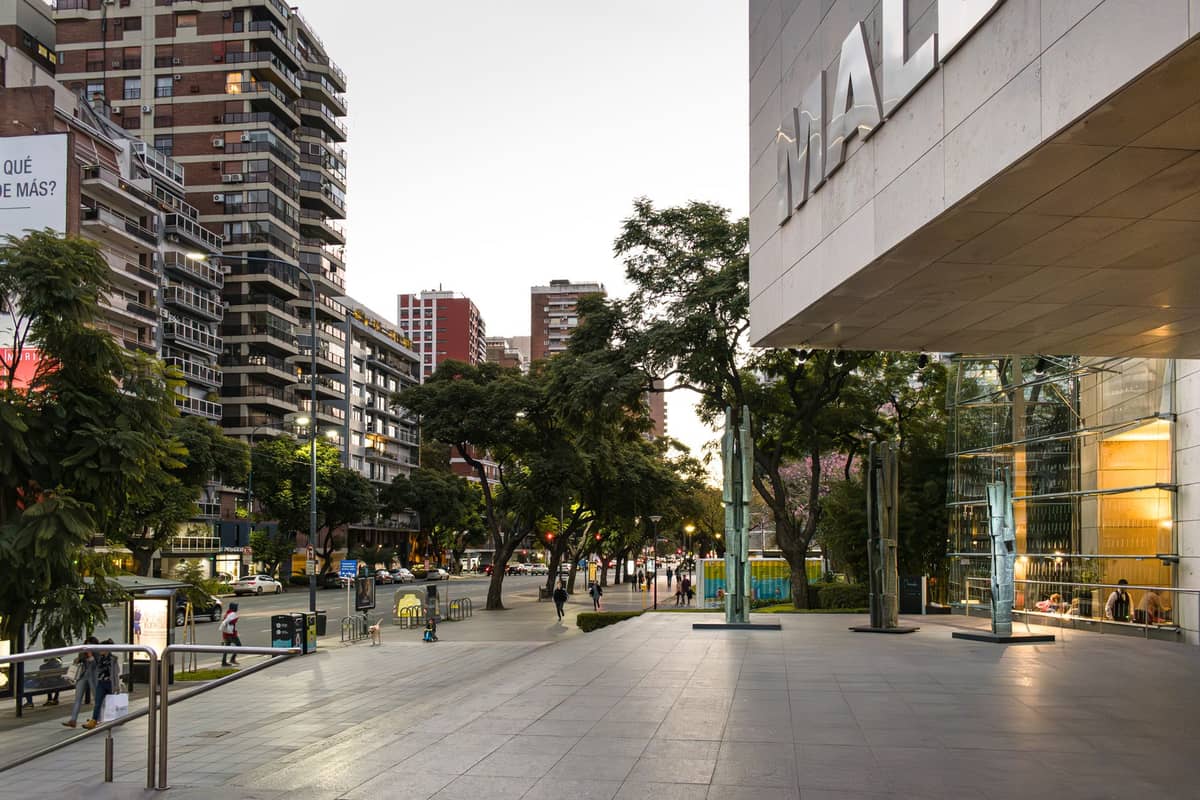
The MALBA building, designed by Argentine architects Gastón Atelman, Martín Fourcade, and Alfredo Tapia, is itself worth studying before you walk through the door. The facade presents a bold triangular glass volume that projects over the entrance, catching northern light and signaling something different from the classical-revival institutions lining nearby avenues. The geometry is sharp and angular, with exposed concrete that ages into the landscape rather than fighting it.
Inside, the atrium is high, airy, and deliberately unhurried in scale. Natural light filters down from above, making the transition from street noise to gallery quiet feel gradual rather than abrupt. The staircase connecting floors is broad enough that it functions almost as a promenade, letting you pause on each landing and orient yourself without feeling rushed toward the next room. For a museum of this size, the circulation is unusually intelligent.
If architecture is a specific interest, MALBA fits well into a broader exploration of the city's building heritage. The Buenos Aires architecture guide covers the full range from Beaux-Arts landmarks to contemporary interventions like this one.
Tickets & tours
Live prices and dates from our booking partner. If you book, we may earn a commission at no extra cost to you.
Boca Juniors Museum skip-the-line tickets
From 17 €Instant confirmationFree cancellationTour to La Boca Jrs and River Plates Stadiums and museums
From 99 €Instant confirmationFree cancellationRiver Stadium and Museum Official Guided Tour
From 33 €Instant confirmationFree cancellationParque de la Costa amusement park tickets with transfer
From 79 €Instant confirmationFree cancellation
Navigating the Permanent Collection
The permanent galleries are arranged thematically and chronologically across multiple levels. The early 20th-century rooms introduce the tension between European influence and distinctly Latin American subject matter: Amazonian geometry in do Amaral's work, the weight of poverty and labor in Berni's realist canvases, the compressed symbolism of Kahlo. These are not works you can walk past in thirty seconds.
Mid-century abstraction and kinetic art occupy a separate gallery section, where artists from Venezuela, Argentina, and Brazil converged on optical and movement-based experiments that were genuinely innovative for their period. The later rooms move into conceptual and political work from the 1960s through the 1980s, where the collection becomes more challenging and, for some visitors, more rewarding.
Signage is bilingual in Spanish and English throughout, which is not guaranteed at smaller Buenos Aires institutions. Audio guides are available to visitors and add meaningful depth to works where the historical context is not immediately legible to non-specialist visitors.
💡 Local tip
The Wednesday opening at 11:00 (one hour earlier than other days) is one of the quieter windows. Weekday mornings between 11:00 and 13:00 see the fewest visitors. Weekend afternoons, especially after 15:00, are significantly busier and the galleries feel crowded near the most recognizable works.
Temporary Exhibitions and Programming
MALBA's temporary exhibition program delivers more than its size suggests. The museum regularly hosts retrospectives of major figures in Latin American art history alongside contemporary commissions, and it has a track record of securing international loans that bring works rarely seen in South America. The temporary galleries occupy dedicated space that does not compete with the permanent collection, so both can be absorbed in a single visit without fatigue.
Beyond the visual arts, MALBA runs a film program in its on-site cinema, screening Latin American and international art-house cinema multiple times weekly. The schedule is published on the official website and tickets are sold separately from museum admission. If your visit overlaps with a screening, the combination of exhibition and film makes for a genuinely rich cultural afternoon.
Before and After Your Visit: The Surrounding Area
MALBA sits on Avenida Figueroa Alcorta, which runs along the edge of Palermo's park belt. Immediately to the south, the Bosques de Palermo and the Jardín Botánico Carlos Thays offer a complete change of register: open green space, relative quiet, and a good place to decompress after two hours of concentrated looking. The combination of museum and park makes for a natural half-day that doesn't require crossing the city.
A short walk along Figueroa Alcorta brings you to the Museo Nacional de Bellas Artes, which presents a complementary but distinct perspective: its collection skews toward European masters and Argentine academic painting, offering useful contrast to MALBA's Latin American focus. Visiting both in a single day is ambitious but feasible if you start at MALBA when it opens on Wednesday and give yourself until early evening.
The museum's ground-floor cafe and bookshop are both genuinely good. The bookshop stocks art monographs, exhibition catalogs, and design objects that you won't find in the average tourist shop. The cafe, facing the street through the glass facade, is a reasonable stop for coffee and a light meal without being overpriced relative to the neighborhood.
Practical Details Worth Knowing
Admission is priced in Argentine pesos, and Argentina’s inflation means the ARS figure on the official ticket page (ARS 12,000 at the time of writing) may shift significantly between our publication date and your visit. Check the official site immediately before you go. Discounted rates exist for certain categories; the ticket desk staff generally speak enough English to assist with questions.
Photography with a phone or compact camera is permitted in the permanent collection without flash. Tripods and professional camera equipment require prior authorization. The museum is not enormous, so there is no real risk of missing a section if you take a wrong turn; but if you have limited time, prioritize the first two permanent gallery floors before exploring the temporary spaces.
For getting to MALBA from other parts of the city, multiple colectivo (bus) routes run along Avenida del Libertador and Avenida Figueroa Alcorta and connect through Palermo. The nearest Subte access requires a walk of several blocks from Line D stations such as Scalabrini Ortiz or Palermo. Taxis and ride-hailing apps drop off directly at the entrance. For a broader picture of moving around the city, the getting around Buenos Aires guide covers all transit options in detail.
⚠️ What to skip
MALBA is closed every Tuesday. Plan around this if your Buenos Aires itinerary is tight. The holiday closures on December 25 and January 1 also catch visitors off guard, as these are peak tourism dates.
Who Should Reconsider This Stop
MALBA is not a spectacle museum. It does not have a single globally famous work that justifies a visit on its own, and it does not produce the sense of awe-at-scale that larger institutions can generate. Visitors who want wall-to-wall blockbuster recognition, or who find contemporary and early modernist art unengaging, may leave feeling the admission price was steep relative to the experience. The collection rewards people who slow down, read the labels, and have some appetite for unfamiliar names.
Families with young children may find the atmosphere better suited to older kids, teenagers, and adults. The museum is not hostile to children, but the works themselves do not have interactive or hands-on elements, and the gallery environment requires a level of patience that very young visitors are unlikely to sustain for two hours.
Insider Tips
- Wednesday is the only day the museum opens at 11:00 rather than 12:00 on other operating days. Arriving at opening on a midweek day gives you the permanent collection almost entirely to yourself for the first hour.
- The bookshop carries limited-run exhibition catalogs that are not available online or at general bookstores. If a temporary exhibition is on during your visit, the catalog is often the best souvenir of the collection.
- The cafe's street-facing seats get good natural light in the afternoon and are a reasonable spot to rest mid-visit rather than pushing through fatigue and rushing the later galleries.
- Ticket prices are denominated in ARS, which means the real cost to foreign visitors fluctuates with the exchange rate. At times of peso weakness, MALBA represents exceptional value; always check the current rate before dismissing the admission fee as expensive.
- If the temporary exhibition changes between your trip planning and arrival, do not assume the same works will be on display. MALBA rotates shows regularly and even elements of the permanent collection are occasionally lent or rotated. Check the official website in the week before your visit.
Who Is Museo MALBA For?
- Art lovers with a specific interest in 20th-century Latin American painting and sculpture
- Architecture enthusiasts who want to study a well-executed contemporary museum building
- Solo travellers who can set their own pace through the galleries without compromise
- Visitors combining a cultural morning with an afternoon in Palermo's parks
- Anyone building a comprehensive Buenos Aires museum itinerary who wants the Latin American counterpoint to the Bellas Artes' European collection
Nearby Attractions
Other things to see while in Palermo:
- Bosques de Palermo (Parque Tres de Febrero)
Parque Tres de Febrero, universally known as Bosques de Palermo, is Buenos Aires' most expansive urban park. Spanning roughly 370 hectares of lakes, tree-lined avenues, a famous rose garden, and open lawns, it offers a genuinely different pace from the surrounding city, and it costs nothing to enter.
- Campo Argentino de Polo
Campo Argentino de Polo in Palermo is the spiritual home of world-class polo, hosting the prestigious Argentine Open each November. Whether you're drawn by the sport or simply curious about one of Buenos Aires' most dramatic spectacles, here is everything you need to plan a visit.
- Ecoparque Buenos Aires
Once the city's traditional zoo, the Ecoparque de la Ciudad de Buenos Aires has been gradually transformed since 2017 into an urban conservation and education center. Set across 18 hectares in Palermo, it offers a quieter, more thoughtful alternative to conventional animal attractions, with free entry for Buenos Aires City residents and some categories of visitors and easy access from the Plaza Italia Subte station.
- El Rosedal de Palermo
Tucked inside the sprawling Parque Tres de Febrero, El Rosedal de Palermo is a formal rose garden containing more than 18,000 roses arranged around a central lake. Free to enter and a short walk from Subte Line D's Plaza Italia station, it offers one of the city's most rewarding outdoor experiences, especially during spring and autumn bloom.
Planning a trip? Discover personalized activities with the Nomado app.