El Rosedal de Palermo: Buenos Aires' Finest Rose Garden
Tucked inside the sprawling Parque Tres de Febrero, El Rosedal de Palermo is a formal rose garden containing more than 18,000 roses arranged around a central lake. Free to enter and a short walk from Subte Line D's Plaza Italia station, it offers one of the city's most rewarding outdoor experiences, especially during spring and autumn bloom.
Quick Facts
- Location
- Parque Tres de Febrero, near Av. Iraola, Av. Infanta Isabel & Av. Pedro Montt, Palermo, Buenos Aires
- Getting There
- Subte Line D to Plaza Italia, then a 10-minute walk through the park. Train: Estación 3 de Febrero (Mitre line). Buses: 10, 37, 57, 67, 130, and others stop near Plaza Italia.
- Time Needed
- 45 minutes to 2 hours depending on pace and season
- Cost
- Free entry
- Best for
- Leisurely walks, photography, botanical interest, couples, families
- Official website
- turismo.buenosaires.gob.ar/en/article/el-rosedal
What El Rosedal Actually Is
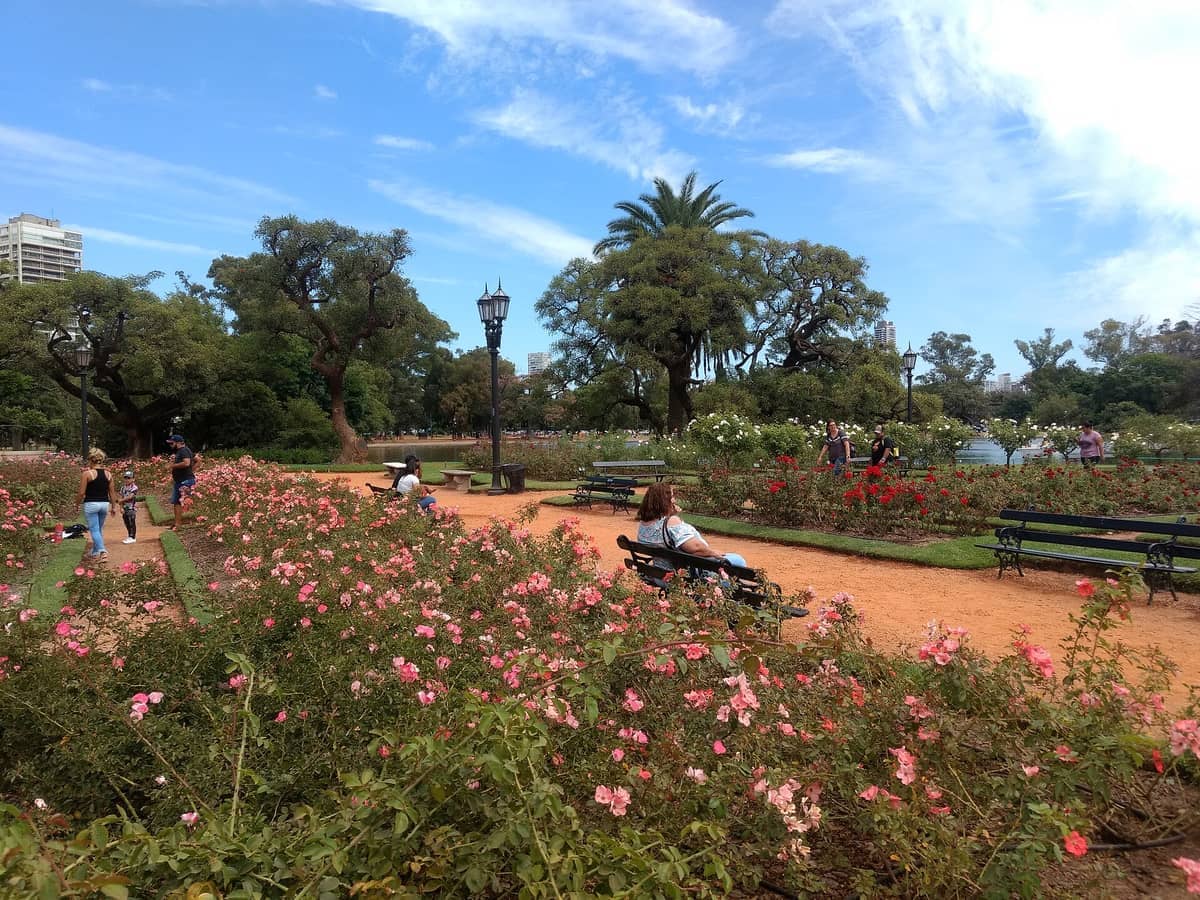
El Rosedal de Palermo is a formal rose garden set within the larger Parque Tres de Febrero, one of Buenos Aires' most expansive urban parks. The garden contains more than 18,000 roses arranged in geometric beds around a central ornamental lake, with trellised arches, sculpted hedgerows, and a small central gazebo that serves as a focal point for the whole layout. It is a public garden managed by the city, with free admission and clearly marked entrances from the main park avenues.
Unlike the looser, more naturalistic sections of Parque Tres de Febrero, the Rosedal follows a structured design tradition rooted in European formal garden planning. The symmetry is immediately apparent when you enter: pathways radiate outward from the lakeside center, each corridor lined with rose varieties labeled by name and origin. Benches positioned throughout the garden make it a place where people genuinely sit and stay, rather than simply passing through.
ℹ️ Good to know
Opening hours vary slightly between sources, but the garden is generally open Tuesday through Sunday from 10:00 to 18:00, and is closed on Mondays and certain public holidays. Confirm locally or via the official Buenos Aires tourism or city government websites before visiting.
The Experience at Different Times of Day
Arriving just after opening on a weekday morning, you encounter the garden at its quietest. The gravel paths are freshly raked, the smell of dew on rose leaves is sharp and green, and the lake surface is still enough to mirror the pergola on the far bank. Joggers from the surrounding park occasionally pass the outer edges, but the interior garden itself is unhurried. This is when the labeling on each rose bed is easiest to read and photograph without other visitors in the frame.
By midday on weekends, particularly in spring, the character shifts noticeably. Families arrive with children who run the peripheral paths while parents claim benches near the water. Small groups of friends lay out food on the grass sections adjacent to the formal beds. The scent of roses intensifies in the afternoon heat, and the garden acquires a genuine social atmosphere, more like a neighborhood square than a botanical attraction. This is neither a flaw nor a virtue, just a different kind of visit.
Late afternoon, roughly an hour before closing, is arguably the most photogenic window. The angle of light coming from the west catches the rose petals from the side, and the lake picks up warm tones. Crowds thin again as families with young children leave, and the garden settles into a calm that suits slower walkers and those who simply want to sit.
Tickets & tours
Live prices and dates from our booking partner. If you book, we may earn a commission at no extra cost to you.
Recoleta and Palermo Bike Tour in Buenos Aires
From 43 €Instant confirmationFree cancellationPrivate tour of Palermo, the Japanese and Botanical Gardens
From 64 €Instant confirmationFree cancellationMadero Tango Show tickets with optional dinner
From 32 €Instant confirmationFree cancellationBuenos Aires small-group city tour with optional lunch and cruise
From 25 €Instant confirmationFree cancellation
History and Context Inside Parque Tres de Febrero
Parque Tres de Febrero was created in the 1870s, following an initiative by President Domingo Faustino Sarmiento, partly on land that had previously served as the estate of the dictator Juan Manuel de Rosas. The park's name commemorates the Battle of Caseros on February 3, 1852, which ended Rosas' rule. The rose garden was developed later as a formal ornamental addition to the park's broader design. For context on how these parks fit into the wider fabric of the neighborhood, the Bosques de Palermo immediately to the north covers a different kind of parkland experience, with lakes, rowing boats, and tree-lined paths distinct from the Rosedal's structured layout.
The Rosedal's design reflects the influence of French formal garden aesthetics associated with the work of landscape architect Charles Thays, which shaped much of Buenos Aires' public architecture and urban planning in the late 19th and early 20th centuries. This was a period when the city invested heavily in European-style civic infrastructure, and the rose garden was conceived as a space for refined public leisure. The iron pergola that arches over one of the main entrances is original to the early design and remains one of the garden's most-photographed structures.
Palermo as a neighborhood carries considerable weight in any visit to Buenos Aires. Beyond the parks, it contains the Jardín Botánico Carlos Thays just a few blocks away, and the Jardín Japonés, making this corner of the city one of the most garden-dense areas in the capital. Combining all three in a single afternoon is practical and avoids the sense of rushing.
When the Roses Actually Bloom
The Rosedal earns its reputation most decisively in spring, from late September through November, when the majority of rose varieties reach peak bloom simultaneously. At that point, the color range across the beds is striking: deep crimsons and burgundies near the entrances give way to creams, yellows, and soft pinks toward the lake, then to climbers in coral and orange scaling the pergola trellises. The fragrance during a warm October morning is strong enough to be noticeable from the outer pathways.
A secondary bloom period occurs in late summer, around March and early April, when temperatures moderate and a second flowering cycle runs through many of the hybrid varieties. This autumn bloom is less dense than spring but can be equally photogenic, with the added advantage that tourist numbers are lower and the surrounding park trees begin shifting color.
💡 Local tip
If rose bloom is your primary reason for visiting, target late October to mid-November for the fullest spring display, or late March to early April for the quieter autumn flowering. Visiting in mid-summer (January–February) means heat, high humidity, and many varieties past peak.
Outside bloom periods, the garden retains structural interest: the lake, the iron-and-wood pergola walkways, and the labeled rose beds are all present year-round. Winter visits (June–August) can be pleasant on clear days when temperatures sit in the low teens Celsius and the park is nearly empty, though you should not expect flowers. The pruned canes in winter make the underlying geometry of the planting design actually more legible than when foliage obscures it.
Getting There and Moving Through the Garden
The most direct route from central Buenos Aires is Subte Line D to Plaza Italia station, located beneath Avenida Santa Fe next to the park. From the station exit, the park entrance is visible across Avenida Santa Fe; walk through the park heading south toward the lake for roughly eight to ten minutes until the Rosedal's iron entrance gates become visible. The entire approach is flat and paved, with no steps on the main route, making it accessible for strollers and wheelchairs, though specific accessibility infrastructure has not been officially detailed in city publications.
Bus lines including routes 10, 37, 57, 67, 130, and several others serve stops along Avenida del Libertador and around Plaza Italia, connecting the park to most city neighborhoods. The Mitre line train stops at Estación 3 de Febrero, which is also within walking distance of the garden's northern edge. The SUBE card, Argentina's rechargeable public transit card, is needed for buses, trains, and the Subte; fares should be confirmed locally as they change frequently.
The Rosedal sits within a broader green corridor that rewards unhurried exploration. After the garden, you can follow the lakeside paths north through the park toward the Planetario Galileo Galilei or continue to the Jardín Botánico. For travelers spending more time in the area, the Palermo neighborhood guide covers restaurants, bars, and evening options close to the park.
Photography Notes and Practical Details
The iron pergola at the main entrance and the central gazebo reflected in the lake are the two compositions most visitors attempt. For the pergola, shooting from within the tunnel toward the far end works well in morning light when the sun is at a low angle behind you. For the lake reflection, the western bank offers the cleanest angle in the hour before closing, when the light falls across the water without harsh midday shadows.
Macro photography of individual blooms is well-suited to the labeled beds, where you can frame a single variety against a blurred background of others. There are no restrictions on personal photography. Drone use is subject to Argentine civil aviation authority regulations and is not something the park specifically authorizes, so should not be assumed permitted.
⚠️ What to skip
The garden is closed on Mondays and on specific public holidays including January 1, Good Friday, May 1, July 20, September 21, November 8, and December 24, 25, and 31, as per city government information. Plan accordingly, especially around Argentine national holidays and note that it may also close during severe weather.
There are no on-site cafes within the Rosedal itself, but vendors and small kiosks operate in adjacent sections of Parque Tres de Febrero, particularly near the main lake. Bring water on warm days, as the open garden offers limited shade in summer and afternoon temperatures regularly exceed 28°C from December through February.
Assessment: What This Place Is and Is Not
El Rosedal delivers consistently on a specific kind of experience: a formal, well-maintained urban garden that rewards a relaxed pace and genuine interest in horticulture or landscape design. It is not a world-ranked botanical garden and does not attempt to be. What it offers, reliably, is a free, quiet, and attractive space within one of Buenos Aires' most pleasant neighborhoods. For travelers building a day around Palermo's parks, it pairs naturally with the Jardín Botánico Carlos Thays next door and fits neatly into a broader free activities itinerary for the city.
Travelers who find formal gardens underwhelming, who are visiting outside bloom season, or who are pressed for time and prioritizing major landmarks will not find the Rosedal essential. It is also not well-suited to evenings or after closing time, when the garden gates are shut and the surrounding park, while open, loses the specific attraction of the rose beds.
Insider Tips
- Enter from the Avenida Infanta Isabel side rather than the main Libertador entrance for a more gradual reveal of the layout, approaching the lake and central gazebo from the south rather than head-on.
- The rose bed labels include the cultivar name and country of origin, which makes the garden genuinely informative if you slow down and read them rather than walking past. Spanish-language labels are standard, but names of rose varieties are usually in English or French and internationally recognizable.
- Weekday mornings, particularly Tuesday through Thursday before 11:00, see the fewest visitors. Weekend afternoons in October can draw local families in large numbers, which changes the atmosphere considerably.
- The iron pergola walkway is partially covered by climbing roses in spring. Walking the full length of it during peak bloom, when the overhead canopy of roses closes in, is the garden's most immersive single experience.
- If you visit during summer (December to February), go in the morning and leave by noon. Afternoon heat in the open garden with limited shade and Buenos Aires humidity makes it uncomfortable, and bloom quality is past its peak in any case.
Who Is El Rosedal de Palermo For?
- Travelers who enjoy formal garden design and want a free, unhurried outdoor experience in the city
- Photographers targeting flowers, reflections, and iron-and-wood architectural details in natural light
- Couples looking for a calm, attractive walk that connects naturally to the wider Palermo park circuit
- Families with young children who need open, flat space with no entry fee or time pressure
- Visitors planning a full Palermo parks day combining the Rosedal, Jardín Botánico, and Jardín Japonés in sequence
Nearby Attractions
Other things to see while in Palermo:
- Bosques de Palermo (Parque Tres de Febrero)
Parque Tres de Febrero, universally known as Bosques de Palermo, is Buenos Aires' most expansive urban park. Spanning roughly 370 hectares of lakes, tree-lined avenues, a famous rose garden, and open lawns, it offers a genuinely different pace from the surrounding city, and it costs nothing to enter.
- Campo Argentino de Polo
Campo Argentino de Polo in Palermo is the spiritual home of world-class polo, hosting the prestigious Argentine Open each November. Whether you're drawn by the sport or simply curious about one of Buenos Aires' most dramatic spectacles, here is everything you need to plan a visit.
- Ecoparque Buenos Aires
Once the city's traditional zoo, the Ecoparque de la Ciudad de Buenos Aires has been gradually transformed since 2017 into an urban conservation and education center. Set across 18 hectares in Palermo, it offers a quieter, more thoughtful alternative to conventional animal attractions, with free entry for Buenos Aires City residents and some categories of visitors and easy access from the Plaza Italia Subte station.
- Jardín Botánico Carlos Thays
The Jardín Botánico Carlos Thays is a free public botanical garden in Palermo covering several hectares of curated green space, Victorian-era glasshouses, and diverse plant collections. Named after the French-Argentine landscape architect who shaped much of Buenos Aires' park system, it offers a genuine respite from the city without costing a peso.
Planning a trip? Discover personalized activities with the Nomado app.