Galileo Galilei Planetarium: Buenos Aires' Window to the Night Sky
Set on the edge of a lake in Palermo's Parque Tres de Febrero, the Galileo Galilei Planetarium is Buenos Aires' main astronomy outreach centre. Beyond the dome shows, the building itself is a mid-century architectural landmark worth visiting even from the outside.
Quick Facts
- Location
- Av. Sarmiento s/n, Parque Tres de Febrero, Palermo, Buenos Aires (CABA)
- Getting There
- Bus lines along Av. del Libertador and Av. Sarmiento; no direct Subte stop — alight at Plaza Italia (D line) and walk ~15 min through the park
- Time Needed
- 1.5–2.5 hours including a dome show; 30–45 min if visiting the grounds only
- Cost
- Grounds free; dome show tickets available online — retirees and visitors with disabilities plus one companion may enter free with prior reservation. Verify current prices at the official site before visiting.
- Best for
- Families with children, science enthusiasts, architecture admirers, and anyone pairing a visit with the Palermo parks
- Official website
- planetario.buenosaires.gob.ar
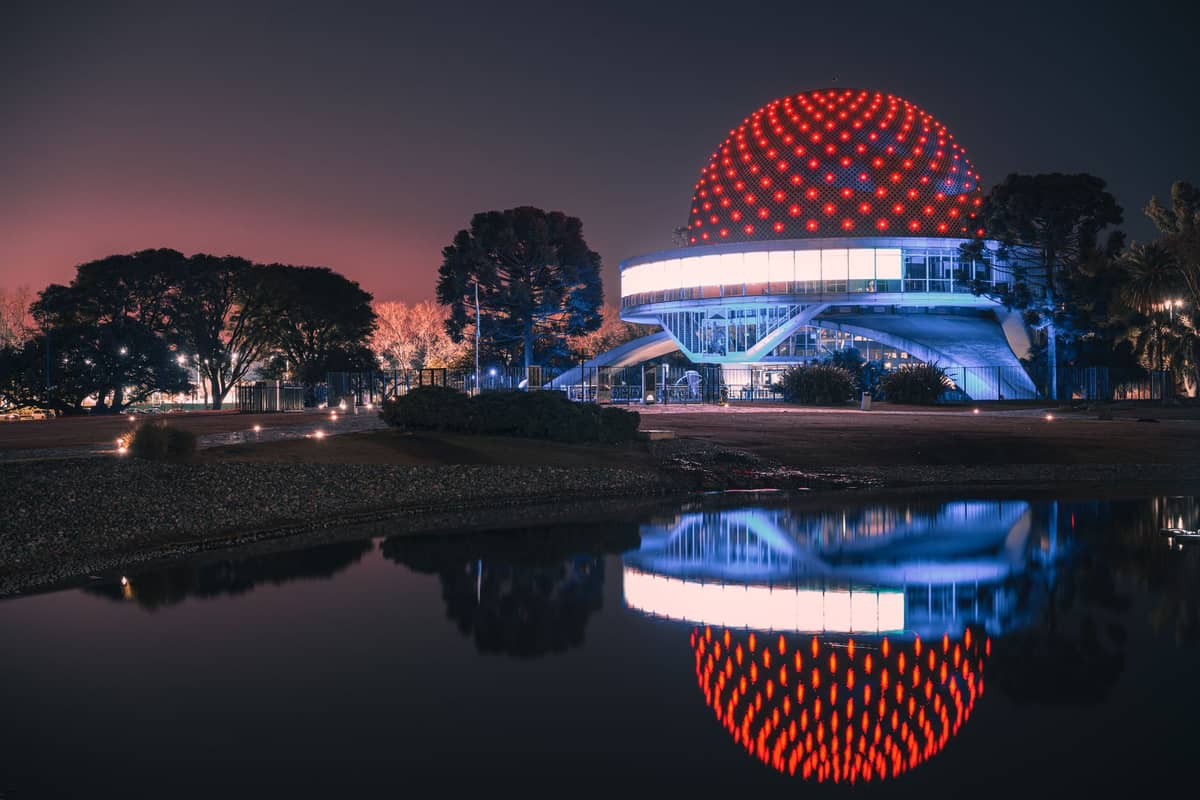
What the Planetario Galileo Galilei Actually Is
The Planetario Galileo Galilei sits at the intersection of Avenida Sarmiento and Avenida Figueroa Alcorta, reflected in the waters of an artificial lake inside Parque Tres de Febrero. It is Buenos Aires' primary public astronomy facility: a projection theatre housed inside a large hemispherical dome, surrounded by exhibition spaces and open lawns that locals use year-round.
Administered by the city government of Buenos Aires, the planetarium runs scheduled dome shows projected onto the ceiling of its main theatre, covering topics from cosmology and the solar system to seasonal night-sky overviews. The programme rotates, so check the official website for the current schedule before you plan your visit.
💡 Local tip
Dome shows sell out on weekends, especially during school holidays. Book tickets online in advance at planetario.buenosaires.gob.ar to avoid arriving to a full session.
The Architecture: A Building Worth the Trip on Its Own
The structure is unmistakable from a distance: a wide concrete disc balanced on a narrow cylindrical base, the main dome perching above it like a flying saucer hovering over the park. This mid-century modernist design gives the building a presence that reads as both futuristic and of its era simultaneously.
The approach from Avenida Sarmiento frames the building against the lake, and the reflection on calm mornings can be striking. The exterior terrace that rings the base of the dome level gives views across the park canopy toward Avenida del Libertador. Even visitors who skip the interior show tend to stop here for photographs.
If you find the architecture interesting in context, the broader Buenos Aires architecture guide covers the city's layered mix of Beaux-Arts civic buildings, art deco towers, and mid-century modernism that makes the streetscape here unlike anywhere else in Latin America.
Tickets & tours
Live prices and dates from our booking partner. If you book, we may earn a commission at no extra cost to you.
Madero Tango Show tickets with optional dinner
From 32 €Instant confirmationFree cancellationBuenos Aires small-group city tour with optional lunch and cruise
From 25 €Instant confirmationFree cancellationPiazzolla Tango Show VIP tickets with transfer and optional dinner
From 112 €Instant confirmationFree cancellationBuenos Aires shopping tour
From 15 €Instant confirmationFree cancellation
Inside the Dome: The Show Experience
The projection theatre seats an audience in reclined chairs arranged in a circle, all oriented toward the curved ceiling above. When the lights dim and the projection begins, the room fills with the Southern Hemisphere sky, rendered with enough resolution to trace constellations and follow planetary movements across the dome. The narration (primarily in Spanish) explains what you are seeing, though the visual experience carries much of the content even for non-Spanish speakers.
Shows run for roughly 45 minutes. The pace is deliberate rather than flashy, aimed at genuine educational engagement rather than spectacle for its own sake. Children tend to stay attentive throughout; adults who arrive expecting an IMAX-style production may want to temper expectations slightly. The experience is closer to a thoughtful lecture illustrated by the entire sky overhead.
ℹ️ Good to know
Shows are primarily in Spanish. If you are visiting with children who do not speak Spanish, the visual content still communicates well, but adults looking for detailed narration in English should check the current schedule for any special language sessions.
The Grounds and the Surrounding Park
The planetarium's immediate grounds are free to enter and see significant foot traffic from joggers, families, and couples who use the lakeside path regardless of whether they plan to enter the building. On weekend afternoons in spring and autumn, the area around the water fills with people sitting on the grass, and food vendors position themselves along the nearby paths.
The planetarium sits within the broader Parque Tres de Febrero, one of Buenos Aires' largest urban green spaces. From the planetarium you can reach the rose garden, the Japanese Garden, and the boating lake within a 10–20 minute walk, making this a natural anchor for a half-day in the parks.
The Jardín Japonés is a short walk north and makes a logical pairing: the contrast between the planetarium's concrete modernism and the garden's deliberate natural landscaping is genuinely interesting to experience in sequence.
How the Experience Changes by Time of Day
Weekday mornings between opening and noon are the quietest period. School groups arrive in organised visits during the week, so the lobby and exhibition areas can feel busy mid-morning on school days, but the park grounds remain calm. If your priority is the dome show without a crowd, Tuesday to Friday at opening time is the most comfortable window.
Weekend afternoons are a different atmosphere. Families arrive after lunch, the queues at the ticket desk grow, and the grounds around the lake fill with activity. The light on the building in late afternoon, particularly in autumn when the trees around the park are turning, produces warmer tones than the flat midday sun. For photography of the exterior, the hour before sunset on a clear day gives the best results.
The planetarium closes before dark on all days, so you will not be watching the actual night sky here. That is worth knowing if you arrive imagining a rooftop observatory experience. The dome shows simulate the sky rather than showing the live sky through a telescope.
Getting There and Practical Details
The planetarium is not directly served by the Subte. The closest metro stop is Plaza Italia on Line D, about a 15-minute walk through the park. Multiple bus routes run along Avenida del Libertador and Avenida Sarmiento; the official Buenos Aires transit app (or the Cuándo Viene el Colectivo service) will show current routes from your location.
Opening hours are Tuesday through Friday, 9:30 to 17:00, and Saturday, Sunday, and public holidays, 12:00 to 19:30. The planetarium is closed on Mondays. Arrive at least 20 minutes before your booked show time to locate the entrance, pass through any queue, and settle in before the lights drop.
⚠️ What to skip
Mondays: the planetarium is closed. If your itinerary falls on a Monday, plan the park visit only and save the dome show for another day.
For those pairing this visit with other Palermo attractions, the Bosques de Palermo and the El Rosedal de Palermo are within comfortable walking distance and round out a full half-day in the area without needing transport between stops.
Who Should Reconsider This Visit
Travellers with only one or two days in Buenos Aires and a tight cultural checklist may find the planetarium a lower priority compared to the city's historic architecture, food markets, and tango venues. The dome show, while well-executed, is not significantly different in concept from planetarium shows found in other major cities worldwide.
If you are not travelling with children and have no particular interest in astronomy or modernist architecture, the park itself is the main draw, and you can enjoy that for free without booking a show. The planetarium adds most value for families, school-aged visitors, and anyone who appreciates the specific combination of science outreach and mid-century urban design.
Insider Tips
- The best exterior photograph of the building is taken from the far bank of the lake, facing north-east. Walk around the water rather than shooting from the main entrance path, where trees partially block the full disc silhouette.
- On weekday afternoons after school groups have departed (roughly from 14:00 onward), the lobby exhibition area is noticeably quieter and easier to move through at your own pace.
- If you are visiting with children under ten, the lakeside grounds themselves hold attention for a long time. Bring bread for the ducks, and build in time before or after the show so the visit does not feel rushed.
- Combine the visit with the Jardín Japonés next door on the same ticket-buying trip: both venues are popular on weekends, so arriving at one just after it opens and moving to the other mid-morning spreads the crowd effectively.
- Accessibility note: the official tickets page states that visitors with disabilities and one companion may enter free with prior reservation. Contact the planetarium directly before your visit to confirm the reservation process, as procedures can change.
Who Is Planetario Galileo Galilei For?
- Families with children aged 5 and up looking for an educational afternoon in a park setting
- Architecture and design enthusiasts interested in mid-century modernism in Buenos Aires
- Travellers spending a full day in Palermo who want to anchor their park visit around a structured indoor experience
- Science and astronomy enthusiasts who enjoy planetarium shows wherever they travel
- Visitors seeking free outdoor space combined with an optional paid cultural experience
Nearby Attractions
Other things to see while in Palermo:
- Bosques de Palermo (Parque Tres de Febrero)
Parque Tres de Febrero, universally known as Bosques de Palermo, is Buenos Aires' most expansive urban park. Spanning roughly 370 hectares of lakes, tree-lined avenues, a famous rose garden, and open lawns, it offers a genuinely different pace from the surrounding city, and it costs nothing to enter.
- Campo Argentino de Polo
Campo Argentino de Polo in Palermo is the spiritual home of world-class polo, hosting the prestigious Argentine Open each November. Whether you're drawn by the sport or simply curious about one of Buenos Aires' most dramatic spectacles, here is everything you need to plan a visit.
- Ecoparque Buenos Aires
Once the city's traditional zoo, the Ecoparque de la Ciudad de Buenos Aires has been gradually transformed since 2017 into an urban conservation and education center. Set across 18 hectares in Palermo, it offers a quieter, more thoughtful alternative to conventional animal attractions, with free entry for Buenos Aires City residents and some categories of visitors and easy access from the Plaza Italia Subte station.
- El Rosedal de Palermo
Tucked inside the sprawling Parque Tres de Febrero, El Rosedal de Palermo is a formal rose garden containing more than 18,000 roses arranged around a central lake. Free to enter and a short walk from Subte Line D's Plaza Italia station, it offers one of the city's most rewarding outdoor experiences, especially during spring and autumn bloom.
Planning a trip? Discover personalized activities with the Nomado app.