Bosques de Palermo (Parque Tres de Febrero): Buenos Aires' Great Green Escape
Parque Tres de Febrero, universally known as Bosques de Palermo, is Buenos Aires' most expansive urban park. Spanning roughly 370 hectares of lakes, tree-lined avenues, a famous rose garden, and open lawns, it offers a genuinely different pace from the surrounding city, and it costs nothing to enter.
Quick Facts
- Location
- Palermo, Buenos Aires. Bounded by Av. Sarmiento, Av. del Libertador, and Av. Figueroa Alcorta
- Getting There
- Subte Line D to Plaza Italia, then a short walk.
- Time Needed
- 1.5 to 3 hours for a relaxed visit; a full half-day if you add nearby attractions
- Cost
- Free. The park is open to the public daily. Nearby attractions (Japanese Garden, Ecoparque) charge separate fees
- Best for
- Joggers, families, picnickers, photographers, and anyone needing a break from concrete
What Bosques de Palermo Actually Is
Parque Tres de Febrero is the official name; Bosques de Palermo is what everyone in the city calls it. Inaugurated in 1875, the park was shaped by Carlos Thays, the French-Argentine landscape architect whose fingerprints are on many of Buenos Aires' finest green spaces. Spread across approximately 370 hectares in the Palermo neighborhood, it is one of the largest urban parks in the Argentine capital, and on weekday mornings it feels almost improbably calm for a city of three million people.
The park is not a manicured formal garden. It is a working public space with wide paved avenues, artificial lakes connected by canals, grassy clearings where families spread blankets, and long shaded paths where the city noise fades to a background murmur. Within and directly adjacent to the park sit a rose garden, a Japanese garden, a planetarium, a zoo converted into an ecopark, and a polo field. You do not need to visit all of them; the park itself is reason enough to come.
Palermo as a neighborhood is large and subdivided in local usage into Palermo Soho, Palermo Hollywood, and other informal zones. The park sits in the more residential, green northern section. If you are trying to plan a full day in the area, the Palermo neighborhood guide covers the surrounding blocks and what else is worth combining with a park visit.
How the Park Changes by Time of Day
Early mornings, particularly on weekdays, belong to runners and dog walkers. The air carries the smell of wet grass and eucalyptus, the light comes through the tree canopy in low, angled shafts, and the paths along the lake edge are uncrowded enough that you can walk a full circuit without stepping around anyone. This is genuinely the best time to be here if you want to understand what the park offers.
By mid-morning on weekends, the character shifts completely. Cyclists take over the dedicated bike lanes, vendors set up food carts near the lake entrances, and families with children claim the larger clearings. The noise level rises, not unpleasantly, but the solitude is gone. Paddle boats appear on the lake from late morning onward, and the rose garden path fills with people photographing the plantings.
Afternoons in summer (December through February, when Buenos Aires sits at 20 to 30 degrees Celsius with high humidity) can be punishing in the open sun. The shaded avenues near the lake and under the older tree cover remain tolerable, but plan around this if you are visiting in peak summer. Spring, from September through November, and autumn, from March through May, offer the most comfortable temperature ranges, roughly 13 to 26 degrees Celsius, and the park looks its best when the trees turn or the rose garden comes into bloom.
💡 Local tip
Visit on a Tuesday or Wednesday morning for the quietest experience. Weekend afternoons draw large crowds around the lake and rose garden, which is fine for atmosphere but less suited to photography or quiet walking.
Tickets & tours
Live prices and dates from our booking partner. If you book, we may earn a commission at no extra cost to you.
Recoleta and Palermo Bike Tour in Buenos Aires
From 43 €Instant confirmationFree cancellationPrivate tour of Palermo, the Japanese and Botanical Gardens
From 64 €Instant confirmationFree cancellationMadero Tango Show tickets with optional dinner
From 32 €Instant confirmationFree cancellationBuenos Aires small-group city tour with optional lunch and cruise
From 25 €Instant confirmationFree cancellation
The Rosedal: The Park's Most Photographed Corner
The Rosedal de Palermo sits within the park and is, by any measure, the part most visitors seek out first. It is a formal rose garden centered on a pergola-covered walkway and a small pond, surrounded by thousands of rose specimens in organized beds. In spring and early summer, the scent is strong enough to notice before you reach the entrance.
Entry to the Rosedal is free. It is open Tuesday through Sunday, from 08:00 to 18:00 in winter and 08:00 to 20:00 in summer. Monday closures apply, so plan accordingly. The El Rosedal de Palermo has its own dedicated page with more detail on the garden layout and best flowering periods.
The garden is flat and easy to navigate, with wide gravel paths between the rose beds and several benches placed to face the central pergola. It is a genuinely pleasant space, though the combination of weekend crowds and smartphones means any expectation of uncrowded photography requires arriving early. The gold and white metal bridge at the entrance to the inner garden is the most photographed structure in the park.
The Lakes and the Rest of the Park
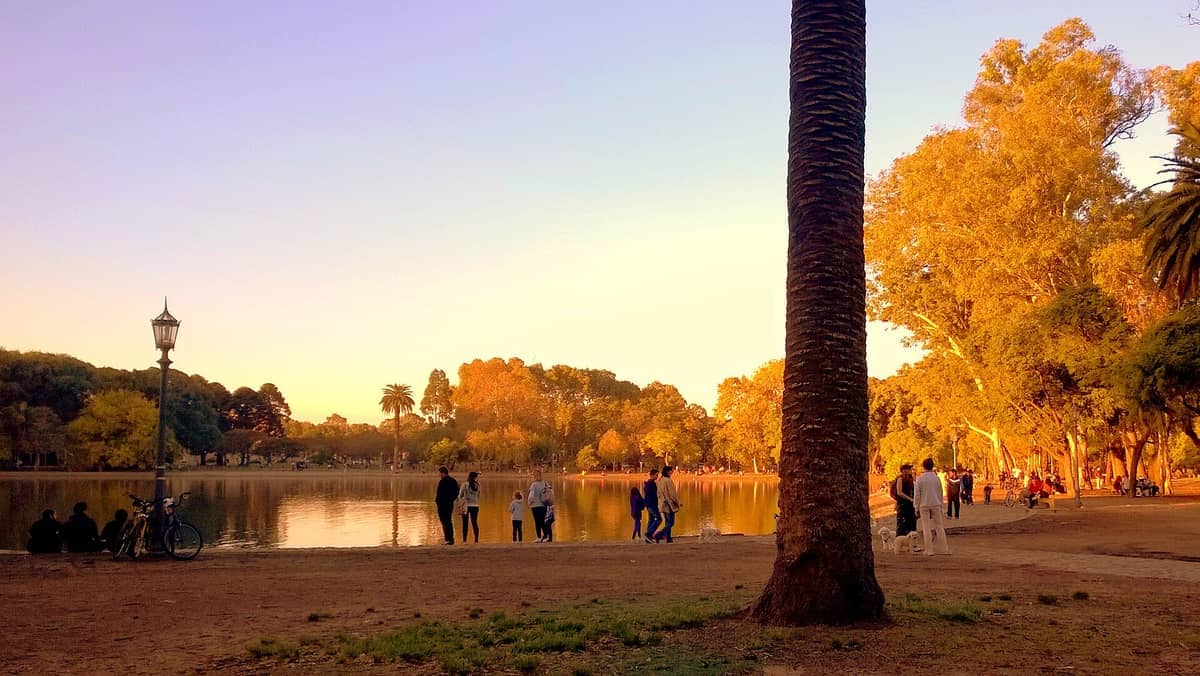
The central lakes are the park's backbone. Shaped artificially and connected by narrow canals, they reflect the surrounding trees and the sky in a way that softens the hard urban edges of the city just outside the park boundary. Rowing boats and paddle boats can be hired at the lake, making this a popular spot for couples and families on weekends. The boat hire area gets busy by 11:00 on Sundays; arrive earlier or accept a short wait.
The tree cover throughout the park includes species of considerable age. On the main avenues, tall planes and acacias form overhead canopies. On summer afternoons these sections offer the most reliable shade, and locals know to set up picnics here rather than in the open clearings. Birdsong is audible throughout, particularly in the early morning, and the park functions as genuine urban green infrastructure rather than ornament.
For families: the park's open lawns are well suited to children running around, and the flat paved paths handle strollers without difficulty. The central areas near the lake are the most family-oriented on weekends, with food vendors, the boat hire, and wide open space. The paths are also used heavily by cyclists, so keep younger children close to the walking lanes.
What Surrounds the Park: Practical Cluster Planning
The park does not exist in isolation. Within walking distance of its main entrances are several independently run attractions that together make this corner of Palermo one of the most activity-dense parts of Buenos Aires. The Jardín Japonés is directly adjacent to the park's northeastern edge and charges separate admission; it operates independently with its own opening hours.
The Planetario Galileo Galilei sits within the park proper and is a notable piece of brutalist architecture. It runs ticketed shows on a fixed schedule and is popular with school groups during the week. The Ecoparque Buenos Aires (the former city zoo, restructured into a wildlife sanctuary model) is at the park's edge on Avenida Sarmiento and charges separate admission.
If you are connecting this visit with the city's museum circuit, the Museo MALBA is a 15-minute walk south of the park along Avenida Figueroa Alcorta. Combining a morning in Bosques de Palermo with an afternoon at MALBA gives a well-paced and diverse full day in Palermo.
Getting There and Getting Around the Park
The simplest public transport approach is Subte Line D to Plaza Italia station. The park entrance at Avenida Sarmiento is a few minutes walk from the station exit. The ride from downtown on Line D takes roughly 20 minutes depending on your starting point. Buenos Aires' bus network also serves the area extensively, with a long list of colectivo lines stopping on the surrounding avenues; the SUBE rechargeable card is required for both Subte and bus travel.
Within the park, the main avenues are wide enough for cyclists and pedestrians. Bike hire is available in the area, and cycling is a popular way to cover more ground. The park is flat throughout, which makes it easy for visitors with limited mobility. Paved paths connect all the main sections. Less-used grassy areas may be uneven after rain, but the core routes are always accessible.
⚠️ What to skip
The park has no single entrance or perimeter fence. It bleeds into surrounding streets and blocks at multiple points. If you are navigating by map, treat the area around Avenida Sarmiento, Avenida del Libertador, and Avenida Figueroa Alcorta as the park's rough boundaries.
Photography and Seasonal Considerations
The park photographs best in spring (September to November), when the rose garden is in full bloom and the tree canopy is lush without being too dense for light. Autumn (March to May) offers warm color in the deciduous trees and softer light in the afternoons. Winter mornings, from June to August, have lower temperatures (around 7 to 15 degrees Celsius) but clear skies and very few people, which suits photography well if you dress for it.
The lake surfaces reflect well in flat morning light before wind picks up. The pergola at the Rosedal catches good light from mid-morning. The main tree avenues photograph best when backlit in late afternoon. Weekdays in any season allow you to frame shots without people constantly moving through the frame.
For broader context on timing your Buenos Aires visit around seasons and events, the best time to visit Buenos Aires guide covers monthly conditions across the city.
Who Should Think Twice Before Visiting
Bosques de Palermo is not a destination for everyone. If you are on a very short trip with limited time and are primarily interested in cultural monuments, historical architecture, or museums, the park may not be the best use of a few hours. It is a pleasant green space, well maintained, and genuinely restorative, but it is still essentially a park. There is no single unmissable sight inside it.
Visitors hoping for wild or natural landscapes will also be disappointed. This is a managed urban park in a major city, not nature. The lakes are artificial, the trees are planted, and at busy times the place feels exactly like what it is: a public park on a weekend. It is not quieter or more authentic than any comparable space in other major cities. It is, however, genuinely good at what it does.
Insider Tips
- The rowing boats on the lake see minimal queues before 11:00 on weekdays. If you want to go out on the water without waiting, arrive early on a weekday morning.
- The northwest edge of the park, near Avenida del Libertador, is noticeably less used than the Sarmiento entrance. Walking in from that direction on a weekend gives you at least 15 minutes of the park feeling uncrowded before you reach the lake.
- Bring your own food and drink. The vendor carts near the lake sell snacks and cold drinks at elevated prices. A thermos of mate or a packed lunch eaten on the grass is what most porteños (Buenos Aires locals) actually do here.
- The Rosedal closes on Mondays. If you arrive at the park on a Monday expecting to visit the rose garden, you will find it locked. The wider park is accessible, but plan your day accordingly.
- For the best light on the lake, position yourself on the western bank in the late afternoon when the sun drops behind the tree line and the surface turns golden. This lasts roughly 20 to 30 minutes and is worth timing your visit around.
Who Is Bosques de Palermo (Parque Tres de Febrero) For?
- Joggers and cyclists wanting a flat, scenic route away from traffic
- Families with young children who need open space and shade
- Photographers looking for garden and reflective water shots in natural light
- Travelers needing a low-cost half-day to decompress between heavier sightseeing
- Spring visitors who can coincide with the Rosedal's peak bloom period
Nearby Attractions
Other things to see while in Palermo:
- Campo Argentino de Polo
Campo Argentino de Polo in Palermo is the spiritual home of world-class polo, hosting the prestigious Argentine Open each November. Whether you're drawn by the sport or simply curious about one of Buenos Aires' most dramatic spectacles, here is everything you need to plan a visit.
- Ecoparque Buenos Aires
Once the city's traditional zoo, the Ecoparque de la Ciudad de Buenos Aires has been gradually transformed since 2017 into an urban conservation and education center. Set across 18 hectares in Palermo, it offers a quieter, more thoughtful alternative to conventional animal attractions, with free entry for Buenos Aires City residents and some categories of visitors and easy access from the Plaza Italia Subte station.
- El Rosedal de Palermo
Tucked inside the sprawling Parque Tres de Febrero, El Rosedal de Palermo is a formal rose garden containing more than 18,000 roses arranged around a central lake. Free to enter and a short walk from Subte Line D's Plaza Italia station, it offers one of the city's most rewarding outdoor experiences, especially during spring and autumn bloom.
- Jardín Botánico Carlos Thays
The Jardín Botánico Carlos Thays is a free public botanical garden in Palermo covering several hectares of curated green space, Victorian-era glasshouses, and diverse plant collections. Named after the French-Argentine landscape architect who shaped much of Buenos Aires' park system, it offers a genuine respite from the city without costing a peso.
Planning a trip? Discover personalized activities with the Nomado app.