Museo de Arte Moderno de Buenos Aires (MAMBA): The Complete Visitor Guide
The Museo de Arte Moderno de Buenos Aires, often still referred to by its old acronym MAMBA, is the city's leading institution for modern and contemporary Argentine art. Housed on Avenida San Juan in San Telmo, its collection of more than 8,000 works spans the 20th and 21st centuries, and free Wednesday admission makes it one of the most accessible cultural experiences in the city.
Quick Facts
- Location
- Av. San Juan 350, San Telmo, Buenos Aires
- Getting There
- Multiple bus lines nearby: 8, 28, 29, 33, 62, 64, 93, 126, 130, 143, 152
- Time Needed
- 1.5 to 3 hours depending on current exhibitions
- Cost
- ARS 16,000 (foreigners); ARS 4,000 (Argentine residents); free on Wednesdays. Verify before visiting.
- Best for
- Contemporary art, budget-conscious travelers, rainy-day culture, San Telmo explorers
- Official website
- museomoderno.org/en
What Is MAMBA and Why It Matters
The Museo de Arte Moderno de Buenos Aires, universally known as MAMBA, is the city's principal museum dedicated to modern and contemporary art. Founded on 11 April 1956 under the initiative of critic and curator Rafael Squirru, it predates many comparable institutions in Latin America and has spent nearly seven decades shaping how Argentine art is understood, archived, and debated.
The collection now exceeds 8,000 works, covering Argentine and international production from the 20th and 21st centuries. That range is significant: you'll encounter pioneering figures of the Argentine avant-garde alongside younger artists currently active in Buenos Aires, often in the same visit. The museum does not position itself as a survey of world art history. Its focus is sharper and more regional, which gives it a coherence that larger encyclopedic museums sometimes lack.
MAMBA sits in San Telmo, one of Buenos Aires' oldest neighborhoods, on Avenida San Juan. The surrounding streets offer cobblestone texture, 19th-century facades, and the kind of slow foot traffic that makes the walk to the museum feel like part of the experience rather than a commute.
💡 Local tip
Wednesday is free admission for everyone, regardless of nationality. Arrive before noon to avoid the early-afternoon crowd that builds from around 13:00 onward.
The Building and First Impressions
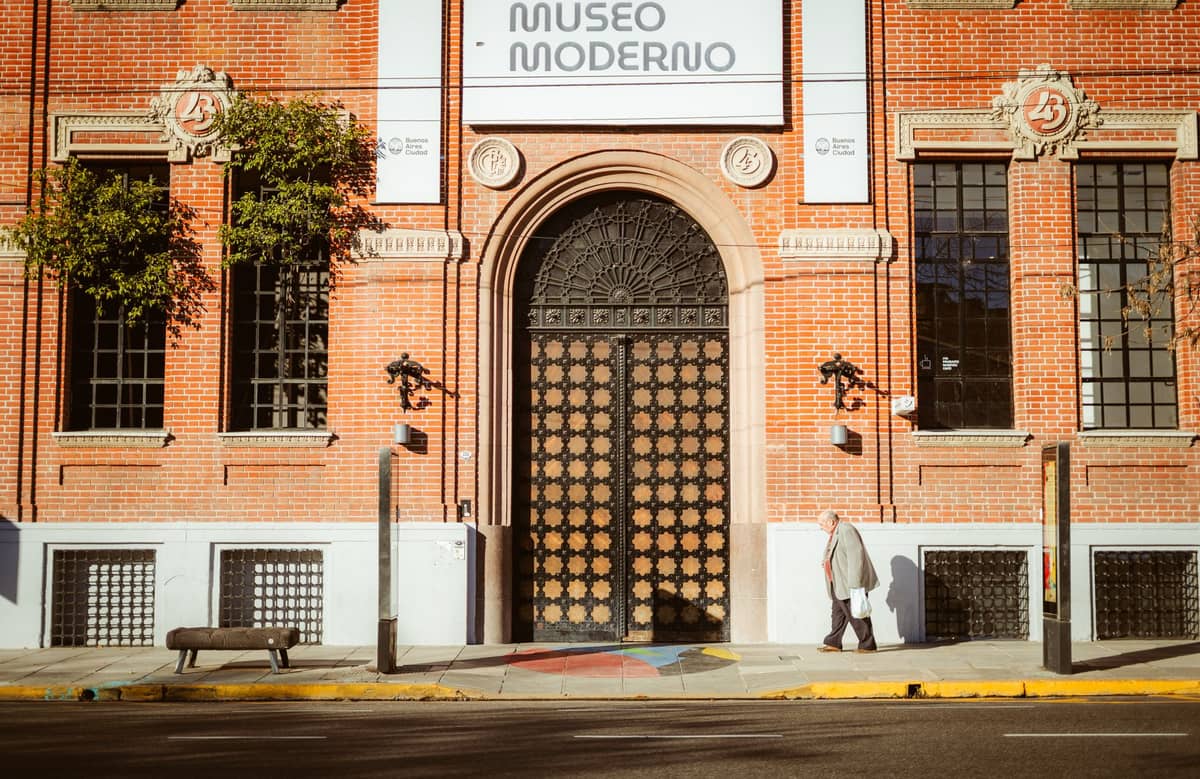
The museum occupies a former tobacco warehouse on Avenida San Juan, a wide, relatively quiet avenue by Buenos Aires standards. The building has been renovated over the years to accommodate gallery space, but traces of its industrial origin remain in the proportions of the rooms: tall ceilings, generous floor space, and a spatial austerity that suits contemporary work particularly well.
The entrance is understated. There is no grand forecourt or imposing staircase. You arrive, collect a ticket or confirm your free-admission status at the desk, and step into the first gallery with minimal ceremony. That directness is actually a relief: you spend your mental energy on the art rather than on orientation.
Natural light enters through specific architectural openings, but the main gallery spaces rely on controlled artificial lighting, which is standard practice for conservation. In the warmer months, the interior temperature is noticeably cooler than the street outside, something to factor in if you plan a midday summer visit.
Tickets & tours
Live prices and dates from our booking partner. If you book, we may earn a commission at no extra cost to you.
Buenos Aires small-group city tour with optional lunch and cruise
From 25 €Instant confirmationFree cancellationBuenos Aires shopping tour
From 15 €Instant confirmationFree cancellationBuenos Aires private city tour with lunch in Puerto Madero
From 90 €Instant confirmationFree cancellationPrivate city tour of Buenos Aires including the Old Underground Tunnels
From 314 €Instant confirmationFree cancellation
The Collection: What You'll Actually See
The permanent collection is where MAMBA earns its reputation. Works by key figures of Argentine modernism sit alongside pieces from conceptual, geometric abstraction, and pop-influenced movements that emerged in Buenos Aires during the 1960s, one of the most fertile decades in the city's art history. The Instituto Di Tella generation, which placed Buenos Aires at the intersection of New York and European avant-garde currents during that period, is well represented.
International names appear throughout, but the curators resist the urge to let global recognition overshadow local artists. This is not a museum trying to impress you with Picassos. It is a museum trying to show you what happened in Argentina, and why it matters. For travelers who know little about Argentine art history, reading the wall texts attentively rewards patience: the context they provide transforms what might otherwise look like abstract shapes into specific cultural arguments.
Temporary exhibitions rotate through the upper and lateral galleries and often respond to current events or overlooked moments in art history. These shows can be uneven in quality, as is the case with most institutions of this size, but the stronger ones generate genuine critical discussion in Buenos Aires and are worth planning a visit around if timing allows.
ℹ️ Good to know
The museum's website (museomoderno.org) publishes current and upcoming exhibitions in both Spanish and English. Check it before your visit to see what temporary shows are running alongside the permanent collection.
Timing Your Visit: Hour-by-Hour Differences
Weekday mornings, particularly Tuesday through Friday between 11:00 and 13:00, offer the quietest conditions. Galleries are nearly empty, staff are attentive, and you can stand in front of a large-format canvas for as long as you want without the social pressure of a crowd behind you. This is the window for anyone who wants to photograph work carefully or spend time with specific pieces.
Weekend afternoons between 14:00 and 17:00 are the busiest periods. Groups with guided tours occupy sections of the permanent collection, and the entry area becomes congested. If a Saturday visit is your only option, arrive close to opening at 11:00 or come after 18:00 when the crowd thins noticeably before closing.
Wednesday, the free-admission day, draws a noticeably different demographic: more students, more locals who would otherwise skip the ticket price, and occasionally organized school groups. The energy is higher and less contemplative than a quiet Tuesday morning, but the social dimension has its own value. Buenos Aires residents experiencing MAMBA for the first time is a phenomenon worth observing.
Getting There and Getting Around San Telmo
MAMBA is reachable by several bus lines that stop on or near Avenida San Juan, including lines 8, 28, 29, 33, 62, 64, 93, 126, 130, 143, and 152. Bus travel requires a SUBE card, the rechargeable fare card used across Buenos Aires public transport. You can load it at kiosks, pharmacies, and some subway stations. Verify current fares before traveling, as they are adjusted periodically.
The museum is a reasonable walk from the heart of San Telmo, which means a visit pairs logically with stops at the Mercado de San Telmo or the Sunday Feria de San Telmo antiques fair on Plaza Dorrego. If you're coming from Recoleta or Palermo by taxi or ride-hailing app, the journey typically takes under 20 minutes outside of peak traffic hours.
Avenida San Juan itself is a wide, relatively low-traffic street with good pavement. The museum entrance is level with the street, which is relevant for visitors with mobility considerations. For detailed accessibility information, including elevator availability and restroom facilities, contact the museum directly through the official website before your visit.
⚠️ What to skip
MAMBA is closed on Tuesdays, except when a Tuesday falls on a public holiday. Many visitors, especially those following a tight itinerary, have arrived to find it shut. Double-check the official calendar at museomoderno.org before heading out.
Practical Details: Tickets, Hours, and What to Expect
As of July 2025, admission is ARS 16,000 for foreign visitors, ARS 8,000 for Mercosur nationals, and ARS 4,000 for Argentine residents. Given Argentina's ongoing currency fluctuations, the real cost in your home currency will vary significantly depending on exchange conditions at the time of your visit. Always verify current prices at museomoderno.org before going.
Free admission applies on Wednesdays for all visitors, and permanently for children under 12, persons with disabilities and one companion, senior citizens, and groups from public schools. Teachers, university students, Culture Pass holders, Sotheby's Preferred cardholders, and ICOM and CIMAM members also enter free with valid credentials. For context on budgeting your Buenos Aires trip more broadly, the Buenos Aires on a budget guide covers free and low-cost cultural options across the city.
Opening hours are 11:00 to 19:00 Monday and Wednesday through Friday, and 11:00 to 20:00 on Saturdays, Sundays, and public holidays. The extended weekend hours mean an early-evening visit is entirely viable on Saturdays, giving you daylight in the neighborhood before stepping inside.
A word on expectations: MAMBA is not a blockbuster tourist attraction in the way that, say, the Recoleta Cemetery draws international crowds. If you are not particularly interested in modern and contemporary art, or if you expect the scale and production of major European or North American institutions, you may find it underwhelming. The building is functional rather than spectacular, and the collection, while substantial at 8,000-plus works, does not display everything simultaneously. What it offers is focus, depth, and a genuinely Argentine perspective on art history that is difficult to find elsewhere.
Photography, Practical Gear, and Who Should Skip It
Photography for personal, non-commercial use is generally permitted in the permanent collection, but rules may differ for temporary exhibitions. Check with staff at the entrance desk on arrival. The controlled lighting makes phone cameras perform well on most works, though large-format pieces in dimmer rooms benefit from a steady hand.
There is no strict dress code. Comfortable shoes are sensible since the galleries involve a fair amount of standing and slow walking. Bags may be asked to be checked at the entrance, which is standard for Buenos Aires museums of this size.
Travelers whose primary interest is colonial history, architecture, or the kind of neighborhood atmosphere that San Telmo is best known for may prefer to spend their limited time at Parque Lezama or the streets around Plaza Dorrego instead. MAMBA rewards a specific kind of attention that not every itinerary has room for. If modern and contemporary art is not a priority, the museum is skippable without missing a definitive Buenos Aires experience. If it is a priority, few institutions in South America do it better.
Insider Tips
- The museum shop near the entrance stocks art books and publications on Argentine artists that are genuinely difficult to find elsewhere, even in Buenos Aires bookshops. It is worth browsing even if you are not buying.
- If you visit on a weekday morning, the security staff are often willing to point you toward specific works or sections they consider highlights. A brief, courteous exchange in Spanish or basic English usually opens this up.
- The museum's exterior wall along Avenida San Juan occasionally hosts large-format outdoor works or institutional graphics that are visible even when the museum is closed. A quick pass on a Tuesday costs nothing.
- Pair MAMBA with the Fundación PROA contemporary art space in La Boca, roughly 15 minutes away by bus, for a full day focused on Argentine art across two institutions with complementary curatorial approaches.
- Argentina's currency situation means that admission prices quoted in pesos can change substantially in real terms over short periods. Budget a modest amount in local currency and verify the current figure on the official site the morning of your visit.
Who Is Museo de Arte Moderno de Buenos Aires (MAMBA) For?
- Travelers with a genuine interest in modern and contemporary Latin American art
- Budget-conscious visitors, especially on free Wednesdays
- Rainy or hot-weather days when outdoor San Telmo exploration is uncomfortable
- Art students and researchers seeking depth on the Argentine avant-garde
- Anyone building a multi-museum day across San Telmo and La Boca
Nearby Attractions
Other things to see while in San Telmo:
- Feria de San Telmo (Sunday Market)
Every Sunday, Calle Defensa closes to traffic and around 300 registered vendors spread across Plaza Dorrego and the surrounding cobblestone streets. Antique silver, vintage maps, leather goods, and live tango performances compete for your attention. Entry is free — the cost is whatever you can't resist buying.
- Iglesia Ortodoxa Rusa de la Santísima Trinidad
Built in 1901 and tucked beside Parque Lezama in San Telmo, the Iglesia Ortodoxa Rusa de la Santísima Trinidad is one of Buenos Aires' most unexpected architectural landmarks. With its blue onion domes and Byzantine interior, it offers a rare glimpse into the city's Russian immigrant heritage — but access is tightly controlled and requires planning.
- Mercado de San Telmo
Built in 1897, Mercado de San Telmo is a covered iron-frame market in Buenos Aires' oldest neighborhood, offering a mix of food stalls, antique dealers, and coffee bars under a single ornate roof. Entry is free, the atmosphere shifts dramatically between weekday mornings and Sunday afternoons, and it rewards visitors who linger rather than rush.
- Museo Histórico Nacional
The Museo Histórico Nacional in San Telmo preserves Argentina's founding artifacts, from the colonial era to the wars of independence. It sits beside Parque Lezama on land traditionally linked to the city's first settlement, and entry is free every Wednesday through Sunday.
Planning a trip? Discover personalized activities with the Nomado app.