Parque Lezama: San Telmo's Historic Heart
Parque Lezama is a free, 8.1-hectare public park in San Telmo, open around the clock, built on the bluffs where historians believe Pedro de Mendoza established the first settlement of Buenos Aires in 1536. It combines genuine historical weight with everyday neighborhood life: shaded benches, an on-site national history museum, a Russian Orthodox church next door, and a weekend crowd that ranges from families to chess players.
Quick Facts
- Location
- Bounded by Av. Paseo Colón, Av. Martín García, Calle Defensa & Calle Brasil, San Telmo, Buenos Aires
- Getting There
- Multiple colectivo lines (including 24, 29, 33, 64, 86, 93, 129, 152 and others) run along or very close to its edges. About 7 blocks from Constitución rail and bus hub.
- Time Needed
- 45 minutes to 2 hours depending on museum visit
- Cost
- Free (park entry). Museo Histórico Nacional has separate hours and may charge admission — verify before visiting.
- Best for
- History, slow afternoon walks, architecture, photographers, families
- Official website
- turismo.buenosaires.gob.ar/en/atractivo/parque-lezama
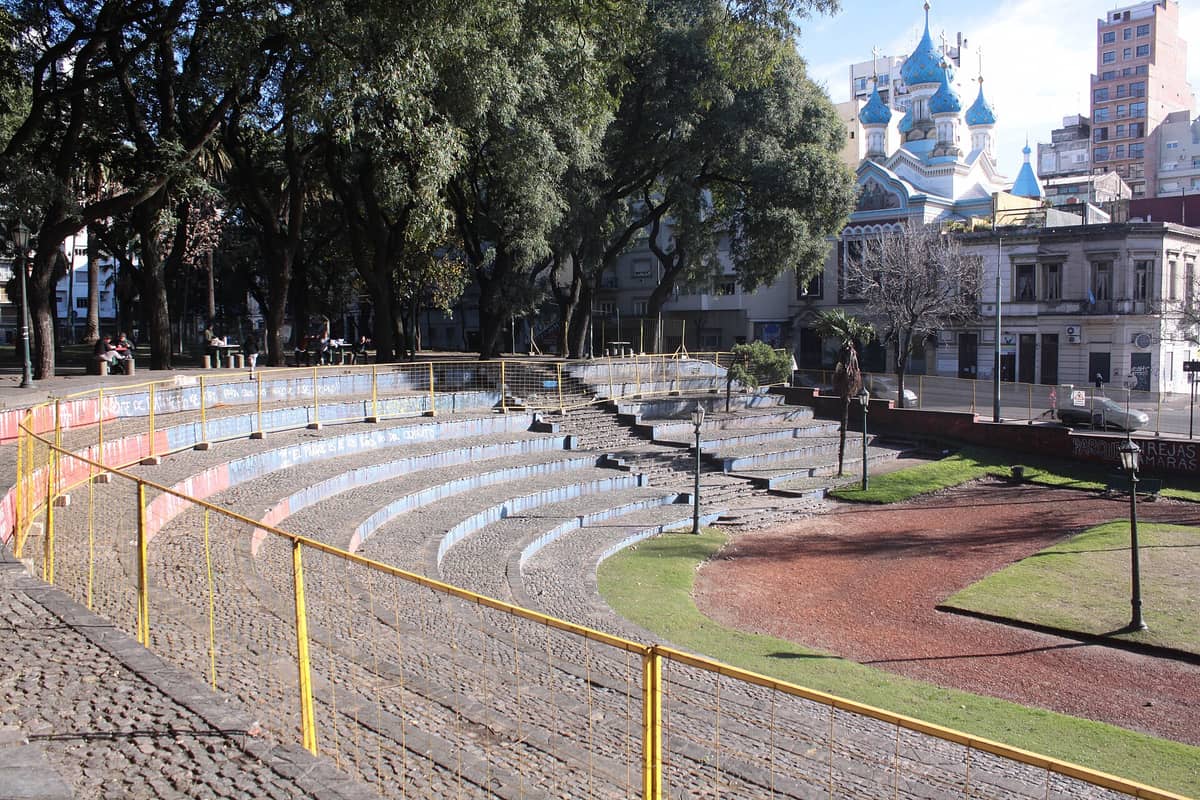
What Parque Lezama Actually Is
Parque Lezama is an 8.1-hectare public park set on the barrancas, the low bluffs that once marked the original riverbank before Buenos Aires expanded eastward with land reclamation. It occupies a slightly elevated plateau in the southern reaches of San Telmo, which gives the upper area a commanding view over Avenida Paseo Colón below. The drop in elevation is gradual but noticeable: stone staircases and sloped paths connect the upper esplanade to the lower perimeter, and that topography is a large part of what makes the park feel distinct from the flat grid surrounding it.
By municipal ordinance on 27 May 1894, the site was designated one of Buenos Aires’ early public parks. Before that it had been a private estate belonging to José Gregorio Lezama, a wealthy merchant whose Italianate mansion still stands inside the park and today houses the Museo Histórico Nacional (National Historical Museum). The park's name has never changed, and neither has its function: it remains one of the few genuinely local green spaces in the southern half of the city, used daily by residents of San Telmo and La Boca rather than primarily by tourists.
ℹ️ Good to know
Parque Lezama is open 24 hours a day, every day, with no admission charge. The Museo Histórico Nacional inside the park has its own separate timetable and may charge entry — check current hours directly before visiting.
The Founding Monument and Historical Significance
At the corner of Calle Defensa and Avenida Brasil, a stone monument marks the site traditionally associated with Pedro de Mendoza's first foundation of Buenos Aires in 1536. The claim is contested by historians — the exact location of that original settlement is not definitively established — but the monument has stood here long enough that the association is now inseparable from the park's identity. Whether or not Mendoza camped on this precise bluff, the site carries the weight of that narrative, and it shapes how porteños relate to the place.
The park also sits within a neighborhood that has layered history at every turn. San Telmo was the first neighborhood to be formally settled after the city's second founding, and its cobbled streets and colonial-era architecture give Parque Lezama a backdrop that reinforces rather than competes with the park's own age. Standing at the upper esplanade and looking south along Defensa on a weekday morning, with few other visitors around, the combination of the old mansion, the tree canopy, and the quiet is one of the more genuinely atmospheric moments the southern city has to offer.
Tickets & tours
Live prices and dates from our booking partner. If you book, we may earn a commission at no extra cost to you.
Parque de la Costa amusement park tickets with transfer
From 79 €Instant confirmationFree cancellationMadero Tango Show tickets with optional dinner
From 32 €Instant confirmationFree cancellationBuenos Aires small-group city tour with optional lunch and cruise
From 25 €Instant confirmationFree cancellationPiazzolla Tango Show VIP tickets with transfer and optional dinner
From 112 €Instant confirmationFree cancellation
How the Park Changes Through the Day
Early mornings, from roughly 7am to 9am, the park belongs almost entirely to locals: dog walkers navigating the upper paths, elderly residents doing laps on the flat sections, a few joggers cutting through from Defensa. The air at this hour, particularly in the cooler months of April through August, smells of damp earth and jacaranda, and the main fountain area is quiet enough that you can hear pigeons landing on the stone balustrades. This is also when the light falls at a low angle across the old mansion facade, turning the terracotta plasterwork a warm amber.
By mid-morning on weekends, the character shifts noticeably. Vendors set up around the perimeter. Families arrive with children who gravitate toward the carousel. Chess players occupy certain benches with a regularity that suggests long-standing territorial claims. The park's density never becomes overwhelming — 7.7 hectares is generous for a city park — but the shade of the older trees fills with groups eating, talking, or simply sitting. On Sundays especially, the upper esplanade sees informal musicians and the kind of unhurried neighborhood socializing that has largely disappeared from wealthier parts of Buenos Aires.
Afternoons in summer (December through February) can be uncomfortably hot on the exposed lower paths, where shade is thinner. The upper section under the large plane trees and ombú stays cooler. If you are visiting between December and February, aim for before 11am or after 5pm. In spring and autumn, temperatures between roughly 15 and 25°C make any part of the day workable, and October and November bring jacaranda blooms that dust the paths in purple.
💡 Local tip
The best light for photographing the Museo Histórico Nacional mansion falls in the morning, when the sun hits the facade directly. The fountain in the upper plaza is best photographed in the afternoon when the surrounding trees cast softer shadows.
The Museo Histórico Nacional
The former Lezama mansion, a mid-19th-century Italianate building with a colonnaded facade, now houses the Museo Histórico Nacional. The collection covers Argentine history from the colonial period through the 19th century, with particular focus on independence-era figures, weapons, portraits, and documents. The building itself is arguably as interesting as the collection inside: the original interior layout has been largely preserved, and walking through the high-ceilinged rooms gives a tangible sense of how upper-class Buenos Aires lived in the 1880s.
The museum has its own specific opening hours and admission policy, separate from the park. These details are time-sensitive and should be verified directly. For broader context on Buenos Aires' museum landscape, the best museums in Buenos Aires guide covers the Museo Histórico Nacional alongside other major collections.
Architecture and What Surrounds the Park
On the eastern edge of the park, facing Avenida Brasil, stands the Russian Orthodox Cathedral of the Most Holy Trinity, a blue-domed structure completed in 1901. It is one of the few Russian Orthodox churches in South America and sits in striking visual contrast to the Italianate mansion across the park. The combination of these two buildings, plus the neoclassical monument to Pedro de Mendoza, makes the park something of an architectural microcosm of 19th-century Buenos Aires, when the city was rapidly importing European styles and communities simultaneously.
The street bordering the park's western edge, Calle Defensa, is one of San Telmo's main arteries. On Sundays it becomes pedestrian-only for the Feria de San Telmo, an antiques and crafts market that stretches from Plaza Dorrego south to the park entrance. The proximity of the two makes it easy to combine both in a single morning.
The area around the park is covered extensively in the Buenos Aires architecture guide, which contextualizes the Italianate and eclectic styles that define the San Telmo streetscape.
Practical Walkthrough: Getting There and Moving Around
There is no Subte (metro) station directly adjacent to Parque Lezama. The most practical public transport options are the colectivo buses that run along Avenida Paseo Colón and Avenida San Juan. Lines 10, 22, 24, 29, 33, 53, 64, 86, 93, 129, 152, and others pass close to the park's boundaries. A SUBE rechargeable card is required to pay bus fares in Buenos Aires — cash is not accepted on buses. If you are arriving from central San Telmo, the park is walkable from Plaza Dorrego in about eight to ten minutes heading south along Defensa.
Constitución, a major rail and long-distance bus terminal, is approximately seven blocks away. If you are arriving from the southern suburbs by commuter train, this is the closest major hub. The walk from Constitución to the park takes around ten minutes through streets that are functional rather than scenic.
Within the park, the terrain involves changes in level. The upper area along Defensa is relatively flat and easily navigated. The paths descending toward Avenida Paseo Colón involve slopes and stone staircases. Visitors with mobility limitations should note that there is no confirmed step-free route through the park — conditions should be verified locally before planning a visit.
⚠️ What to skip
Like most large parks in Buenos Aires, Parque Lezama is safer in daylight. The park is open 24 hours but is not recommended for visits late at night. The surrounding streets near Constitución warrant standard urban caution regardless of the time of day.
Photography and What to Bring
The park rewards photographers who are willing to arrive early. The dome of the Russian Orthodox church catches the morning sky well, and the Italianate mansion facade photographs cleanly before midday when direct sun flattens the relief. The upper fountain plaza has symmetrical paths and benches that work as compositional frames, especially when covered with fallen jacaranda petals in late October and November.
Bring water, particularly in summer. There are no cafes inside the park itself, though vendors operate on weekends. The nearest reliable coffee options are back up Defensa toward Plaza Dorrego, which has several cafe terraces. Sun protection is advisable from November through March, especially on the lower, more exposed paths.
Insider Tips
- Visit on a Sunday morning to catch both the Feria de San Telmo on Calle Defensa and the park at its most social — vendors and chess players are out by 10am, and the atmosphere is at its most characteristic of southern Buenos Aires.
- The Pedro de Mendoza monument at the corner of Defensa and Brasil is easy to walk past without noticing. Look for it specifically: the stone plinth with its relief panels is one of the older public monuments in the city and rarely has anyone standing near it.
- October and November bring jacaranda bloom to the upper esplanade. The petals accumulate on the paths and around the fountain, creating conditions that are worth timing a visit around if you are in Buenos Aires during those months.
- The Russian Orthodox church facing Avenida Brasil is not always open to visitors, but it is worth checking — the interior is rarely seen and the blue-domed exterior is one of the more unexpected architectural sights in the city's south.
- If combining the park with the Museo Histórico Nacional, arrive when the museum opens rather than after touring the park — museum energy tends to drain later in the morning, and the collection takes more focus than the park does.
Who Is Parque Lezama For?
- History-focused travelers wanting to stand on the contested site of Buenos Aires' first founding
- Photographers looking for Italianate architecture, Orthodox domes, and jacaranda-lined paths in a single location
- Travelers who want to experience a genuine local neighborhood park rather than a tourist-oriented attraction
- Families with children, particularly on weekends when the carousel and open spaces are in use
- Anyone combining a San Telmo Sunday walk with the Feria de San Telmo along Calle Defensa
Nearby Attractions
Other things to see while in San Telmo:
- Feria de San Telmo (Sunday Market)
Every Sunday, Calle Defensa closes to traffic and around 300 registered vendors spread across Plaza Dorrego and the surrounding cobblestone streets. Antique silver, vintage maps, leather goods, and live tango performances compete for your attention. Entry is free — the cost is whatever you can't resist buying.
- Iglesia Ortodoxa Rusa de la Santísima Trinidad
Built in 1901 and tucked beside Parque Lezama in San Telmo, the Iglesia Ortodoxa Rusa de la Santísima Trinidad is one of Buenos Aires' most unexpected architectural landmarks. With its blue onion domes and Byzantine interior, it offers a rare glimpse into the city's Russian immigrant heritage — but access is tightly controlled and requires planning.
- Mercado de San Telmo
Built in 1897, Mercado de San Telmo is a covered iron-frame market in Buenos Aires' oldest neighborhood, offering a mix of food stalls, antique dealers, and coffee bars under a single ornate roof. Entry is free, the atmosphere shifts dramatically between weekday mornings and Sunday afternoons, and it rewards visitors who linger rather than rush.
- Museo de Arte Moderno de Buenos Aires (MAMBA)
The Museo de Arte Moderno de Buenos Aires, often still referred to by its old acronym MAMBA, is the city's leading institution for modern and contemporary Argentine art. Housed on Avenida San Juan in San Telmo, its collection of more than 8,000 works spans the 20th and 21st centuries, and free Wednesday admission makes it one of the most accessible cultural experiences in the city.
Planning a trip? Discover personalized activities with the Nomado app.