Feria de San Telmo: What to Know Before You Go to Buenos Aires' Sunday Market
Every Sunday, Calle Defensa closes to traffic and around 300 registered vendors spread across Plaza Dorrego and the surrounding cobblestone streets. Antique silver, vintage maps, leather goods, and live tango performances compete for your attention. Entry is free — the cost is whatever you can't resist buying.
Quick Facts
- Location
- Plaza Dorrego & Calle Defensa, San Telmo, Buenos Aires
- Getting There
- Subte Line C — Independencia station (5-block walk)
- Time Needed
- 2–4 hours; longer if you browse both the fair and Mercado de San Telmo
- Cost
- Free entry; bring Argentine pesos (ARS) for purchases
- Best for
- Antique hunters, first-time visitors, photography, Sunday mornings
- Official website
- feriadesantelmo.com
What the Feria de San Telmo Actually Is
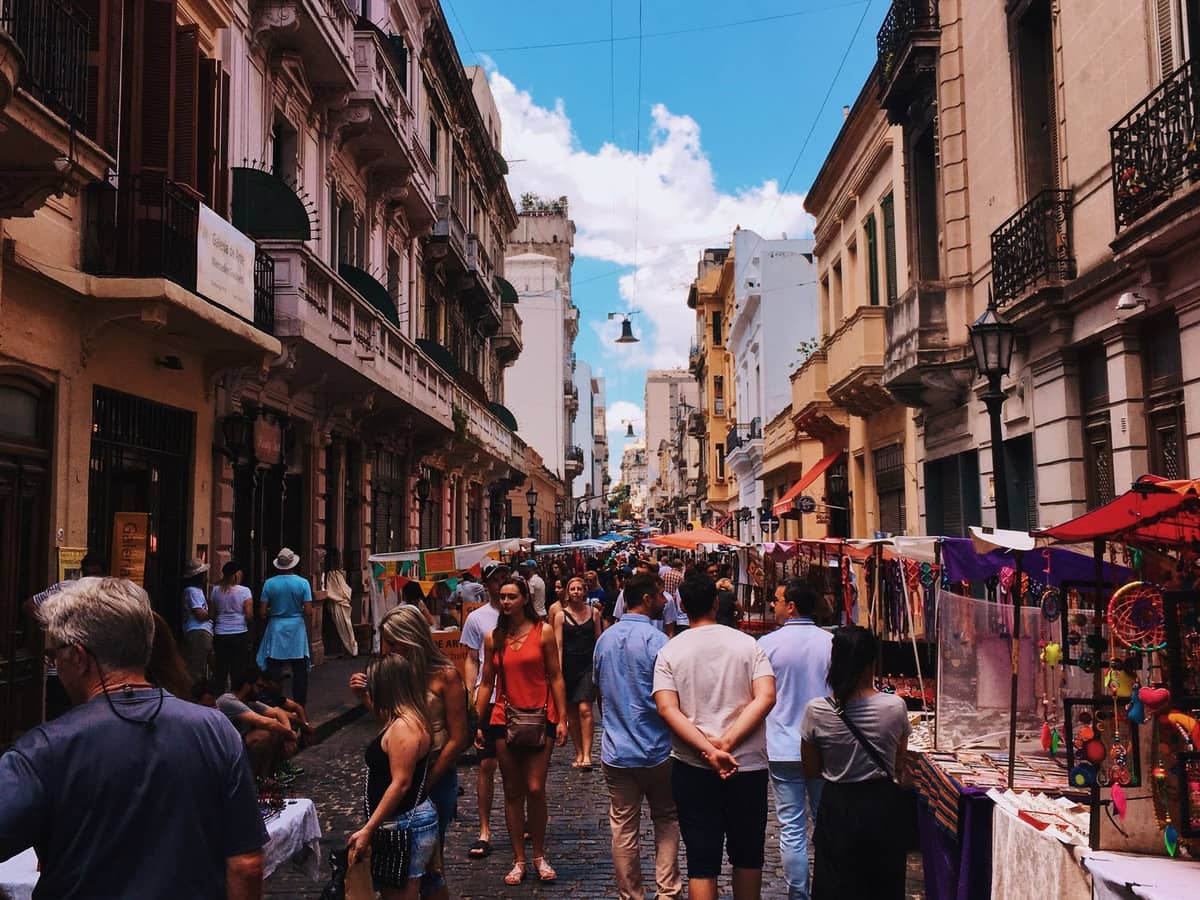
The Feria de San Telmo, officially known as the Feria de San Pedro Telmo or Feria de Antigüedades de San Telmo, is an open-air antiques market held every Sunday from 10:00 to 17:00 along Calle Defensa and Plaza Dorrego. It stretches roughly 10 to 13 blocks, from near Plaza de Mayo in the north all the way to Parque Lezama in the south. Around 270 to 300 registered vendors occupy the street each week, making this one of the largest and most consistently attended outdoor markets in Argentina.
The fair draws a wide mix of stalls: genuine antique dealers with silver mate gourds, old phonographs, and yellowing maps sit alongside artisans selling leather belts, hand-printed textiles, and ceramic figures. The quality and authenticity vary considerably from stall to stall. Experienced collectors know which vendors are specialists; first-time visitors tend to browse without a filter and often find something unexpected regardless.
The market operates year-round in principle and is not usually subject to seasonal closures, which is useful to know if you're planning a trip outside peak tourist months. For context on when crowds thin out and prices at nearby restaurants become more reasonable, the best time to visit Buenos Aires guide covers seasonal patterns across the city.
How the Fair Changes Through the Day
Arriving at 10:00 when the fair opens means thinner crowds, cooler air in summer, and vendors still arranging their tables. The light on Calle Defensa at this hour, especially in autumn and spring, falls low and golden between the 19th-century building facades. Serious antique buyers tend to arrive early for exactly this reason.
By midday, the street fills considerably. The smells shift: coffee and medialunas from nearby cafes give way to choripán grills set up at the southern end near Parque Lezama, and the occasional chimichurri smoke cuts through the air. Street performers begin appearing around Plaza Dorrego after noon. Tango dancers in full costume take over sections of the square, performing short shows and then circulating for tips. This is the fair at its most photogenic — and its most crowded.
The last hour before 17:00 sees some vendors packing up early, particularly those with smaller operations. If you're visiting primarily to browse rather than buy, the middle of the day offers the fullest experience. If you plan to negotiate on price, late afternoon gives you mild leverage as sellers consider packing up.
💡 Local tip
Summer Sundays (December–February) can reach 30°C by early afternoon. Bring water and wear light layers. The fair has almost no shade along Defensa — the only real relief is ducking into the covered Mercado de San Telmo, which also has food stalls and a café.
Tickets & tours
Live prices and dates from our booking partner. If you book, we may earn a commission at no extra cost to you.
Walking private tour of Plaza de Mayo and San Telmo
From 38 €Instant confirmationFree cancellationSan Telmo and La Boca Bike Tour in Buenos Aires
From 43 €Instant confirmationFree cancellationBuenos Aires San Telmo and Mataderos Fairs private tour
From 62 €Instant confirmationFree cancellationSan Telmo and Mataderos Fairs guided tour
From 143 €Instant confirmationFree cancellation
The Neighborhood That Frames the Market
San Telmo is one of the oldest surviving residential districts in Buenos Aires, settled in the colonial period and later associated with the city's Italian and Spanish immigrant working class. The neighborhood's low-rise 19th-century architecture — chorizo houses, colonial courtyards, and ornate iron balconies — gives the fair its visual backdrop. Walking north along Defensa from Parque Lezama toward Plaza de Mayo is effectively a compressed architectural tour of the neighborhood.
Plaza Dorrego itself is worth pausing at beyond the market context. It is one of the oldest public squares in Buenos Aires, and on ordinary days (not Sundays) it functions as a quiet plaza with outdoor café seating. The Plaza Dorrego and its surrounding streets are also where you'll find some of San Telmo's most atmospheric corner bars, or bares notables, which have been operating for decades.
A short detour off Defensa leads to the Mercado de San Telmo, a covered iron-and-glass market hall built in 1897 that operates Tuesday through Sunday. Inside, the original iron structure is intact and houses a combination of antique dealers, produce stands, and food counters serving everything from empanadas to craft beer. On Sundays it operates from 9:00 to 20:00, making it a natural extension of the outdoor fair.
What You'll Actually Find at the Stalls
The northern stretch of the fair, closer to Plaza de Mayo, tends to have more mass-market artisan goods: leather keychains, mate cups aimed at tourists, printed t-shirts, and knitted goods. These are fine for souvenirs but not representative of what makes the market interesting.
The concentration of genuine antique dealers clusters around Plaza Dorrego and the blocks immediately north and south of it. Here you'll find Argentine peso banknotes from before currency reforms, 1940s and 1950s postcards, silverware with family crests, old Peronist political ephemera, wine decanters, and ornate religious objects. Prices are quoted in Argentine pesos; vendors rarely display fixed prices and expect some negotiation, though aggressive bargaining is not culturally standard here. A polite counteroffer of 10 to 20 percent below the asking price is usually met without friction.
Handmade leather goods from established artisan vendors at the southern end of the fair represent reasonable value. Look for hand-stitched wallets, belts, and bags rather than the machine-stamped pieces that are common in more tourist-facing stalls. The difference is visible in the stitching and the texture of the leather.
ℹ️ Good to know
Bring Argentine pesos in cash. While some vendors accept cards, many do not — and cell signal on Defensa can be unreliable during peak hours when the street is densely packed. ATMs in San Telmo can run out of cash on busy Sunday afternoons.
Getting There and Moving Around
The simplest route by public transit is Subte Line C to Independencia station. From the exit, walk east on Independencia and then south on Defensa — about five blocks in total. You'll hear the market before you see it on busy Sundays: the sound of street musicians and the murmur of crowds carries from a block away.
Multiple bus lines stop near Plaza Dorrego and Calle Defensa, including routes 22, 24, 29, 33, 54, 86, and others. For visitors using Buenos Aires public transport for the first time, a SUBE card (the rechargeable transit card used across the Subte and colectivo network) is needed for Subte access — single-use tickets are not available.
If you're combining the fair with other San Telmo sights, the Parque Lezama sits at the southern end of Defensa and makes a good endpoint for a north-to-south walk through the market. The park has benches, mature trees, and a low-traffic atmosphere that contrasts well with the density of the fair.
⚠️ What to skip
Calle Defensa is closed to vehicle traffic on Sundays, but the surrounding streets are not — cross-streets remain open and can be hectic. Keep an eye on traffic at each intersection as you walk south along the fair.
Photography, Accessibility, and Practical Details
The fair is one of the more photogenic street markets in South America, but the combination of narrow cobblestone streets and dense crowds makes wide-angle shots difficult by midday. The best light for photography is in the morning, when foot traffic is lighter and the low sun catches the ironwork balconies above the stalls. Street performers in Plaza Dorrego are accustomed to being photographed; tipping after a performance is standard practice.
Cobblestone underfoot is the main accessibility concern. Calle Defensa and Plaza Dorrego are surfaced with irregular paving stones that are uneven in places, particularly where vendor tables have been anchored. Wheelchair users and anyone with mobility difficulties will find movement slow and potentially challenging during peak hours. The covered Mercado de San Telmo has smoother internal aisles and may be more manageable, though stall layouts inside vary.
The fair is not ideal for visitors who dislike crowds, find street noise overwhelming, or have no interest in antiques, artisan goods, or people-watching. If that describes you, the surrounding San Telmo neighborhood has quieter streets on Sunday mornings — the market is the main draw, not the pretext.
Is It Worth It for First-Time Visitors?
For most first-time visitors to Buenos Aires, the answer is yes — with calibrated expectations. The Feria de San Telmo is not a curated design market. It's an outdoor Sunday fair that has been running in this form for decades, combining genuine antique culture with street performance and neighborhood atmosphere. It gives a useful ground-level view of the San Telmo neighborhood that you can't get from a museum or a restaurant.
The market works best as part of a longer Sunday in the area: arrive mid-morning, walk the full length of Defensa at a slow pace, spend time in Plaza Dorrego watching the tango performances, step into the Mercado de San Telmo for lunch, and continue south to Parque Lezama in the afternoon. If you have more time and want to understand how Buenos Aires has shaped its cultural identity, the broader things to do in Buenos Aires guide places the fair in the context of the city's other major experiences.
Insider Tips
- Walk the full length of Defensa from north to south before stopping to buy anything. The quality and character of stalls changes significantly by block, and the best antique dealers are concentrated around Plaza Dorrego rather than at the northern (Plaza de Mayo) end.
- Tango performances in Plaza Dorrego happen multiple times through the afternoon, but the dancers rotate. If you miss one set, another typically begins within 30 to 45 minutes. Tip in Argentine pesos — the performers are professionals, not hobbyists.
- Sunday lunch inside the Mercado de San Telmo is significantly less crowded before 13:00. After that hour, the food counter seats fill quickly and queues at popular stalls can stretch into the aisles.
- Vendors at the fair are accustomed to tourists photographing their stalls, but ask before photographing a seller's face directly. A brief gesture and a smile before raising your camera is all it takes — most vendors are happy to pose if asked.
- If you're buying antique silverware or old currency notes, ask the vendor about provenance. Many long-term dealers know the history of their pieces and will tell you more than the price tag suggests. That knowledge is part of what you're paying for.
Who Is Feria de San Telmo (Sunday Market) For?
- First-time visitors wanting an authentic Buenos Aires Sunday experience without a ticket price
- Antique collectors and anyone with interest in Argentine material culture and 20th-century ephemera
- Photographers looking for street-level texture, architecture, and performance subjects
- Travelers who enjoy unhurried neighborhood walks combined with food and people-watching
- Anyone building a full San Telmo day that includes the Mercado de San Telmo and Parque Lezama
Nearby Attractions
Other things to see while in San Telmo:
- Iglesia Ortodoxa Rusa de la Santísima Trinidad
Built in 1901 and tucked beside Parque Lezama in San Telmo, the Iglesia Ortodoxa Rusa de la Santísima Trinidad is one of Buenos Aires' most unexpected architectural landmarks. With its blue onion domes and Byzantine interior, it offers a rare glimpse into the city's Russian immigrant heritage — but access is tightly controlled and requires planning.
- Mercado de San Telmo
Built in 1897, Mercado de San Telmo is a covered iron-frame market in Buenos Aires' oldest neighborhood, offering a mix of food stalls, antique dealers, and coffee bars under a single ornate roof. Entry is free, the atmosphere shifts dramatically between weekday mornings and Sunday afternoons, and it rewards visitors who linger rather than rush.
- Museo de Arte Moderno de Buenos Aires (MAMBA)
The Museo de Arte Moderno de Buenos Aires, often still referred to by its old acronym MAMBA, is the city's leading institution for modern and contemporary Argentine art. Housed on Avenida San Juan in San Telmo, its collection of more than 8,000 works spans the 20th and 21st centuries, and free Wednesday admission makes it one of the most accessible cultural experiences in the city.
- Museo Histórico Nacional
The Museo Histórico Nacional in San Telmo preserves Argentina's founding artifacts, from the colonial era to the wars of independence. It sits beside Parque Lezama on land traditionally linked to the city's first settlement, and entry is free every Wednesday through Sunday.
Planning a trip? Discover personalized activities with the Nomado app.