Museo Histórico Nacional: Argentina's Story in One Building
The Museo Histórico Nacional in San Telmo preserves Argentina's founding artifacts, from the colonial era to the wars of independence. It sits beside Parque Lezama on land traditionally linked to the city's first settlement, and entry is free every Wednesday through Sunday.
Quick Facts
- Location
- Defensa 1600, Parque Lezama, San Telmo, Buenos Aires
- Getting There
- Bus lines to Defensa / Parque Lezama; taxi or rideshare to 'Defensa 1600'
- Time Needed
- 1.5 to 2.5 hours
- Cost
- Free entry
- Best for
- History enthusiasts, architecture admirers, quiet weekday cultural visits
- Official website
- museohistoriconacional.cultura.gob.ar
What the Museo Histórico Nacional Actually Is
The Museo Histórico Nacional is Argentina's principal repository of national history, housed in a 19th-century building on the southern edge of San Telmo. Its collection spans the colonial period, the May Revolution of 1810, the wars of independence, and the first decades of the Argentine republic. The permanent galleries hold portraits of founding figures, uniforms, weapons, maps, documents, and decorative objects that would be scattered across dozens of institutions in other countries but here occupy a single, coherent space.
The building sits directly beside Parque Lezama, a sloping park on land traditionally associated with the area where Pedro de Mendoza made the first, short-lived attempt to found Buenos Aires in 1536. Whether or not that exact identification is archaeologically confirmed, the symbolic weight of the location is built into how the museum presents itself. Arriving through the park, with its old rubber trees and weekend families, already sets a particular tone before you step inside.
ℹ️ Good to know
Opening hours: Wednesday to Sunday, 11:00–19:00 (last entry 18:50). Closed Monday and Tuesday. Open on most public holidays — check the official site before visiting on a holiday weekend.
The Building and Its Setting
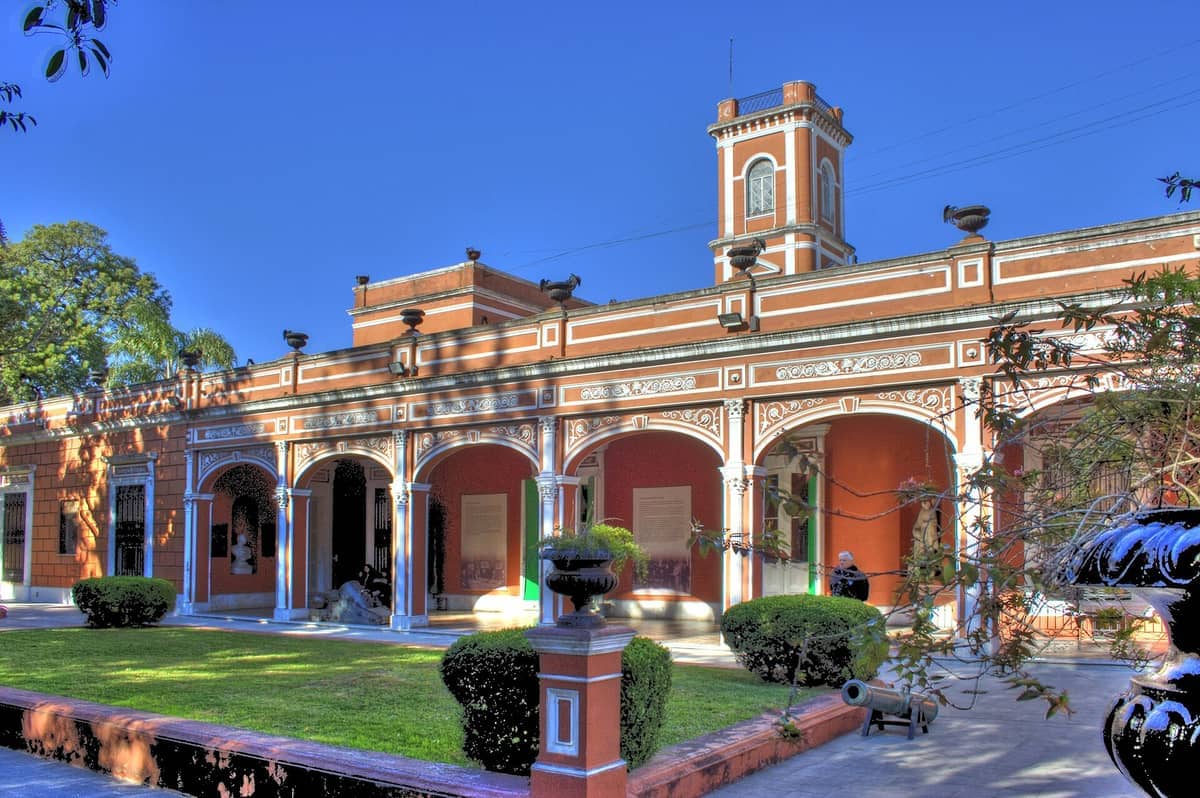
The museum occupies a substantial Italianate mansion, its ochre facade visible through the trees of Parque Lezama. From the street on Defensa, the museum entrance appears modest, but the park approach from the central ramp reveals the full scale of the building against a green backdrop. This is one of the better-located museums in the city: the park immediately in front provides space to decompress after the galleries, which not every Buenos Aires museum can claim.
The neighborhood framing the visit is equally telling. San Telmo is one of Buenos Aires's oldest and most architecturally intact barrios, with cobbled streets, 19th-century tenements (conventillos), and the Mercado de San Telmo a short walk north. Walking down Defensa from the market district toward the museum gives you a gradual transition from weekend street life to something quieter and more contemplative at the Parque Lezama end.
Wheelchair users and visitors with mobility considerations should note that step-free access is available via the ramp through the park entrance, not from the main street facade. This is clearly signposted but worth knowing before you arrive.
Tickets & tours
Live prices and dates from our booking partner. If you book, we may earn a commission at no extra cost to you.
Boca Juniors Museum skip-the-line tickets
From 17 €Instant confirmationFree cancellationTour to La Boca Jrs and River Plates Stadiums and museums
From 99 €Instant confirmationFree cancellationRiver Stadium and Museum Official Guided Tour
From 33 €Instant confirmationFree cancellationHistoric Buenos Aires city exploration game
From 10 €Instant confirmationFree cancellation
Inside the Galleries: What You Will See
The permanent collection is organized roughly chronologically, beginning with pre-independence colonial Argentina and moving through the May Revolution, the campaigns of José de San Martín, the wars against the Spanish, and into the republic's early decades. The room dedicated to San Martín is among the most visited: it holds personal effects, swords, and campaign-era documents connected to the liberator, displayed in cases that show their age in a way that feels appropriately serious.
The portrait gallery is dense with faces that shaped the early republic, many of them unfamiliar to visitors from outside Argentina. Rather than a limitation, this is actually the museum's value: it forces engagement with a cast of characters most international tourists have never encountered, making Argentine history feel specific and populated rather than abstract.
Room sizes vary considerably. Some halls have high ceilings and generous circulation space; others feel compressed, with objects displayed close together. The quality of labeling is uneven. Spanish explanatory text is generally thorough; English labeling is present but inconsistent. If Spanish is not your language, the context for individual objects can sometimes be thin.
💡 Local tip
Download the official museum app or bring a translation tool. English signage is partial, and several of the most significant objects have explanatory text only in Spanish.
How the Experience Changes by Time of Day
The museum is at its quietest on weekday mornings shortly after the 11:00 opening. The light through the older gallery windows is soft in the morning hours, and the relative silence makes the weight of the collection more apparent. Rooms that feel slightly cluttered on a busy Sunday afternoon become contemplative spaces on a Wednesday morning with three other visitors in them.
Sunday afternoons draw families from the park and San Telmo's weekend market crowd, making it the busiest period. This is not overwhelming by major museum standards — the Museo Histórico Nacional does not attract the volume of the MALBA or the Teatro Colón — but the change in atmosphere is noticeable. Weekend afternoons also tend to bring school groups, which changes the sound profile of the building considerably.
Late afternoon light in the rear galleries is worth the wait if you are already inside. The building's orientation means some interior rooms catch warm afternoon light in a way that photographs well and makes the displayed canvases easier to examine.
Parque Lezama Before or After
Treating Parque Lezama as a standalone stop rather than just the museum's front yard is worth considering. The park has old-growth trees, a Russian Orthodox church on its northeastern edge, and a gently elevated viewpoint toward the south of the city. On weekends, vendors, chess players, and families occupy the benches, making it one of the more genuinely local public spaces in the central-south of Buenos Aires, without the explicit tourism overlay of, say, the Caminito area in La Boca.
The Russian Orthodox Church on Parque Lezama is architecturally striking and takes only a few minutes to walk around. Combining the museum, the park, and the church makes for a coherent two-to-three-hour loop in the southern San Telmo area.
Getting There and Practical Logistics
The museum is at Defensa 1600, at the point where Defensa meets the southern boundary of Parque Lezama. The nearest Subte (metro) stations, such as Constitución (Line C) or San Juan (Line E), are around a 15–20 minute walk away; many visitors find city buses along Defensa and Brasil the most direct public transit option. Check the Cómo Llego tool (the Buenos Aires public transit route planner) for current bus numbers, as services change periodically.
Taxis and rideshare services drop you directly at the park perimeter. For those walking from the San Telmo market area, the walk south down Defensa takes about 10 to 12 minutes from the Plaza Dorrego end, passing several interesting facades along the way.
San Telmo repays a slow approach. If you are combining this visit with the Sunday antiques fair at Feria de San Telmo or a stop at the market building, plan the museum for the end of the day rather than the beginning — market energy and museum quietude work better in that sequence.
⚠️ What to skip
The museum is free, but the free admission is not prominently advertised outside. Do not pay anyone offering 'tickets' near the entrance. Entry is simply by presenting yourself at the desk inside.
Is It Worth Your Time?
For visitors with a serious interest in South American independence history, Argentine political history, or 19th-century material culture, the Museo Histórico Nacional is genuinely excellent and considerably undervisited relative to its quality. The San Martín room alone contains objects that would be centerpieces of a European military history museum.
For visitors whose Buenos Aires itinerary is already full of the city's cultural and architectural highlights, this museum is better suited to a second or third visit than a single tight trip. It rewards context: arriving knowing something about the May Revolution, San Martín, or the formation of the Argentine state means the labels and objects connect into a coherent narrative. Arriving cold, without that background, makes the experience feel like a collection of objects whose significance is hard to locate.
Travelers who want a broader picture of what Buenos Aires's museum landscape offers can cross-reference our guide to the best museums in Buenos Aires to prioritize by interest.
Insider Tips
- The ramp access from Parque Lezama is the smoother entrance for anyone with luggage, a stroller, or mobility needs. The street-facing entrance on Defensa has steps.
- The museum's temporary exhibition program changes several times a year and occasionally covers topics not addressed in the permanent galleries. Check the official site's Exhibiciones section before visiting if thematic programming matters to you.
- Weekday mornings after opening are the least crowded period. If you visit on a Sunday when the San Telmo street fair is running on Defensa, factor in 5 to 10 extra minutes of walking through market crowds to reach the museum.
- The museum has a small library and archive that are available for researchers by appointment. This is not open to general visitors but is worth knowing if you are pursuing specific historical research.
- Parque Lezama has a good cafe kiosk near the central fountain. It is a reasonable place to sit after the museum without backtracking into the busier market area.
Who Is Museo Histórico Nacional For?
- Travelers with prior interest in Argentine or South American independence history
- Architecture and heritage enthusiasts interested in 19th-century Buenos Aires interiors
- Visitors looking for a free, unhurried cultural experience away from the main tourist circuit
- Those combining a San Telmo walking itinerary with Parque Lezama and the Russian Orthodox Church
- Repeat visitors to Buenos Aires who have already covered the city's headline museums
Nearby Attractions
Other things to see while in San Telmo:
- Feria de San Telmo (Sunday Market)
Every Sunday, Calle Defensa closes to traffic and around 300 registered vendors spread across Plaza Dorrego and the surrounding cobblestone streets. Antique silver, vintage maps, leather goods, and live tango performances compete for your attention. Entry is free — the cost is whatever you can't resist buying.
- Iglesia Ortodoxa Rusa de la Santísima Trinidad
Built in 1901 and tucked beside Parque Lezama in San Telmo, the Iglesia Ortodoxa Rusa de la Santísima Trinidad is one of Buenos Aires' most unexpected architectural landmarks. With its blue onion domes and Byzantine interior, it offers a rare glimpse into the city's Russian immigrant heritage — but access is tightly controlled and requires planning.
- Mercado de San Telmo
Built in 1897, Mercado de San Telmo is a covered iron-frame market in Buenos Aires' oldest neighborhood, offering a mix of food stalls, antique dealers, and coffee bars under a single ornate roof. Entry is free, the atmosphere shifts dramatically between weekday mornings and Sunday afternoons, and it rewards visitors who linger rather than rush.
- Museo de Arte Moderno de Buenos Aires (MAMBA)
The Museo de Arte Moderno de Buenos Aires, often still referred to by its old acronym MAMBA, is the city's leading institution for modern and contemporary Argentine art. Housed on Avenida San Juan in San Telmo, its collection of more than 8,000 works spans the 20th and 21st centuries, and free Wednesday admission makes it one of the most accessible cultural experiences in the city.
Planning a trip? Discover personalized activities with the Nomado app.