Iglesia Ortodoxa Rusa de la Santísima Trinidad: San Telmo's Hidden Orthodox Cathedral
Built in 1901 and tucked beside Parque Lezama in San Telmo, the Iglesia Ortodoxa Rusa de la Santísima Trinidad is one of Buenos Aires' most unexpected architectural landmarks. With its blue onion domes and Byzantine interior, it offers a rare glimpse into the city's Russian immigrant heritage — but access is tightly controlled and requires planning.
Quick Facts
- Location
- Brasil 315, San Telmo, Buenos Aires (near Parque Lezama)
- Getting There
- Bus lines stop nearby on Paseo Colón and Av. Brasil; closest Subte is Line C (San Juan station)
- Time Needed
- 30–45 minutes for a guided visit; exterior viewing takes 10 minutes
- Cost
- Voluntary contribution (bono) for guided visits; amount varies — confirm in advance
- Best for
- Architecture enthusiasts, history travelers, those interested in religious heritage
- Official website
- www.iglesiarusa.org.ar
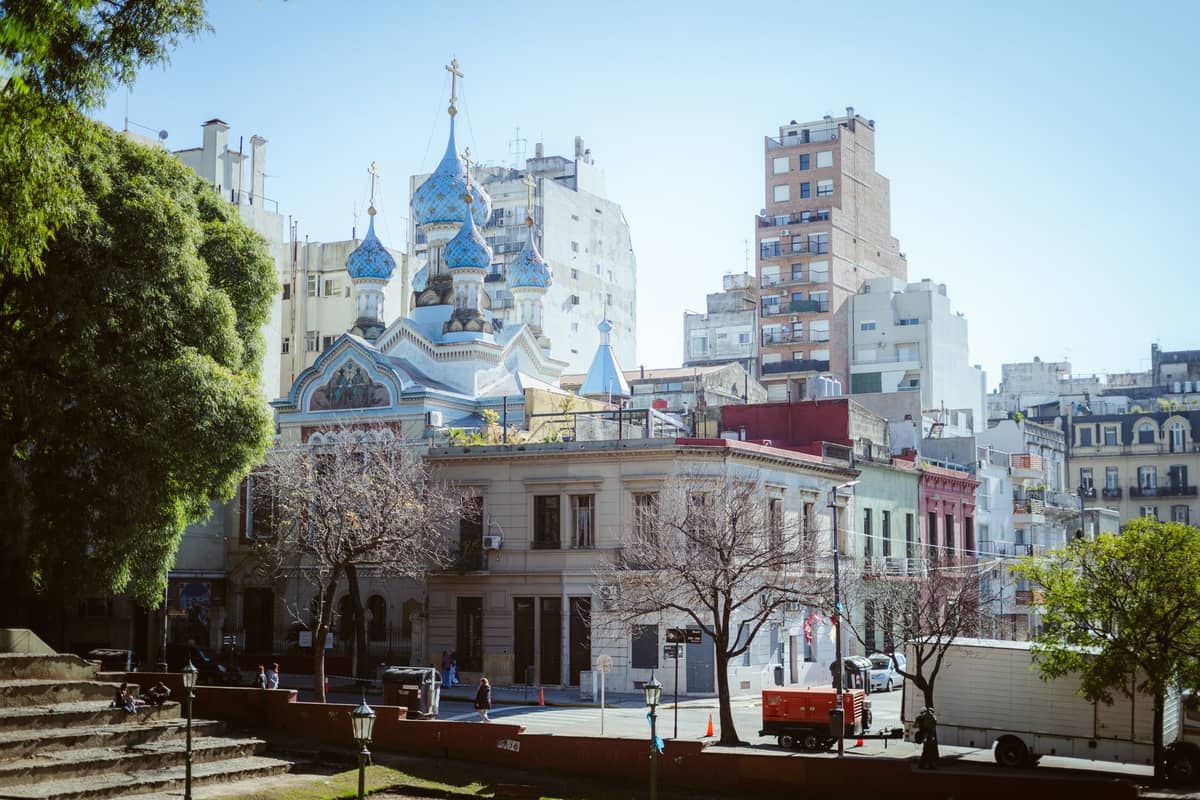
What You're Looking At: A Piece of Imperial Russia in Buenos Aires
The Iglesia Ortodoxa Rusa de la Santísima Trinidad — officially the Russian Orthodox Cathedral of the Most Holy Trinity — rises unexpectedly from a residential corner of San Telmo, its blue-tiled onion domes catching light in a neighborhood better known for cobblestones and antique markets. Inaugurated in 1901, it stands as one of the oldest Russian Orthodox churches in Latin America and a direct product of the wave of Russian and Eastern European immigration that reshaped Buenos Aires at the turn of the 20th century.
From the street, the church reads as genuinely foreign — not in a curated, museum-piece way, but architecturally distinct from every other building on the block. The façade combines pale rendered walls with ornamental brickwork, and those domes, glazed in a deep cobalt blue and topped with Eastern Orthodox crosses, are visible from Parque Lezama just across the road. Even visitors who know the city well tend to do a double take the first time they pass it.
⚠️ What to skip
Access is not like a typical tourist church. The interior is open to the public primarily during scheduled services (Saturday 17:00–19:00 and Sunday 10:00–12:00) and on guided visits, which typically take place roughly once a month, often on the second Sunday afternoon. Hours change and are not always posted online in advance. Check the official website or contact the church directly before planning a visit around the interior.
The Architecture: Byzantine Tradition on a San Telmo Street Corner
The building follows the Russian Orthodox architectural tradition rooted in Byzantine forms: a Greek-cross floor plan, heavy masonry walls, small arched windows set deep into thick stone, and the characteristic drum-and-dome silhouette that defines the skyline of churches from Moscow to Kyiv. What makes this example unusual is its scale — it is modest by cathedral standards, which makes the craftsmanship feel intimate rather than imposing.
Inside, on the occasions when visitors are admitted, the experience shifts dramatically from the street-level exterior. The air is cool and faintly scented with incense from decades of liturgical use. The iconostasis — the ornate screen of gilded icons that separates the nave from the sanctuary in Orthodox churches — is the visual centerpiece. The icons are painted in the traditional Russian style, with deep reds and golds that absorb rather than reflect the light filtering through small windows. Natural light inside is limited at most times of day, which gives the space a contemplative, almost amber atmosphere.
Photographing the interior during services is not appropriate. If you are admitted during a guided visit, behavior follows the conventions of an active place of worship: modest dress (shoulders and knees covered), no flash photography without explicit permission, and respectful silence. Visitors who treat it as a backdrop rather than a sacred space often find themselves asked to leave.
Tickets & tours
Live prices and dates from our booking partner. If you book, we may earn a commission at no extra cost to you.
Walking private tour of Plaza de Mayo and San Telmo
From 38 €Instant confirmationFree cancellationSan Telmo and La Boca Bike Tour in Buenos Aires
From 43 €Instant confirmationFree cancellationBuenos Aires San Telmo and Mataderos Fairs private tour
From 62 €Instant confirmationFree cancellationSan Telmo and Mataderos Fairs guided tour
From 143 €Instant confirmationFree cancellation
Historical Context: Russian Immigration and Buenos Aires at the Turn of the Century
Argentina received millions of immigrants between roughly 1880 and 1930, drawn by the promise of agricultural land and urban work. Russians, along with Ukrainians, Poles, and Jews from the Russian Empire, formed a significant thread in this migration. The church was built to serve a growing community of Russian Orthodox faithful who had settled in and around Buenos Aires, primarily in San Telmo and its adjacent neighborhoods, which were then densely populated working-class districts.
The 1901 inauguration date places the church in the final years of Tsarist Russia, before the 1917 Revolution that would sever most ties between the Russian community abroad and their homeland. In that sense, the church preserves a form of Russian Orthodox practice and aesthetic that predates the Soviet period entirely. It is a physical artifact of a world that no longer exists. For more on Buenos Aires' layered immigrant history and how it shaped the city's architecture, the Buenos Aires architecture guide covers the broader urban context.
Visiting in Practice: What the Experience Is Actually Like
Most visitors who arrive without checking schedules in advance will find the exterior gate closed. The church does not operate tourist hours. This is not a place you drop into on a Sunday afternoon walk without preparation. That said, the exterior alone is worth the short detour from Parque Lezama, and the surrounding corner has a quiet, residential quality that feels different from the more trafficked parts of San Telmo.
If you are in the neighborhood on a Saturday evening or Sunday morning, it is worth walking past to check whether the doors are open for service. Worshippers are generally welcoming to respectful observers, though this is an active liturgical community, not a tourist attraction with staff on hand. The guided visit format — held approximately monthly — offers the most structured access and includes explanation of the iconostasis and the church's history. Parque Lezama is directly across the road and makes a logical pairing: spend time in the park, then check whether the church doors are open.
The surrounding block is quiet even on weekends, a contrast to the market crowds a few streets north. In the morning light, the domes catch a particularly clean blue against the sky, which makes this a worthwhile photography stop even if the interior remains closed. Late afternoon light from the west also illuminates the façade well.
💡 Local tip
For the best exterior photographs, arrive in the morning on a clear day. The domes face roughly eastward, so morning light hits them directly. By midday the façade falls into partial shadow. Bring a wide-angle lens or step back toward Parque Lezama to get the full dome silhouette against the sky.
The Surrounding Neighborhood: San Telmo Beyond the Church
The church sits at the southern edge of San Telmo, where the neighborhood transitions into a quieter residential zone bordering La Boca. The streets here are less commercialized than the area around Plaza Dorrego, with fewer restaurants and souvenir shops and more old tenements and corner stores. It gives you a sense of what the neighborhood looks like when it isn't performing for visitors.
If you are building a half-day itinerary around this area, the logical sequence runs from the church and Parque Lezama northward through San Telmo toward the Mercado de San Telmo and Plaza Dorrego. On Sunday mornings, when the church may be open for service, the San Telmo antiques fair is also active, which makes the combination genuinely efficient.
Accessibility and Practical Notes
No official accessibility statement has been published by the church. Based on visitor accounts, access to the main worship space involves steps, which may present difficulties for visitors using wheelchairs or with significant mobility limitations. The exterior and surrounding pavement are navigable on foot. If accessibility is a concern, it is worth contacting the church in advance.
The church is located in Buenos Aires' Ciudad Autónoma (CABA) and is well served by bus routes along Paseo Colón and Avenida Brasil. The nearest Subte station on Line C is San Juan, though the walk from there takes around 10 to 12 minutes. Taxis and ride-hailing apps are straightforward in this area and may be the most practical option if you are combining the visit with luggage or if the weather is poor. Buenos Aires has a humid subtropical climate, with hot summers and cool winters, so dress accordingly — and note that a sudden summer rainstorm can make exterior photography impractical.
ℹ️ Good to know
A voluntary contribution (bono contribución) is typically collected during guided visits. The specific amount is not officially published and changes over time due to Argentina's fluctuating economic conditions. Bring small denomination Argentine pesos rather than expecting card payment.
Who Should Consider Skipping This
If your travel style involves dropping into attractions spontaneously, this church will likely frustrate you — the probability of finding it open on any given afternoon without prior research is low. Travelers with only one or two days in Buenos Aires and a long list of major sites should probably treat this as an exterior-only detour rather than a primary attraction. It is also not suitable for visitors unwilling to observe religious-site norms around dress and conduct.
The church is small, and even the guided visit is measured in minutes rather than hours. It does not offer the kind of comprehensive cultural experience you get from, say, a full morning at a major museum. Its value is in its specificity: it tells a precise story about a particular immigrant community at a particular moment in Buenos Aires history, and for the right visitor, that specificity is exactly the point.
Insider Tips
- Check the official website (iglesiarusa.org.ar) at least a week before your visit — the monthly guided tour schedule is sometimes posted there and fills up with local interest groups.
- If you arrive and find the gate closed, the view from Parque Lezama across the road still gives you a clear sightline to the domes, which are photogenic without needing to enter the grounds.
- Saturday evening service (reported at 17:00–19:00) tends to draw a smaller, more devout congregation than Sunday morning, which may mean a quieter, more reflective atmosphere for respectful observers.
- Dress conservatively regardless of season — this means covered shoulders and knees. Carrying a light scarf or layer for this purpose is practical across many Buenos Aires churches and saves you from being turned away.
- The streets immediately south of the church, heading toward La Boca, are less trafficked by tourists and give a more unfiltered look at the southern end of San Telmo — worth a short walk if you have time after visiting.
Who Is Iglesia Ortodoxa Rusa de la Santísima Trinidad For?
- Architecture and religious heritage travelers interested in Orthodox Christian traditions
- History enthusiasts researching Buenos Aires' immigrant communities of the early 20th century
- Photographers seeking unusual Buenos Aires subjects beyond the standard circuit
- Visitors spending a Sunday in San Telmo who want to combine the church with the neighborhood's antiques market
- Slow travelers who appreciate planning a visit around a monthly guided tour
Nearby Attractions
Other things to see while in San Telmo:
- Feria de San Telmo (Sunday Market)
Every Sunday, Calle Defensa closes to traffic and around 300 registered vendors spread across Plaza Dorrego and the surrounding cobblestone streets. Antique silver, vintage maps, leather goods, and live tango performances compete for your attention. Entry is free — the cost is whatever you can't resist buying.
- Mercado de San Telmo
Built in 1897, Mercado de San Telmo is a covered iron-frame market in Buenos Aires' oldest neighborhood, offering a mix of food stalls, antique dealers, and coffee bars under a single ornate roof. Entry is free, the atmosphere shifts dramatically between weekday mornings and Sunday afternoons, and it rewards visitors who linger rather than rush.
- Museo de Arte Moderno de Buenos Aires (MAMBA)
The Museo de Arte Moderno de Buenos Aires, often still referred to by its old acronym MAMBA, is the city's leading institution for modern and contemporary Argentine art. Housed on Avenida San Juan in San Telmo, its collection of more than 8,000 works spans the 20th and 21st centuries, and free Wednesday admission makes it one of the most accessible cultural experiences in the city.
- Museo Histórico Nacional
The Museo Histórico Nacional in San Telmo preserves Argentina's founding artifacts, from the colonial era to the wars of independence. It sits beside Parque Lezama on land traditionally linked to the city's first settlement, and entry is free every Wednesday through Sunday.
Planning a trip? Discover personalized activities with the Nomado app.