Plaza Dorrego: San Telmo's Historic Square, Antiques Fair and Tango
Plaza Dorrego is the oldest public square in San Telmo and one of Buenos Aires' most atmospheric outdoor spaces. Free to visit at any hour, it draws antique hunters on Sundays, tango dancers on weekend evenings, and café-goers throughout the week. The cobblestone perimeter, colonial-era facades, and mix of locals and travellers give it a character that few city squares in South America can match.
Quick Facts
- Location
- Corner of Defensa and Humberto I, San Telmo, Buenos Aires
- Getting There
- Subte Line C (Independencia), then ~10-min walk; several bus lines stop nearby
- Time Needed
- 30 min to browse; 2–3 hours on Sunday fair day
- Cost
- Free entry; café drinks and antique purchases extra (prices in ARS)
- Best for
- Antique hunters, tango fans, architecture lovers, Sunday morning wanderers
What Plaza Dorrego Actually Is
Plaza Coronel Manuel Dorrego, universally called Plaza Dorrego, is a compact public square at the intersection of Defensa and Humberto I in San Telmo. It is one of the oldest plazas in the city, and its formal status as a historic site is matched by its informal function as the social centre of an entire neighbourhood. The square is open around the clock and free to enter at any time, making it as much a place for a morning espresso as for a midnight stroll.
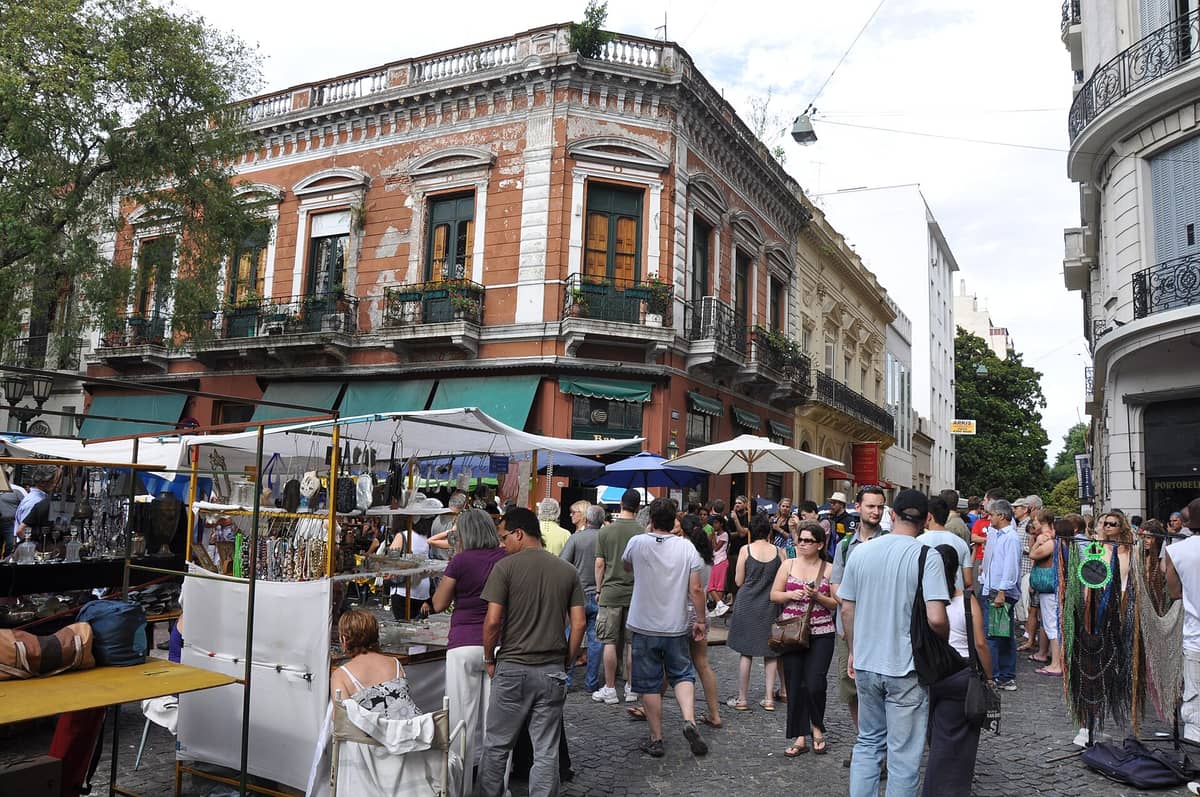
The square's footprint is modest: a central open area of paving stones flanked by benches and mature trees, ringed by the terraces of classic Buenos Aires cafés and bars. What makes it distinctive is not scale but density of character. Colonial and early-republican building facades line three sides, the street Defensa closes to vehicles on weekends, and on Sunday mornings the entire plaza is consumed by the Feria de Antigüedades de San Telmo, one of the city's most established open-air antiques markets.
💡 Local tip
Sunday is Plaza Dorrego's main event, but don't overlook weekday mornings: the square is quieter, café seating spills out into the sun, and you can actually examine the architecture without the market stalls in the way.
A Short History Worth Knowing
The site now occupied by the square was originally known as Plaza del Comercio following a renaming in 1822, reflecting its early role as a node for trade in one of the city's first settled quarters. San Telmo was among the earliest residential and commercial districts of colonial Buenos Aires, situated between the port and the inland settlements, and the plaza served as a natural gathering point for commerce and public life.
In 1861, a market building called the Mercado del Comercio was constructed directly on the square, anchoring the area's commercial identity for several decades before the market eventually relocated. By the late 19th century, Buenos Aires had shifted its economic centre northward and San Telmo became a working-class and immigrant neighbourhood. That social history is still visible in the surrounding streetscape, particularly along Defensa, where narrow lots with ornate upper-floor ironwork give way to ground floors occupied by antique dealers, tango milongas, and cafés.
The square is named after Manuel Dorrego, a governor of Buenos Aires Province who was executed in 1828. Understanding that history adds a layer of meaning to what might otherwise seem like a pleasant but ordinary plaza. For a broader sense of how this neighbourhood fits into the city's past, the Museo Histórico Nacional is a short walk away in Parque Lezama.
Tickets & tours
Live prices and dates from our booking partner. If you book, we may earn a commission at no extra cost to you.
Walking private tour of Plaza de Mayo and San Telmo
From 38 €Instant confirmationFree cancellationMadero Tango Show tickets with optional dinner
From 32 €Instant confirmationFree cancellationBuenos Aires small-group city tour with optional lunch and cruise
From 25 €Instant confirmationFree cancellationPiazzolla Tango Show VIP tickets with transfer and optional dinner
From 112 €Instant confirmationFree cancellation
The Sunday Antiques Fair: What to Expect
The Feria de Antigüedades de San Telmo that fills the square on Sundays is not a flea market in the casual sense. Vendors set up fixed stalls selling genuine antiques, vintage silverware, old Argentine banknotes and coins, Art Deco lamps, vinyl records, leather goods, and an enormous range of 20th-century porcelain and glass. Some dealers are specialists who have operated here for years and know their inventory in detail. Prices reflect this: serious pieces carry serious prices, and vendors are accustomed to negotiating but not to being lowballed.
The fair extends well beyond the plaza itself. On Sundays, street vendors line Defensa for many blocks north and south, creating a corridor of activity that connects Plaza Dorrego to the Mercado de San Telmo and beyond. Walking the full stretch can easily take two hours if you stop to look properly.
⚠️ What to skip
Pickpocketing is a known issue in crowded Sunday markets. Keep bags closed and in front of you. The fair draws large crowds by mid-morning and the density makes it easy for opportunists to work unnoticed.
The best time to arrive at the Sunday fair is between 10am and 11am. By noon the square is at maximum density and navigating the stalls becomes uncomfortable. By 5pm many vendors are already packing down. Arriving early also gives you first pick of the better pieces and more willingness from vendors to have genuine conversations about what they're selling.
Tango at the Plaza: Spontaneous and Scheduled
Weekend evenings at Plaza Dorrego bring a different energy. Tango performers, some professional and some semi-professional, dance in the open space of the square or just outside the café terraces. These performances are not ticketed and are not announced on any official schedule. They happen because the plaza has a long-standing tradition of street tango and because the surrounding bars generate the kind of foot traffic that makes performing worthwhile.
Watching tango here is a different experience from watching it inside a formal milonga or dinner-show venue. The lighting is ambient rather than theatrical, the dancers are often close enough to touch, and the audience stands or sits at café tables rather than in rows. Some performances pass a hat afterward; contributing is expected if you watch for more than a few minutes. The quality varies considerably from week to week, which is itself part of the authenticity.
If seeing tango in a more structured setting matters to you, the city's tango scene extends well beyond this square, with dedicated milongas throughout San Telmo and other neighborhoods.
Café Terraces and the Atmosphere at Different Hours
Several cafés and bars directly face Plaza Dorrego, with outdoor seating that allows you to observe the square from a fixed position. Bar Dorrego and similar establishments on the perimeter have the kind of worn wooden interiors and slow service that come from not needing to update anything since the 1970s. Coffee comes in small cups, beer is cold, and the staff expect customers to stay as long as they like. The terrace experience is at its best on weekday late mornings or late afternoons in autumn or spring, when the temperature in Buenos Aires sits between roughly 15 and 25°C and the square is calm enough to actually hear the birds in the trees.
Early mornings, before around 9am, the plaza is nearly empty: pigeons, one or two elderly residents on benches, and the sound of delivery vans on Defensa. Late at night, especially on Friday and Saturday, the bars keep their terraces open and the square takes on a looser, more social character. Tourists and locals mix at outdoor tables, and the street noise from the surrounding neighbourhood carries through. It is not loud in the way of a nightlife district, but it is not quiet either.
ℹ️ Good to know
Buenos Aires has a humid subtropical climate with hot summers (December to February, up to 30°C) and cool winters (June to August, around 8–15°C). The plaza is entirely outdoors, so the experience changes significantly with the season. Spring and autumn visits offer the most comfortable conditions for spending extended time at a terrace table.
Getting There and Moving Around
Plaza Dorrego sits inside San Telmo, a neighbourhood that is best reached on foot from adjacent districts or by Subte. The closest station is Independencia on Line C, from which the plaza is approximately a 10-minute walk south along Defensa. The street is direct and easy to follow. Alternatively, buses 29 and 39 stop within a short walk of the Humberto I and Defensa intersection.
On Sundays, walking from the Microcentro or from San Telmo's northern edge is actually the most practical approach because Defensa closes to vehicle traffic and becomes a pedestrian corridor lined with market stalls. This means the walk to the plaza is itself part of the experience. Taxis and ride-hailing apps can drop you at the edge of the pedestrian zone.
The cobblestone surface around the plaza and throughout much of San Telmo is uneven in places. Visitors with mobility limitations should be aware that the historic paving is not uniformly smooth and that ramp or elevator access is not documented for the plaza itself. If exploring the neighbourhood more broadly, the Mercado de San Telmo is one block north and has a covered interior that avoids the cobblestones entirely.
Photography and Practical Notes
Plaza Dorrego photographs well at most hours, but the best light for capturing the surrounding facades falls in the late afternoon when the sun is low and the café awnings cast long shadows across the paving stones. On Sunday mornings, the stall setup begins early and the market creates a cluttered foreground in wide-angle shots, which can be interesting or frustrating depending on what you are trying to capture. If you want the architecture without the market, weekday mornings are your window.
Street tango performers generally welcome being photographed but expect a small contribution if you shoot extensively. Asking first with a gesture is usually enough. The surrounding antique vendors are accustomed to tourists with cameras but prefer you engage with their merchandise rather than treat their stall as a prop.
San Telmo's Defensa street has some of the city's most photogenic architecture. If urban photography is a priority, pair this visit with a walk toward Parque Lezama to the south, or through the historic street grid toward the Russian Orthodox Church nearby.
Insider Tips
- Arrive at the Sunday fair before 10am to find the best antique pieces and to have genuine conversations with vendors before crowd density makes it impractical.
- The cafés facing the plaza charge tourist-facing prices on Sunday. If you want a cheaper coffee with no performance, walk one block off Defensa to a neighborhood café on a side street.
- Tango performances at the plaza are spontaneous and unannounced. If you arrive on a Sunday afternoon and see no dancing, try returning around 5pm when the market crowd thins and performers often start.
- San Telmo's cobblestones are uneven enough to twist an ankle in the wrong footwear. Flat, closed shoes are worth wearing regardless of season.
- The square's formal name is Plaza Coronel Manuel Dorrego. If you ask a local for 'Plaza Dorrego' they will know exactly where you mean, but on official maps you may see the full name used.
Who Is Plaza Dorrego For?
- Antique collectors and vintage market browsers who want a genuinely curated open-air fair rather than a general flea market
- Tango enthusiasts wanting to see the dance in an informal, street-level setting before or instead of booking a dinner show
- Architecture and photography travelers drawn to colonial and early-republican facades in a walkable historic neighbourhood
- Travellers who want to sit outdoors for an hour with a coffee and absorb neighbourhood life without paying for an attraction
- Sunday morning walkers combining the plaza with the full Defensa street market corridor
Nearby Attractions
Other things to see while in San Telmo:
- Feria de San Telmo (Sunday Market)
Every Sunday, Calle Defensa closes to traffic and around 300 registered vendors spread across Plaza Dorrego and the surrounding cobblestone streets. Antique silver, vintage maps, leather goods, and live tango performances compete for your attention. Entry is free — the cost is whatever you can't resist buying.
- Iglesia Ortodoxa Rusa de la Santísima Trinidad
Built in 1901 and tucked beside Parque Lezama in San Telmo, the Iglesia Ortodoxa Rusa de la Santísima Trinidad is one of Buenos Aires' most unexpected architectural landmarks. With its blue onion domes and Byzantine interior, it offers a rare glimpse into the city's Russian immigrant heritage — but access is tightly controlled and requires planning.
- Mercado de San Telmo
Built in 1897, Mercado de San Telmo is a covered iron-frame market in Buenos Aires' oldest neighborhood, offering a mix of food stalls, antique dealers, and coffee bars under a single ornate roof. Entry is free, the atmosphere shifts dramatically between weekday mornings and Sunday afternoons, and it rewards visitors who linger rather than rush.
- Museo de Arte Moderno de Buenos Aires (MAMBA)
The Museo de Arte Moderno de Buenos Aires, often still referred to by its old acronym MAMBA, is the city's leading institution for modern and contemporary Argentine art. Housed on Avenida San Juan in San Telmo, its collection of more than 8,000 works spans the 20th and 21st centuries, and free Wednesday admission makes it one of the most accessible cultural experiences in the city.
Planning a trip? Discover personalized activities with the Nomado app.