Obelisco de Buenos Aires: The Monument That Defines the City
Standing 67.5 meters above the intersection of Avenida 9 de Julio and Avenida Corrientes, the Obelisco de Buenos Aires is the city's most recognizable landmark. Free to view at any hour, it also offers a Mirador Obelisco panoramic viewing platform near the summit, accessed via advance booking.
Quick Facts
- Location
- Plaza de la República, Av. Corrientes & Av. 9 de Julio, Microcentro
- Getting There
- Subte lines B (Carlos Pellegrini), C (Diagonal Norte), and D (9 de Julio) all stop within about a 5-minute walk
- Time Needed
- 15–30 min for exterior; 45–60 min including Mirador interior visit
- Cost
- Exterior: free (24/7). Mirador interior: from around ARS 18,000 for Argentine residents and ARS 36,000 for foreign adults; child tickets (4–11) are lower. Prices as of August 2026 — verify before visiting
- Best for
- First-time visitors, photography, urban orientation, architecture enthusiasts
- Official website
- turismo.buenosaires.gob.ar/en/otros-establecimientos/obelisk
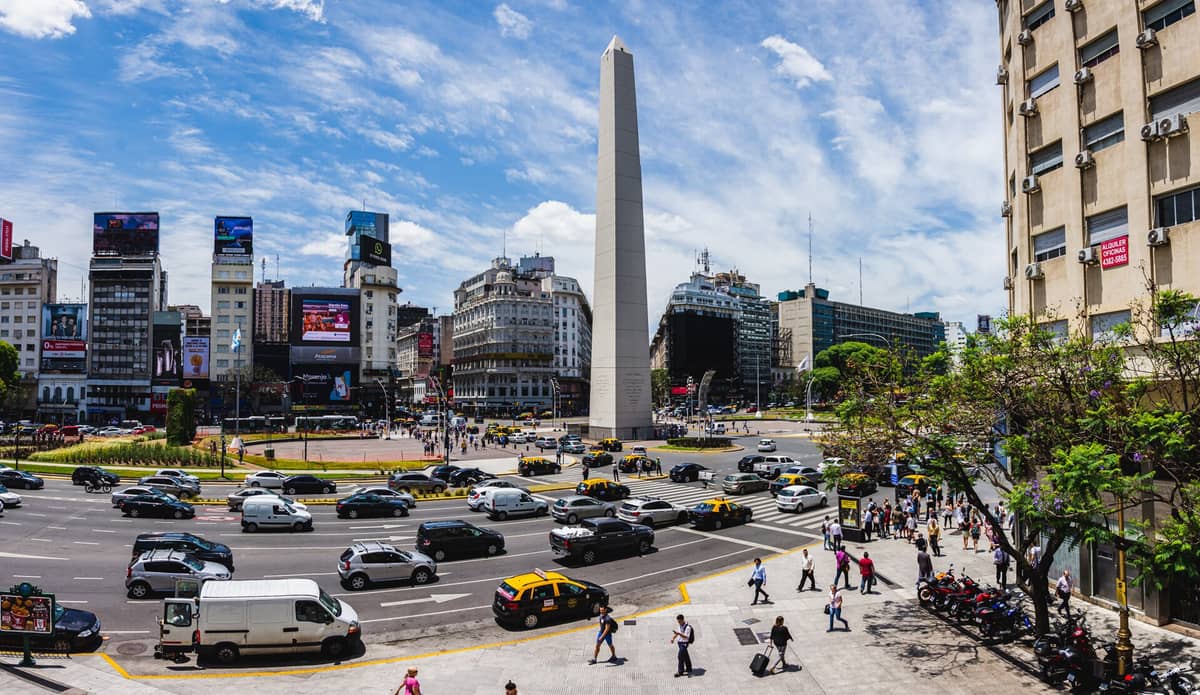
What the Obelisco Actually Is
The Obelisco de Buenos Aires is a 67.5-meter reinforced concrete obelisk at the center of Plaza de la República, where Avenida 9 de Julio — one of the widest avenues in the world — crosses Avenida Corrientes. It was erected in 1936 to mark the 400th anniversary of the first founding of Buenos Aires, and it went up in a remarkable 31 days. The speed of construction is still a talking point: locals at the time called it a civic provocation, and the Buenos Aires city council actually voted to demolish it shortly after completion. The motion failed, and the monument has since been protected as a historic landmark of the city.
Architecturally, the Obelisco belongs to a tradition of republican monumentalism common in early 20th-century Latin America. Its designer, Alberto Prebisch, also designed the nearby Teatro Gran Rex and was influenced by rationalist aesthetics. The structure tapers on four faces from a square base rising through a series of setbacks to a pyramidal tip. It is neither ornate nor symbolic in the way classical obelisks are — there are no hieroglyphs, no reliefs. Its power is purely formal: scale and verticality in the middle of a flat, sprawling city.
ℹ️ Good to know
The exterior of the Obelisco is always free to visit and accessible around the clock. The paid Mirador Obelisco viewing platform inside the monument requires advance online booking through its official reservation website.
How It Feels to Visit: Time of Day and Crowd Patterns
The plaza around the Obelisco operates on a completely different rhythm than most tourist sites. At 7 in the morning, the monument is surrounded by commuters cutting across the avenue on foot, coffee cup in hand, barely glancing up. The air at that hour smells of exhaust and fresh medialunas from nearby kiosks. There is almost no tourist presence. This is when the scale of Avenida 9 de Julio hits you most clearly: twelve lanes of traffic on either side, the Obelisco at the axis, and a low haze catching the early light.
Midday brings the most chaotic conditions. Traffic is dense, pedestrian crossings fill with office workers, and tour groups arrive in rotation. If you are visiting solely to photograph the exterior, midday in summer is the worst combination of heat, crowds, and flat overhead light. The surrounding sidewalks are narrow relative to the foot traffic, and there is no shade in the plaza itself.
Late afternoon and early evening is when the Obelisco shows its best face for visitors. From around 5pm onward, the surrounding streets fill more gradually. The long golden light of the Southern Hemisphere sun, particularly in spring and autumn, catches the white concrete and creates strong contrasts against a blue sky. On weekends, the plaza and surrounding pedestrian sections of Corrientes become genuinely animated, with street performers, food vendors, and crowds gathering well into the night. When Argentina's national football team wins a major match, this intersection becomes the spontaneous gathering point for tens of thousands of people — one of the most intense collective celebrations in South America.
Tickets & tours
Live prices and dates from our booking partner. If you book, we may earn a commission at no extra cost to you.
The Mirador Obelisco: Going Inside
For most of its existence, the interior of the Obelisco was inaccessible to the public. The Mirador Obelisco changed that, opening a small viewing platform near the summit. Entry involves ascending through the narrow interior of the monument in timed, capacity-controlled groups. The experience is deliberately brief — this is not a large observation deck with cafes and exhibit halls. It is a tight, atmospheric climb that rewards you with a view down Avenida 9 de Julio in both directions and across the Microcentro rooftop landscape.
Opening hours for the Mirador are generally every day from 09:00 to 21:00, with visits in timed, capacity-controlled 15–20 minute slots. Evening entries offer a view of Buenos Aires lit at night, with the avenue's streetlights extending in a straight corridor to the horizon in both directions — worth booking specifically for that effect. Ticket pricing is tiered, with Argentine residents paying around ARS 18,000 and foreign adults ARS 36,000; children aged 4–11 and seniors pay reduced rates (prices as of August 2026; confirm current rates before visiting as Argentine peso pricing changes frequently). Book online through the official Mirador Obelisco website before arriving — walk-up availability is not guaranteed.
⚠️ What to skip
The Mirador may close without notice during public events, political demonstrations, or large gatherings on Avenida 9 de Julio. If your visit falls during a national holiday or major football match, check ahead. Your booked slot may be affected.
Visitors with mobility concerns should contact the official tourism office before booking. The official information does not detail whether the interior ascent includes an elevator or is stairs-only, and capacity is tightly controlled either way. Ground-level viewing of the exterior has no access barriers — the plaza surface is flat and paved.
Historical and Cultural Weight
The Obelisco sits on a site of multiple historical layers. The first Argentine national flag was raised on a church that once occupied this exact location — the Iglesia San Nicolás de Bari, demolished in 1931 to widen the avenue. The decision to place the Obelisco here rather than elsewhere in the city was politically loaded: it planted a secular, modernist structure on former sacred ground at the intersection of two major arteries, asserting the primacy of civic progress over religious precedent. That tension has never fully resolved in Buenos Aires public life.
The monument has also served as a canvas for political and social expression throughout its history. It has been draped in enormous banners, projected with protest imagery, and wrapped in a giant pink condom during HIV awareness campaigns in the 1990s — a move that caused considerable controversy at the time. It anchors not just the Microcentro geographically, but the city's collective political imagination. Understanding this layered use makes the Obelisco considerably more interesting than it appears on first approach.
Getting There and Navigating the Area
The Obelisco is one of the easiest landmarks in Buenos Aires to reach by public transport. Subte Line B stops at Carlos Pellegrini, Line C at Diagonal Norte, and Line D at 9 de Julio — all within a 2-minute walk of the plaza. Dozens of colectivo (bus) lines run along both Avenida 9 de Julio and Avenida Corrientes. If you are using the SUBE card for public transit, these lines connect you directly to most other central neighborhoods. Taxis and ride-hailing apps drop off on the surrounding streets with no difficulty.
Once you are at the plaza, orient yourself quickly: Avenida 9 de Julio runs north-south, and Corrientes runs east-west. Walking south on 9 de Julio toward Constitución, you pass close to the Avenida de Mayo and eventually reach the Congreso de la Nación. Walking east on Corrientes takes you toward the Microcentro's theatre and bookshop corridor. The surrounding streets are dense with cafes, pizza parlors (Buenos Aires has a strong pizza tradition), and kiosks — practical for a pre- or post-visit meal without going far.
💡 Local tip
The best unobstructed photograph of the Obelisco from ground level is taken from the pedestrian island on Avenida 9 de Julio looking south in the late afternoon, when the light comes from the west and the monument stands in partial relief. Use a wide-angle lens or step back further north if you want to include the avenue's full width in the frame.
What to Realistically Expect
The Obelisco is not a museum, a park, or an experience that unfolds over time. The monument itself does not have an interior exhibition, a gift shop at street level, or guided tours of its base. Its value to a visitor is primarily symbolic and photographic: it is the single image most associated with Buenos Aires internationally, and standing in front of it provides a sense of orientation within the city that maps and apps cannot replicate.
If you are not interested in the Mirador and have already seen photographs of the Obelisco, a 15-minute stop to absorb the scale and move on is entirely reasonable. The area around the base is also a natural starting or ending point for a walk along Avenida Corrientes toward the theatre district, or for continuing down toward Plaza de Mayo and the Casa Rosada. First-time visitors who skip it entirely often feel, in retrospect, that they missed a useful geographic anchor.
Travelers who find large urban monuments intrinsically uninteresting — who prefer parks, markets, or interiors — will not find much to hold them here beyond the photo. The plaza itself has minimal greenery and is surrounded by high-traffic roads. In summer heat (December through February, when temperatures regularly hit 28–30°C), spending extended time in the exposed plaza is uncomfortable. Autumn and spring visits, when temperatures sit between 15 and 25°C, are significantly more pleasant.
Insider Tips
- Book the Mirador for an evening slot (generally available until around 21:00). The view of Avenida 9 de Julio lit at night, extending in a straight line in both directions, is qualitatively different from the daytime view and often less crowded than afternoon slots.
- Argentine peso ticket prices for the Mirador are affected by inflation and can change without prominent public announcement. Always check the official city tourism portal within a week of your visit rather than relying on prices quoted in travel articles or third-party booking platforms.
- The pedestrian crossing island on Avenida 9 de Julio, about 60 meters north of the Obelisco, is the best free vantage point for a straight-on photograph that includes the full height of the monument with the avenue receding behind it. Most tourists photograph from too close, cutting off the top.
- The Obelisco becomes the center of massive public celebrations after major national football victories. If your visit coincides with Argentina playing in a Copa América final or World Cup knockout match, expect the surrounding streets to be impassable post-match. Plan your transit accordingly — or embrace the spectacle.
- Avenida Corrientes running east from the Obelisco is lined with bookshops, theatres, and pizza restaurants that stay open late. After an evening Mirador visit, this stretch makes for one of the more genuinely local night walks in the central city.
Who Is Obelisco de Buenos Aires For?
- First-time visitors to Buenos Aires seeking a geographic and cultural reference point for the city
- Architecture and urban design enthusiasts interested in early 20th-century civic modernism
- Photographers wanting the city's most iconic long-avenue composition
- Travelers combining a central walking itinerary through Microcentro, Corrientes, and Plaza de Mayo
- Evening visitors who want to see Buenos Aires's central avenue at night from above via the Mirador
Nearby Attractions
Other things to see while in Microcentro & Monserrat:
- Avenida Corrientes
Avenida Corrientes is the cultural backbone of central Buenos Aires, a long avenue lined with independent bookshops, mid-century theatres, and late-night pizzerias. Free to walk at any hour, it rewards visitors who linger past midnight as much as those who arrive at noon.
- Avenida de Mayo
Stretching 1.35 km through the heart of Buenos Aires, Avenida de Mayo connects the seat of government at Plaza de Mayo to the National Congress. Inaugurated in 1894 and declared a National Historic Site in 1997, it remains the city's most architecturally dense corridor — free to walk, open at all hours, and best explored at a deliberate pace.
- Cabildo de Buenos Aires
Standing at the western end of Plaza de Mayo, the Cabildo de Buenos Aires is where Argentina's independence process began in May 1810. Today it operates as the Museo Nacional del Cabildo de Buenos Aires y de la Revolución de Mayo, offering free admission and a carefully curated look at colonial-era governance and revolutionary history. Few buildings in the country carry this much political and architectural weight.
- Café Tortoni
Founded in 1858 on Avenida de Mayo, Gran Café Tortoni is the oldest continuously operating café in Buenos Aires. Its marble counters, stained-glass ceilings, and literary history make it one of the city's most photographed interiors — though the lines outside and tourist-oriented service mean expectations need calibrating before you walk in.
Planning a trip? Discover personalized activities with the Nomado app.