Congreso de la Nación Argentina: Inside the Seat of Argentine Democracy
The Palacio del Congreso de la Nación Argentina is Buenos Aires's most imposing civic building and the working home of Argentina's bicameral legislature. Free guided tours admit visitors into gilded legislative chambers, marble corridors, and a century of constitutional history, all steps from Subte Line A.
Quick Facts
- Location
- Hipólito Yrigoyen 1863 (tour entrance), between Av. Entre Ríos and Av. Rivadavia, Buenos Aires
- Getting There
- Subte Line A – Congreso station (2-min walk); multiple colectivo lines along Av. Rivadavia
- Time Needed
- 1.5–2 hours (guided tour + exterior/plaza)
- Cost
- Free (prior reservation required; bring photo ID or passport)
- Best for
- Architecture enthusiasts, history travelers, politically curious visitors
- Official website
- www.congreso.gob.ar
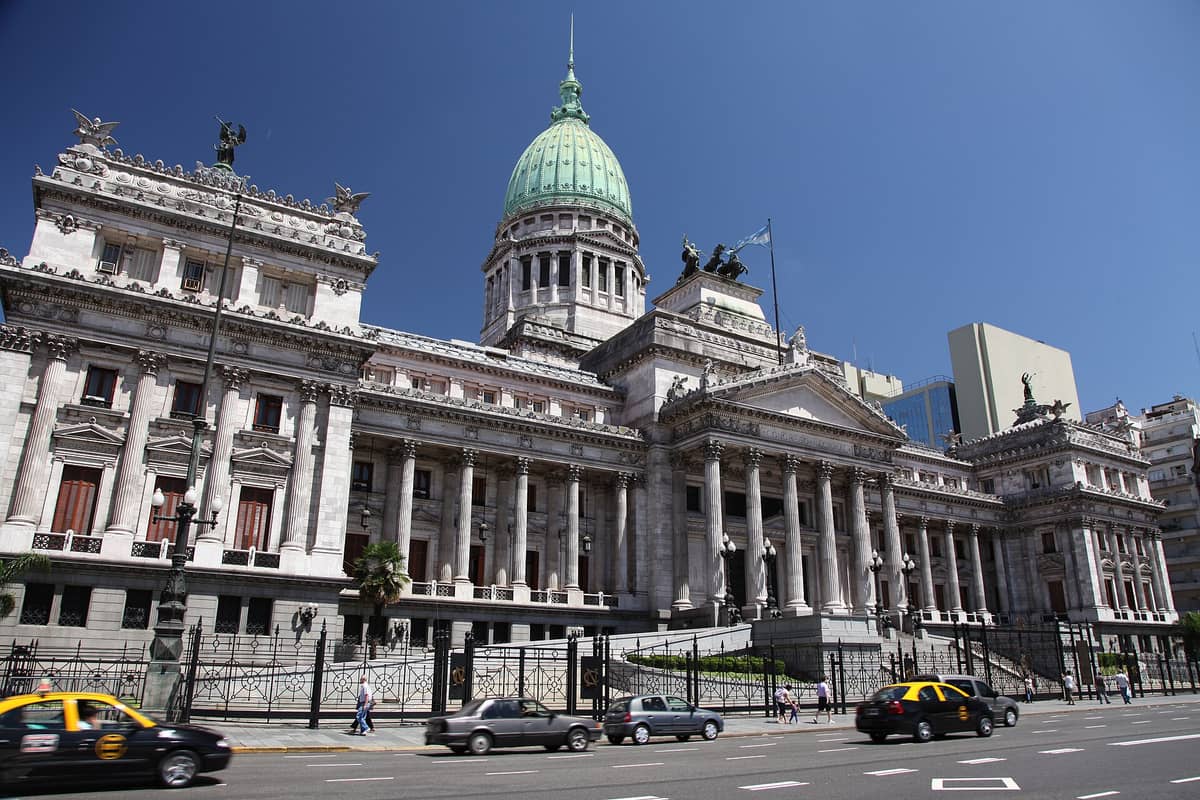
First Impressions: A Building That Wants to Be Seen
The Congreso de la Nación Argentina announces itself from several blocks away. The pale stone dome rises to roughly 80–82 meters above street level, visible along the full length of Avenida de Mayo, which was inaugurated in 1894 and deliberately designed to frame it as a terminal vista from the Casa Rosada. Stand at the midpoint of that avenue in the morning light and you get the full effect: two symbols of Argentine state power anchoring opposite ends of the same ceremonial boulevard.
Up close, the scale becomes more physical. The Palacio del Congreso was constructed between 1898 and 1906 to a design by Italian architect Vittorio Meano, who won an international competition. Meano did not live to see it completed. The building references the Beaux-Arts tradition while incorporating neoclassical elements common to Latin American civic architecture of the era: Corinthian columns, heavily rusticated lower levels, bronze entrance doors, and an allegorical sculptural program that covers the principal facade. The dome itself, modeled loosely on that of the United States Capitol, is clad in copper that has aged to a green-grey patina.
💡 Local tip
The tour entrance is at Hipólito Yrigoyen 1863, not the grand columned facade on Rivadavia. Arrive at least 15 minutes early with your passport or national ID to clear security. Reservation is required in advance through the Senate's guided visits office.
What the Guided Tour Actually Shows You
Tours are organized by the Senate (Honorable Senado de la Nación Argentina) and run on weekdays in both Spanish and English, generally with multiple scheduled slots such as 10:00, 12:00, 14:00, and 16:00; specific times vary by season and current agenda. Schedules expand during school holiday periods, with additional weekend slots added. Because the building is an active legislature, tour access can occasionally be restricted when sessions are in progress. Verify current availability at visitasguiadas.senado.gob.ar or by contacting the guided visits office directly at +54 11 2822-3000 (ext. 2410/2411/2420).
The tour moves through spaces that most Argentine citizens never enter: the Salon Azul (the Senate's primary ceremonial room, finished in blue and gold with a painted ceiling), the legislative chambers where senators and deputies debate, and a series of marble-floored corridors lined with portraits of historical figures. The quality of the finish throughout is remarkable even by South American capital standards. Imported marbles, inlaid floors, custom-cast bronze fixtures, and murals commissioned from early 20th-century Argentine artists appear in room after room.
Guides typically explain the constitutional structure of Argentina's bicameral system, the history of the building's construction, and the significance of specific architectural or decorative elements. English-language guides vary in fluency, so if you have specific historical questions, preparing them in basic Spanish may get you more detailed answers.
Tickets & tours
Live prices and dates from our booking partner. If you book, we may earn a commission at no extra cost to you.
Madero Tango Show tickets with optional dinner
From 32 €Instant confirmationFree cancellationBuenos Aires small-group city tour with optional lunch and cruise
From 25 €Instant confirmationFree cancellationPiazzolla Tango Show VIP tickets with transfer and optional dinner
From 112 €Instant confirmationFree cancellationBuenos Aires shopping tour
From 15 €Instant confirmationFree cancellation
The Building in Its Historical Context
The Palacio del Congreso sits at the western end of Avenida de Mayo, the processional boulevard inaugurated in 1894 to connect the legislature with the executive. That physical relationship between the two buildings was not accidental. Argentina's late 19th-century governing class was deliberately building a capital city that projected the image of a modern, European-style republic, and the Congress was central to that vision.
The building opened officially in 1906, though interior works continued for years afterward. It has witnessed some of the most turbulent episodes in Argentine political history: congressional sessions that preceded and followed military coups, the constitutional debates of the return to democracy in 1983, and the dramatic sessions during the 2001 economic crisis. The chamber walls have absorbed more Argentine political history than almost any other single room in the country.
For broader context on Buenos Aires's remarkable architectural legacy, the Buenos Aires architecture guide covers the wave of Beaux-Arts and eclectic construction from the same period, much of it clustered within walking distance of the Congress.
Plaza Congreso: The Outdoor Extension of the Visit
Directly in front of the building, Plaza Congreso functions as the informal public forecourt to Argentine democracy. The plaza is split into two connected green spaces by Avenida Rivadavia and contains several notable monuments, including the Monumento a los Dos Congresos, a multilevel sculptural fountain commemorating the 1813 Assembly and 1816 Congress of Tucumán that led to Argentine independence.
The plaza is heavily used at all hours. On weekday mornings, office workers cross it on foot. By midday, it fills with people eating lunch on the benches under the jacaranda trees, which bloom purple-blue in November. In the afternoon, the space attracts students, political demonstrators (this is the traditional terminus for marches along Avenida de Mayo), and tourists circling the perimeter with cameras. At night, the dome and facade are floodlit, which makes for better photography than the harsh midday sun.
ℹ️ Good to know
The plaza is a traditional gathering point for political demonstrations in Buenos Aires. These are usually peaceful but can affect foot traffic around the building's perimeter and occasionally delay guided tour entry. If you notice a large crowd assembling on the approach, allow extra time.
When to Go and How the Experience Changes
The building's exterior reads very differently depending on the light. Early morning (before 9:00) offers the cleanest facade photographs with minimal pedestrian interference and soft light on the eastern-facing columns. The midday tours are practical but the direct overhead sun flattens the architectural details. If your interest is primarily the interior, the timing of the tour slot matters less, but the 10:00 tour tends to have fewer people.
Seasonally, Buenos Aires summers (December through February) bring heat and humidity that makes standing in the open plaza uncomfortable, though the building's interior stays relatively cool. Spring and autumn, roughly March through May and September through November, offer the most comfortable conditions for combining the tour with a walk along Avenida de Mayo. Winter tours (June through August) have the advantage of smaller crowds and softer natural light, though the jacarandas in the plaza will be bare.
If you are trying to time your Buenos Aires visit around comfort and crowd levels, the best time to visit Buenos Aires guide breaks down the trade-offs by month.
Getting There and Getting Around the Area
Subte Line A stops directly at Congreso station, a two-minute walk from the tour entrance on Hipólito Yrigoyen. The Subte runs on a SUBE rechargeable card, available at most station kiosks and many convenience stores. Numerous colectivo routes serve Avenida Rivadavia, which borders the building on the north. If you are coming from San Telmo or the Microcentro, the walk along Avenida de Mayo is itself worth the journey: the boulevard is lined with early 20th-century buildings in various states of preservation, cafes with tiled interiors, and the occasional surviving kiosk newsstand.
The Congress sits within the Monserrat neighborhood, which also contains the Casa Rosada and the Cabildo de Buenos Aires a few blocks east, making it easy to combine these into a single half-day walk focused on Argentine civic and political history.
Photography, Accessibility, and Practical Details
Photography inside the building is generally permitted on public tours, though guides may restrict it in specific rooms or during certain sessions. The dome and facade photograph best from the far end of Plaza Congreso or from the median of Avenida de Mayo, using a moderate wide-angle focal length. At night, the floodlighting creates even, relatively shadow-free illumination on the facade, though the dome lighting can be uneven depending on the current setup.
Accessibility within the building is handled through the security-controlled entrance on Hipólito Yrigoyen. Visitors with specific accessibility needs are advised to contact the guided visits office in advance at visitasguiadas@senado.gob.ar or by phone at +54 11 2822-3000, extensions 2410, 2411, or 2420. The plaza itself is flat and wheelchair-accessible, though some sections near the monuments involve low steps.
Who might not enjoy this visit: travelers who dislike guided tour formats with fixed timing will find it limiting, since you cannot explore independently. The tour moves at a docent's pace and does not accommodate people who want to linger or rush ahead. If your interest is purely the exterior and the plaza, no reservation is needed and the building can be appreciated from outside at any time.
Insider Tips
- Book your guided tour slot at least a few days ahead through the Senate website. Slots fill quickly during Argentine school holiday periods (July and January especially), and walk-ins are not accepted.
- Bring your actual passport or Argentine DNI. Photocopies are not accepted at the security desk, and you will be turned away without original ID regardless of your reservation.
- For the best dome photograph, walk to the far western end of Plaza Congreso and shoot from the low fountain platform. This gives you enough distance to capture the full building without excessive upward tilt.
- If you are visiting in November, the jacaranda trees along the plaza's central path bloom a strong violet-blue that creates an unusual foreground against the pale stone facade. Timing varies by year but typically peaks in the second half of November.
- The 10:00 weekday slot is consistently the least crowded. Tours later in the day attract more school groups, which can make it harder to hear the guide and move freely through the rooms.
Who Is Congreso de la Nación Argentina For?
- Architecture enthusiasts interested in Beaux-Arts and neoclassical civic buildings from the early 1900s
- Travelers with an interest in Argentine political history and constitutional government
- First-time visitors wanting to understand the physical geography of Buenos Aires's historic center
- Budget travelers: the tour is completely free and pairs naturally with other no-cost nearby sites
- Photographers looking for monumental architecture that photographs well in both daylight and after dark
Nearby Attractions
Other things to see while in Microcentro & Monserrat:
- Avenida Corrientes
Avenida Corrientes is the cultural backbone of central Buenos Aires, a long avenue lined with independent bookshops, mid-century theatres, and late-night pizzerias. Free to walk at any hour, it rewards visitors who linger past midnight as much as those who arrive at noon.
- Avenida de Mayo
Stretching 1.35 km through the heart of Buenos Aires, Avenida de Mayo connects the seat of government at Plaza de Mayo to the National Congress. Inaugurated in 1894 and declared a National Historic Site in 1997, it remains the city's most architecturally dense corridor — free to walk, open at all hours, and best explored at a deliberate pace.
- Cabildo de Buenos Aires
Standing at the western end of Plaza de Mayo, the Cabildo de Buenos Aires is where Argentina's independence process began in May 1810. Today it operates as the Museo Nacional del Cabildo de Buenos Aires y de la Revolución de Mayo, offering free admission and a carefully curated look at colonial-era governance and revolutionary history. Few buildings in the country carry this much political and architectural weight.
- Café Tortoni
Founded in 1858 on Avenida de Mayo, Gran Café Tortoni is the oldest continuously operating café in Buenos Aires. Its marble counters, stained-glass ceilings, and literary history make it one of the city's most photographed interiors — though the lines outside and tourist-oriented service mean expectations need calibrating before you walk in.
Planning a trip? Discover personalized activities with the Nomado app.