Puente de la Mujer: Buenos Aires' Iconic Calatrava Footbridge
Puente de la Mujer is a 170-metre rotating pedestrian bridge in Puerto Madero, designed by Spanish architect Santiago Calatrava and inaugurated in December 2001. Entry is free, access is around the clock, and the structure offers some of the most photogenic waterfront views in Buenos Aires.
Quick Facts
- Location
- Dique 3, Puerto Madero, Buenos Aires
- Getting There
- Subte Line B – Leandro N. Alem station; nearby colectivos serve Puerto Madero
- Time Needed
- 20–40 minutes to cross and photograph; 1–2 hours with a waterfront walk
- Cost
- Free – no admission fee
- Best for
- Architecture enthusiasts, sunset photography, evening waterfront strolls
What Is Puente de la Mujer?
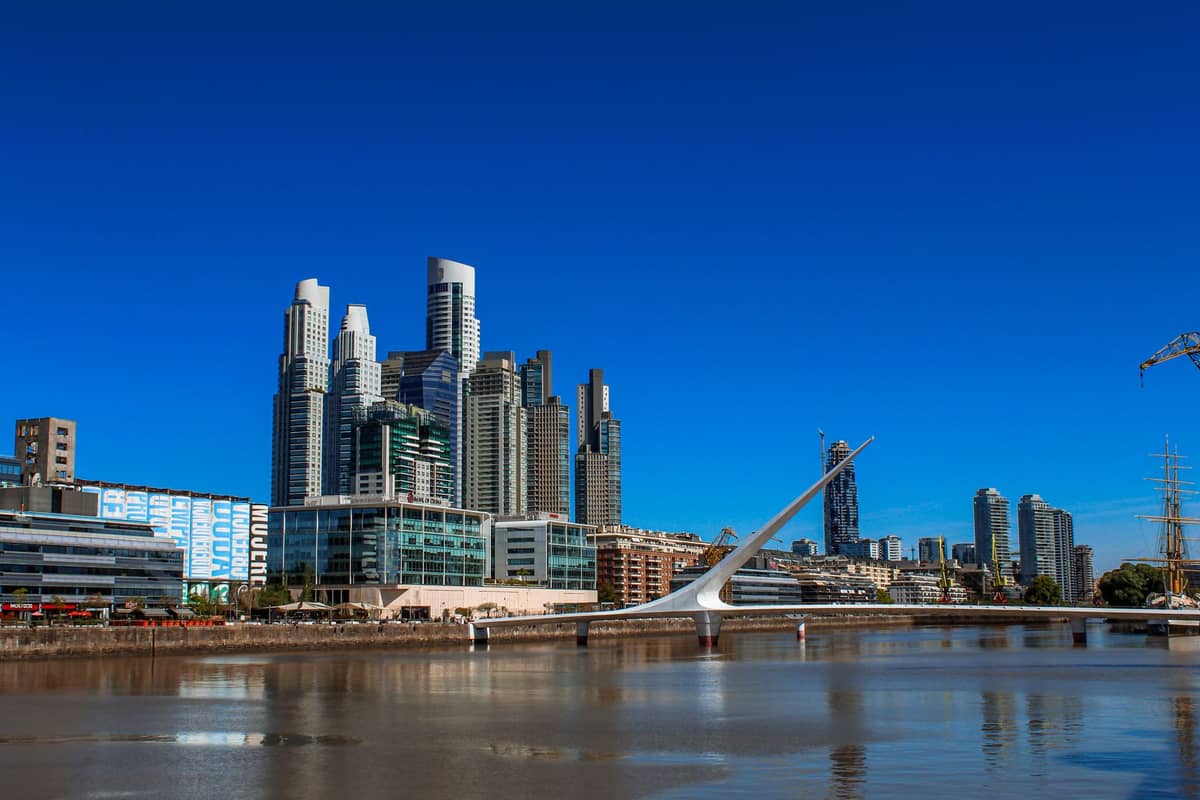
Puente de la Mujer is a rotating pedestrian footbridge spanning Dock 3 of Puerto Madero, Buenos Aires' redeveloped docklands district. Designed by Valencian-born architect Santiago Calatrava and officially inaugurated in December 2001, the bridge has become one of the city's most recognisable landmarks in a neighbourhood full of glass towers and waterside restaurants. It connects the restored brick warehouses on the western side of the dock with the newer towers and ecological reserve to the east, forming the most recognisable landmark in a neighbourhood full of glass towers and waterside restaurants.
The structure is a swing bridge: its central span can rotate 90 degrees on a central axis to allow boat traffic through the dock. In practice, rotations are not frequent, and pedestrians cross freely on foot, giving priority to people on foot. The entire crossing is free of charge and open 24 hours a day, 365 days a year.
💡 Local tip
Access is completely free. You do not need to book, queue, or pay anything to cross the bridge. Just walk in from either end.
The Architecture: What Calatrava Built Here
Santiago Calatrava's signature language is structural expressionism: bridges and buildings that look like bones, wings, or skeletal forms caught mid-motion. Puente de la Mujer is no exception. The single inclined pylon leans at a sharp angle over the water, held in tension by cables that fan outward and anchor into the walkway deck below. Seen from the dock's northern end, the composition reads as a diagonal white arrow against the Buenos Aires skyline.
Calatrava has said the design evokes a couple dancing tango: the pylon as one partner leaning back, the deck as the other extending forward. Whether you buy the metaphor or not, the geometry is striking. The white steel and concrete finish reflects hard in midday light, softens at dusk, and glows a warm amber under the bridge's own illumination at night. Each of these lighting conditions produces a genuinely different aesthetic experience.
For visitors interested in Buenos Aires' broader architectural landscape, the bridge fits into a city with an unusually rich stock of early 20th-century European-influenced public buildings. Our Buenos Aires architecture guide covers the broader context, from Beaux-Arts palaces in the Microcentro to postmodern towers in Puerto Madero itself.
Tickets & tours
Live prices and dates from our booking partner. If you book, we may earn a commission at no extra cost to you.
Madero Tango Show tickets with optional dinner
From 32 €Instant confirmationFree cancellationBuenos Aires small-group city tour with optional lunch and cruise
From 25 €Instant confirmationFree cancellationPiazzolla Tango Show VIP tickets with transfer and optional dinner
From 112 €Instant confirmationFree cancellationBuenos Aires shopping tour
From 15 €Instant confirmationFree cancellation
How the Experience Changes Through the Day
Morning, roughly 7 to 10 am, is the quietest window. Joggers circle the docks, the water in the dock sits calm, and the pylon casts a long shadow across the deck. The light is directional and good for photography without harsh contrast. You will share the bridge with commuters cutting through from the ecological reserve on the eastern bank, but there is nothing like a crowd.
By midday the tourist traffic picks up significantly, particularly on weekends. The white surfaces catch full overhead sun, which makes the bridge look bright in photos but also means squinting and heat reflecting off the steel handrails in summer. December through February in Buenos Aires runs hot and humid, with temperatures regularly reaching 29 to 30°C. Bring water and light clothing. Winter visits (June to August) offer pleasant cool temperatures around 8 to 15°C and clearer air quality.
Sunset is the sweet spot for most visitors. The western sky behind the old city turns orange and pink, the dock water picks up the colours, and the bridge's own lighting system activates before full dark. The 30-minute window just after sunset, when the sky is deep blue and the bridge is fully lit but ambient light still registers in photographs, is when the best images are made. Photographers call this the blue hour, and at Puente de la Mujer it is reliable on clear evenings.
At night the bridge stays open and is used by locals walking between the dock restaurants on the western side and the ecological reserve paths on the eastern bank. The area is well lit and sees steady foot traffic until midnight and beyond, particularly on weekends when Puerto Madero's restaurants fill up.
ℹ️ Good to know
Weather matters here. On overcast or rainy days, the reflective white surfaces look flat and grey in photographs. If photography is your primary goal, check the forecast and aim for a clear evening.
Getting There
Puerto Madero has no Subte station immediately adjacent. The closest subway stop is Leandro N. Alem on Line B, from which Dock 3 and Puente de la Mujer are a short walk east. Alternatively, several colectivo bus routes serve Avenida Alicia Moreau de Justo, the road running along the western edge of the docks.
The most common approach for visitors already in the city centre is simply to walk. From Plaza de Mayo, the walk takes under 20 minutes and passes through a transition from the dense Microcentro streetscape into the wide, pedestrian-friendly waterfront of Puerto Madero. This is worth doing on foot at least once to understand how dramatically the city changes within a short distance.
If you are combining this with other Puerto Madero sights, the Reserva Ecológica Costanera Sur begins at the eastern end of the bridge, making a logical half-day pairing. The reserve is a 350-hectare urban nature area with walking paths and birdwatching that contrasts sharply with the polished docklands just across the dock.
Photography: What Actually Works Here
Best angles
The north side of the dock gives you the classic composition: full pylon, cables, deck, and the city skyline or old brick warehouses as background. Get low if you want to emphasise the diagonal lean of the pylon. From the south side, the composition is more compact and the reflection in the dock water is easier to capture if conditions are calm.
The view from the bridge deck itself, looking west toward the old city, works well at sunset. Look east for the ecological reserve treeline and, on very clear days, a wide slice of the Río de la Plata. A wide-angle lens or a smartphone camera set to panoramic mode handles the full width of the structure without distortion.
Practical notes
- A tripod is useful for blue-hour and night shots but can be awkward on a busy bridge deck – arrive early or wait for lighter foot traffic.
- The bridge cables create interesting leading lines from ground level on either bank.
- On weekends, a drone operator sometimes photographs from the dock banks; the results you see online are often from elevated angles not achievable on foot.
- Polarising filters cut reflections on the dock water in midday light.
Putting It in Context: Puerto Madero and the Surrounding Area
Puerto Madero was Buenos Aires' original port, built in the 1880s by engineer Eduardo Madero and rendered obsolete within two decades by the deeper Puerto Nuevo further north. The brick warehouses along the western docks were repurposed from the 1990s onward into restaurants, offices, and eventually the neighbourhood that exists today: a strip of high-rise residential towers on reclaimed land east of the docks, and rehabilitated 19th-century industrial buildings on the west side. Puente de la Mujer, built in the late 1990s and opened in 2001, was a deliberate piece of place-making commissioned to give the district a landmark of architectural significance.
The neighbourhood surrounding the bridge functions as an upscale leisure and residential district. It lacks the historical texture of San Telmo or the depth of offer in Palermo, but it gives visitors a clear sense of the city's ambition for its riverfront and the architectural scale of Buenos Aires at its most contemporary.
A straightforward caveat for expectation management: the bridge is a pedestrian infrastructure element, not a museum or exhibition space. There is no interpretation on-site, no guided tour, and no interior to enter. Visitors who come expecting an immersive cultural experience may feel it is too brief a stop. For anyone with a genuine interest in modern structural engineering or Calatrava's body of work, it is a serious and well-executed example.
Accessibility and Practical Details
The bridge deck is flat with gentle ramps at each end, making it generally accessible for people with mobility considerations. Official accessibility specifications (ramp gradients, tactile paving details) are not published by the city tourism authority, so visitors with specific requirements should verify current conditions directly with Puerto Madero's management.
There are no facilities on the bridge itself: no toilets, no kiosks, no seating. Both banks of Dock 3 have restaurant and café options within a short walk, particularly on the western (warehouse) side. The area is well covered by mobile data networks. Parking is available in the Puerto Madero area but can be expensive and limited on weekends.
Insider Tips
- The bridge occasionally rotates to allow vessel passage through Dock 3. Rotations are not scheduled in a publicly visible calendar, but if you happen to be there during one, the mechanical movement of the 500-tonne central span is a genuinely memorable sight. Asking dock staff about recent rotation frequency is worth a try.
- If you want the bridge to yourself for photographs, arrive on a weekday morning before 9 am. Weekend afternoons in spring and summer bring tour groups and large numbers of visitors to the narrow deck.
- The western bank of Dock 3, where the old brick warehouses are now restaurants, has outdoor terrace seating that faces directly toward the bridge. It is an alternative vantage point that requires buying a coffee or a meal but puts the structure in a different compositional frame.
- Buenos Aires' blue hour is reliable and predictable: check the official sunset time for the date and plan to be on the dock about 20 minutes after sunset. The sky colour and bridge lighting align for roughly 15 to 25 minutes before full dark.
- Cyclists and scooter users share the bridge deck but are required to slow to walking pace. On busy weekend afternoons the deck can feel narrow, so if you want unobstructed walking, a weekday visit is noticeably more relaxed.
Who Is Puente de la Mujer For?
- Architecture and engineering enthusiasts with an interest in Santiago Calatrava's structural work
- Photographers targeting sunset or blue-hour waterfront compositions
- Visitors combining the docklands with a walk through the Reserva Ecológica Costanera Sur
- Travellers who want a visually impressive stop that costs nothing and requires no advance booking
- Evening walkers looking for a well-lit, safe waterfront route through Puerto Madero
Nearby Attractions
Other things to see while in Puerto Madero:
- Reserva Ecológica Costanera Sur
The Reserva Ecológica Costanera Sur is a 350-hectare nature reserve in Puerto Madero where lagoons, grasslands, and reed beds have reclaimed former landfill along the Río de la Plata. Entry is free, the birdlife is extraordinary, and the contrast with the surrounding city skyline is unlike anything else in Buenos Aires.
Planning a trip? Discover personalized activities with the Nomado app.