Palacio de Aguas Corrientes: Buenos Aires' Most Surprising Utility Building
Built in 1894 to supply potable water to a booming capital, the Palacio de Aguas Corrientes is one of the most ornate public-works buildings in South America. Its glazed ceramic facade conceals vast internal water tanks, and today a small museum (paid except on Wednesdays) tells the story of the city's sanitation history. It rewards curious visitors who look past the obvious tourist circuit.
Quick Facts
- Location
- Riobamba 750, corner of Av. Córdoba, Balvanera, Buenos Aires
- Getting There
- Subte Line B – Callao station (short walk); multiple colectivos along Av. Córdoba
- Time Needed
- 45–90 minutes (longer with a guided tour)
- Cost
- ARS 5,200 (foreign visitors); ARS 2,800 (residents); free on Wednesdays, for children under 8, retirees and pensioners (with ID), and visitors with disabilities plus one companion. Verify current prices before visiting.
- Best for
- Architecture lovers, history buffs, travellers wanting something off the main tourist loop
- Official website
- aysa.com.ar/Museo/inicio
What Is the Palacio de Aguas Corrientes?
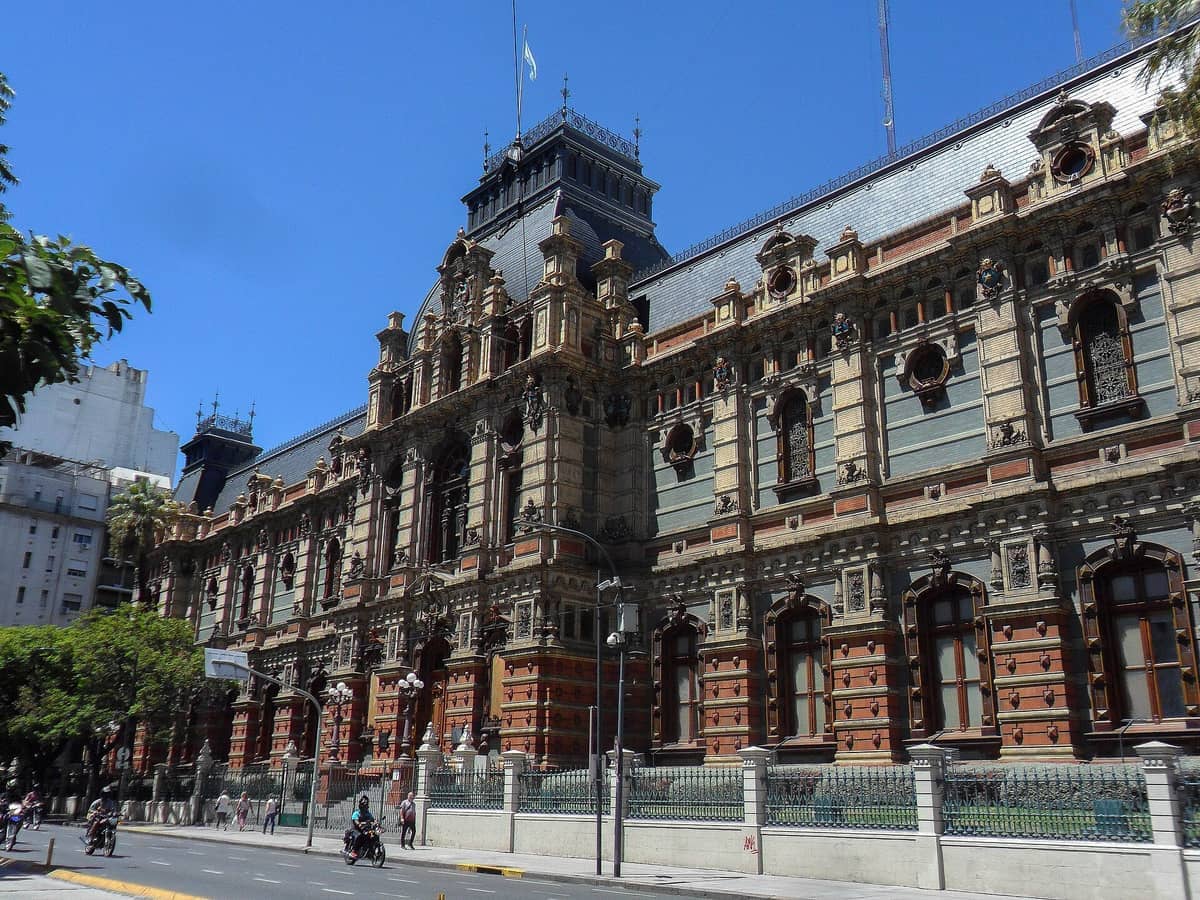
The Palacio de Aguas Corrientes is, on the surface, a palace. It occupies an entire city block in the Balvanera neighbourhood, its four facades clad in tens of thousands of glazed ceramic tiles fired in England and imported by ship. The cornices, pilasters, and terracotta ornamentation stack up in a language that sits somewhere between French Renaissance and neo-Baroque. Standing at the corner of Riobamba and Avenida Córdoba, the building overwhelms the eye in the best possible way.
Behind that facade, though, is something far less romantic: a series of enormous iron water tanks, built to hold millions of litres and supply a rapidly growing Buenos Aires with potable water. When the building was completed in 1894, it represented a genuine feat of public engineering. Yellow fever had devastated the city in 1871, killing roughly eight percent of the population, and the pressure to build reliable sanitation infrastructure was existential. The palace was the answer, designed to look like anything but what it was.
Today, the building houses the Museo del Agua y de la Historia Sanitaria (Museum of Water and Sanitary History), operated by AySA, the city's water utility. It sits in a zone between the neighbourhoods that tourism tends to concentrate in: close to Recoleta to the north and the edges of the Microcentro to the south, which means most visitors walk past it rather than to it. That relative obscurity is part of what makes it worth the detour.
The Architecture: A Facade That Earns Its Attention
Few buildings in Buenos Aires have a more coherent exterior than the Palacio de Aguas Corrientes. The ceramic tiles were manufactured by Doulton & Co. in Lambeth, England, and the structural ironwork was fabricated in Belgium. The design was the work of engineers and architects working under the supervision of the Argentine government, producing something that deliberately looked like civic grandeur rather than water infrastructure.
Walk the full perimeter before entering. Each facade rewards close inspection: the tiles shift slightly in colour depending on the angle and the light, and there are decorative motifs repeated at each corner that are easy to miss from across the street. In the early morning, when low-angle sunlight hits the Riobamba facade, the glazed surfaces catch the light in a way that photographs rarely convey. By midday the building is flatter, more uniform. Late afternoon light from the west brings the Córdoba facade back to life.
💡 Local tip
Photography tip: The northeast corner (Riobamba at Córdoba) gives the best diagonal composition including both facades. Early morning on a weekday offers the cleanest shot with fewer parked vehicles in the foreground.
If you are building an itinerary around Buenos Aires' architectural heritage, the Palacio fits naturally into a route that also includes the Palacio Barolo and the Galería Güemes. The city's late 19th and early 20th-century building boom produced a concentration of ornate public and commercial architecture that has few equals in the Americas. The water palace is among the earliest and most distinctive examples.
Tickets & tours
Live prices and dates from our booking partner. If you book, we may earn a commission at no extra cost to you.
Madero Tango Show tickets with optional dinner
From 32 €Instant confirmationFree cancellationBuenos Aires small-group city tour with optional lunch and cruise
From 25 €Instant confirmationFree cancellationPiazzolla Tango Show VIP tickets with transfer and optional dinner
From 112 €Instant confirmationFree cancellationBuenos Aires shopping tour
From 15 €Instant confirmationFree cancellation
Inside the Museum: What to Expect
The Museo del Agua y de la Historia Sanitaria occupies the ground level and portions of the interior spaces. The collection documents Buenos Aires' sanitation history through original equipment, period photographs, maps, and scale models. There are antique toilets and bathroom fixtures arranged in glass cases, which sounds mundane until you see the craftsmanship on Victorian-era porcelain and realise how much design effort went into objects no one was meant to discuss in polite company.
The highlight for most visitors is the glimpse into the building's internal structure: the iron framework, the tank spaces, and the industrial guts behind the decorative shell. The contrast between the ornate exterior and the purely functional interior is jarring in an interesting way. This is not a large museum, and the exhibits are relatively modest in scope compared to the city's major institutions. Plan on 45 minutes for a self-guided visit, or up to 90 minutes if you join a guided tour.
Guided tours run Monday, Wednesday and Friday at 11:00, and Tuesday and Thursday at 15:00. Tours are conducted in Spanish; English-speaking visitors should confirm current language options directly with the museum before visiting. The entrance is at Riobamba 750.
ℹ️ Good to know
The museum is closed on weekends and public holidays. Opening hours are Monday to Friday, 9:00–13:00 and 14:00–16:00 (last entry 15:30). Verify hours before visiting, as these are subject to change.
Historical Context: Why the City Built a Palace for Water
The 1871 yellow fever epidemic is the event that anchors the Palacio's origin story. Within weeks of the outbreak, tens of thousands of residents fled the city, and the epidemic killed somewhere between 13,000 and 14,000 people in a city of around 180,000. The disaster accelerated a political consensus around urban infrastructure investment that had previously stalled. A reliable, clean water supply was understood as a public health necessity, not a luxury.
By the time the Palacio was completed in 1894, Buenos Aires was one of the fastest-growing cities in the world, driven by massive European immigration. The government was acutely aware of how it was perceived internationally, and chose to house its water infrastructure in a building that projected ambition and modernity. The use of imported British ceramics and Belgian ironwork was partly practical and partly symbolic: Buenos Aires was positioning itself as a city that belonged in the same conversation as Paris or London.
That context is worth keeping in mind as you walk through the museum. The history of Buenos Aires' sanitation is also a history of the city's self-image, its relationship with European capital and labour, and its efforts to manage explosive population growth. For a deeper look at how the city's built environment reflects those ambitions, the Buenos Aires architecture guide covers several complementary sites across the city.
Visiting Logistics: Getting There, Timing, and What to Bring
The closest Subte stop is Callao on Line B, a short walk south along Callao and then west on Córdoba, or directly up Riobamba. From the Microcentro, the building is accessible on foot in around 15–20 minutes. Several bus lines run along Avenida Córdoba and pass within a block of the entrance; check the Cómo Llego route planner or a current colectivo map for the most relevant services.
Weekday mornings between 9:00 and 12:00 see the lightest visitor numbers. The building is in a working commercial and residential area, so there is always some street activity outside, but the museum interior rarely feels crowded. Weekdays also give you the option of the 11:00 guided tour on Monday, Wednesday, and Friday, which is often the best way to understand what you are actually looking at.
Wear comfortable shoes: the neighbourhood streets around the building are typical Buenos Aires pavement, with uneven tiles and gaps that catch heels. If you plan to photograph the exterior seriously, a wide-angle lens (or the wide setting on a smartphone) handles the scale of the facade better than a standard focal length. The building is too tall and too wide to capture in full from across the narrow street.
💡 Local tip
Visit on a Wednesday if you can: admission is free for everyone on Wednesdays, which makes it easy to combine with a morning walk through the neighbourhood without any ticket planning, and no prior booking is required.
Assessment: Strengths, Limitations, and Who Should Consider Skipping
The Palacio de Aguas Corrientes is genuinely one of the more remarkable-looking buildings in Buenos Aires, and the context of its function makes it more interesting, not less. However, the museum inside is modest. Visitors expecting the depth of collections at the Museo Nacional de Bellas Artes or the theatrical impact of spaces like the Teatro Colón will find it underwhelming. The building itself is the main event; the museum is supplementary.
Travellers with limited time who are following a standard Buenos Aires itinerary covering Recoleta Cemetery, the Teatro Colón, and the historic centre may find the Palacio better treated as a stop in transit rather than a primary destination. On the other hand, if you are staying nearby or have a morning free, it earns its time easily.
Visitors with significant mobility limitations should contact the museum directly before visiting, as parts of the interior involve uneven surfaces and stairs. The museum does offer free admission for people with disabilities and an accompanying person. For specific accessibility arrangements, reach the museum at (54-11) 6319-1104 or museo_del_agua@aysa.com.ar (both currently listed as official contacts).
The neighbourhood around Riobamba and Córdoba is a standard Buenos Aires commercial street: not a tourist zone, but not remote or particularly unfamiliar either. It is safe to walk during daylight hours, and the surrounding blocks have cafes and small restaurants where you can have lunch before or after your visit.
Insider Tips
- Wednesday admission is free for all visitors, no ID or form required. If your schedule has any flexibility, this is the easiest way to visit without worrying about current peso prices.
- The guided tours (Mon/Wed/Fri at 11:00, Tue/Thu at 15:00) are significantly more informative than a self-guided walk. The exhibit labels alone do not fully explain the engineering or the social history, so the tour adds real value if your Spanish is solid.
- Walk all four exterior sides of the building before entering. The side facades along Riobamba and on the other streets each have distinct tile patterns and details that the main corner view does not show. This takes about 10 minutes and is worth every step.
- The museum contact email (museo_del_agua@aysa.com.ar) responds to English-language enquiries, which is useful for confirming tour language options or current hours ahead of your visit.
- Combine the visit with a walk along Avenida Córdoba toward the Microcentro. The stretch passes several notable early 20th-century buildings and ends near Avenida Corrientes, giving you a cross-section of the city's historical commercial architecture in one route.
Who Is Palacio de Aguas Corrientes For?
- Architecture enthusiasts who want to understand how Buenos Aires expressed civic ambition through its public buildings
- History-focused travellers interested in the relationship between urban infrastructure, public health, and city growth
- Photographers looking for an ornate, photogenic facade that does not appear in every Buenos Aires stock image collection
- Budget travellers: free on Wednesdays, and the exterior can be appreciated at no cost at any time
- Visitors staying in Recoleta or the Microcentro who want a worthwhile 90-minute excursion within walking distance
Nearby Attractions
Combine your visit with:
- Cementerio de la Chacarita
Larger and less visited than its famous counterpart in Recoleta, Cementerio de la Chacarita is a vast urban cemetery spanning multiple city blocks in the Chacarita neighborhood. Free to enter, it holds the tombs of cultural icons including tango legend Carlos Gardel, and its monumental mausoleums, wide internal avenues, and layers of Argentine social history make it one of the most atmospheric and underappreciated sites in the city.
- Colonia del Sacramento (Uruguay)
Colonia del Sacramento, Uruguay's oldest city and a UNESCO World Heritage Site, sits just across the Río de la Plata from Buenos Aires. Its Barrio Histórico packs cobblestone lanes, Portuguese-era walls, and a working lighthouse into a compact quarter that most visitors can absorb in a single afternoon.
- Espacio Memoria y Derechos Humanos (ex-ESMA)
Built on the grounds of one of Argentina's most notorious clandestine detention centers, Espacio Memoria y Derechos Humanos (ex-ESMA) is a 17-hectare memorial complex in northern Buenos Aires dedicated to human rights and collective memory. Entry is free, the site has regular daily opening hours, and a visit here is one of the most sobering and important experiences the city offers.
- Estadio Monumental (River Plate)
The Estadio Más Monumental Antonio Vespucio Liberti is more than a football ground. Home to Club Atlético River Plate and the largest stadium in South America, it holds around 85,000 spectators and carries decades of Argentine football history. Whether you visit on a quiet Tuesday morning or a roaring match day, the scale and atmosphere of El Monumental is unlike anything else in Buenos Aires.
Planning a trip? Discover personalized activities with the Nomado app.