Cementerio de la Chacarita: Buenos Aires' Grand Open-Air Monument
Larger and less visited than its famous counterpart in Recoleta, Cementerio de la Chacarita is a vast urban cemetery spanning multiple city blocks in the Chacarita neighborhood. Free to enter, it holds the tombs of cultural icons including tango legend Carlos Gardel, and its monumental mausoleums, wide internal avenues, and layers of Argentine social history make it one of the most atmospheric and underappreciated sites in the city.
Quick Facts
- Location
- Av. Guzmán 680, Chacarita, Buenos Aires
- Getting There
- Subte Line B, Federico Lacroze station (short walk to main entrance)
- Time Needed
- 1.5 to 3 hours, depending on how much ground you cover
- Cost
- Free admission. No tickets required.
- Best for
- History enthusiasts, architecture admirers, tango pilgrims, slow walkers
What Chacarita Actually Is
Cementerio de la Chacarita is the largest cemetery in Buenos Aires, occupying a vast tract of land with its main frontage on Avenida Guzmán 680 in the Chacarita neighborhood. In scale, it dwarfs most urban cemeteries in South America. Where the Recoleta Cemetery is compact, curated, and loaded with tour groups, Chacarita is sprawling, quieter, and far more representative of Buenos Aires as a whole rather than its elite upper crust.
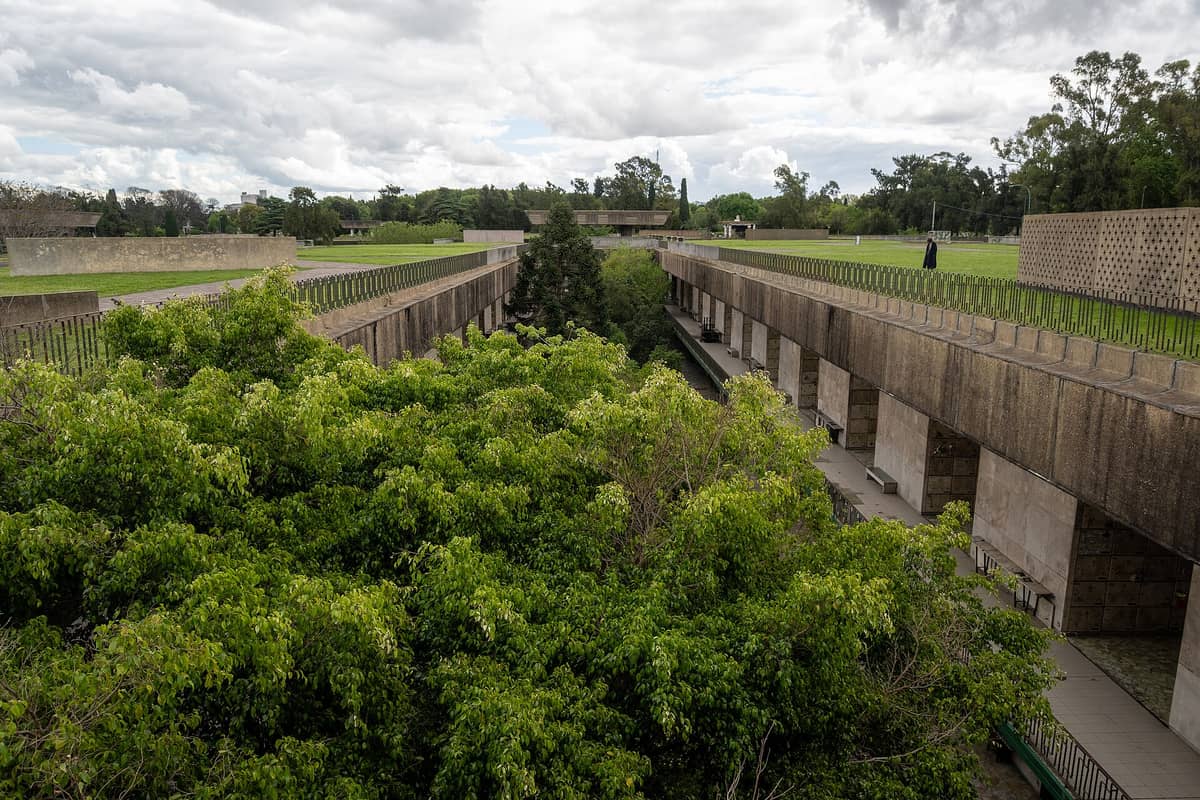
Municipal authorities and Argentine cultural institutions classify it as an open-air museum, and that description earns its keep. The cemetery contains monumental mausoleums ranging from Art Deco towers to neoclassical marble chapels, maintained family vaults, long colonnaded galleries of niches, and avenues wide enough to feel like city streets. It is the resting place of Argentine presidents, military figures, artists, musicians, and working-class families, all within the same walls.
If you have already visited the Recoleta Cemetery and want to understand how Buenos Aires actually mourns and memorializes, Chacarita provides the necessary counterpoint. It is less polished, more emotionally raw in places, and considerably more interesting architecturally once you leave the main paths.
ℹ️ Good to know
Opening hours: daily from 08:00 to 17:00. Entry is free. The main entrance is at Av. Guzmán 680. A free internal shuttle operates from Galería 14 on Fridays (12:00–15:00) and on Saturdays, Sundays, and public holidays (10:00–16:00), with departures approximately every hour.
The Experience: Walking the Grounds
Arriving through the main gate on Avenida Guzmán, the scale hits you immediately. The internal avenues are labeled and mapped, but the cemetery is large enough that first-time visitors often find themselves doubling back or discovering sections by accident rather than design. That is not entirely a bad thing. The unexpected turns are frequently the most rewarding.
The mausoleums closest to the main entrance tend to be the grandest in ambition: tall stone structures with ornate ironwork gates, stained glass panels, and statuary ranging from weeping angels to full-scale bronze portraits of the deceased. The stonework shows the influence of the large Italian and Spanish immigrant communities who shaped Buenos Aires from the late 19th century onward. Surnames on the facades read like a cross-section of that immigration wave. Walking deeper into the cemetery, the architecture becomes more eclectic and the maintenance more variable, which gives the space a texture that manicured tourist attractions lack.
Noise from the surrounding city fades quickly once you move away from the perimeter gates. On weekday mornings the cemetery is largely silent apart from birdsong, the occasional groundskeeper at work, and the low hum of traffic on the bordering avenues. Weekend afternoons bring more visitors, particularly to the areas associated with famous tombs, but the sheer size of the grounds means it never feels crowded.
Tickets & tours
Live prices and dates from our booking partner. If you book, we may earn a commission at no extra cost to you.
Madero Tango Show tickets with optional dinner
From 32 €Instant confirmationFree cancellationBuenos Aires small-group city tour with optional lunch and cruise
From 25 €Instant confirmationFree cancellationPiazzolla Tango Show VIP tickets with transfer and optional dinner
From 112 €Instant confirmationFree cancellationBuenos Aires shopping tour
From 15 €Instant confirmationFree cancellation
Carlos Gardel and the Pilgrimage of Tango
The single most visited point in Chacarita is the tomb of Carlos Gardel, the defining figure of Argentine tango, who died in a plane crash in Medellín, Colombia, in 1935. His tomb in Chacarita has become something close to a secular shrine. The bronze statue standing at the site is almost always adorned with fresh flowers and, more characteristically, lit cigarettes placed between the fingers, a tradition whose origin is disputed but whose persistence speaks to the intensity of Argentine devotion to Gardel.
Gardel's tomb draws visitors from across Argentina and from abroad, particularly from Uruguay, where questions of his birthplace remain a genuine point of national pride. If you want to understand the cultural weight tango carries in Buenos Aires, the pilgrimage to this tomb is more illuminating than many formal museum exhibits. You can read more about that cultural context in the tango in Buenos Aires guide.
The tomb is not difficult to find. Staff at the main entrance can direct you, and it is marked on the cemetery's printed maps, which are sometimes available at the entrance office. Allow a few minutes at the site itself rather than a quick photograph stop. The people who visit are often genuinely moved, and observing that is part of understanding the place.
Architecture and Historical Layers
The cemetery's architectural range spans roughly a century and a half of changing tastes and immigrant influences. The oldest sections reflect 19th-century neoclassicism: columns, pediments, Roman lettering carved in marble. Moving into the 20th century, you encounter unmistakable Art Deco elements, particularly in the tall vertical mausoleums built between the 1920s and 1940s, when that style was fashionable across Buenos Aires.
The cemetery fits into the broader story of Buenos Aires as an architectural city. The same decades that produced the grand mausoleums here also produced landmark buildings like the Palacio Barolo and the ornate residential palaces of Recoleta. Chacarita reflects how those same aesthetic ambitions extended into spaces of mourning and commemoration.
Beyond the individual mausoleums, the colonnaded gallery sections of the cemetery, where niches are stacked several rows high along covered walkways, have their own austere visual logic. The galleries run for considerable distances, and the sheer accumulation of names, dates, and small personal photographs sealed behind glass creates an effect that is quietly overwhelming in the best sense.
When to Visit and How the Atmosphere Changes
Weekday mornings between 09:00 and 11:00 offer the most peaceful experience. The light is good for photography without the harsh midday flatness, the grounds are at their quietest, and you have the best chance of sharing sections of the cemetery with no one else at all. Midweek visits in autumn (March to May) combine mild temperatures with fallen leaves that gather around the stone bases and ironwork, adding visual texture.
Summer visits (December through February) should account for Buenos Aires heat and humidity. Temperatures can reach 30°C or above, and while the tree canopy in parts of the cemetery provides shade, the exposed gallery sections and open avenues offer none. Bring water, wear light clothing, and consider visiting earlier in the morning if you are sensitive to heat.
November 2nd, the Día de los Muertos and All Souls' Day, brings significantly more visitors, including families maintaining tombs with fresh flowers and candles. This is one of the few times the cemetery takes on an explicitly communal atmosphere rather than an individualized one. It is worth planning around if you are in Buenos Aires in late October or early November.
💡 Local tip
Photography tip: personal photography is generally allowed in the cemetery, but be discreet around mourners and ceremonies. The best light for the taller mausoleums falls in the morning from the east. The gallery sections photograph well under overcast skies, which soften the contrast between the pale stone and shadow.
Getting There and Getting Around
The most straightforward route is Subte Line B to Federico Lacroze station, from which the main entrance on Avenida Guzmán is a short walk. Line B connects through the city center and is accessible from several central neighborhoods. Bus routes also pass along the bordering avenues; the Cómo Llego tool on the Buenos Aires city website or the Moovit app are useful for planning routes from specific starting points.
For those combining a visit with other attractions in the northern part of the city, the cemetery sits at a reasonable distance from Palermo by foot or short taxi ride. The guide to getting around Buenos Aires covers the SUBE card system, which is used across the Subte and bus network and is worth acquiring if you plan to use public transport across multiple days.
Inside the cemetery, the free internal shuttle from Galería 14 is a practical option for covering the full extent of the grounds, particularly for visitors with limited mobility or those who want to reach the far sections without a long walk in the heat. The shuttle runs on Fridays from 12:00 to 15:00 and on Saturdays, Sundays, and public holidays from 10:00 to 16:00, with departures approximately every hour.
⚠️ What to skip
The cemetery closes at 17:00 daily. Arrive by 14:30 at the latest if you want adequate time to cover the principal areas without rushing. The grounds are large enough that underestimating the time needed is a common mistake.
Who Should Skip This, and Why
Chacarita is not the attraction for visitors looking for a tightly packaged sightseeing experience. There are no audio guides, no interpretive panels in English, and no organized English-language tours operating on a fixed schedule. Much of what makes the cemetery rewarding requires a willingness to wander without a clear destination and to sit with atmosphere rather than extract information.
Travelers on tight schedules who have already allocated time to Recoleta Cemetery may find duplicating the cemetery experience less useful than using that time elsewhere in the city. For a broader sense of what Buenos Aires offers historically, the Buenos Aires architecture guide and a walk through San Telmo might complement a Chacarita visit rather than compete with it.
Young children are unlikely to engage with the cemetery beyond the novelty of the setting, and the walking distances can be taxing for small legs. Families with younger children may prefer to prioritize other destinations.
Insider Tips
- Pick up a paper map at the entrance office if one is available. The internal streets are labeled, but the cemetery is large enough that a map saves significant backtracking, especially when locating the Gardel tomb for the first time.
- The colonnaded gallery sections on the eastern side of the cemetery receive almost no casual visitors and offer some of the most photogenic architectural details in the entire complex. Budget time to explore beyond the main avenues.
- If you are visiting on a Saturday or Sunday, the free internal shuttle is worth using to reach the far sections first and then walking back toward the entrance at your own pace. This avoids the common mistake of running out of energy before seeing the full grounds.
- November 2nd transforms the atmosphere entirely. If your visit coincides with All Souls' Day, arriving in the morning gives you the most authentic experience of Argentine mourning traditions before the afternoon crowds.
- The Chacarita neighborhood surrounding the cemetery has good cafés along Avenida Corrientes and the streets near the Federico Lacroze station. Plan a post-visit coffee stop rather than arriving hungry, as there are no food options inside the grounds.
Who Is Cementerio de la Chacarita For?
- History and culture travelers who want a less touristic complement to Recoleta Cemetery
- Tango enthusiasts making a pilgrimage to Carlos Gardel's tomb
- Architecture admirers interested in Art Deco and neoclassical funerary design
- Slow travelers and photographers who want atmospheric, unhurried time in an unusual urban space
- Budget travelers: free entry makes this one of the most substantive no-cost attractions in the city
Nearby Attractions
Combine your visit with:
- Colonia del Sacramento (Uruguay)
Colonia del Sacramento, Uruguay's oldest city and a UNESCO World Heritage Site, sits just across the Río de la Plata from Buenos Aires. Its Barrio Histórico packs cobblestone lanes, Portuguese-era walls, and a working lighthouse into a compact quarter that most visitors can absorb in a single afternoon.
- Espacio Memoria y Derechos Humanos (ex-ESMA)
Built on the grounds of one of Argentina's most notorious clandestine detention centers, Espacio Memoria y Derechos Humanos (ex-ESMA) is a 17-hectare memorial complex in northern Buenos Aires dedicated to human rights and collective memory. Entry is free, the site has regular daily opening hours, and a visit here is one of the most sobering and important experiences the city offers.
- Estadio Monumental (River Plate)
The Estadio Más Monumental Antonio Vespucio Liberti is more than a football ground. Home to Club Atlético River Plate and the largest stadium in South America, it holds around 85,000 spectators and carries decades of Argentine football history. Whether you visit on a quiet Tuesday morning or a roaring match day, the scale and atmosphere of El Monumental is unlike anything else in Buenos Aires.
- Feria de Mataderos
The Feria de Mataderos is Buenos Aires' premier showcase of Argentine rural and folkloric culture, held every Sunday at the intersection of Av. Lisandro de la Torre and Av. de los Corrales in the working-class barrio of Mataderos. Free to enter and far removed from the tourist trail, it offers handcrafted goods, traditional folk music and dance, and some of the most authentic street food in the city.
Planning a trip? Discover personalized activities with the Nomado app.