Feria de Mataderos: Where Buenos Aires Keeps Its Gaucho Soul
The Feria de Mataderos is Buenos Aires' premier showcase of Argentine rural and folkloric culture, held every Sunday at the intersection of Av. Lisandro de la Torre and Av. de los Corrales in the working-class barrio of Mataderos. Free to enter and far removed from the tourist trail, it offers handcrafted goods, traditional folk music and dance, and some of the most authentic street food in the city.
Quick Facts
- Location
- Av. Lisandro de la Torre & Av. de los Corrales, Mataderos, Buenos Aires
- Getting There
- No Subte line reaches Mataderos. Take colectivo lines 36, 55, 63, 80, 92, 97, 103, 117, 126, 141, 155, 180 or 185. Allow 40–60 min from the city centre.
- Time Needed
- 3–5 hours (arrive by midday to catch the folk performances)
- Cost
- Free entry. Costs apply only to food, crafts, and optional guided tours.
- Best for
- Culture seekers, food lovers, families, photographers, repeat visitors who have already seen the tourist circuit
- Official website
- http://www.feriademataderos.com.ar
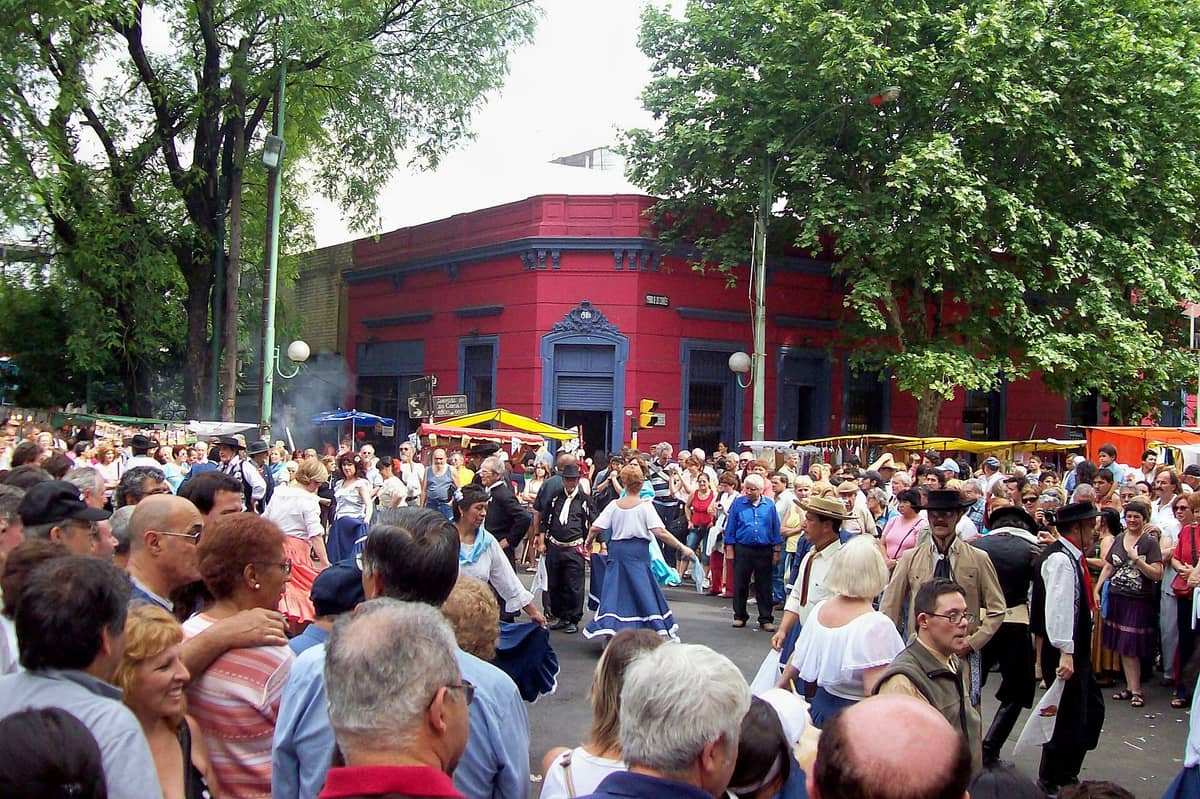
What the Feria de Mataderos Actually Is
The Feria de las Artesanías y Tradiciones Populares Argentinas, universally known as the Feria de Mataderos, is not a tourist market. It is a civic institution. Founded in 1986 with the explicit purpose of promoting and preserving Argentina's gaucho and folkloric heritage, the fair has operated continuously for nearly four decades in Mataderos, a southwestern barrio whose name literally means 'slaughterhouses' and whose identity was shaped by the livestock industry that once dominated this edge of the city.
Every Sunday from mid-March through mid-December, the streets around the old livestock market transform into an open-air stage for traditional music, folk dance, equestrian displays, and craft vendors selling work that is genuinely handmade rather than factory-produced for resale. The scale is considerable: hundreds of stalls, live performances running throughout the day, and a crowd that is overwhelmingly local. For most porteños who attend, this is a Sunday ritual, not a sightseeing detour.
⚠️ What to skip
The fair does not operate on Sundays in January or February, and all outdoor activities are suspended in case of rain. During summer, a night version may run on Saturdays instead. Always check the official website or the Buenos Aires city tourism portal before making the trip, as schedules shift by season and weather.
The Setting: Mataderos and Its History
Mataderos sits at the far southwestern edge of the Ciudad Autónoma de Buenos Aires, about 10 kilometres from the Microcentro. For much of the 20th century it was the site of the Mercado Nacional de Hacienda, one of South America's largest livestock markets, where cattle from the Pampas arrived after days on the road. The workers who settled around the market came from the Argentine interior, bringing with them the musical traditions, food cultures, and social customs of the rural provinces. That demographic inheritance is what gives the Feria de Mataderos its character.
The neighbourhood does not look like Palermo or San Telmo. There are no boutique hotels, no upscale coffee bars, no Instagram-optimised murals. The streets are wide and flat, the buildings low and functional, the atmosphere unhurried. On fair days, the intersection of Av. Lisandro de la Torre and Av. de los Corrales fills with the smell of grilling meat and fried dough, and the sound of chacarera and malambo drifts over the stalls from the main stage. It is as close as Buenos Aires gets to the Argentine countryside without leaving the city limits.
Tickets & tours
Live prices and dates from our booking partner. If you book, we may earn a commission at no extra cost to you.
Buenos Aires San Telmo and Mataderos Fairs private tour
From 62 €Instant confirmationFree cancellationSan Telmo and Mataderos Fairs guided tour
From 143 €Instant confirmationFree cancellationMadero Tango Show tickets with optional dinner
From 32 €Instant confirmationFree cancellationBuenos Aires small-group city tour with optional lunch and cruise
From 25 €Instant confirmationFree cancellation
Walking Through the Fair: What You Will Find
The fair spreads across several blocks of closed streets, and there is no single correct route through it. Craft stalls occupy the bulk of the space, grouped loosely by category. Expect leather goods, silverwork, woven textiles, ceramics, wooden carvings, and mate gourds. The quality varies, as it does at any large market, but a significant portion of vendors are certified artisans who have passed review by the fair's organizers. If you are buying, look for the official seal that distinguishes handmade Argentine work from imported stock.
Food stalls cluster near the main plaza and along the central avenue. Empanadas are everywhere, usually freshly made and priced well below what you would pay in Palermo or Recoleta. Locro, the thick Andean stew of corn, beans, and pork, appears on cooler autumn and winter Sundays. Tortas fritas, the fried flatbreads associated with rainy-day cooking in the Pampas, are sold in paper bags. Vendors also offer regional wines, yerba mate, and homemade liqueurs from the interior provinces.
The main stage hosts continuous performances from early afternoon until the fair closes. Malambo, the percussive solo dance of the gaucho that involves rapid footwork and boleadora handling, is performed here with a competitive intensity that draws genuine crowds. Folk music ensembles from Buenos Aires and visiting groups from the interior provinces play chacarera, zamba, and cuarteto. If you have already seen tango at a milonga in San Telmo, the contrast is instructive: this is the music of the Pampas, not the port. For broader context on Argentine dance traditions, the tango guide for Buenos Aires explains how the two traditions diverged and why both remain culturally significant.
How the Fair Changes Through the Day
The fair officially opens at 11:00, but the first hour is quiet. Vendors are still setting up, the food stalls are lighting grills, and the main stage is empty. This early window is the best time to browse craft stalls without pressure, talk to artisans who are not yet busy, and photograph the space before it fills. The light in winter is cool and flat at this hour, useful for photographing textiles and leatherwork without harsh shadows.
By 13:00 the fair reaches full pace. Performances begin on the main stage, the food queues lengthen, and the streets become genuinely crowded. Families with young children occupy the central plaza. Groups of older visitors in traditional dress gather near the performance area. By 15:00 on a good winter Sunday, the crowd is dense enough that moving between stalls requires patience. This is when the fair feels most alive, but also when the noise level and crowd density peak.
From about 17:00 onward, the atmosphere shifts. Families begin to leave, the food vendors sell down their stock, and the performers move to longer, more informal sets. The light in autumn and winter turns golden around this time, which is useful for photography. The fair closes between 19:00 and 20:00 depending on the season, and the streets empty quickly once vendors start packing down.
💡 Local tip
Arriving around 12:00 to 12:30 gives you the best balance: the fair is in full swing, food stalls are freshly stocked, and the first main-stage performances are starting. If you come primarily for the folk dancing, aim to be at the main stage by 14:00.
Getting There: The Practical Version
Mataderos is not served by the Subte. Getting there from central Buenos Aires means taking a colectivo (city bus), arranging a taxi or ride-hailing service, or joining a guided excursion. Bus lines 36, 55, 63, 80, 92, 97, 103, 117, 126, 141, 155, 180, and 185 all pass through or near the Mataderos area. Journey time from the city centre is typically 30 to 50 minutes depending on traffic and your starting point. A SUBE card, the rechargeable transit card used across Buenos Aires' public transport network, is required for buses; single-use cash payment is not available on colectivos.
Taxis and ride-hailing apps offer a more direct option and cost more, but the distance from central neighbourhoods means the fare is not trivial. Some tour operators run half-day minibus excursions from San Telmo and other central districts, which simplify logistics and add context from a guide. These are worth considering if navigating the bus network on a Sunday feels uncertain.
For visitors planning a Sunday that combines the fair with other sights, note that Mataderos is geographically isolated from the main tourist corridor. It does not pair conveniently with, say, a morning at the Recoleta Cemetery unless you are prepared for a long cross-city trip. A more practical pairing is to dedicate the entire Sunday to Mataderos and return to central neighbourhoods for dinner.
Practical Details: Weather, Accessibility, and What to Bring
The fair is entirely outdoors, which means weather matters considerably. Buenos Aires' autumn and winter months, from April through August, bring temperatures between 8 and 20 degrees Celsius. On a clear winter Sunday, the fair is comfortable in a mid-layer jacket, but the open streets offer little shelter from wind. Spring (September to November) and early autumn (March to April) are the most reliably pleasant seasons for an outdoor market visit.
The fair takes place on public streets and plazas with temporary stalls. Pavement is generally flat but not uniformly smooth, and during peak hours the crowd density makes navigation slow. Visitors with reduced mobility should be aware that there is no single accessible entrance, no indoor area, and limited information about accessible toilet facilities on-site. Contacting the organizers directly before visiting is advisable.
Bring Argentine pesos in cash. While card acceptance has expanded in Buenos Aires generally, many artisan vendors at street fairs still prefer cash, and ATMs are not present at the fair itself. For broader guidance on managing money in the city, the Buenos Aires currency and money guide covers the current exchange landscape in detail.
ℹ️ Good to know
Photography is generally welcome throughout the fair. Performers and artisans are accustomed to cameras, but a brief gesture of acknowledgment before photographing individuals is standard courtesy and almost always received warmly.
Is the Feria de Mataderos Worth the Effort?
The short answer is: it depends entirely on what you are looking for. The fair is far from the hotel zones, requires planning to reach, and offers no famous monuments or iconic photo backdrops. If your Buenos Aires itinerary is already dense with museums, neighbourhoods, and food, adding a half-day trip to Mataderos on a Sunday may feel like too much.
But for travellers who find that the standard tourist circuit of Caminito and the Microcentro leaves them wanting something less curated, the Feria de Mataderos delivers exactly that. The crowd is local, the food is regional, the music is performed by people who grew up with it, and the crafts are made by hands rather than machines. It is the part of Buenos Aires that the guidebooks gesture toward without quite managing to describe.
Visitors who are not interested in folk music, traditional crafts, or Argentine rural culture will find little here to hold their attention beyond the food stalls. The fair does not cater to disengaged browsers. It rewards curiosity and patience.
Insider Tips
- The equestrian displays, where riders in gaucho dress perform traditional exercises, typically take place in an open area near the main stage in the afternoon. Ask a vendor or security volunteer for the day's schedule when you arrive, as exact timing shifts week to week.
- The empanada quality varies significantly across stalls. Look for vendors with a visible queue of locals and ask which regional style they are making: empanadas salteñas (from Salta, spicier) versus criollas (milder, more common in Buenos Aires) are notably different.
- If you are buying leather goods or silverwork, take time to look at the reverse side and edges of the piece. Genuine handmade work shows irregularities and tool marks; mass-produced items have uniform machine stitching and laser-cut edges.
- Winter Sundays draw smaller crowds than spring and autumn, which makes browsing easier and gives you more time with individual artisans. The cold also means the locro stalls are fully stocked and freshly made rather than sold down.
- The fair does not appear prominently on most GPS navigation apps under its full official name. Search for 'Feria de Mataderos' or navigate directly to the intersection of Av. Lisandro de la Torre and Av. de los Corrales.
Who Is Feria de Mataderos For?
- Travellers on a second or third visit to Buenos Aires looking beyond the standard circuit
- Food-focused visitors wanting to try regional Argentine cooking in an informal setting
- Families with children: the folk dance performances and open space work well for younger visitors
- Photographers interested in documentary street photography with willing, unhurried subjects
- Anyone wanting to buy genuine Argentine handmade crafts rather than mass-produced souvenirs
Nearby Attractions
Combine your visit with:
- Cementerio de la Chacarita
Larger and less visited than its famous counterpart in Recoleta, Cementerio de la Chacarita is a vast urban cemetery spanning multiple city blocks in the Chacarita neighborhood. Free to enter, it holds the tombs of cultural icons including tango legend Carlos Gardel, and its monumental mausoleums, wide internal avenues, and layers of Argentine social history make it one of the most atmospheric and underappreciated sites in the city.
- Colonia del Sacramento (Uruguay)
Colonia del Sacramento, Uruguay's oldest city and a UNESCO World Heritage Site, sits just across the Río de la Plata from Buenos Aires. Its Barrio Histórico packs cobblestone lanes, Portuguese-era walls, and a working lighthouse into a compact quarter that most visitors can absorb in a single afternoon.
- Espacio Memoria y Derechos Humanos (ex-ESMA)
Built on the grounds of one of Argentina's most notorious clandestine detention centers, Espacio Memoria y Derechos Humanos (ex-ESMA) is a 17-hectare memorial complex in northern Buenos Aires dedicated to human rights and collective memory. Entry is free, the site has regular daily opening hours, and a visit here is one of the most sobering and important experiences the city offers.
- Estadio Monumental (River Plate)
The Estadio Más Monumental Antonio Vespucio Liberti is more than a football ground. Home to Club Atlético River Plate and the largest stadium in South America, it holds around 85,000 spectators and carries decades of Argentine football history. Whether you visit on a quiet Tuesday morning or a roaring match day, the scale and atmosphere of El Monumental is unlike anything else in Buenos Aires.
Planning a trip? Discover personalized activities with the Nomado app.