Caminito: La Boca's Open-Air Street Museum
Caminito is a 150-metre pedestrian alley in La Boca where corrugated iron tenements, painted in clashing primary colours, line a street that doubles as an open-air museum. Entry is free, the atmosphere is theatrical, and the history behind it runs deeper than the photo opportunity suggests.
Quick Facts
- Location
- Magallanes 800, La Boca, Buenos Aires
- Getting There
- No direct Subte stop. Take a taxi, ride-hailing app, or bus to Av. Don Pedro de Mendoza 1900. Walk a few minutes to Calle Magallanes.
- Time Needed
- 45–90 minutes for the street itself; half a day if combining with nearby museums
- Cost
- Free (public street). Nearby museums and stadium tours charge separate admission.
- Best for
- Photography, cultural history, first-time Buenos Aires visitors
- Official website
- turismo.buenosaires.gob.ar/en/otros-establecimientos/caminito
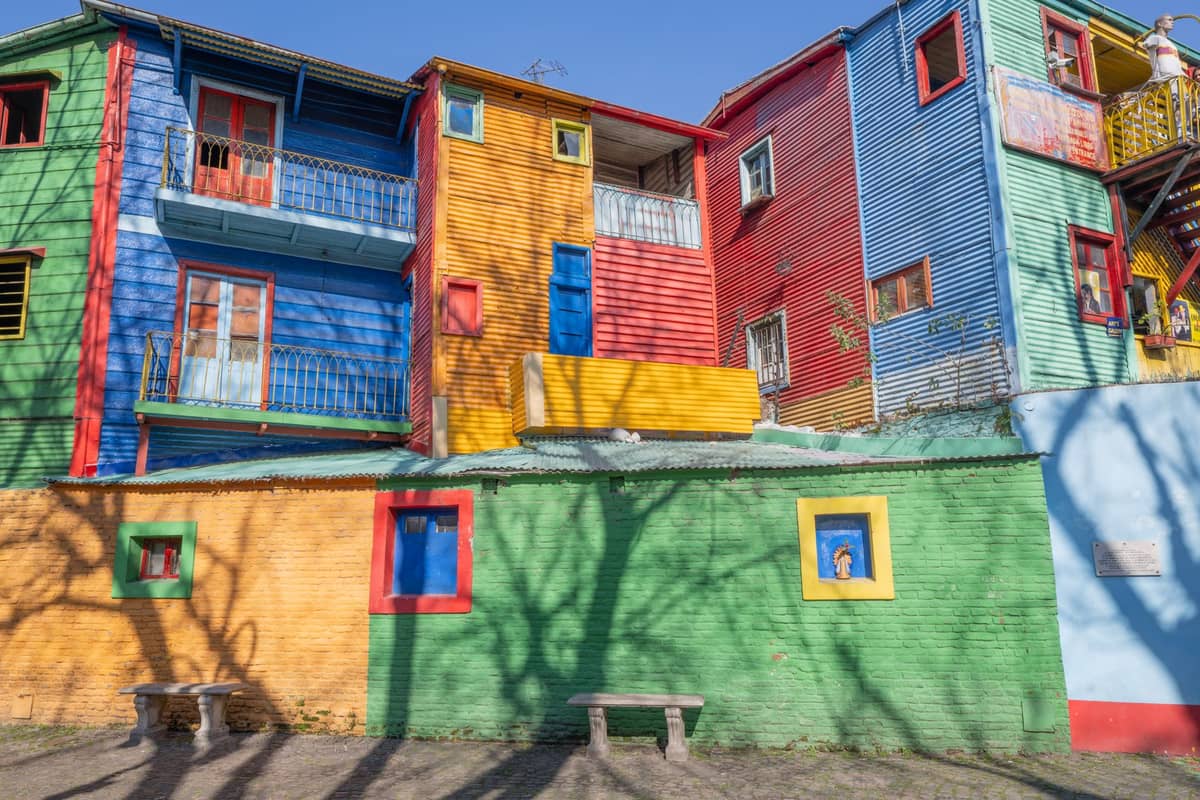
What Caminito Actually Is
Caminito, officially known as the Calle Museo Caminito, is a pedestrian street and open-air museum running roughly 150 metres through La Boca, one of Buenos Aires' oldest riverside districts. The name translates simply as "little walkway" or "little path," and that modesty is intentional: this is not a grand boulevard. It is a narrow alley flanked by two- and three-storey tenements clad in corrugated iron and painted in overlapping blocks of ochre, cobalt, crimson, and lime green.
The street is publicly accessible at all hours, with no gate, no ticket booth, and no closing time. What changes across the day is the atmosphere, the crowd density, and frankly how enjoyable the experience is. From around 10:00 to 18:00, shops, galleries, and street performers fill the alley. Before and after those hours, the street is quiet, which is actually when it rewards a second look.
ℹ️ Good to know
Caminito is a free public street. You will not pay to walk it. Where money enters the picture is in the restaurants, souvenir stalls, and tango show venues that line the route — and you are under no obligation to use any of them.
The History Behind the Colour
La Boca grew as a portside neighbourhood in the late 19th and early 20th centuries, populated largely by Genoese immigrants who arrived to work the docks along the Matanza-Riachuelo River. Housing was informal and cheap: workers built homes from whatever materials came off the ships, which meant corrugated iron sheet metal, timber, and leftover boat paint. That paint, available in industrial primary colours, gave the neighbourhood its defining visual identity. It was not an aesthetic choice so much as a practical one.
In the 1950s, the Argentine painter Benito Quinquela Martín, who was born in La Boca and spent his career documenting its dockworkers and river life, led an effort to transform an abandoned rail siding in this corner of the neighbourhood into a formal open-air museum. The street was named after the popular tango "Caminito," composed by Juan de Dios Filiberto in 1926. The Museo Quinquela Martín still stands at the far end of the street and holds a significant collection of his work, including a rooftop sculpture terrace overlooking the Riachuelo.
The result is a place that sits between two things at once: genuine urban heritage from a specific immigrant community, and a heavily curated tourist set piece. Both are true, and understanding that duality makes the visit more interesting rather than less.
Tickets & tours
Live prices and dates from our booking partner. If you book, we may earn a commission at no extra cost to you.
Madero Tango Show tickets with optional dinner
From 32 €Instant confirmationFree cancellationBuenos Aires small-group city tour with optional lunch and cruise
From 25 €Instant confirmationFree cancellationPiazzolla Tango Show VIP tickets with transfer and optional dinner
From 112 €Instant confirmationFree cancellationBuenos Aires shopping tour
From 15 €Instant confirmationFree cancellation
What the Walk Looks and Feels Like
The alley itself is largely flat and wide enough for two people to walk side by side even when it is crowded. The corrugated iron facades are painted in solid colour blocks with minimal ornamentation, and the effect in direct sun, particularly in the late morning when the light hits the southern-facing walls, is genuinely striking. Sculptures and murals are set into some of the buildings, most referencing working-class portside life or the tango's origins in this neighbourhood.
At street level, vendors sell mate gourds, leather goods, and Boca Juniors merchandise. Tango performers in period dress dance on small platforms outside restaurants, and photographers press them on tourists. The performances are competent and the offers to be photographed with the dancers for a tip are standard and generally good-natured. The restaurant menus are tourist-oriented, the prices reflect it, and the food is generally not the reason to eat here.
The smells vary by block: grilling meat from the restaurant patios, a faint metallic tang from the old iron facades in the heat, and closer to the Riachuelo, the particular brackish smell of the river that Quinquela Martín painted so often. It is not always pleasant, but it is specific, and it reminds you that this is not a theme park reconstruction but an actual working riverside district.
💡 Local tip
Walk the full length of Caminito first before stopping anywhere. The northern end near Av. Don Pedro de Mendoza is where most tour groups enter, making it the most congested. The southern end near the Riachuelo is calmer and offers better photographs of the facades without crowds in the foreground.
Best Time to Visit and How the Experience Changes
Midday on a weekend between October and March is the peak of peak: tour groups, school parties, and independent visitors converge simultaneously. The alley feels compressed and the photography becomes difficult. If your schedule allows any flexibility, a weekday morning between 10:00 and 12:00 gives you the street when the stalls are open and the light is good, but before the tour buses arrive in numbers.
Earlier than 10:00, the street is quiet to the point of being empty. The buildings are still there, the colours still register, and the absence of commercial activity makes it possible to look at the architecture rather than past it. This is genuinely the best time for photography, though you will not see the performers or the painted carts. Late afternoon, after around 16:00, the crowds thin again as tour groups return to their hotels, but some shops begin closing before 18:00.
Spring (September to November) and autumn (March to May) offer the most comfortable temperatures for walking the area, with Buenos Aires typically seeing daytime temperatures between roughly 15 and 26°C. Summer (December to February) brings heat and humidity that makes the metal-clad alley feel warmer than surrounding streets. For more on timing your trip overall, see the guide to the best time to visit Buenos Aires.
Beyond the Alley: What to Combine Nearby
The Museo Quinquela Martín is the most logical addition to a Caminito visit and takes about an hour. It provides the historical context that the street itself lacks signage for. A short walk from Caminito, Fundación Proa is a contemporary art institution with rotating international exhibitions, a rooftop café with river views, and a bookshop worth visiting regardless of what is showing.
Estadio La Bombonera, home of Club Atlético Boca Juniors, is roughly a 10-minute walk from Caminito. The La Bombonera stadium offers tours that include the Museo de la Pasión Boquense, a well-produced museum covering the club's history. Combine a morning on Caminito with an afternoon stadium tour for a full La Boca day.
La Boca neighbours San Telmo, Buenos Aires' other historically dense inner-city neighbourhood. The Feria de San Telmo runs on Sundays and is walkable from La Boca with a 20-minute stroll north along Av. Almirante Brown, making it a natural pairing on the same day.
Practical Notes: Getting There, Safety, and What to Bring
Caminito has no Subte station in La Boca within comfortable walking distance. The most straightforward approach is a taxi or ride-hailing app to the corner of Av. Don Pedro de Mendoza and Calle Magallanes. Several bus routes serve Av. Almirante Brown, which runs parallel to the neighbourhood. Journey times from central Buenos Aires depend heavily on traffic.
La Boca as a neighbourhood requires the same awareness you would apply in any dense urban area with heavy foot traffic. The tourist zone around Caminito is well-patrolled and busy during opening hours, but the streets beyond the immediate pedestrian area are a different environment. Visitors are consistently advised by local tourism authorities not to wander away from the Caminito corridor and the main connecting streets to Proa and La Bombonera without local guidance.
⚠️ What to skip
Keep to the recognised tourist circuit in La Boca. The blocks immediately surrounding Caminito are safe and actively managed. Venturing beyond them, particularly toward the Riachuelo wharves, puts you in an industrial zone where tourist infrastructure does not exist and situational awareness matters more.
Wear comfortable walking shoes. The street itself is paved and accessible, but some adjoining lanes have uneven cobblestones. Bring cash in Argentine pesos for any purchases from market stalls, as many smaller vendors do not take cards. Water is worth carrying in summer. If you are using a camera, a wide-angle lens earns its place here: the alley is narrow and the facades are tall.
A Clear Assessment: Is It Worth Your Time?
Caminito is one of the most photographed spots in Buenos Aires, and that visibility has costs. The commercial layer, restaurants pitching tango dinners, stalls selling identical merchandise, performers working for tips, sits heavily on top of what is genuinely interesting architectural and social history. If you arrive expecting an authentic slice of Argentine life, you will find something more staged.
But the history is real, the colours are real, and at 150 metres long, the commitment required is low. Almost every first-time visitor to Buenos Aires ends up here, and the question is not really whether to go but how to approach it. Come early, skip the tango restaurants, walk to the end and back, then use the time you saved to visit Quinquela Martín's museum or Fundación Proa. Those two institutions give Caminito the depth it cannot provide on its own.
If Caminito is part of a broader Buenos Aires itinerary and you want to see how the city's street culture looks outside its most photographed corridor, the guide to Buenos Aires street art covers neighbourhoods where the visual culture is less curated and considerably more current.
Insider Tips
- Arrive before 10:00 if your priority is photography. The facades read most clearly in the morning light, and without crowds you can shoot the full length of the alley from either end.
- The painted carts and props positioned along the street for tourist photos are free to photograph from a distance. If a performer invites you to pose with them, a tip is expected — that is the arrangement, and it is fair.
- The Museo Quinquela Martín charges a separate admission but is genuinely worth it. Quinquela Martín's large-format paintings of dockworkers and the Riachuelo provide context that makes the street itself more legible afterward.
- If you want to eat in the area, walk two blocks away from Caminito toward Av. Almirante Brown. The restaurants there serve the same food at lower prices to a local rather than tourist clientele.
- Caminito is one of the few attractions in Buenos Aires where a guided walking tour adds real value — not for the walk itself, which takes 15 minutes unguided, but for the neighbourhood history that is otherwise invisible on the street.
Who Is Caminito For?
- First-time visitors to Buenos Aires checking key cultural landmarks
- Photography-focused travellers who can come early to avoid crowds
- Anyone combining a La Boca morning with a Boca Juniors stadium tour in the afternoon
- Travellers interested in immigrant history and working-class urban heritage
- Families with children, given the flat street, open space, and visual stimulation
Nearby Attractions
Other things to see while in La Boca:
- Estadio Alberto J. Armando (La Bombonera)
La Bombonera is the home ground of Club Atlético Boca Juniors, one of Argentina's most storied football clubs. Located in the working-class neighborhood of La Boca, the stadium is as much a cultural institution as a sports venue, drawing tens of thousands of visitors every year who come not just for matches but for the architecture, the museum, and the atmosphere that has made it iconic.
- Fundación PROA
Fundación PROA is a contemporary art center at Av. Pedro de Mendoza 1929, steps from Caminito in La Boca. Spread across three floors with four exhibition halls, a multimedia auditorium, a bookshop, and a rooftop restaurant overlooking the Riachuelo, it presents rotating modern and contemporary art shows of genuine international caliber. Entry is free every Wednesday.
- Museo de la Pasión Boquense
Attached to the legendary La Bombonera stadium in La Boca, the Museo de la Pasión Boquense (Boca Juniors Museum) traces over a century of the club's history through trophies, jerseys, and an immersive circular gallery. Whether you follow football or not, the museum offers a genuine window into Argentine popular culture and the intense identity of one of the world's most recognized clubs.
- Museo Quinquela Martín
The Museo Benito Quinquela Martín preserves the former home and studio of Argentina's most celebrated port painter, holding a substantial collection of his intense industrial canvases, a gallery of Argentine figurative art, and a remarkable assembly of antique ship figureheads. The building itself overlooks the Riachuelo waterway in La Boca, with rooftop terraces that frame the neighborhood's corrugated iron skyline.
Planning a trip? Discover personalized activities with the Nomado app.