Museo de la Pasión Boquense: Inside the Heart of La Bombonera
Attached to the legendary La Bombonera stadium in La Boca, the Museo de la Pasión Boquense (Boca Juniors Museum) traces over a century of the club's history through trophies, jerseys, and an immersive circular gallery. Whether you follow football or not, the museum offers a genuine window into Argentine popular culture and the intense identity of one of the world's most recognized clubs.
Quick Facts
- Location
- Brandsen 805, La Boca, Ciudad Autónoma de Buenos Aires, Argentina
- Getting There
- Buses 25, 46, 86 (Brandsen); 29, 53, 152, 168, 64 (Av. Almirante Brown); 22, 24, 39, 70 (Av. Patricios). No Subte line reaches La Boca directly.
- Time Needed
- 1.5–2.5 hours for museum only; add 45–60 minutes for the stadium tour
- Cost
- Verify current ARS prices on the official site before visiting — figures change frequently. Combined museum + stadium tour pricing for adult residents is currently listed in the low thousands of ARS; non-resident prices are higher.
- Best for
- Football fans, Argentine culture enthusiasts, travelers curious about Buenos Aires identity
- Official website
- museoboquense.com
What Is the Museo de la Pasión Boquense?
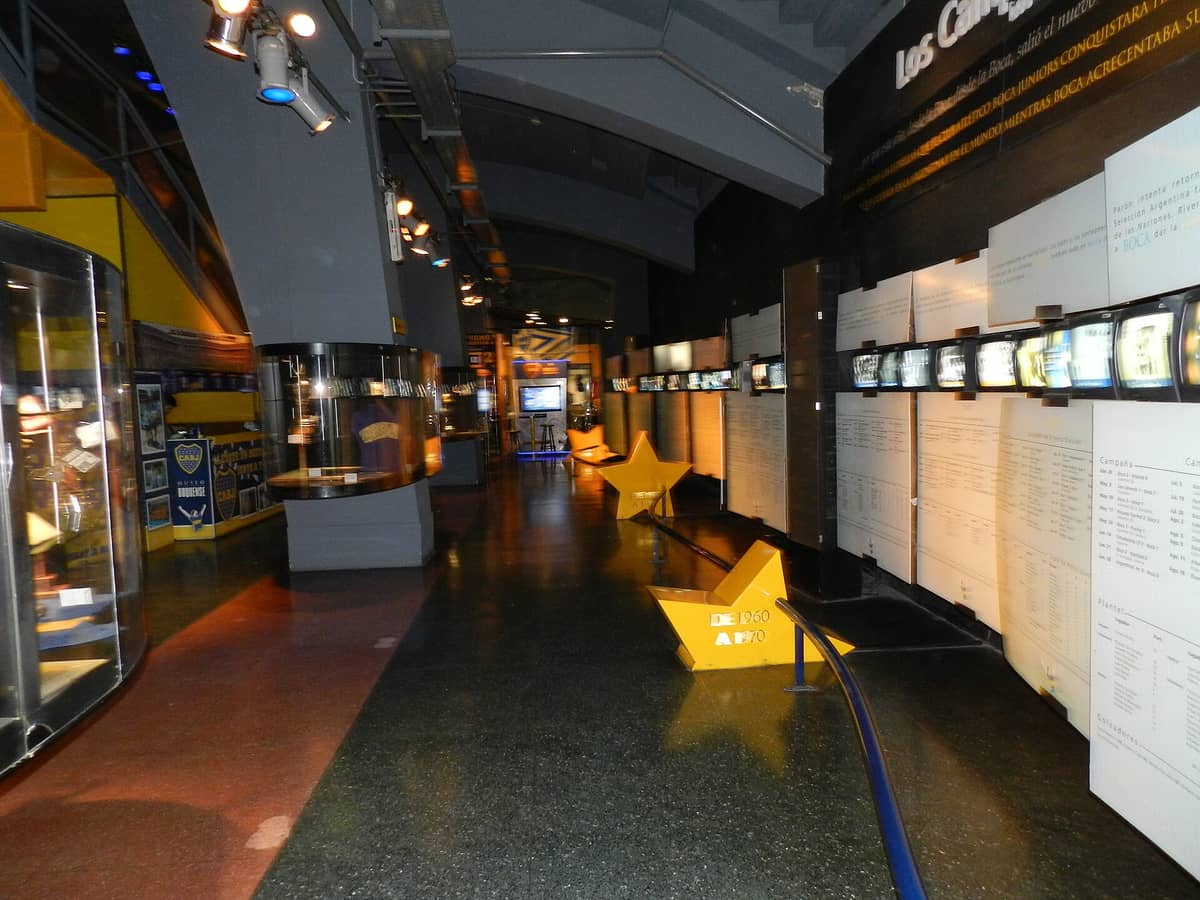
The Museo de la Pasión Boquense, known in English as the Boca Juniors Museum, opened in 2001 and sits directly inside the Estadio Alberto J. Armando, the stadium that Boca fans call La Bombonera. The museum chronicles more than 100 years of Club Atlético Boca Juniors through an architecture of ramps, curved galleries, and glass cases that wrap around you the way the stadium's stands wrap around the pitch. Even if you have never watched a full football match, the experience communicates something specific about how this club functions as a civic institution, not merely a sports team.
Boca Juniors and their arch-rivals River Plate define Argentine football culture. The Superclásico between the two clubs is routinely cited as one of the most emotionally charged derby matches in the world. If you want broader context for what you will see inside the museum, reading up on football in Buenos Aires before you visit will make the displays considerably more meaningful.
⚠️ What to skip
The museum reduces or suspends public access on match days when Boca Juniors play at home at La Bombonera. Always check the official site before heading down to La Boca — arriving on a home-game day without a ticket to the match means you will likely be turned away from the museum entrance.
The Building Itself: La Bombonera as Architecture
Before entering the museum, stop and look at the stadium from across Brandsen. La Bombonera, completed in 1940, is an unusual structure: three steep, near-vertical stands surround the pitch on three sides, while a fourth side has a much lower profile due to the tight urban plot. The design creates extraordinary acoustics — when the stands are full, the concrete vibrates with the crowd's synchronized jumping, a phenomenon Boca fans describe with visible pride. You can hear references to this throughout the museum.
The stadium is embedded in a working-class neighborhood that was built by Italian and Spanish immigrant laborers in the late nineteenth and early twentieth centuries. The club itself was founded in 1905 by immigrants from Genoa, a heritage that still shapes the neighborhood's visual identity. The corrugated iron and brightly painted facades you see walking from Caminito toward the stadium belong to the same social history that the museum narrates inside.
La Boca as a whole rewards time on foot. The Caminito street museum is about a ten-minute walk from the stadium entrance and is worth combining with your visit, particularly in the morning before both sites become crowded with tour groups.
Tickets & tours
Live prices and dates from our booking partner. If you book, we may earn a commission at no extra cost to you.
Boca Juniors Museum skip-the-line tickets
From 17 €Instant confirmationFree cancellationTour to La Boca Jrs and River Plates Stadiums and museums
From 99 €Instant confirmationFree cancellationRiver Stadium and Museum Official Guided Tour
From 33 €Instant confirmationFree cancellationParque de la Costa amusement park tickets with transfer
From 79 €Instant confirmationFree cancellation
What You Will See Inside the Museum
The museum's core display occupies a circular, spiraling gallery that rises through multiple levels on a continuous ramp, drawing visual comparisons to the Guggenheim in New York, though on a considerably more modest scale. The layout means you never feel rushed: there are no strict room-to-room transitions, just a gradual ascent through decades of club history.
Cases along the route hold original jerseys from different eras, showing how the distinctive blue and gold vertical stripe kit evolved over time. Boots, balls, pennants, and medals occupy their own sections. There is a significant amount of audiovisual content: screens replay historic goals, crowd celebrations, and interviews with players, and the sound design adds a low ambient roar that makes the atmosphere feel stadium-adjacent rather than library-quiet.
One of the most discussed stops is the section dedicated to Diego Maradona, who played for Boca Juniors at different points in his career, including his final professional season. The display is not only about football statistics; it functions more like a civic memorial, and the emotional weight visitors bring to it is palpable. Expect the Maradona section to be more crowded than the rest, and expect some visitors to be genuinely moved.
The trophy display covers international titles including the Copa Libertadores, which Boca has won multiple times, making them one of the most successful clubs in South American football history. The trophies are well-lit and presented with enough contextual information in both Spanish and English that non-specialists can follow the chronology.
💡 Local tip
Signage and labels are available in Spanish and English throughout the museum. However, some of the more detailed audiovisual content runs only in Spanish. If Spanish is not your language, the visual and object-based exhibits still work well independently.
The Stadium Tour: What It Adds
The combined ticket adds a guided walk through La Bombonera that takes you through areas normally closed to the public: the players' changing rooms, the tunnel, and the pitch-side perimeter. Standing at pitch level and looking up at those steep stands is a genuinely different experience from what photographs suggest. The vertical angle of the upper tier is steep enough that the effect, even empty, communicates the atmosphere of a sold-out match better than any display case.
Tour availability depends on the club's schedule and is typically not offered on match days or during training sessions. Tours usually run in Spanish, but guides with English capability are sometimes available; it is worth calling ahead or checking the official site if this matters to you. The tour portion adds roughly 45 to 60 minutes to your total visit time.
ℹ️ Good to know
Visiting during a match is an entirely different proposition from the museum experience. If you want to watch Boca Juniors play at La Bombonera, ticket procurement requires separate planning — and significant advance booking for high-profile fixtures.
Timing Your Visit
The museum opens daily from 10:00 and the ticket office closes at 17:30, with the museum itself closing at 18:00. Arriving by 10:00 on a weekday gives you the best combination of light, manageable crowds, and full access to the interactive elements before school groups and tour buses arrive.
Late mornings on weekends draw the largest crowds, particularly when international tour groups overlap with local visitors. If you arrive between 11:00 and 14:00 on a Saturday or Sunday, expect queues at the entrance and crowded ramp sections in the main gallery. Weekday afternoons between 14:00 and 16:30 are usually the quietest window if a midday visit fits your schedule.
Buenos Aires summers (December to February) bring heat and humidity that can make the walk from the bus stop or from Caminito uncomfortable, particularly with children. Spring and autumn visits, roughly September to November and March to May, offer the most physically comfortable conditions for the neighborhood walk combined with the museum interior.
Getting There and the La Boca Safety Context
La Boca is not served by the Subte network, so reaching the museum means taking a bus or a taxi or ride-hailing service. From San Telmo or the Microcentro, several bus routes cover the route; lines 25, 46, and 86 stop on Brandsen close to the stadium entrance. Journey time from central neighborhoods is typically 20 to 35 minutes depending on traffic.
For travelers unfamiliar with Buenos Aires' bus system, a SUBE rechargeable card is required for colectivos. You can consult the guide to getting around Buenos Aires for practical fare and card information before your trip.
La Boca has a justified reputation as a neighborhood where visitors should remain oriented and aware of their surroundings. The area immediately around the stadium and along the tourist corridor toward Caminito is well-trafficked and generally fine during daylight hours. Straying further into the neighborhood's residential streets without local knowledge is not recommended, particularly after dark. Arrive and depart by bus or taxi rather than walking extended distances through unfamiliar blocks.
⚠️ What to skip
Do not walk from La Boca to Puerto Madero along the riverside — that route passes through areas that are not safe for tourists on foot. Stick to the tourist corridor or use transport between destinations.
Photography and Practical Notes
Photography is generally permitted inside the museum for personal use. The circular gallery's interior is reasonably well lit for a museum space, and the trophy cases are individually lit in a way that photographs clearly without flash. The Maradona display tends to have people standing close to the cases, so patience is needed for an unobstructed shot. On the stadium tour, the pitch-side view and the changing rooms are the most photographed spots; the tunnel entrance, with its low ceiling and the pitch framed at the end, is a particularly strong image if you have a wide-angle lens.
Accessibility information for the museum has been inconsistently reported by third-party sources: some describe it as wheelchair accessible and others do not. Given the building's ramp-based layout, mobility access may be theoretically possible but practically variable. Visitors with mobility requirements should contact the museum directly before purchasing tickets to confirm current conditions.
If you are building a full day around La Boca, combining the museum with the Fundación PROA contemporary art foundation makes for a contrasting but complementary pair. PROA is also on Av. Pedro de Mendoza, a short walk from the stadium, and represents an entirely different side of La Boca's cultural output.
Insider Tips
- Buy tickets online via the official museum site (museoboquense.com) before arriving. Walk-up availability is usually fine on weekdays, but weekend queues at the ticket window can eat 20 to 30 minutes of your visit time.
- The ramp ascent through the main gallery means the upper levels are less crowded than the entrance floors, even on busy days. Move through the lower sections quickly on arrival and spend more time at the top where the FIFA World Cup and Copa Libertadores sections sit.
- The souvenir shop at the museum exit sells officially licensed Boca Juniors merchandise. Prices are comparable to or sometimes lower than the market stalls around Caminito, and authenticity is guaranteed. If you want a jersey or scarf, this is a reliable place to buy.
- On a match day when you are not attending the game, the neighborhood around the stadium from about two hours before kickoff is an experience in itself — the street food, the crowd density, the noise. You will not be able to access the museum, but watching the pre-match atmosphere from a café on a nearby block is something most visitors do not plan for.
- Ticket prices for international visitors (non-residents) are higher than the resident rate. Prices in ARS change frequently due to Argentine inflation, so always check the official site the week of your visit rather than relying on prices cited in articles or review platforms.
Who Is Museo de la Pasión Boquense For?
- Football fans with specific interest in South American club football and Boca Juniors history
- Travelers interested in Argentine popular culture, immigrant history, and working-class identity
- Architecture enthusiasts curious about mid-twentieth-century stadium design and its urban context
- Anyone who wants to combine the museum with Caminito and Fundación PROA for a full day in La Boca
- Families with older children who have some context for football or Argentine culture
Nearby Attractions
Other things to see while in La Boca:
- Caminito
Caminito is a 150-metre pedestrian alley in La Boca where corrugated iron tenements, painted in clashing primary colours, line a street that doubles as an open-air museum. Entry is free, the atmosphere is theatrical, and the history behind it runs deeper than the photo opportunity suggests.
- Estadio Alberto J. Armando (La Bombonera)
La Bombonera is the home ground of Club Atlético Boca Juniors, one of Argentina's most storied football clubs. Located in the working-class neighborhood of La Boca, the stadium is as much a cultural institution as a sports venue, drawing tens of thousands of visitors every year who come not just for matches but for the architecture, the museum, and the atmosphere that has made it iconic.
- Fundación PROA
Fundación PROA is a contemporary art center at Av. Pedro de Mendoza 1929, steps from Caminito in La Boca. Spread across three floors with four exhibition halls, a multimedia auditorium, a bookshop, and a rooftop restaurant overlooking the Riachuelo, it presents rotating modern and contemporary art shows of genuine international caliber. Entry is free every Wednesday.
- Museo Quinquela Martín
The Museo Benito Quinquela Martín preserves the former home and studio of Argentina's most celebrated port painter, holding a substantial collection of his intense industrial canvases, a gallery of Argentine figurative art, and a remarkable assembly of antique ship figureheads. The building itself overlooks the Riachuelo waterway in La Boca, with rooftop terraces that frame the neighborhood's corrugated iron skyline.
Planning a trip? Discover personalized activities with the Nomado app.