Colonia del Sacramento: The Day Trip That Earns Its Reputation
Colonia del Sacramento, Uruguay's oldest city and a UNESCO World Heritage Site, sits just across the Río de la Plata from Buenos Aires. Its Barrio Histórico packs cobblestone lanes, Portuguese-era walls, and a working lighthouse into a compact quarter that most visitors can absorb in a single afternoon.
Quick Facts
- Location
- Colonia del Sacramento, Uruguay (department of Colonia), across the Río de la Plata from Buenos Aires
- Getting There
- Ferry from Buenos Aires (Buquebus or Colonia Express) to Colonia del Sacramento port; roughly 1–3 hrs depending on service. Check current schedules and book in advance.
- Time Needed
- 4–6 hours for a comfortable day trip; the historic quarter itself takes 2–3 hours to explore on foot
- Cost
- Historic district access is free. Guided tours: 250 Uruguayan pesos (Spanish) / 400 pesos (other languages). Lighthouse: 35 pesos. Multi-museum pass: around 50 pesos for access to several museums (children under 12 free). Prices subject to change — verify locally.
- Best for
- Architecture lovers, couples, history enthusiasts, anyone wanting a contrast to Buenos Aires's scale
- Official website
- www.colonia.gub.uy/turismo
What Colonia del Sacramento Actually Is
Colonia del Sacramento is the capital of Uruguay's Colonia department, and its Barrio Histórico (Historic Quarter) is one of the most intact examples of Iberian colonial urban planning in South America. Founded in 1680 by the Portuguese governor of Brazil, Manuel Lobo, as a strategic trading outpost on the Río de la Plata, the town changed hands multiple times between Portugal and Spain over the following century before becoming Uruguayan territory around 1828. In 1995, UNESCO added the historic quarter to its World Heritage List, recognizing the rare layering of Portuguese, Spanish, and post-colonial architecture within a single compact area.
For travelers based in Buenos Aires, Colonia represents something the Argentine capital cannot offer: a place where the streets still run at a human pace, the buildings top out at two stories, and you can hear birds rather than traffic. The two cities are separated by only about 50 km of water, but they feel like different centuries.
ℹ️ Good to know
The Barrio Histórico is entered via the Portón del Campo (the old city gate) and its surrounding streets, including Odriozola, Manuel Lobo, Rivadavia, 18 de Julio, and Avenida General Flores. The Centro de Bienvenida, Interpretación y Turismo (BIT) is at Odriozola 434 — stop here first to pick up a free map.
The Ferry Crossing: Getting the Logistics Right
The journey begins at the ferry terminals in Buenos Aires. Two main operators run the route: Buquebus (from the terminal in Puerto Madero) and Colonia Express. Travel times vary significantly by service type, ranging from about 1 hour on the fast ferry to roughly 3 hours on slower crossings. The price difference between fast and slow services is substantial, so choose based on how much of the day you want to spend on the water versus on land.
Book tickets in advance, especially on weekends and Argentine public holidays, when demand is high and last-minute seats disappear. Uruguayan immigration is handled on the Colonia side, so bring your passport — even if you are from a country that normally crosses without documentation, the border crossing is international. Currency shifts the moment you arrive: Uruguay uses the Uruguayan peso (UYU), and while some tourist-facing businesses accept Argentine pesos or US dollars, you will get better value exchanging or paying in local currency.
💡 Local tip
The afternoon fast ferry back to Buenos Aires fills up quickly. Book your return crossing before you leave Buenos Aires, not once you arrive in Colonia.
For broader planning advice on managing Buenos Aires as a base for excursions, see the day trips from Buenos Aires guide, which covers transport options and timing in more detail.
Tickets & tours
Live prices and dates from our booking partner. If you book, we may earn a commission at no extra cost to you.
Tigre delta trip and visit to Puerto de Frutos
From 54 €Instant confirmationFree cancellationPrivate Buenos Aires city tour with Tigre Delta ride
From 89 €Instant confirmationFree cancellationCarlos Gardel Tango Show tickets with optional dinner
From 66 €Instant confirmationFree cancellationCarlos Gardel Tango Show VIP with transfer and optional dinner
From 88 €Instant confirmationFree cancellation
Walking the Barrio Histórico: What You Will See
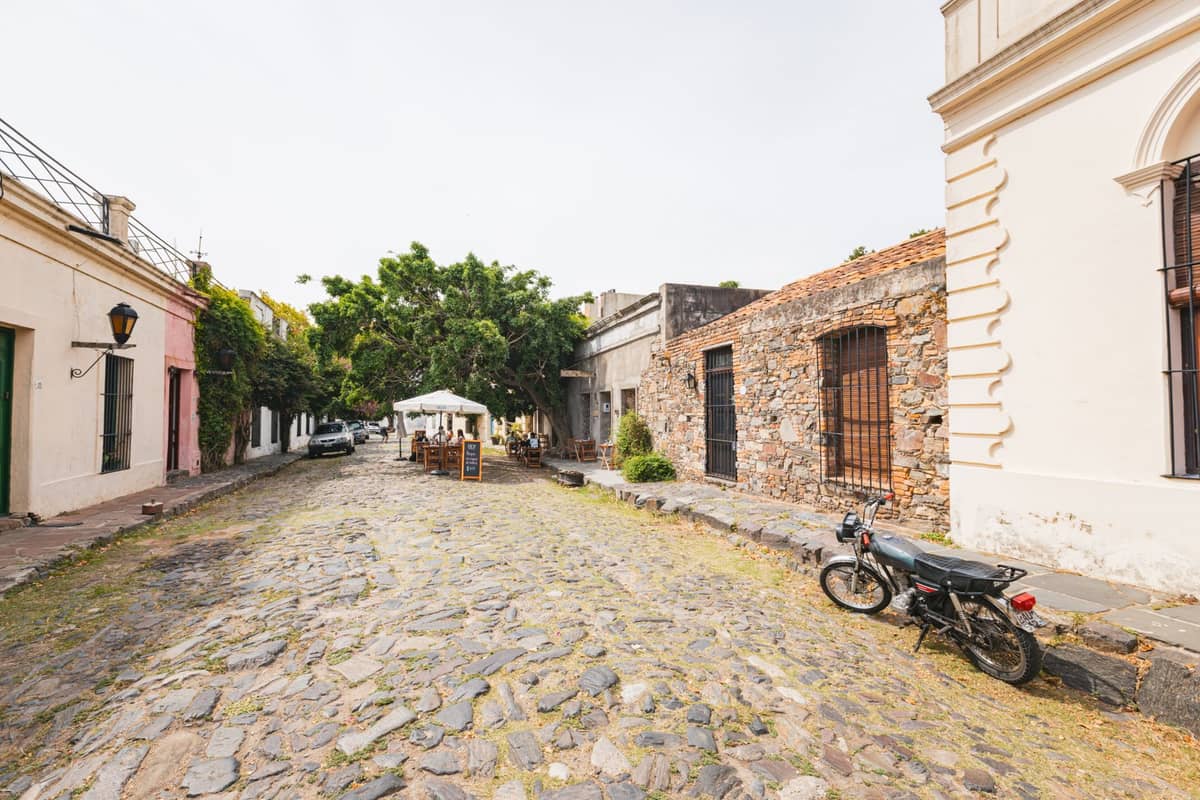
The historic quarter occupies a small peninsula, and its compact footprint is one of its defining qualities. From the Portón del Campo, the original city gate reinforced with a dry moat, you enter a grid of lanes paved with irregular cobblestones worn smooth by three centuries of foot traffic. The stones are uneven in ways that require attention: comfortable walking shoes with a flat, grippy sole are the right call here. Heels are not.
The architecture blends Portuguese-era whitewashed walls and terracotta roof tiles with Spanish colonial additions, giving individual blocks a slightly mismatched quality that is historically honest rather than artificially curated. Bougainvillea spills over low garden walls. Dogs sleep on doorsteps. The smell varies by block: woodsmoke from an open kitchen, eucalyptus from a courtyard tree, river air drifting in from the Plata.
Central landmarks within the quarter include the ruins of the Convento de San Francisco (17th century), the Faro de Colonia (the working lighthouse that you can climb for a panoramic view of the estuary for 35 Uruguayan pesos), the Plaza Mayor with its central well and surrounding colonial buildings, and the Museo Portugués, which documents the city's founding period. None of these require more than 20–30 minutes individually; the pleasure is in the accumulation and the walking between them.
⚠️ What to skip
Accessibility note: cobblestone streets throughout the Barrio Histórico make wheelchair navigation genuinely difficult. The site is only partially accessible for visitors with mobility impairments.
How the Experience Changes Through the Day
Morning arrivals, before 10:00, find the quarter close to empty. Shop shutters are still down, and the light is soft and flat — useful for photography but limiting if you want cafes or museums open. The town wakes slowly.
By late morning, the texture of the visit shifts. The tourist office at Portón del Campo runs guided tours daily at 11:00 and 15:00 (250 Uruguayan pesos per person in Spanish, 400 pesos in other languages — confirm pricing locally as it is subject to change). The 11:00 tour is a good anchor for first-time visitors, giving orientation before the midday crowds from Buenos Aires arrive on the fast ferry.
Midday, roughly 12:30–14:30, is the most crowded period. The main lane from the gate toward the lighthouse sees the most foot traffic, and the handful of restaurants along Calle del Comercio fill up. If you are eating in town, arriving before noon or after 14:00 avoids the worst of the queues. Afternoons are calmer again, and the light on the whitewashed walls between 15:00 and 17:00 produces the warm, directional quality that makes this one of the more photographable places within a short reach of Buenos Aires.
In some seasons, the tourist office runs a Saturday evening guided tour at around 19:00 called the 'Recorrido guiado a la luz del farol' (lantern-light guided walk). If this coincides with your visit, it is worth checking availability at the BIT office on arrival, as the experience of the quarter at dusk is genuinely different from the daytime version.
Cultural and Historical Context Worth Knowing
Colonia del Sacramento was founded in 1680 by the Portuguese governor of Brazil, Manuel Lobo, as a direct challenge to Spanish control of the Río de la Plata trade. Its location was strategic: positioned directly across from Buenos Aires, it served as a conduit for goods moving between Portuguese Brazil and Spanish colonial territory, bypassing Spanish trade controls. The Spanish took it by force in 1705, returned it under treaty in 1715, and fought over it again repeatedly until Spain finally consolidated control in 1777; it became part of Uruguayan territory after independence around 1828. This contested history is legible in the built fabric: Portuguese-period structures sit adjacent to Spanish-era additions, and the fortification walls reflect changing tactical priorities across different occupiers.
The UNESCO designation in 1995 recognized this layering as exceptional. Unlike many preserved colonial towns, Colonia was not comprehensively restored or reconstructed; much of what you see is original material, which accounts for the lived-in rather than theme-park quality of the place.
If architectural history is a particular interest, it is worth reading the Buenos Aires architecture guide before your trip — it provides useful context on the broader Rioplatense tradition that shapes both cities.
Practical Walkthrough: Moving Through the Quarter
The BIT visitor center at Odriozola 434 is the logical first stop. Pick up a printed map, check current guided tour times, and confirm any museum entry fees before heading in, as prices change and not all sources online are current.
A self-guided circuit of the main points of interest, including the Portón del Campo, Plaza Mayor, lighthouse, convent ruins, and the waterfront Paseo de San Gabriel, takes 90 minutes at a steady pace. Add another hour if you enter any of the small museums. Most visitors naturally walk the circuit in a loose loop, drifting toward the waterfront — the bank of the Río de la Plata on the western edge of the peninsula offers long views across the estuary toward Buenos Aires on a clear day.
Eating options within and immediately around the historic quarter include a small number of cafes and restaurants serving Uruguayan standards: chivito (steak sandwich), grilled meats, and local craft beer. The quality varies and prices are higher than in residential Colonia neighborhoods, reflecting the tourist concentration. Carrying water is advisable, particularly in summer when temperatures can exceed 30°C and the cobblestone surfaces retain heat.
Photography Notes
The quarter photographs well across most of the day, but the strongest light for exteriors is in the late afternoon, when the angle catches the texture of the old walls and the color of the roof tiles. The lighthouse provides an elevated view over the red-tiled rooftops and out to the estuary — worth the modest entry fee even if you have no particular interest in lighthouses. Wide-angle lenses work better than telephoto in the narrow lanes, where the buildings are close on both sides.
Crowds thin noticeably after 16:00 as day-trippers head back toward the ferry. If your return crossing allows, staying past 16:00 gives the best combination of good light and manageable foot traffic.
💡 Local tip
For the clearest view of Buenos Aires skyline from the Colonia waterfront, go on a day with low humidity. In summer, haze off the Plata frequently obscures the opposite bank entirely.
Insider Tips
- Rent a golf cart or bicycle near the port on arrival. The historic quarter itself is small enough to walk, but the wider town between the port and the Barrio Histórico is a 15-minute walk in heat — wheels make the transit easier and open up neighborhoods beyond the tourist core.
- The official guided tour at 11:00 from Portón del Campo is worth taking even if you normally skip guided tours. The historic quarter's layered history is not obvious from the street, and 45–60 minutes with a guide gives you a framework that makes the rest of the self-guided walk more legible.
- Uruguayan pesos go further at local supermarkets and bakeries in the residential streets beyond the historic quarter than at the tourist-facing cafes inside the walls. If you want good coffee at a fair price, walk two blocks past the Portón toward the main commercial street.
- The Saturday evening lantern-light tour (Recorrido guiado a la luz del farol) is only available in some seasons. Check at the BIT office on Odriozola 434 on the day of arrival rather than relying on advance information online.
- Argentine credit and debit cards may not work in Uruguayan ATMs or point-of-sale terminals, depending on your bank. Bring small denomination US dollars as backup — they are widely accepted in tourist areas at a reasonable exchange rate.
Who Is Colonia del Sacramento (Uruguay) For?
- Couples looking for a change of pace from Buenos Aires's intensity
- Architecture and history enthusiasts who want to see colonial layers that the Argentine capital lacks
- Photographers drawn to textured streets, warm light, and manageable crowds
- Families with older children who can handle a full day of walking
- Travelers who want to tick a UNESCO World Heritage Site without a long-haul journey
Nearby Attractions
Combine your visit with:
- Cementerio de la Chacarita
Larger and less visited than its famous counterpart in Recoleta, Cementerio de la Chacarita is a vast urban cemetery spanning multiple city blocks in the Chacarita neighborhood. Free to enter, it holds the tombs of cultural icons including tango legend Carlos Gardel, and its monumental mausoleums, wide internal avenues, and layers of Argentine social history make it one of the most atmospheric and underappreciated sites in the city.
- Espacio Memoria y Derechos Humanos (ex-ESMA)
Built on the grounds of one of Argentina's most notorious clandestine detention centers, Espacio Memoria y Derechos Humanos (ex-ESMA) is a 17-hectare memorial complex in northern Buenos Aires dedicated to human rights and collective memory. Entry is free, the site has regular daily opening hours, and a visit here is one of the most sobering and important experiences the city offers.
- Estadio Monumental (River Plate)
The Estadio Más Monumental Antonio Vespucio Liberti is more than a football ground. Home to Club Atlético River Plate and the largest stadium in South America, it holds around 85,000 spectators and carries decades of Argentine football history. Whether you visit on a quiet Tuesday morning or a roaring match day, the scale and atmosphere of El Monumental is unlike anything else in Buenos Aires.
- Feria de Mataderos
The Feria de Mataderos is Buenos Aires' premier showcase of Argentine rural and folkloric culture, held every Sunday at the intersection of Av. Lisandro de la Torre and Av. de los Corrales in the working-class barrio of Mataderos. Free to enter and far removed from the tourist trail, it offers handcrafted goods, traditional folk music and dance, and some of the most authentic street food in the city.
Planning a trip? Discover personalized activities with the Nomado app.