Galería Güemes: Buenos Aires' First Skyscraper and Its Rooftop Secret
Completed in 1915–1916, Galería Güemes stands 87 metres above Microcentro as one of Buenos Aires' finest Art Nouveau structures and its first true skyscraper. Below street level, a grand commercial arcade draws pedestrians through ornate ironwork and glass. Above, a timed-entry observation deck offers one of the most unusual city views available anywhere in central Buenos Aires.
Quick Facts
- Location
- Florida 165 / San Martín 170, San Nicolás (Microcentro), Buenos Aires
- Getting There
- Subte Line B (Florida or Uruguay) and Line C (Lavalle) within a few minutes' walk
- Time Needed
- 30–60 minutes for the arcade; 90 minutes if including the mirador tour
- Cost
- Arcade free to enter; Mirador ARS 10,000 (cash on-site; verify current rate before visiting)
- Best for
- Architecture lovers, history enthusiasts, photography from above, and anyone curious about early 20th-century Buenos Aires
- Official website
- http://www.galeriaguemes.com.ar
What Is Galería Güemes?
Galería Güemes is a historic Art Nouveau commercial gallery occupying an 87-metre, 14-floor tower on Florida Street, just steps from Avenida Corrientes. When the building was completed around 1915–1916, it was widely considered Buenos Aires' first skyscraper, a claim that still holds architectural weight today. The structure combines an interior pedestrian arcade at ground level with offices, residential floors above, and a public observation deck near the top.
The official Spanish name is Galería General Güemes, honoring Martín Miguel de Güemes, the Argentine independence hero from Salta. Most residents simply call it Galería Güemes, and it appears under that name on city tourism platforms and transit maps.
The gallery sits in the San Nicolás section of Microcentro, the commercial heart of the city. The surrounding blocks are among the most foot-trafficked in all of Buenos Aires, making this a natural stop on any walk along Florida Street or a detour from Avenida de Mayo.
The Arcade: What You See at Street Level
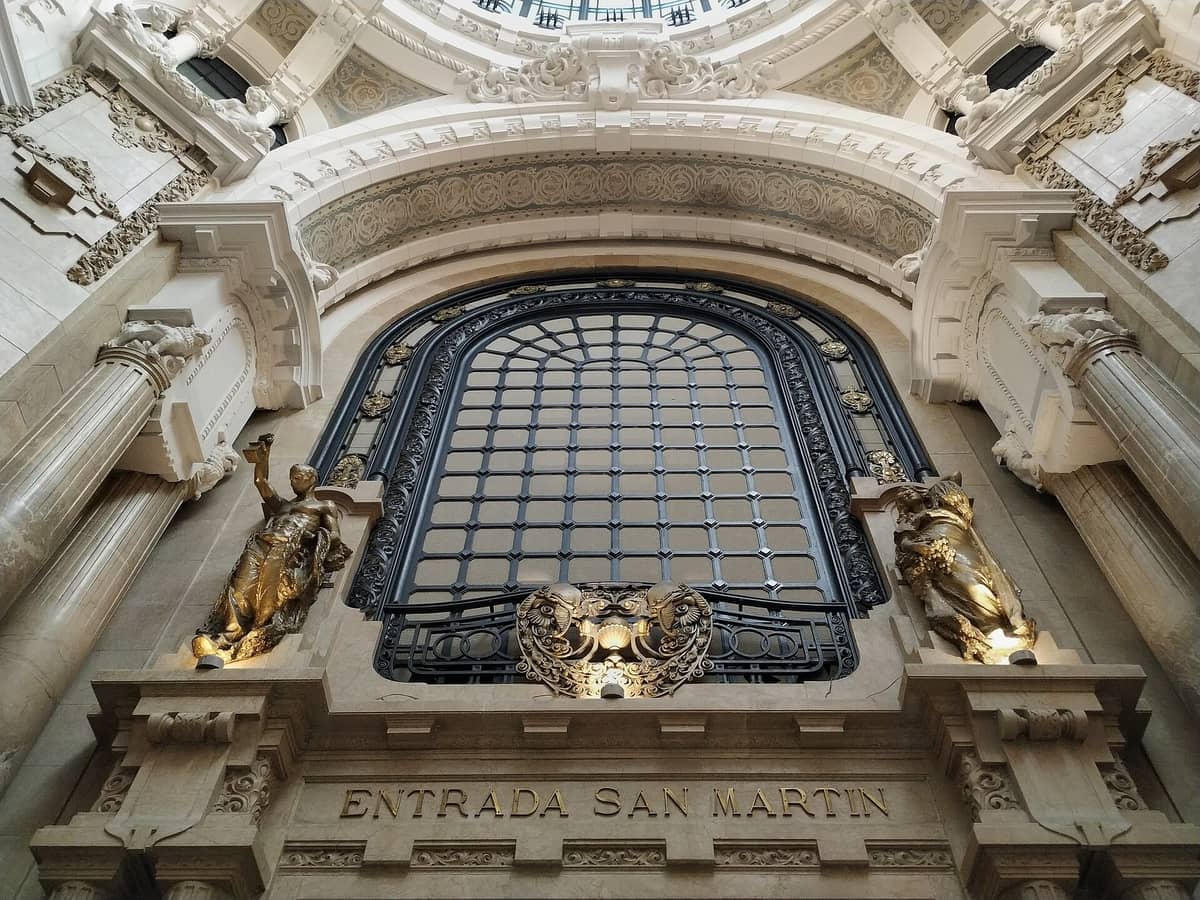
Stepping off the constant stream of Florida Street pedestrians into the gallery entrance, the shift is immediate. The arcade is quieter, cooler, and dramatically taller than you expect. Look up and the Art Nouveau ironwork and glass vault climbs several floors above the passage, letting in diffuse natural light that gives the interior a soft, slightly amber tone on sunny mornings.
The ornamentation throughout is the main architectural event: carved stone details around doorways, decorative iron railings on the interior balconies, and mosaic-style floor sections near the entrance. The quality of the detailing rewards slow observation rather than a quick pass-through. The shops and service businesses currently operating in the arcade are low-key and practical, which keeps the ground floor from feeling like a tourist showcase. That authenticity is part of its appeal.
Photography inside is straightforward in the mornings when natural light filters through the vault. By mid-afternoon on overcast days, the interior grows noticeably darker and artificial lighting from the shops creates uneven exposure for photographs. A wide-angle lens or a phone in portrait mode both handle the vertical space well.
💡 Local tip
Enter from the Florida 165 entrance for the widest view of the iron-and-glass vault as you walk in. The San Martín 170 entrance is slightly narrower and less dramatic for a first impression.
Tickets & tours
Live prices and dates from our booking partner. If you book, we may earn a commission at no extra cost to you.
Madero Tango Show tickets with optional dinner
From 32 €Instant confirmationFree cancellationBuenos Aires small-group city tour with optional lunch and cruise
From 25 €Instant confirmationFree cancellationPiazzolla Tango Show VIP tickets with transfer and optional dinner
From 112 €Instant confirmationFree cancellationBuenos Aires shopping tour
From 15 €Instant confirmationFree cancellation
The Mirador: Getting to the Top
Access to the observation deck, known as the Mirador, is restricted to timed visits rather than open free entry. According to the gallery's own mirador page, guided slots run Monday to Friday at 11:00, 12:00, 14:00, and 15:30. The building is closed for mirador access on Saturdays, Sundays, and public holidays. Groups are small, which means the terrace is never crowded, but it also means you cannot simply arrive and go straight up. Arriving a few minutes before a scheduled slot is strongly advised.
Admission is paid in cash on-site. The listed price on the official mirador page is ARS 10,000, though Argentina's currency situation means this figure can change without notice. Always verify the current rate directly with the gallery before your visit, and carry small-denomination Argentine pesos in cash.
The ascent involves an elevator to the 14th floor followed by a signed staircase to the terrace. The final stair section means the deck is not fully accessible for visitors with significant mobility limitations. If this is a concern, it is worth calling or emailing ahead to understand the current layout.
⚠️ What to skip
Hours vary across sources and can change without much notice. Before building your day around the mirador, confirm current timeslots at galeriaguemes.com.ar or by contacting the gallery directly.
The View from the Terrace
At 87 metres and roughly 14 floors up, the Mirador delivers a different perspective from other Buenos Aires viewpoints. Unlike the open-air terrace of a modern tower or the edge of a riverside observation point, the terrace here sits inside a dense 20th-century urban fabric. What you see is not a sweeping panoramic horizon but the layered roofline of central Buenos Aires as it existed through the middle of the last century: water towers, mansard-style rooftops, ornate cornices, and the occasional taller modern building breaking through.
To the south you can pick out the dome of the Congreso de la Nación, and on clear days the Rio de la Plata is faintly visible to the east. The view is genuinely unusual and worth the entry cost for anyone interested in the city's architectural texture, but travelers expecting a postcard panorama with unobstructed sightlines in every direction may feel the terrace is more intimate than expansive.
Early morning slots, particularly the 11:00 session, tend to offer the best light for photography of the surrounding rooftops. By the 15:30 slot on winter days (June through August), the light is already fading and the view toward the west is partially backlit. Spring and autumn visits, when Buenos Aires temperatures are in the 15–25°C range, make the time on the exposed terrace more comfortable than a January visit when heat and humidity on a concrete platform can be tiring.
Historical and Architectural Context
When Galería Güemes was completed around 1915–1916, Buenos Aires was in the middle of a rapid expansion fueled by immigration and agricultural export wealth. The city was importing European styles wholesale, and the building reflects that ambition directly. Art Nouveau was already past its commercial peak in France and Belgium by then, but in Buenos Aires it still carried prestige associations with modernity and continental sophistication.
The building's mixed-use program, combining a public commercial arcade at the base with offices and apartments above and an observation function at the top, was architecturally progressive for its time and place. The 87-metre height made it the tallest structure in the city at completion, a status it held until larger towers rose in the following decades.
The building is recognized by the Buenos Aires city government as a significant example of the city's architectural heritage. It fits naturally into any broader itinerary focused on Buenos Aires architecture, sitting in a neighborhood where Art Nouveau, Beaux-Arts, and early modernist buildings share the same blocks.
ℹ️ Good to know
The Jorge Luis Borges connection is worth knowing: the Argentine writer is said to have lived in the building for a period, and he referenced it in his fiction. The gallery appears in travel writing about Buenos Aires partly for this literary association, though visitors should not expect any formal Borges exhibition on-site.
How the Experience Changes by Time of Day
Midweek mornings between 09:00 and 11:00 are when the arcade is at its most atmospheric. Foot traffic from office workers moving through creates a quiet but purposeful energy, the vaulted roof catches the early light, and the building feels like something that still has a functional life rather than a preserved relic. Avoid lunchtime on weekdays if you prefer less movement in the arcade; the surrounding area generates significant pedestrian flow from roughly 12:30 to 14:00.
On Saturday mornings the arcade is open but quieter than during the week, and the surrounding Florida Street corridor has a different, slightly more relaxed pace compared to the frantic weekday scene. The mirador is not accessible on Saturdays, so if your primary interest is the observation deck, plan for a weekday.
Rain does not significantly affect the arcade visit since the interior is covered. It does make the observation deck wet underfoot and can obscure distant views completely. Buenos Aires receives its heaviest rainfall in summer (December through March); if your trip falls during those months and the mirador is a priority, check the morning forecast before committing to a midday slot.
Getting There and Practical Details
The gallery is located at Florida 165 and San Martín 170 in central Buenos Aires. The nearest Subte stations are on Line B (the Florida stop or nearby Uruguay stop along Corrientes) and Line C (the Lavalle stop), both within a short walk. Florida Street itself is pedestrianized along this stretch, so arriving on foot from Plaza de Mayo to the south or from Corrientes to the north is straightforward.
Public transport in Buenos Aires uses the SUBE rechargeable card for Subte and buses. If you are new to the system, the getting around Buenos Aires guide covers how to obtain and use the card. Taxis and ride-hailing services also serve the immediate area, though Florida Street itself is pedestrian-only, so drop-offs happen on surrounding streets.
The arcade general opening hours are typically Monday to Friday 08:00–20:00 and Saturday 09:00–15:00, with Sunday closure, though individual businesses inside may keep their own schedules. Mirador visits follow the separate timed-slot system described above and operate only on weekdays. Carry cash in Argentine pesos for the mirador admission, as card payment at the ticket point is not reliably available.
Insider Tips
- Book the 11:00 mirador slot on a weekday in spring or autumn (March–May or September–November) for the best combination of light quality and comfortable temperatures on the exposed terrace.
- The view looking down into the interior glass vault from the internal balconies on the upper arcade floors, if accessible during your visit, is more impressive than most guidebook photos suggest. Look for the internal stairways near the main entrance.
- Carry small-denomination Argentine peso notes specifically for the mirador admission. The ticketing point is informal and change is not guaranteed.
- If you are combining this with a walk along Florida Street, time your arrival at the gallery before 10:00 on a weekday to experience the arcade before the midday crowds from surrounding offices fill the pedestrian street outside.
- The building is recognized as architectural heritage by the Buenos Aires city government, which means any signage, plaques, or guided commentary inside carries official weight. Read the heritage panels near the main entrance for context that most visitors walk straight past.
Who Is Galería Güemes For?
- Architecture and design travelers interested in South American Art Nouveau
- Photographers looking for rooftop city perspectives beyond the standard viewpoints
- History-oriented visitors tracing early 20th-century Buenos Aires through its buildings
- Anyone wanting a genuine piece of the city's daily commercial life rather than a purely tourist-facing attraction
- Literary travelers with an interest in Jorge Luis Borges and the city he wrote about
Nearby Attractions
Other things to see while in Microcentro & Monserrat:
- Avenida Corrientes
Avenida Corrientes is the cultural backbone of central Buenos Aires, a long avenue lined with independent bookshops, mid-century theatres, and late-night pizzerias. Free to walk at any hour, it rewards visitors who linger past midnight as much as those who arrive at noon.
- Avenida de Mayo
Stretching 1.35 km through the heart of Buenos Aires, Avenida de Mayo connects the seat of government at Plaza de Mayo to the National Congress. Inaugurated in 1894 and declared a National Historic Site in 1997, it remains the city's most architecturally dense corridor — free to walk, open at all hours, and best explored at a deliberate pace.
- Cabildo de Buenos Aires
Standing at the western end of Plaza de Mayo, the Cabildo de Buenos Aires is where Argentina's independence process began in May 1810. Today it operates as the Museo Nacional del Cabildo de Buenos Aires y de la Revolución de Mayo, offering free admission and a carefully curated look at colonial-era governance and revolutionary history. Few buildings in the country carry this much political and architectural weight.
- Café Tortoni
Founded in 1858 on Avenida de Mayo, Gran Café Tortoni is the oldest continuously operating café in Buenos Aires. Its marble counters, stained-glass ceilings, and literary history make it one of the city's most photographed interiors — though the lines outside and tourist-oriented service mean expectations need calibrating before you walk in.
Planning a trip? Discover personalized activities with the Nomado app.