Edificio Kavanagh: The Skyscraper That Stunned a Continent
Completed in 1936, the Edificio Kavanagh was once the tallest skyscraper in Latin America and the largest reinforced concrete structure in the world. Today it stands in Retiro as a landmark of Art Deco architecture, best appreciated from the adjacent Plaza San Martín at different times of day.
Quick Facts
- Location
- Florida 1065, Retiro, Buenos Aires — facing Plaza San Martín
- Getting There
- General San Martín station (Subte Line C); short walk from Retiro station and several bus lines
- Time Needed
- 20–40 minutes for exterior viewing; combine with Plaza San Martín for 1–1.5 hours
- Cost
- Free — exterior viewing only; interior is private residential, not open to the public
- Best for
- Architecture enthusiasts, photography, walking itineraries through Retiro
What You're Actually Looking At
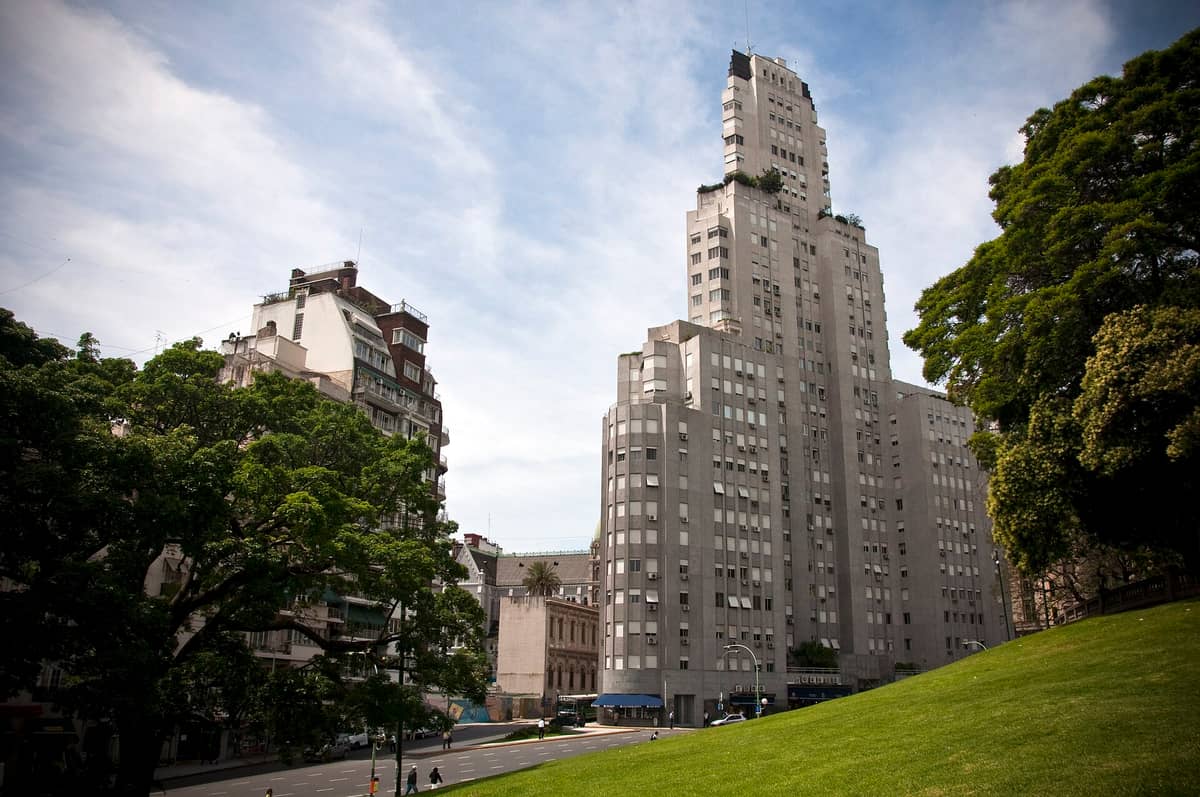
The Edificio Kavanagh rises 120 meters above Florida 1065, its stepped silhouette narrowing floor by floor in the stepped-back Art Deco style that was at the cutting edge of architectural fashion in the 1930s. When it was completed in 1936, it became the tallest skyscraper in Latin America and the largest reinforced concrete structure in the world — records that held for years. That context is worth keeping in mind as you stand in Plaza San Martín and look up: this building was a statement of technological ambition that rivaled anything being built in the United States at the time.
The facade reads differently depending on light and angle. From the center of Plaza San Martín, the tower appears to grow organically from its wide base, each setback creating a rhythm of horizontal ledges up to the narrow crown. The concrete exterior has a slightly textured, cream-gray tone that turns almost golden in the late afternoon sun. At ground level, the proportions can be deceiving — the building only reveals its true scale when you step back across the full width of the plaza.
ℹ️ Good to know
The Edificio Kavanagh is a private residential building. There are no public tours of the interior and no tickets to purchase. The full experience here is architectural: read the building from the outside, in changing light.
The Story Behind the Building
The building was commissioned by Corina Kavanagh, an Argentine businesswoman of Irish descent, and designed by the architectural firm Sánchez, Lagos y de la Torre. Construction was completed in 1936 — a remarkable pace for a 105-apartment tower of this scale and structural complexity. The speed was partly a matter of financial strategy: Kavanagh reportedly needed the rental income quickly. The result was a building that compressed years of structural engineering into a single, concentrated effort.
One persistent story attached to the building is that Kavanagh positioned it deliberately to block the view of the Basílica del Santísimo Sacramento from the nearby Anchorena family's mansion on the opposite side of the plaza, as revenge for a broken engagement between a member of that family and her own. Whether fully accurate or embellished over time, the story has become part of the building's folklore. What is architecturally certain is that the Kavanagh does interrupt the church's sightline from certain angles — and that the Basílica del Santísimo Sacramento sits almost directly behind it when viewed from the north end of Plaza San Martín.
The building was declared a National Historic Monument of Argentina in 1999, formally recognizing its engineering and architectural significance. For context on how it fits within the broader legacy of early 20th-century building in Buenos Aires, the Buenos Aires architecture guide covers the full sweep of styles across the city's neighborhoods.
Tickets & tours
Live prices and dates from our booking partner. If you book, we may earn a commission at no extra cost to you.
Madero Tango Show tickets with optional dinner
From 32 €Instant confirmationFree cancellationBuenos Aires small-group city tour with optional lunch and cruise
From 25 €Instant confirmationFree cancellationPiazzolla Tango Show VIP tickets with transfer and optional dinner
From 112 €Instant confirmationFree cancellationBuenos Aires shopping tour
From 15 €Instant confirmationFree cancellation
The Experience by Time of Day
Morning, roughly between 8am and 10am, is the most photogenic window. The low eastern sun catches the building's west-facing setbacks and throws the horizontal ledges into sharp relief, accentuating the stepback geometry. The plaza is calm at this hour — dog walkers, joggers, and the occasional office worker crossing through — and the lack of crowds means you can move freely to find your angle without navigating around other visitors.
Midday flattens the light considerably. The building loses some of its drama under overhead sun, becoming a more uniform gray-white mass. If you arrive at noon, spend the time reading the base of the building rather than trying to photograph it: the ground-level entrance details, the lobby windows, and the proportional relationship between the tower and the surrounding Beaux-Arts and early modern buildings that line the plaza edges are worth examining up close.
Late afternoon, particularly in the hour before sunset, is the second strong window. The western facade catches warm light and the tower casts a long shadow east across the plaza. This is also when the Torre Monumental and the Retiro station buildings nearby are bathed in the same golden tone, making the whole Retiro district feel architecturally coherent in a way that is easy to miss at other times. Dusk and early evening bring a different quality: the building is not dramatically lit at night in the way that some urban landmarks are, so after dark it recedes into the skyline rather than commanding it.
Plaza San Martín: The Essential Foreground
You cannot fully experience the Kavanagh Building without spending time in Plaza San Martín. The plaza is the spatial frame that gives the tower its setting, and it is genuinely one of the better urban parks in central Buenos Aires. Designed by landscape architect Carlos Thays in the late 19th century, it sits opposite the Kavanagh's base near the Retiro transport hub below, with large palo borracho trees whose bottle-shaped trunks are themselves worth noticing. In spring, these trees produce pink and white flowers that drift across the stone paths.
The plaza contains monuments, benches, and enough shade to make it a genuine resting point on a warm day. It connects naturally to the nearby Torre Monumental and the Plaza San Martín complex as a whole — together they make a coherent 90-minute architectural and historical walk through Retiro.
Photography: Getting the Shot Right
The most reproduced angle places the Kavanagh tower rising behind the green canopy of the plaza trees, shot from the lower northern end of the park looking south. A wide-angle lens works here, but you need distance to capture the full height without excessive upward distortion. A longer focal length — 50mm to 85mm equivalent — compresses the layers between the trees, the Basílica del Santísimo Sacramento, and the tower itself into a dense architectural composition.
For the classic postcard framing that shows the church and the Kavanagh in the same frame, stand near the Monumento al General San Martín equestrian statue and look roughly south-southeast. The church's tower and the Kavanagh's upper floors align in a way that illustrates the legend about blocked sightlines. A polarizing filter helps cut haze on bright days and deepens the sky.
💡 Local tip
Shoot from the lower park level looking upward through the trees in morning light. The interplay of the palo borracho canopy and the stepped tower crown gives far more depth than any straight-on street-level shot.
Getting There and Practical Logistics
The Edificio Kavanagh sits at Florida 1065 in Retiro, one of the most accessible corners of Buenos Aires. The Retiro bus terminal and train station are a short walk away. Subte Line C stops at General San Martín, roughly four blocks away. Dozens of colectivo bus routes pass through the Retiro district; the bus network in Buenos Aires is extensive enough that most neighborhoods in the city connect directly here.
If you are arriving from the Microcentro on foot, the building is at the northern end of the Florida pedestrian street — a logical endpoint for anyone walking up from the Obelisco or Café Tortoni. The walk takes around 15 to 20 minutes and passes several other notable facades along Florida and its cross streets.
No advance planning is required for a visit since there is no admission process and no interior access to arrange. The surrounding public space is accessible at all hours. That said, the plaza and its surroundings are a major thoroughfare, and as with any central Buenos Aires location, it is sensible to be attentive with bags and cameras, particularly during crowded midday and evening hours.
For broader safety context and general navigation advice in the city, the Buenos Aires safety guide provides current and practical orientation.
Is It Worth Your Time?
If you are primarily interested in interiors — lobbies, exhibition spaces, guided historical rooms — the Kavanagh Building will disappoint. It is a private residence, full stop. You will not cross the threshold. For travelers whose connection to architecture is primarily experiential rather than visual, spending 40 minutes looking at a building's exterior may feel thin.
For anyone with even a passing interest in early modernism, engineering history, or urban design, however, this is one of the most significant structures in South America — and it is free to see. The combination of the Kavanagh tower, Plaza San Martín, the Basílica del Santísimo Sacramento, and the cluster of Beaux-Arts buildings on the plaza's perimeter makes Retiro a more architecturally concentrated neighborhood than it is often given credit for. The Kavanagh is the anchor of that cluster.
Pair it with the Palacio Paz a block away, and you have a walk that spans the full range of early 20th-century ambition in Buenos Aires — from Beaux-Arts aristocratic excess to modernist structural record-breaking — in under two hours.
Insider Tips
- The cleanest elevated view of the Kavanagh's full stepped silhouette comes not from street level but from the upper terraces of the nearby Sheraton hotel or, more accessibly, from the slope of Plaza San Martín itself — position yourself at the lower (northern) end of the park and look south-uphill.
- The legend about Corina Kavanagh blocking the church view is best confirmed in person: stand at the equestrian statue of San Martín and look toward the Basílica del Santísimo Sacramento. The Kavanagh's mass genuinely interrupts the sightline — the story has architectural evidence to support it.
- Buenos Aires architecture walking tours that include the Kavanagh often depart from nearby Plaza San Martín or the Microcentro and cover 8 to 10 buildings in a two-hour circuit. Joining one transforms what is otherwise a single exterior stop into a coherent historical narrative.
- If you visit on a clear day after recent rain, the concrete facade takes on a cooler, almost blue-gray tone that photographs very differently from its warm-weather appearance. The sky contrast is much sharper on these days, which suits architectural photography.
- The building's Florida Street address means you can combine this visit with the full length of the Florida pedestrian strip — start at Plaza de Mayo and walk north, ending at the Kavanagh and Plaza San Martín for a natural 2-kilometer urban transect.
Who Is Edificio Kavanagh For?
- Architecture and design enthusiasts who want to see a genuine 1930s engineering landmark in context
- Photographers looking for strong geometric compositions in morning or late afternoon light
- Travelers doing a self-guided walking tour of Retiro and the Microcentro
- History readers interested in the social and personal stories behind Buenos Aires's built environment
- Visitors who want a meaningful free stop that requires no booking or planning
Nearby Attractions
Other things to see while in Retiro:
- Museo de Arte Hispanoamericano Isaac Fernández Blanco
Housed inside the extraordinary Palacio Noel, a 1920s Spanish Colonial Revival mansion in Retiro, the Museo de Arte Hispanoamericano Isaac Fernández Blanco holds Buenos Aires' most important collection of colonial silverwork, religious imagery, and period furniture spanning the 16th to 19th centuries. It is quieter, more focused, and ultimately more rewarding than many of the city's larger art institutions.
- Palacio Paz (Círculo Militar)
Built for a press baron and completed in 1914, Palacio Paz is the largest private residence ever constructed in Argentina. Today operated by the Círculo Militar, it opens its gilded salons to guided tours that reveal a Belle Époque interior of staggering scale, matched by an important national arms museum on the premises.
- Plaza San Martín
Plaza San Martín is the defining green space of the Retiro neighborhood, framed by some of Buenos Aires' most striking early 20th-century buildings. Free, open around the clock, and rich in political history, it rewards a slow walk at almost any hour of the day.
- Torre Monumental (Torre de los Ingleses)
Standing at the edge of Retiro since 1916, the Torre Monumental is a gift from the British community to Argentina and one of the few publicly accessible viewpoints in central Buenos Aires. Foreign visitors pay a modest admission fee. The clock tower rises about 50 metres above the plaza, offering clear sightlines over the city's roofline, the river, and the web of commuter rail lines below.
Planning a trip? Discover personalized activities with the Nomado app.