Torre Monumental (Torre de los Ingleses): The Retiro Clock Tower Viewpoint
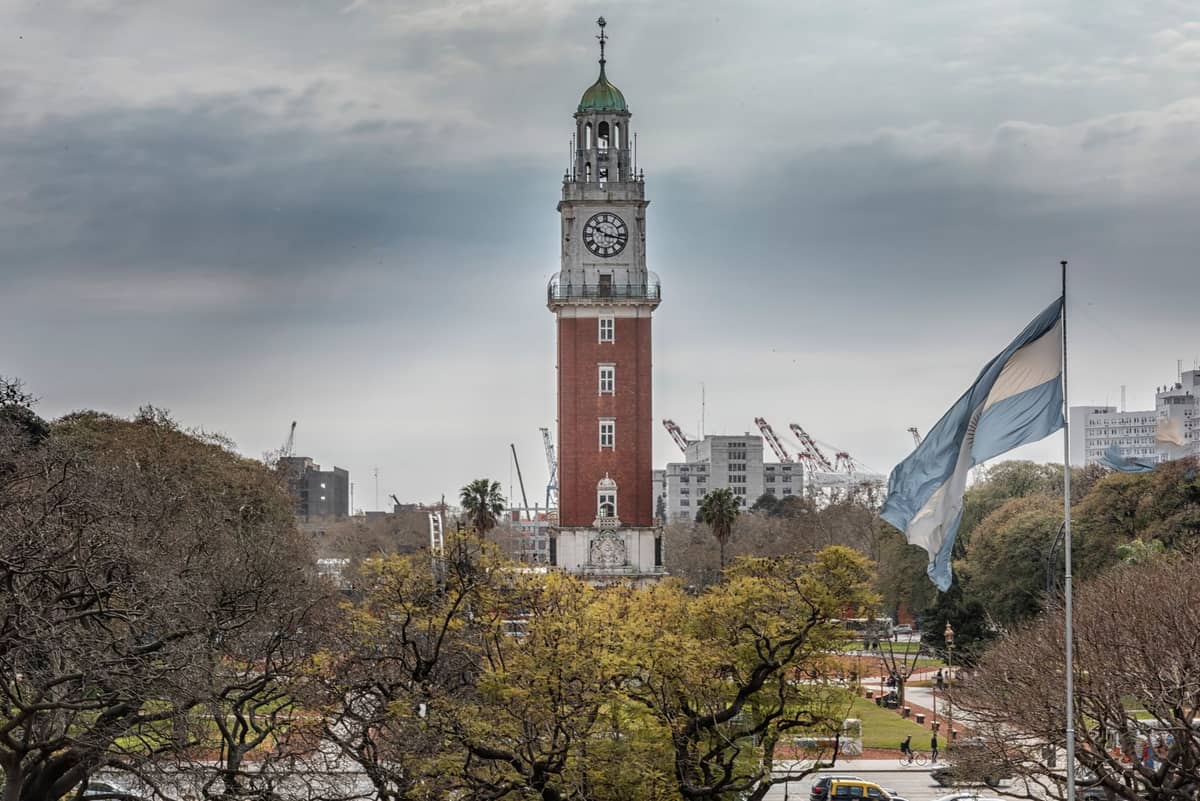
Standing at the edge of Retiro since 1916, the Torre Monumental is a gift from the British community to Argentina and one of the few publicly accessible viewpoints in central Buenos Aires. Foreign visitors pay a modest admission fee. The clock tower rises about 50 metres above the plaza, offering clear sightlines over the city's roofline, the river, and the web of commuter rail lines below.
Quick Facts
- Location
- Av. Dr. José María Ramos Mejía 1315, Retiro, Buenos Aires
- Getting There
- Retiro railway terminus (multiple suburban lines); multiple colectivo routes stop directly outside
- Time Needed
- 30–60 minutes
- Cost
- ARS 10,000 general; ARS 2,000 for residents with DNI; free Wednesdays for Argentine residents; free for retirees, students, people with disabilities, children under 12, Malvinas veterans, and public school groups (verify before visiting)
- Best for
- Panoramic city views, architectural history, travelers arriving or departing from Retiro
What the Torre Monumental Actually Is
The Torre Monumental, long known as the Torre de los Ingleses, is a stone clock tower that rises from a small plaza at the northern edge of Retiro, directly across from the city's main railway terminus. Inaugurated in 1916 as a gift from the British community resident in Argentina, it was designed in a style that would not look out of place in an Edwardian English market town: red brick and Portland stone, four clock faces near the top, and a colonnade at its base. In Buenos Aires, a city whose architectural DNA is largely French, Italian, and Spanish, the tower reads as a deliberate anomaly.
The name change from Torre de los Ingleses to Torre Monumental came in the aftermath of the 1982 Falklands War, when anti-British sentiment ran high and several British-named landmarks were renamed. Many porteños still use both names interchangeably, and you will see both on signs and in conversation.
ℹ️ Good to know
The viewpoint (mirador) at approximately 50 metres is suspended whenever it rains. If weather is uncertain on the day you plan to visit, check conditions before making a special trip.
The View from the Top: What to Expect
The climb to the mirador passes through a narrow staircase inside the tower's interior, which smells of stone dust and aged wood, with small interpretive panels lining the walls. The viewpoint itself is compact, with a metal railing and enough space for a small group to stand comfortably. At around 40 metres, this is not the highest vantage point in Buenos Aires, but the location is distinctive. To the east, the Río de la Plata stretches to a horizon you cannot resolve on hazy days, its brown water blending into the sky. To the south, the grid of Microcentro extends toward the towers of Puerto Madero. Below and to the north, the red-roofed structure of Retiro train station, the long-distance bus terminal, and the plaza itself spread out in a geometry that makes immediate sense from above.
On clear mornings, particularly in autumn and winter when the air is drier and the humidity drops, visibility improves considerably. The view at that hour, with the low sun catching the glass facades of Puerto Madero and the old station lit warmly, is sharper than the midday glare of a January afternoon. Midday in summer brings haze and flat light that flattens the scene. If you want the view at its best, arrive on a clear winter morning, shortly after the 10:00 opening.
For context on other panoramic spots in the city, the Buenos Aires viewpoints guide covers the full range of options, from rooftop bars to elevated parks.
Tickets & tours
Live prices and dates from our booking partner. If you book, we may earn a commission at no extra cost to you.
Madero Tango Show tickets with optional dinner
From 32 €Instant confirmationFree cancellationBuenos Aires small-group city tour with optional lunch and cruise
From 25 €Instant confirmationFree cancellationPiazzolla Tango Show VIP tickets with transfer and optional dinner
From 112 €Instant confirmationFree cancellationBuenos Aires shopping tour
From 15 €Instant confirmationFree cancellation
Historical and Architectural Context
By 1916, the British community in Buenos Aires was one of the largest and most established expatriate groups in Latin America. British capital had financed much of Argentina's railway network, and the community was sufficiently embedded to commission a permanent monument to the centennial of the May Revolution. The tower was designed in the style of a classic English clock tower, with the four clock faces set high on each face so they could be read from the platforms of the railway station across the road.
The structural detail that surprises most visitors: the clock mechanism and bells were manufactured in England and shipped to Buenos Aires. The tower shares this Atlantic transit story with many of Retiro's buildings, a neighborhood shaped by the commerce and migration of the early twentieth century.
The architectural contrast between the tower's Edwardian English style and the surrounding Beaux-Arts and Rationalist buildings is part of what makes Retiro one of the more layered neighborhoods in the city. Visitors interested in this context will find the Buenos Aires architecture guide a useful companion.
Visiting: A Practical Walkthrough
The tower entrance faces the small Plaza Fuerza Aérea Argentina. On weekday mornings, the plaza fills with commuters crossing from the bus terminal and Retiro station toward the Subte and the city center. On weekends, the pace slows considerably and the plaza has a more unhurried quality, with families and visitors pausing at the base of the tower.
Opening hours are Monday to Friday 10:00 to 17:00, and Saturday, Sunday, and public holidays 10:00 to 18:00. The ticket price for the general public is ARS 10,000; residents with a DNI (Argentine national identity document, also issued to foreign residents) pay ARS 2,000. On Wednesdays, residents enter free. Free admission applies to retirees, accredited university students, people with disabilities plus one companion, children under 12, Malvinas war veterans, and groups from public schools. Prices are quoted in Argentine pesos, which are subject to significant inflation: verify current amounts before visiting.
💡 Local tip
If you are arriving in Buenos Aires by train or long-distance bus into Retiro, the tower is a five-minute walk from the station exit. It makes a practical first stop or a final one before departure, requiring no additional transit.
The staircase is narrow with uneven stone steps, and the upper levels are noted by the city as not suitable for people with reduced mobility.
Getting There and Getting Around Retiro
Retiro is one of the best-connected transport hubs in Buenos Aires. The railway terminus serves multiple suburban and regional rail lines. The long-distance bus terminal (Terminal de Ómnibus de Retiro) is immediately adjacent, handling routes across Argentina and to neighboring countries. Dozens of colectivo routes stop on the surrounding avenues. The Subte Line C runs through the area, with the Retiro station connecting to the San Martín and Mitre railway lines.
For a broader overview of how to use Buenos Aires public transport, the getting around Buenos Aires guide explains the SUBE card system and how the different networks connect.
On foot from Microcentro or the San Martín cultural corridor, On foot from Microcentro or the San Martín cultural corridor, the tower is roughly a 15-minute walk north along Avenida Ramos Mejía or through the tree-lined Plaza San Martín. The walk passes through some of the city's most interesting architectural streetscapes and is worth doing at least one way rather than always taking transit.
Photography Tips and Practical Details
The exterior of the tower is best photographed from a distance, using the plaza and surrounding streets to frame the full height against the sky. Early morning on a weekday provides the clearest foreground, before the foot traffic from the train and bus terminals fills the plaza. The four clock faces are lit at night and visible from a considerable distance, making the tower a navigational landmark in the Retiro area after dark even when it is closed.
From the mirador, a wide-angle lens captures the spread of the city more satisfactorily than a telephoto. The railing and structural elements of the viewpoint will appear in most shots taken from inside, so positioning close to the railing gaps works better. Polarizing filters help manage the glare off the Río de la Plata on bright days.
⚠️ What to skip
The Retiro area around the bus terminal has a reputation for pickpocketing, particularly in the pedestrian approaches and the plaza itself. Keep bags closed and phones in pockets while navigating the crowded approaches to the tower. This is a practical caution, not a reason to skip the area, which functions as a busy public transit hub throughout the day.
Is It Worth Your Time?
The Torre Monumental is a short visit, not an afternoon. The viewpoint is modest by the standards of tall building observatories, and the exhibition inside is informative rather than immersive. What makes it worth the stop is the combination: a free or low-cost entry point into a piece of Buenos Aires history that most visitors walk past without entering, a view that genuinely reorients your sense of the city's geography, and a location that integrates naturally into any visit to Retiro or transit through the neighborhood.
Travelers who should think twice: those with limited mobility, Travelers who should think twice: those with limited mobility, since the upper levels are not suitable; anyone visiting on a rainy day, since the mirador will be closed; and those already planning visits to multiple higher or more comprehensive viewpoints in the city, for whom this may feel repetitive. For most visitors, though, the tower adds context without costing significant time or money.
The Retiro neighborhood connects naturally to the Plaza San Martín, one of the city's most architecturally significant public squares, a five-minute walk to the southwest.
Insider Tips
- Wednesday is the best day to visit if you have Argentine residency or a DNI, since entry is free. If you are a foreign visitor, combining the visit with a weekday morning avoids the weekend queues that can build at the entrance.
- The clock chimes on the hour. If you time your ascent to arrive at the viewpoint a few minutes before the hour, you will hear the mechanism operate from close range, which is genuinely impressive.
- The small exhibition at ground level often includes rotating displays related to Retiro's history and the British community in Argentina. It is easy to rush past heading for the stairs, but it takes only 10 minutes and adds substantially to what the view means when you reach the top.
- For the clearest views toward the Río de la Plata, visit between May and August. Winter mornings after cold fronts from the south bring exceptionally clear air and the best visibility of any season.
- The tower is immediately adjacent to the start point for several walking routes through Retiro, San Martín, and toward Recoleta. Using it as an orientation point before walking the neighborhood makes the view practically useful rather than just scenic.
Who Is Torre Monumental (Torre de los Ingleses) For?
- Travelers passing through Retiro by train or bus who have 30–45 minutes to spare
- Architecture and history enthusiasts interested in British-Argentine connections
- Photographers looking for a low-cost elevated perspective over central Buenos Aires
- Budget travelers: the free and low-cost entry tiers make this one of the most accessible viewpoints in the city
- First-time visitors wanting a geographic overview of the city layout before exploring further
Nearby Attractions
Other things to see while in Retiro:
- Edificio Kavanagh
Completed in 1936, the Edificio Kavanagh was once the tallest skyscraper in Latin America and the largest reinforced concrete structure in the world. Today it stands in Retiro as a landmark of Art Deco architecture, best appreciated from the adjacent Plaza San Martín at different times of day.
- Museo de Arte Hispanoamericano Isaac Fernández Blanco
Housed inside the extraordinary Palacio Noel, a 1920s Spanish Colonial Revival mansion in Retiro, the Museo de Arte Hispanoamericano Isaac Fernández Blanco holds Buenos Aires' most important collection of colonial silverwork, religious imagery, and period furniture spanning the 16th to 19th centuries. It is quieter, more focused, and ultimately more rewarding than many of the city's larger art institutions.
- Palacio Paz (Círculo Militar)
Built for a press baron and completed in 1914, Palacio Paz is the largest private residence ever constructed in Argentina. Today operated by the Círculo Militar, it opens its gilded salons to guided tours that reveal a Belle Époque interior of staggering scale, matched by an important national arms museum on the premises.
- Plaza San Martín
Plaza San Martín is the defining green space of the Retiro neighborhood, framed by some of Buenos Aires' most striking early 20th-century buildings. Free, open around the clock, and rich in political history, it rewards a slow walk at almost any hour of the day.
Planning a trip? Discover personalized activities with the Nomado app.