Museo de Arte Hispanoamericano Isaac Fernández Blanco: Colonial Silver, Sacred Art, and a Palace Worth the Detour
Housed inside the extraordinary Palacio Noel, a 1920s Spanish Colonial Revival mansion in Retiro, the Museo de Arte Hispanoamericano Isaac Fernández Blanco holds Buenos Aires' most important collection of colonial silverwork, religious imagery, and period furniture spanning the 16th to 19th centuries. It is quieter, more focused, and ultimately more rewarding than many of the city's larger art institutions.
Quick Facts
- Location
- Suipacha 1422, Retiro, Buenos Aires
- Getting There
- Retiro (Subte Line C), approx. 10-min walk; buses 17, 45, 56, 59, 67, 70, 86, 91, 100, 105
- Time Needed
- 1.5 to 2.5 hours
- Cost
- Low admission fee (verify current price on official site before visiting; some days may be free)
- Best for
- Colonial art, Argentine history, architecture lovers, slow-travel visitors
- Official website
- http://museofernandezblanco.buenosaires.gob.ar
What You Are Actually Visiting
The Museo de Arte Hispanoamericano Isaac Fernández Blanco is not a generic city museum stuffed with miscellaneous acquisitions. It has a clear, deliberate focus: the visual and material culture of Spanish-colonial Latin America, from the early 16th century through the end of the 19th. That specificity is precisely what makes it worth your time. The collection is anchored in colonial silverwork (liturgical pieces, domestic objects, processional items), religious polychrome sculpture, paintings in the colonial cuzqueña tradition, and period furniture from the Viceroyalty era. Each object speaks to the same centuries-long entanglement of Indigenous craft traditions, Baroque Catholic imagery, and European imported taste that shaped what is now Argentina, Peru, and Bolivia.
The museum operates from two locations. The main site at Suipacha 1422, known as the Palacio Noel, covers the colonial period. A second location, the Casa Fernández Blanco in Congreso, extends the timeline into the 19th and early 20th centuries. If you are visiting Retiro, the Palacio Noel is the destination worth prioritizing.
⚠️ What to skip
Opening hours and admission prices have changed more than once in recent years. The schedule commonly listed is Monday, Wednesday, Thursday, and Friday 11:00–19:00 and Saturday to Sunday 11:00–20:00, closed Tuesday. However, other sources cite extended weekday hours. Confirm directly on the official site before you go: museofernandezblanco.buenosaires.gob.ar
The Building: Palacio Noel as the First Exhibit
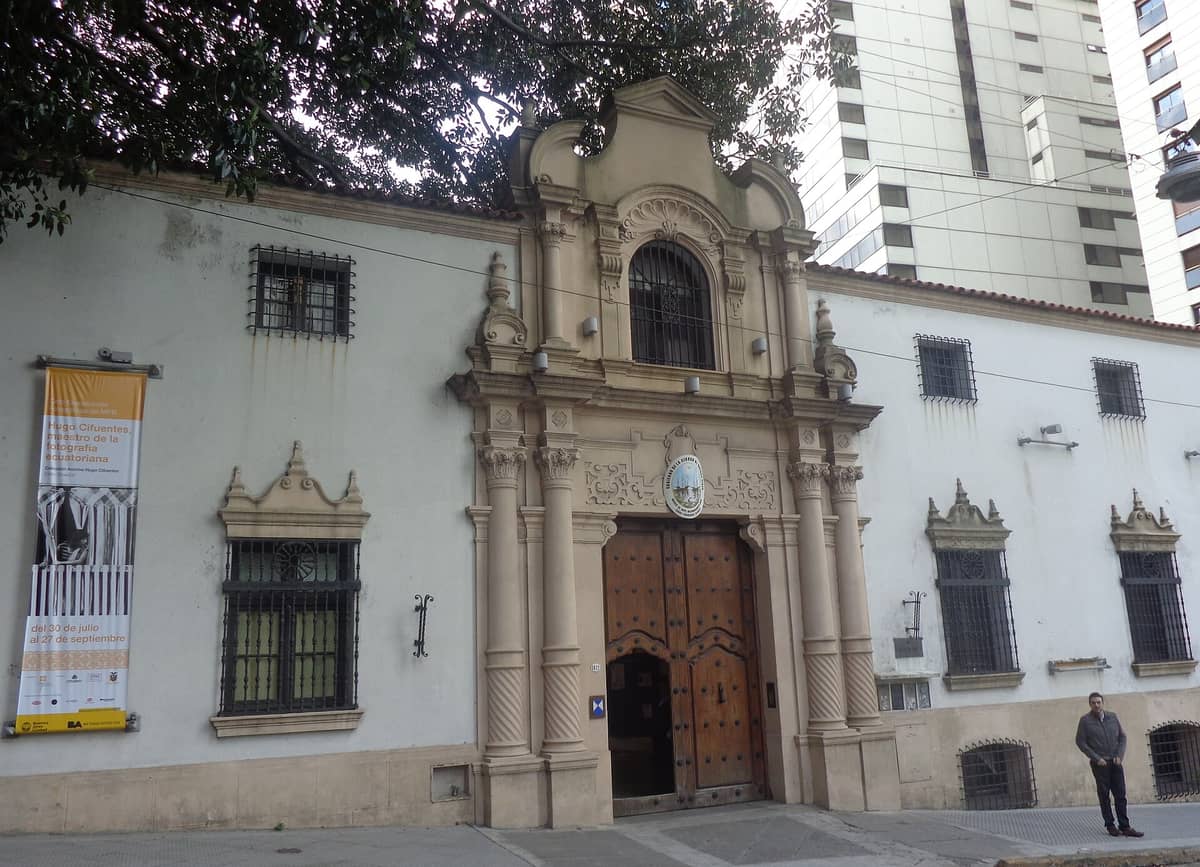
You would be doing the visit a disservice if you treated the Palacio Noel as mere packaging. The building is an attraction in its own right. Designed by architect Martín Noel and completed in the 1920s, it is one of the most accomplished examples of Spanish Colonial Revival architecture in Buenos Aires. Noel was not simply copying historical forms; he was part of an intellectual movement in early 20th-century Argentina that sought to construct a national identity rooted in the pre-independence Hispanic heritage of the Río de la Plata region. The house he built for himself reflects that project in stone, tile, and plaster.
The façade reads as Andalusian at first glance: whitewashed walls, ornate carved stonework around doorways, Moorish-inflected arches, and a tiled entrance patio that filters afternoon light in pale geometric shapes across the floor. Inside, coffered wooden ceilings, carved doorframes, and interior courtyards give the house a texture and coolness that feels deliberately removed from the surrounding city. The building was donated to the city of Buenos Aires by Noel himself, along with the initial art collection, to serve as a public museum.
For travelers already interested in Buenos Aires architecture, this visit pairs naturally with a walk along Avenida de Mayo or a look at the Palacio Barolo, both of which represent different but equally assertive moments in Argentine architectural ambition.
Tickets & tours
Live prices and dates from our booking partner. If you book, we may earn a commission at no extra cost to you.
Boca Juniors Museum skip-the-line tickets
From 17 €Instant confirmationFree cancellationTour to La Boca Jrs and River Plates Stadiums and museums
From 99 €Instant confirmationFree cancellationRiver Stadium and Museum Official Guided Tour
From 33 €Instant confirmationFree cancellationParque de la Costa amusement park tickets with transfer
From 79 €Instant confirmationFree cancellation
What the Collection Looks Like, Room by Room
The silverwork is the collection's most internationally recognized component. The pieces range from domestic mate gourds and bombillas with elaborate filigree work to massive liturgical pieces: chalices, monstrances, processional crosses, and reliquaries produced in the workshops of Alto Perú (modern Bolivia) and the River Plate region between the 17th and early 19th centuries. The craftsmanship is striking in its density. The Andean silverwork in particular reflects the synthesis of Indigenous technique with European Baroque formal vocabulary that is one of the defining characteristics of colonial-era Latin American art.
The religious painting collection features works in the cuzqueña school tradition, produced in the workshops of Cuzco, Peru, during the 17th and 18th centuries. These are not paintings to rush past. The gold-leaf backgrounds, the flattened spatial logic, the blend of Catholic iconography with Andean visual references: all of it rewards slow looking. Religious polychrome sculpture occupies several rooms as well, with figures of saints and Virgins that retain traces of original pigment and period fabric vestments.
Period furniture, decorative objects, and documentary materials round out the permanent collection. The overall effect is of a historically coherent world rather than a random accumulation. Temporary exhibitions are also staged regularly, often focused on colonial or Ibero-American themes, and vary in quality and interest.
How the Visit Changes by Time of Day
Afternoon visits on weekdays tend to be the quietest. After 14:00 on a Tuesday or Wednesday, you may have entire rooms to yourself. The light entering the interior courtyard shifts considerably as the afternoon progresses: between 15:00 and 17:00 it reaches the tiled floor at a low angle, which makes it the best window for photographing the architecture without crowds or harsh overhead glare.
Weekend mornings from 11:00 onward bring a more varied audience: local families, architecture students, and tourists who have combined the museum with a walk through Recoleta. The pace is still unhurried by the standards of major Buenos Aires attractions; this is not a place that draws long queues. If you arrive close to opening time on a Saturday, the garden adjacent to the palace offers a good few minutes of calm before the doors open.
💡 Local tip
The museum's interior courtyards and tiled patios are among the most photographable spaces in Retiro. Bring a wide-angle lens or shoot with a phone held low to capture the tile geometry. Avoid using flash on the colonial paintings and silverwork.
Getting There and Getting Around the Neighborhood
The Palacio Noel sits at Suipacha 1422, in the northern section of Retiro, close to the border with Recoleta. From the Retiro Subte station (Line C), the walk takes roughly ten minutes heading west and slightly north along Suipacha. The surrounding streets are calm and residential at this point, a noticeably different atmosphere from the transport interchange and market area around the Retiro bus terminal a few blocks east.
Multiple colectivo lines stop nearby: lines 17, 45, 56, 59, 67, 70, 86, 91, 100, and 105 all serve the Suipacha 1422 area. If you are coming from San Telmo or Palermo, a bus is generally the more direct option than the Subte. Taxis and ride-hailing services drop directly outside. Street parking is available on surrounding blocks.
The museum sits within comfortable walking distance of Recoleta, making it easy to combine with the Cementerio de la Recoleta or the Museo Nacional de Bellas Artes in a single afternoon circuit.
Accessibility and Practical Considerations
The Palacio Noel does not have an elevator. The museum occupies multiple floors, and accessing the upper galleries requires navigating staircases in a historic building that was not designed with modern accessibility standards in mind. Visitors with significant mobility limitations should be aware that full access to all rooms may not be possible. Staff are generally willing to assist where they can, but the architectural constraints are real. The ground floor and courtyard areas are accessible without stairs.
The admission fee is low by international standards, and the museum is operated by the Buenos Aires city government. Prices have changed frequently given Argentina's inflationary context; some sources mention free days mid-week, but this should be confirmed on the official website rather than assumed. The SUBE card is not used here; this is a cash or card payment at the door.
ℹ️ Good to know
Argentina uses 220V electricity at 50Hz with Type C and Type I plugs. If you plan to charge camera equipment or use a travel adapter, confirm your devices are compatible before your trip.
Is It Worth Your Time? A Clear Assessment
For visitors with a genuine interest in colonial Latin American history, Iberian decorative arts, or Argentine architectural heritage, the Museo Fernández Blanco is one of the most satisfying museum experiences in Buenos Aires. It is undervisited relative to its quality, which means the experience is unhurried and the objects are genuinely accessible. You can spend time in front of a 17th-century Andean silver monstrance without a crowd pressing at your back.
That said, visitors looking for contemporary art, impressionist painting, or a broad survey of Argentine culture will find this collection narrow in scope. The colonial period focus is a strength for those it interests and a real limitation for those it does not. If your Buenos Aires museum priority is modern and contemporary work, the MALBA is the better allocation of time. If you want a broader sweep of Argentine fine art across periods, the Bellas Artes covers more ground.
Travelers building a focused history or architecture itinerary through the city should also consider the Cabildo de Buenos Aires and the Manzana de las Luces complex in Microcentro, both of which address the colonial and early independence period from a different angle.
Insider Tips
- Visit on a weekday afternoon if you want the rooms largely to yourself. Saturday mornings are busier but still manageable; avoid arriving on Tuesday when the museum is closed.
- The interior courtyard is the single best architectural set piece in the building. Spend time there before entering the main galleries, not just as an afterthought on the way out.
- Ask at the reception desk whether any temporary exhibitions are currently running. These are often not heavily advertised externally and can add significant depth to a visit focused on colonial themes.
- Combine this museum with the Museo Nacional de Bellas Artes in a single morning or afternoon circuit. Both are within comfortable walking distance of each other through the Retiro-Recoleta border, and the contrast between colonial sacred art here and the broader Bellas Artes collection is genuinely instructive.
- Admission prices in Buenos Aires museums are revised frequently due to inflationary adjustments. Do not rely on prices listed in guidebooks or third-party sites; check the official city museum page before your visit.
Who Is Museo de Arte Hispanoamericano Isaac Fernández Blanco For?
- History-focused travelers interested in the colonial period of the Americas
- Architecture enthusiasts who want to see Spanish Colonial Revival design up close
- Visitors who prefer quiet, crowd-light museum experiences over large-scale institutions
- Travelers with a specific interest in Latin American decorative arts, particularly silverwork and religious imagery
- Anyone building a thematic Buenos Aires itinerary around the 16th-to-19th-century heritage of the Río de la Plata
Nearby Attractions
Other things to see while in Retiro:
- Edificio Kavanagh
Completed in 1936, the Edificio Kavanagh was once the tallest skyscraper in Latin America and the largest reinforced concrete structure in the world. Today it stands in Retiro as a landmark of Art Deco architecture, best appreciated from the adjacent Plaza San Martín at different times of day.
- Palacio Paz (Círculo Militar)
Built for a press baron and completed in 1914, Palacio Paz is the largest private residence ever constructed in Argentina. Today operated by the Círculo Militar, it opens its gilded salons to guided tours that reveal a Belle Époque interior of staggering scale, matched by an important national arms museum on the premises.
- Plaza San Martín
Plaza San Martín is the defining green space of the Retiro neighborhood, framed by some of Buenos Aires' most striking early 20th-century buildings. Free, open around the clock, and rich in political history, it rewards a slow walk at almost any hour of the day.
- Torre Monumental (Torre de los Ingleses)
Standing at the edge of Retiro since 1916, the Torre Monumental is a gift from the British community to Argentina and one of the few publicly accessible viewpoints in central Buenos Aires. Foreign visitors pay a modest admission fee. The clock tower rises about 50 metres above the plaza, offering clear sightlines over the city's roofline, the river, and the web of commuter rail lines below.
Planning a trip? Discover personalized activities with the Nomado app.