Manzana de las Luces: Buenos Aires' Oldest Cultural Block
The Complejo Histórico Cultural Manzana de las Luces is the most historically layered city block in Buenos Aires, combining Jesuit-era architecture, underground tunnels, a colonial cloister, and free guided tours. Located steps from Plaza de Mayo in Monserrat, it is one of the few places in the city where you can stand in a room that predates Argentine independence.
Quick Facts
- Location
- Perú 222/272, Monserrat, Buenos Aires (5-min walk from Plaza de Mayo)
- Getting There
- Subte Line A (Plaza de Mayo) or Line D (Catedral); multiple colectivo routes along Avenida de Mayo
- Time Needed
- 45 min (self-guided) to 2 hrs (with guided historical tour)
- Cost
- Free entry for standard visits; some guided visits may carry a fee (verify current price, approx. ARS 5,000 as of mid-2025)
- Best for
- History lovers, architecture enthusiasts, and travelers wanting context for the colonial city center
- Official website
- manzanadelasluces.cultura.gob.ar
What Is the Manzana de las Luces?
The Manzana de las Luces, officially the Complejo Histórico Cultural Manzana de las Luces, is a full city block in the Monserrat neighborhood whose name translates literally as 'Block of Enlightenment.' The name is not decorative. From the 18th century onward, this block housed the Jesuits, a later intellectual seat of the Viceroyalty of the Río de la Plata (the first university in the territory was Córdoba, 1613), the city's early legislature, and a web of underground tunnels whose original purpose is still debated by historians. For a traveler walking through central Buenos Aires, this is the one place where three centuries of the city's intellectual and political life compress into a walkable rectangle.
It sits two blocks south of Plaza de Mayo and is technically within Monserrat, the oldest barrio in the city, though visitors often lump it into the broader Microcentro. The block is bounded by Perú, Moreno, Bolívar, and Alsina streets, and it anchors a pocket of colonial Buenos Aires that survives largely intact despite the pressures of 20th-century development.
The Architecture: Layers You Can Read Like a Timeline
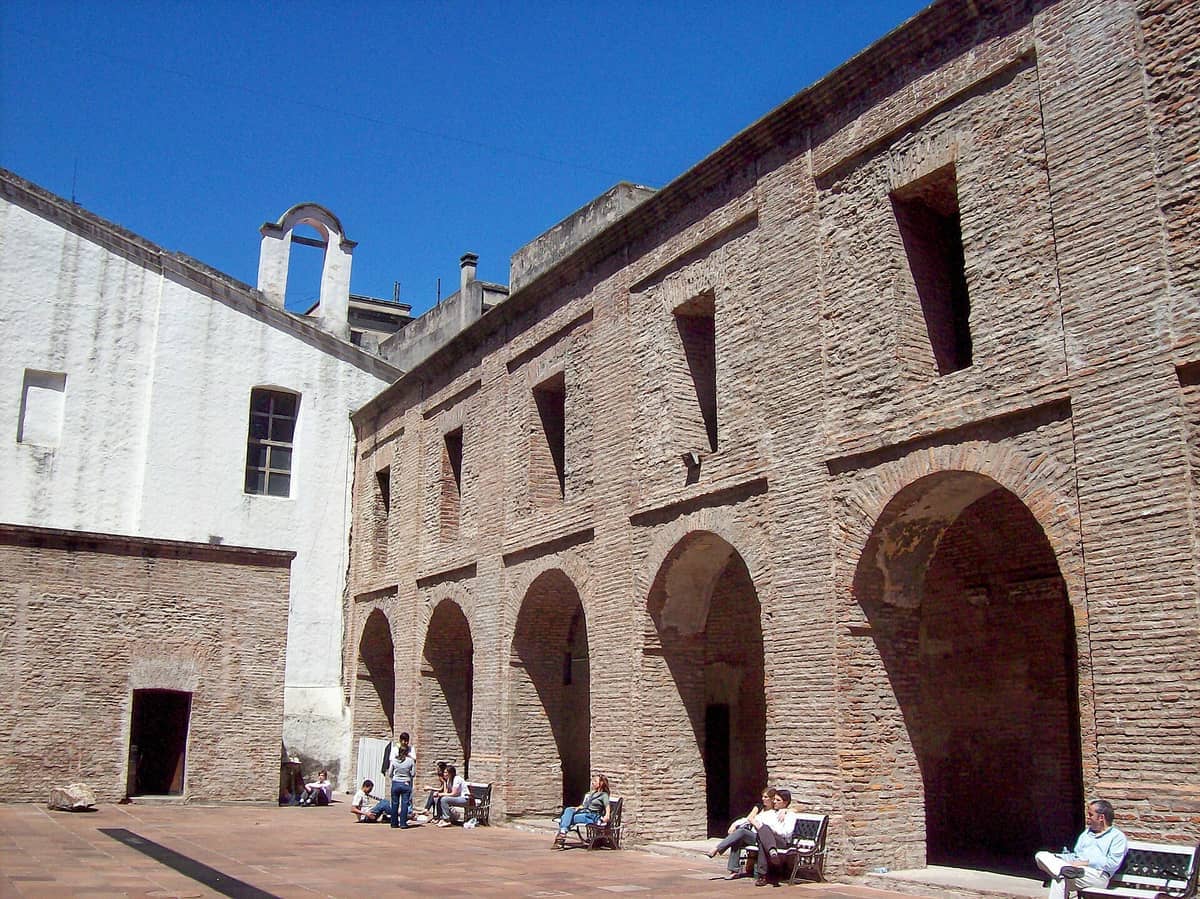
The oldest surviving structure within the complex is the Antiguo Claustro de las Misiones Guaraníes, built in the mid-18th century (around 1730). Originally it served as a depot for goods produced by the Jesuit missions in the northeastern territories, where Guaraní communities worked under the mission system. The cloister's thick-walled, arched corridors have that slightly damp, mineral smell that old stone buildings carry in humid climates, and the proportions are unmistakably colonial: low ceilings, deep window recesses, a courtyard designed for utility rather than ornament.
Alongside the cloister, the block contains the Iglesia de San Ignacio de Loyola, the oldest standing church in Buenos Aires, whose façade faces Bolívar street. The church itself predates the Manzana's most famous period and has been altered multiple times, but stepping inside reveals a surviving colonial interior that feels genuinely unpolished compared to Buenos Aires' more famous religious buildings.
The block also once housed the Real Colegio de San Carlos, and the inaugural ceremony of the University of Buenos Aires in 1821, promoted by Bernardino Rivadavia, was held here. The institutional DNA of Argentine higher education traces back to this block. Travelers interested in the broader architectural history of the capital will find the Buenos Aires architecture guide useful for placing this site within the city's longer urban development story.
Tickets & tours
Live prices and dates from our booking partner. If you book, we may earn a commission at no extra cost to you.
Madero Tango Show tickets with optional dinner
From 32 €Instant confirmationFree cancellationBuenos Aires small-group city tour with optional lunch and cruise
From 25 €Instant confirmationFree cancellationPiazzolla Tango Show VIP tickets with transfer and optional dinner
From 112 €Instant confirmationFree cancellationBuenos Aires shopping tour
From 15 €Instant confirmationFree cancellation
The Underground Tunnels: What You Actually See
The tunnels are the element that most visitors come specifically to see, and it is worth calibrating expectations. These are not Hollywood catacombs. They are low, brick-vaulted passageways, roughly a meter wide in places, with uneven floors and a noticeable drop in temperature compared to the street above. The air smells of old brick and compressed clay. Lighting is kept dim, partly for atmosphere and partly because the spaces are genuinely narrow.
Their exact original purpose remains contested. Popular accounts link them to Jesuit escape routes or to the colonial defense of the city. More measured historical research suggests they may have functioned as storage passages or drainage infrastructure, with military use added later. What is certain is that they connect under the block and extend in directions that have not been fully mapped or excavated. The sections open to the public give a real sense of the physical scale of colonial-era construction without requiring any particular leaps of faith about their mythology.
💡 Local tip
Tunnel and recorrido histórico visits follow the Wednesday-to-Friday guided schedule (typically at 15:15 on working days) with limited capacity and free entry; confirm the current schedule and any separate paid guided activities at the entrance on Perú 222, as times and pricing are updated periodically.
When to Visit and How It Feels at Different Times
The complex is open Wednesday through Sunday, 11:00 to 18:00; some tourism sites list a 12:00–19:00 window, but the official schedule confirms 11:00–18:00. Early afternoon on a weekday is the quietest window. By around 15:00, the guided tour group forms at the entrance and the patios briefly fill with students, local school groups, and a scattering of foreign visitors. The guided tour itself is conducted in Spanish; if your Spanish is limited, the spatial experience of the tunnels and courtyards still carries weight, but the interpretive depth will be reduced.
On weekends, particularly Sunday afternoons, the surrounding streets in Monserrat are noticeably quieter than the rest of the city center. This can actually work in the complex's favor: fewer people, less traffic noise, and the colonial streets feel more like themselves. Summer visits (December to February) should factor in Buenos Aires' humidity, which makes the lower-ground tunnel sections feel sticky rather than cool. Spring and autumn visits, when temperatures sit between roughly 15 and 25 degrees Celsius, are the most comfortable for walking the open courtyards and patios.
⚠️ What to skip
Both entrances at Perú 222 and Perú 272 currently have steps at the threshold. Visitors with reduced mobility should contact the complex directly before visiting, as accessibility conditions may have changed. Check the official accessibility page at manzanadelasluces.cultura.gob.ar/info/accesibilidad/ for current information.
Getting There and Practical Logistics
The complex is easily reached by Subte. Line A stops at Plaza de Mayo, a two-minute walk north on Perú. Line D's Catedral stop deposits you on the plaza itself. Both lines use the SUBE rechargeable card, which can be loaded at kiosks throughout the city. Colectivo buses running along Avenida de Mayo or Bolívar also stop within a block of the entrance.
Because the complex sits in the heart of Monserrat, it pairs naturally with other nearby sites on a walking circuit. The Cabildo de Buenos Aires is four blocks north on Plaza de Mayo, and the Catedral Metropolitana faces the same plaza. Budget two to three hours total if you plan to combine them.
Admission to the complex itself is free. Some guided tunnel or historical visits may carry a fee, reported at approximately ARS 5,000 as of mid-2025, but this figure should be verified on the day as Argentine peso pricing adjusts frequently. Wear shoes with some grip if you plan to enter the tunnels; the floors are uneven and occasionally damp.
Photography and What to Photograph
The interior courtyards photograph well in the flat light of overcast days. Direct midday sun creates harsh shadows in the arcaded corridors and makes the stone walls bleach out in images. The tunnel sections are genuinely dark, and a phone camera without a strong night mode will produce muddy results. A small torch or your phone's flashlight helps you see details the overhead lighting misses, like the brick-seaming patterns in the vault.
For a broader sense of how the Manzana fits into the street grid, the junction of Perú and Alsina gives a decent elevated view toward the church tower. If you are serious about urban photography in Buenos Aires, the Buenos Aires viewpoints guide covers better vantage points across the city.
Is It Worth Your Time?
For travelers with a genuine interest in colonial Latin American history or Argentine political history, the Manzana de las Luces is a serious and undervisited site. The combination of the Jesuit cloister, the underground tunnels, and the institutional heritage is genuinely rare, and the free entry makes the threshold for trying it very low.
For travelers who prefer visceral, visually spectacular experiences, it may disappoint. There are no grand staircases, no sweeping rooms, no polished museum installations. The signage is adequate but not exceptional, and the interpretation relies heavily on the Spanish-language guided tour. If your Buenos Aires time is limited and you have not yet seen the Teatro Colón or walked the Recoleta Cemetery, those are harder to skip.
Travelers who have already covered the city's main landmarks and want something with more historical texture will find the Manzana rewarding. It fits naturally into a half-day itinerary of the historic center, described in detail in the Buenos Aires walking tours guide.
Insider Tips
- The guided recorrido histórico at 15:15 on working days is the main fixed-schedule visit that includes tunnel sections within the complex. Arrive at Perú 222 by 14:45 at the latest, particularly on weekdays when school groups sometimes fill capacity.
- The Iglesia de San Ignacio de Loyola, on the Bolívar-facing side of the block, is technically a separate entry but is the oldest standing church in Buenos Aires. It is often overlooked by visitors focused on the complex's interior. Check whether it is open before assuming you can enter.
- Spanish-language skills significantly improve the experience. Even a basic level lets you follow the guided tour's explanations of the tunnels and the Jesuit mission history, which is the interpretive heart of the visit.
- The block itself is most photogenic from the Perú street side in morning light, before the midday heat and crowds build up in the surrounding area. The stone and brick warm up noticeably under direct afternoon sun.
- Ticket pricing in Argentine pesos changes frequently due to inflation. Always check current fees at the official site or at the entrance rather than relying on any printed or online figure, including this one.
Who Is Manzana de las Luces For?
- History travelers wanting colonial-era Buenos Aires context beyond Plaza de Mayo
- Architecture enthusiasts interested in Jesuit-era construction and early republican buildings
- Budget-conscious visitors: free entry makes this one of the most substantive no-cost cultural sites in the city center
- Travelers on a half-day Monserrat walking circuit who want depth over Instagram spectacle
- Spanish speakers who can fully engage with the guided recorrido histórico
Nearby Attractions
Other things to see while in Microcentro & Monserrat:
- Avenida Corrientes
Avenida Corrientes is the cultural backbone of central Buenos Aires, a long avenue lined with independent bookshops, mid-century theatres, and late-night pizzerias. Free to walk at any hour, it rewards visitors who linger past midnight as much as those who arrive at noon.
- Avenida de Mayo
Stretching 1.35 km through the heart of Buenos Aires, Avenida de Mayo connects the seat of government at Plaza de Mayo to the National Congress. Inaugurated in 1894 and declared a National Historic Site in 1997, it remains the city's most architecturally dense corridor — free to walk, open at all hours, and best explored at a deliberate pace.
- Cabildo de Buenos Aires
Standing at the western end of Plaza de Mayo, the Cabildo de Buenos Aires is where Argentina's independence process began in May 1810. Today it operates as the Museo Nacional del Cabildo de Buenos Aires y de la Revolución de Mayo, offering free admission and a carefully curated look at colonial-era governance and revolutionary history. Few buildings in the country carry this much political and architectural weight.
- Café Tortoni
Founded in 1858 on Avenida de Mayo, Gran Café Tortoni is the oldest continuously operating café in Buenos Aires. Its marble counters, stained-glass ceilings, and literary history make it one of the city's most photographed interiors — though the lines outside and tourist-oriented service mean expectations need calibrating before you walk in.
Planning a trip? Discover personalized activities with the Nomado app.