Palacio Paz (Círculo Militar): Inside Buenos Aires' Most Lavish Private Palace
Built for a press baron and completed in 1914, Palacio Paz is the largest private residence ever constructed in Argentina. Today operated by the Círculo Militar, it opens its gilded salons to guided tours that reveal a Belle Époque interior of staggering scale, matched by an important national arms museum on the premises.
Quick Facts
- Location
- Avenida Santa Fe 702, Retiro, Buenos Aires
- Getting There
- Subte Line C (Retiro station); multiple bus lines on Av. Santa Fe; Retiro railway terminal nearby
- Time Needed
- 1 to 1.5 hours (guided tour format)
- Cost
- Paid guided tours; prices vary and change frequently due to inflation — verify current fees directly with the venue before visiting
- Best for
- Architecture lovers, history enthusiasts, and anyone who wants to experience 20th-century Buenos Aires aristocratic life up close
What Is Palacio Paz?
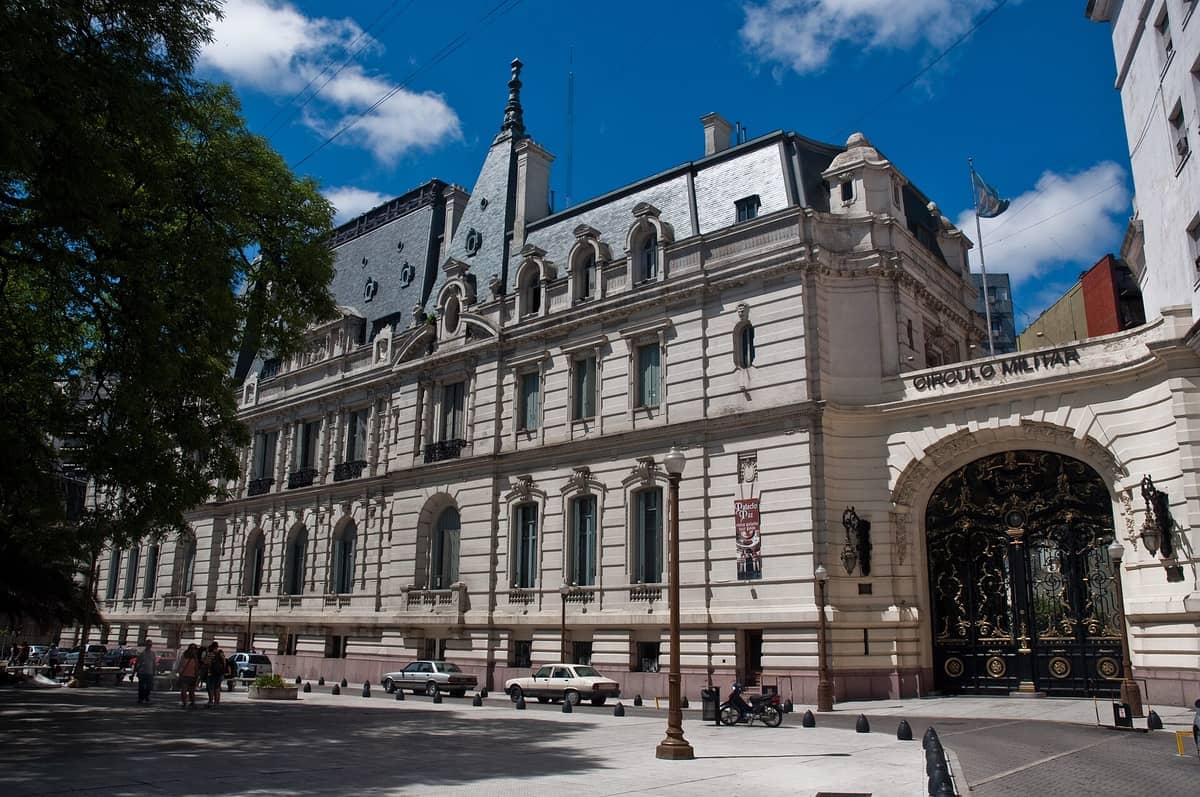
Palacio Paz is the largest private residence ever built in Argentina. Completed in 1914 for José C. Paz, founder of the influential newspaper La Prensa, the palace occupies an entire city block on Avenida Santa Fe at the edge of Plaza San Martín in the Retiro neighborhood. Its footprint alone tells you something about the ambition of the project: roughly 12,000 square meters of floor space and around 140 rooms, and a facade that borrows heavily from the French Renaissance style of the Loire Valley chateaux.
The Paz family retained ownership until 1938, when the property was sold to the Círculo Militar, Argentina's army officers' club, which uses it to this day as its headquarters. A portion of the building houses the Museo de Armas de la Nación, one of South America's most significant military weaponry collections. The combination of palace architecture and arms museum makes this a layered experience rather than a straightforward sightseeing stop.
⚠️ What to skip
Palacio Paz operates exclusively through guided tours, and the schedule changes regularly because its grand halls are frequently rented for private events and ceremonies. Always confirm current tour days and times by contacting the venue directly before you travel across the city for a visit.
The Architecture: A Loire Chateau Transplanted to the Río de la Plata
Standing on the corner of Avenida Santa Fe and Marcelo T. de Alvear, the building's exterior is immediately striking even by Retiro's high architectural standards. The facade is dressed in light stone, punctuated by ornate dormers, turrets, and mansard rooflines that visually reference 16th-century French aristocratic architecture. The scale is best appreciated from the far end of Plaza San Martín, where you can take in the full sweep of the building without craning your neck.
The interior is where the building truly separates itself from Buenos Aires' already impressive stock of Belle Époque construction. Visitors on the guided tour move through a sequence of ceremonial rooms with coffered ceilings decorated in gold leaf, marble flooring in complex geometric patterns, carved wood paneling imported from Europe, and Flemish tapestries covering entire wall surfaces. The ballroom, with its painted ceiling and crystal chandeliers, is the set piece most visitors photograph, but the library and the winter garden reward equal attention. For broader context on the architectural era that produced Palacio Paz, the Buenos Aires architecture guide covers the city's Belle Époque and eclectic period in detail.
The building was designed by the French architect Louis Sortais, and construction stretched over more than a decade. The craftsmanship reflects what was possible when an unlimited budget met European artisans: every room has a distinct decorative program, and the transitions between spaces are carefully staged to maximize visual impact. This is not a restored approximation of grandeur; it is the original material, largely intact.
Tickets & tours
Live prices and dates from our booking partner. If you book, we may earn a commission at no extra cost to you.
Madero Tango Show tickets with optional dinner
From 32 €Instant confirmationFree cancellationBuenos Aires small-group city tour with optional lunch and cruise
From 25 €Instant confirmationFree cancellationPiazzolla Tango Show VIP tickets with transfer and optional dinner
From 112 €Instant confirmationFree cancellationBuenos Aires shopping tour
From 15 €Instant confirmationFree cancellation
The Guided Tour Experience
Access to Palacio Paz is only possible as part of an organized guided tour. You cannot wander the rooms independently. Tours in Spanish have historically run on weekday mornings and early afternoons, with English-language options available on select days, though the precise schedule is subject to change and should be confirmed in advance. Groups typically range from a handful of visitors to a few dozen, and the pace is controlled by the guide, which means you spend longer in some rooms than you might choose and less time in others.
The tour covers the principal ceremonial rooms on the main floor and typically includes an explanation of the Paz family's history and the building's transition to military ownership. Guides tend to be knowledgeable about the architectural details and will point out specific features that are easy to miss without prompting, such as the provenance of individual tapestries or the mechanics of the original heating system. Photography is generally permitted inside, though this can vary depending on the guide and any events in progress.
The Museo de Armas de la Nación, housed within the palace complex, is sometimes included in the tour and sometimes requires a separate arrangement. The collection spans firearms, edged weapons, armor, and military regalia from multiple centuries and continents, with particular strength in 19th-century Argentine military history. It is substantial enough to warrant dedicated time if this period interests you.
💡 Local tip
Arrive a few minutes early. Tours depart on schedule and the entrance procedure on Avenida Santa Fe requires passing through a staffed reception point. Late arrivals may not be able to join a tour already in progress.
Location and the Retiro Context
The palace sits at one of the most architecturally concentrated intersections in Buenos Aires. Within a five-minute walk, you have Plaza San Martín, one of the city's finest public squares, flanked by the Kavanagh Building, the Torre Monumental, and the Edificio Libertador. The Retiro bus terminal and railway station are a short distance to the north. This concentration of civic and private architecture from the early 20th century makes the immediate area worth exploring slowly on foot before or after your palace tour.
The neighborhood of Retiro was, at the turn of the 20th century, the preferred address for Buenos Aires' wealthiest families. Palacio Paz was not an outlier in its ambition; it was the apex of a broader pattern of aristocratic construction that transformed this part of the city between roughly 1890 and 1930. Understanding that context makes the building more legible: it was built to impress peers who were themselves building substantial palaces.
Planning Your Visit: Practical Details
The most reliable way to reach Palacio Paz is via Subte Line C to Retiro station, which deposits you a few blocks’ walk from the palace entrance on Avenida Santa Fe. Multiple city bus lines also pass along Santa Fe and along Avenida del Libertador nearby. Taxis and ride-hailing apps drop off directly at the door. The surrounding streets are flat and easily walkable.
Ticket prices are denominated in Argentine pesos and have changed multiple times in recent years due to inflation. Published figures from 2023 and 2025 differ substantially from each other, which means any specific amount cited here would risk being outdated before you read it. Check current prices directly through the official website or by calling ahead. The Argentine peso situation also means it is worth reviewing current currency practicalities before your trip.
The best weather for the walk around Retiro and Plaza San Martín before or after your tour is during spring (September to November) and autumn (March to May), when temperatures sit comfortably between 15 and 25 degrees Celsius. Buenos Aires summers (December to February) are hot and humid, which can make extended outdoor walking less comfortable, though the interior of the palace itself is cool. For broader trip timing considerations, the best time to visit Buenos Aires guide breaks down seasonal trade-offs in detail.
ℹ️ Good to know
Accessibility: The palace is a historic building with original staircases and period flooring throughout. Public sources do not detail step-free access routes or elevator availability. Visitors with mobility requirements should contact the Círculo Militar directly before booking to confirm what can be accommodated.
Photography and What to Expect Visually
Interior lighting in Palacio Paz is a mixture of natural light from tall windows and artificial lighting from chandeliers, which varies significantly by room and time of day. Morning tours tend to have better natural light in the main salons facing the street. A camera that handles moderate low-light conditions well will serve you better than relying solely on a phone, particularly in rooms with darker wood paneling and heavy curtains. Wide-angle capability helps in the larger rooms, where you cannot step back far enough to capture the ceiling and floor in a single frame with a standard lens.
The exterior is best photographed from across Avenida Santa Fe or from within Plaza San Martín in the late afternoon, when the stone facade catches warm directional light. At midday, the light is flat and the street-level angle is awkward due to parked vehicles. Early morning, before tour groups and office workers fill the plaza, the area is considerably quieter and easier to photograph without crowds in the foreground.
Is Palacio Paz Worth Visiting?
For anyone with an interest in architecture, the decorative arts, or the social history of early 20th-century Latin America, Palacio Paz is genuinely impressive. The scale and state of preservation set it apart from most comparable buildings in the city. It is not the kind of place you linger in for half a day, but the guided tour gives you enough time to absorb the main rooms properly. Visitors who enjoyed the Museo de Arte Decorativo in Palermo, another Belle Époque palace repurposed as a cultural institution, will find Palacio Paz similarly rewarding, though with a distinctly different character given its military ownership.
Who might want to skip it: travelers with very limited time in Buenos Aires who have already prioritized the Teatro Colón, the Recoleta area, and the major museums may find that Palacio Paz covers similar thematic ground without adding much that is new. The tour format also means you cannot move at your own pace, which frustrates some visitors. And the scheduling unpredictability, driven by private event bookings, means there is real risk of arriving to find tours suspended for the day.
If you are building a full itinerary around Buenos Aires' grand interiors, pairing Palacio Paz with a visit to the Teatro Colón and the Palacio Barolo covers three very different expressions of the same era of architectural ambition, each with its own logic and aesthetic.
Insider Tips
- Call or check the official website the morning of your planned visit. Private events can cancel public tours with little advance notice, and this is not always reflected immediately on third-party listing sites.
- The English-language tour has at times run on Tuesday afternoons only, with limited spots. If English is important to you, confirm the current day and time directly and arrive with time to spare, as the slot may not repeat that day.
- The Plaza San Martín side of the building, particularly the corner turret, is the most photogenic exterior angle and is best captured in the late afternoon when the sun hits the stone directly. The Avenida Santa Fe entrance side is usually in shadow by mid-afternoon.
- The Museo de Armas de la Nación within the complex is undervisited and genuinely interesting for its breadth of historical weaponry. Ask at reception whether it is included in your tour or requires a separate arrangement on the day.
- Dress more formally than you would for a typical museum visit. The Círculo Militar is an active military officers' club, and the atmosphere at the entrance reflects that; very casual clothing can occasionally draw attention from staff at the door.
Who Is Palacio Paz (Círculo Militar) For?
- Architecture and design enthusiasts who want to see Belle Époque interiors preserved at their original scale
- History travelers interested in Argentina's oligarchic era and the families who shaped Buenos Aires in the early 1900s
- Military history buffs, given the on-site Museo de Armas de la Nación
- Photographers looking for grand interior spaces with original period detailing
- Visitors who have already seen the main sights and want to go deeper into the city's layered architectural heritage
Nearby Attractions
Other things to see while in Retiro:
- Edificio Kavanagh
Completed in 1936, the Edificio Kavanagh was once the tallest skyscraper in Latin America and the largest reinforced concrete structure in the world. Today it stands in Retiro as a landmark of Art Deco architecture, best appreciated from the adjacent Plaza San Martín at different times of day.
- Museo de Arte Hispanoamericano Isaac Fernández Blanco
Housed inside the extraordinary Palacio Noel, a 1920s Spanish Colonial Revival mansion in Retiro, the Museo de Arte Hispanoamericano Isaac Fernández Blanco holds Buenos Aires' most important collection of colonial silverwork, religious imagery, and period furniture spanning the 16th to 19th centuries. It is quieter, more focused, and ultimately more rewarding than many of the city's larger art institutions.
- Plaza San Martín
Plaza San Martín is the defining green space of the Retiro neighborhood, framed by some of Buenos Aires' most striking early 20th-century buildings. Free, open around the clock, and rich in political history, it rewards a slow walk at almost any hour of the day.
- Torre Monumental (Torre de los Ingleses)
Standing at the edge of Retiro since 1916, the Torre Monumental is a gift from the British community to Argentina and one of the few publicly accessible viewpoints in central Buenos Aires. Foreign visitors pay a modest admission fee. The clock tower rises about 50 metres above the plaza, offering clear sightlines over the city's roofline, the river, and the web of commuter rail lines below.
Planning a trip? Discover personalized activities with the Nomado app.