Shakespeare and Company: Paris's Most Storied Bookshop
Perched on the Left Bank directly opposite Notre-Dame, Shakespeare and Company is far more than a bookshop. It is a living archive of literary exile, radical hospitality, and the enduring romance of books, drawing readers from every corner of the world to its crooked, ink-scented rooms.
Quick Facts
- Location
- 37 rue de la Bûcherie, 75005 Paris (Latin Quarter, 5th arrondissement)
- Getting There
- Métro Saint-Michel (line 4) or RER B/C Saint-Michel–Notre-Dame, 3-min walk
- Time Needed
- 30 to 90 minutes depending on how deeply you browse
- Cost
- Free entry; books priced individually
- Best for
- Book lovers, literary history enthusiasts, solo travelers, rainy-day wanderers
- Official website
- www.shakespeareandcompany.com
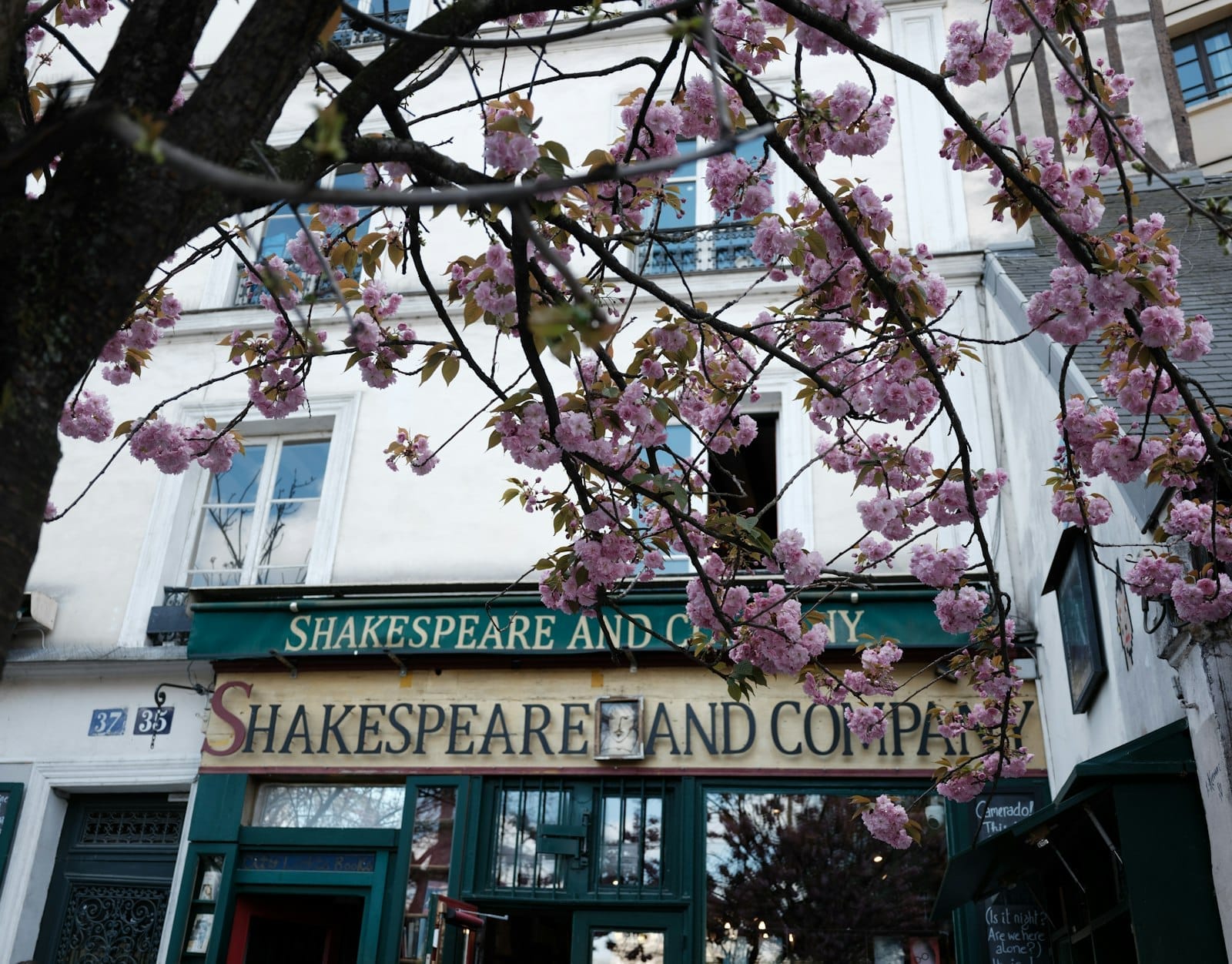
What Shakespeare and Company Actually Is
Shakespeare and Company is an English-language independent bookshop at 37 rue de la Bûcherie, in Paris's 5th arrondissement, facing the Seine and the towers of Notre-Dame Cathedral from the opposite bank. It is one of the most photographed bookshops in the world, and one of the few where the building itself tells as much of a story as anything on its shelves.
The shop occupies a narrow, multi-level space whose rooms accumulate rather than organize: paperbacks wedged into alcoves, handwritten notes pinned above shelves, a piano that visitors occasionally play, and beds tucked into corners where thousands of writers have slept for free over the decades. This is not a curated lifestyle concept. It is the real, slightly chaotic result of one man's utopian idea, continued by his daughter. For the broader literary and intellectual tradition that frames the shop, the guide to Saint-Germain-des-Prés provides essential context.
ℹ️ Good to know
Entry is free. Browsing is genuinely encouraged and you are not obligated to buy anything. The shop is typically open daily from 10am to 8pm (Mon-Fri), 10am to 10pm (Sat-Sun), but verify current hours on the official website before visiting, as they can vary seasonally and around public holidays.
The History Behind the Name
The current Shakespeare and Company was founded in 1951 by George Whitman, an American who arrived in Paris after World War II and converted a building on the Left Bank into a bookshop and informal community center. He originally called it Le Mistral. In 1964, on the 400th anniversary of William Shakespeare's birth, he renamed it in tribute to Sylvia Beach, who had run the original Shakespeare and Company at 12 rue de l'Odéon from 1919 until the Nazi occupation forced its closure in 1941.
Beach's original shop had been a landmark of literary modernism: she published James Joyce's Ulysses in 1922 when no mainstream publisher would touch it, and her rooms became a gathering point for Hemingway, Ezra Pound, and Gertrude Stein. By adopting her name, Whitman was staking a claim to that lineage. He also extended its spirit through radical hospitality: since 1951, more than 30,000 writers and travelers have slept among the shelves as free guests, a group that has included James Baldwin, William Burroughs, Allen Ginsberg, and Julio Cortázar. The beds are still there. Writers still stay.
George Whitman's daughter, Sylvia Beach Whitman, named after the original shop's founder, took over in 2006. She has expanded the events program, added the adjoining cafe, and carried the shop through the Notre-Dame fire of 2019 and the pandemic closures of 2020.
Tickets & tours
Hand-picked options from our booking partner. Prices are indicative; availability and final rates are confirmed when you complete your booking.
Paris Essential dinner cruise at 6.15pm
From 99 €Instant confirmationFree cancellationEiffel Tower reserved elevator entrance to 2nd floor with walking tour and Seine cruise
From 94 €Instant confirmationFree cancellationBest of Paris city tour with Eiffel Tower lunch and Seine cruise
From 144 €Instant confirmationFree cancellationBike tour of Versailles Palace with skip-the-line tickets
From 109 €Instant confirmationFree cancellation
What the Visit Feels Like, Hour by Hour
Arrive before 11:00 am on a weekday and the shop is quiet enough to hear the wooden floor creak. Light falls through small windows onto the front table of new releases and staff picks, where handwritten recommendation cards sit propped against spines. The smell is old paper, a trace of dust, and something faintly woody from the beams.
By early afternoon, especially on weekends and in summer, the ground floor becomes crowded and the narrow staircase to the upper level creates a genuine bottleneck. The room at the top, lined with beds and packed with secondhand titles, can feel more like a pilgrimage site than a place to read. Arrive early or come on a weekday afternoon in autumn or winter for a more comfortable experience. The evening hours from around 6:00 pm bring a different atmosphere: customers thin out, the yellow light inside glows against the darkening Seine, and browsing feels calmer.
💡 Local tip
The upper floor reading room holds the most interesting secondhand stock, including out-of-print titles. It is easily missed by visitors who only browse the ground floor. Take the narrow stairs at the back.
The Building and Its Surroundings
The building dates to the 17th century, and its rooms have never been rationalized into a conventional retail layout. Shelves lean at angles. Doorways are low. A typewriter sits on a table as if someone left mid-sentence. The inscription above one doorway reads: "Be not inhospitable to strangers lest they be angels in disguise." These details have accumulated over seventy years of actual use, not been installed for effect.
The exterior is equally distinctive: a green facade with hand-painted lettering and window boxes. Directly across the Seine, the towers of Notre-Dame Cathedral frame the view from the shop's door in a way that photographs from this angle regularly appear across travel media worldwide. The adjoining Shakespeare and Company Cafe serves coffee and light food in a book-lined space and provides welcome overflow seating when the main shop is at capacity.
Getting There and Pairing the Visit
The shop is a few minutes' walk from Métro Saint-Michel (line 4) and from the RER B/C stop at Saint-Michel–Notre-Dame. The surrounding Latin Quarter is one of the most walkable parts of Paris. Coming from the Île de la Cité, cross Pont au Double from the parvis of Notre-Dame and the bookshop is directly ahead on rue de la Bûcherie.
The shop pairs naturally with a half-day on the Left Bank. The medieval Musée de Cluny is a five-minute walk east. Sainte-Chapelle and its Gothic stained glass are across the river on the Île de la Cité. For a longer literary itinerary in the city, the best museums in Paris guide covers several institutions with deep ties to French and expatriate literary history.
⚠️ What to skip
The street outside, particularly on summer weekends, can be congested with tour groups. Watch for cyclists on the dedicated quai lane when crossing to the riverbank for photographs.
Events and Who Should Reconsider
Shakespeare and Company runs a year-round program of free or low-cost author readings and book launches, listed on the official website. The shop also administers the Shakespeare and Company Prize for short stories and the Paris Literary Prize for unpublished novels in English. If you are a writer visiting Paris, checking the events calendar before your trip is practical rather than optional.
If you are not interested in books or literary history, however, the shop offers less than its reputation implies. There is no ticketed exhibition, no permanent historical display, and no guided tour. Its significance is contextual: it rewards visitors who arrive knowing what they are looking at. Without that context, it is a small, crowded bookshop near a famous cathedral. Visitors with limited mobility should also note that the upper floor is accessible only by a steep, narrow staircase with no lift, and that the ground-floor aisles are tight during busy periods.
Insider Tips
- Ask a staff member to stamp your copy of any book you buy with the Shakespeare and Company stamp. It is free, takes ten seconds, and transforms the book into a souvenir that actually means something.
- The shop keeps a guestbook near the entrance where visitors have written notes for decades. It is worth pausing to read a few pages: the entries range from earnest to funny to quietly moving.
- Secondhand stock on the upper floor is priced individually and changes constantly. If you are looking for specific out-of-print titles, it is worth asking a staff member rather than searching the shelves, as not everything is displayed.
- The bookshop's events are free but seats are limited. For popular author readings, arrive at least 30 minutes early. The events page on the official website lists upcoming dates and, occasionally, registration links.
- If you visit when the Notre-Dame restoration scaffolding is still up, the exterior photograph from rue de la Bûcherie will look different from the images you have seen. The full facade of the cathedral was expected to be revealed again in December 2024, so check recent photos before building expectations.
Who Is Shakespeare and Company For?
- Book lovers and readers looking for English-language titles in Paris
- Literary history enthusiasts interested in expatriate modernism and the Beat Generation
- Solo travelers seeking a calm, intellectually stimulating space on a rainy afternoon
- Writers in Paris who want to connect with an active literary community and events program
- Photographers after the classic Left Bank shot with Notre-Dame in the background
Nearby Attractions
Other things to see while in Saint-Germain-des-Prés & the Latin Quarter:
- Catacombs of Paris
Twenty metres underground, the Catacombs of Paris hold the remains of more than six million people in a network of former limestone quarries beneath the 14th arrondissement. It is one of the most unusual historical sites in Europe, and one of the most crowded. Here is what visiting actually looks like.
- Jardin des Plantes
Founded in 1626 as a royal medicinal herb garden, the Jardin des Plantes is France's principal botanical garden and one of Paris's most underrated green spaces. Free to enter and open every day of the year, it combines formal flowerbeds, towering greenhouse pavilions, a zoo, and four natural history museums inside a single 28-hectare site on the left bank of the Seine.
- Jardin du Luxembourg
Spread across 25.72 hectares in the heart of the 6th arrondissement, Jardin du Luxembourg is Paris's most refined public garden. Created in 1612 by Marie de Médicis, it blends French formal geometry with wilder English-style landscaping, 102 statues, a working orchard, and the grand Luxembourg Palace. Entry is free and the atmosphere shifts completely depending on the hour.
- Latin Quarter (Saint-Michel)
The Latin Quarter is Paris's most historically layered neighborhood, stretching across the 5th and 6th arrondissements on the Left Bank. From the monumental Saint-Michel Fountain to streets that follow paths worn by Roman Lutetia, this is a district where two thousand years of intellectual and political life are woven into the stone. Entry is free, and it rewards exploration at any hour.