Latin Quarter (Saint-Michel): Paris's Oldest Student District
The Latin Quarter is Paris's most historically layered neighborhood, stretching across the 5th and 6th arrondissements on the Left Bank. From the monumental Saint-Michel Fountain to streets that follow paths worn by Roman Lutetia, this is a district where two thousand years of intellectual and political life are woven into the stone. Entry is free, and it rewards exploration at any hour.
Quick Facts
- Location
- Place Saint-Michel, 5th & 6th arrondissements, Left Bank, Paris
- Getting There
- Saint-Michel Notre-Dame (Métro lines 4 and RER B, C)
- Time Needed
- 2–4 hours for a thorough walk; full day if you visit interior sites
- Cost
- Free to explore; individual sites (Sainte-Chapelle, Panthéon) charge separately
- Best for
- History lovers, book browsers, architecture enthusiasts, evening strollers
- Official website
- parisjetaime.com/eng/article/timeless-paris-a897
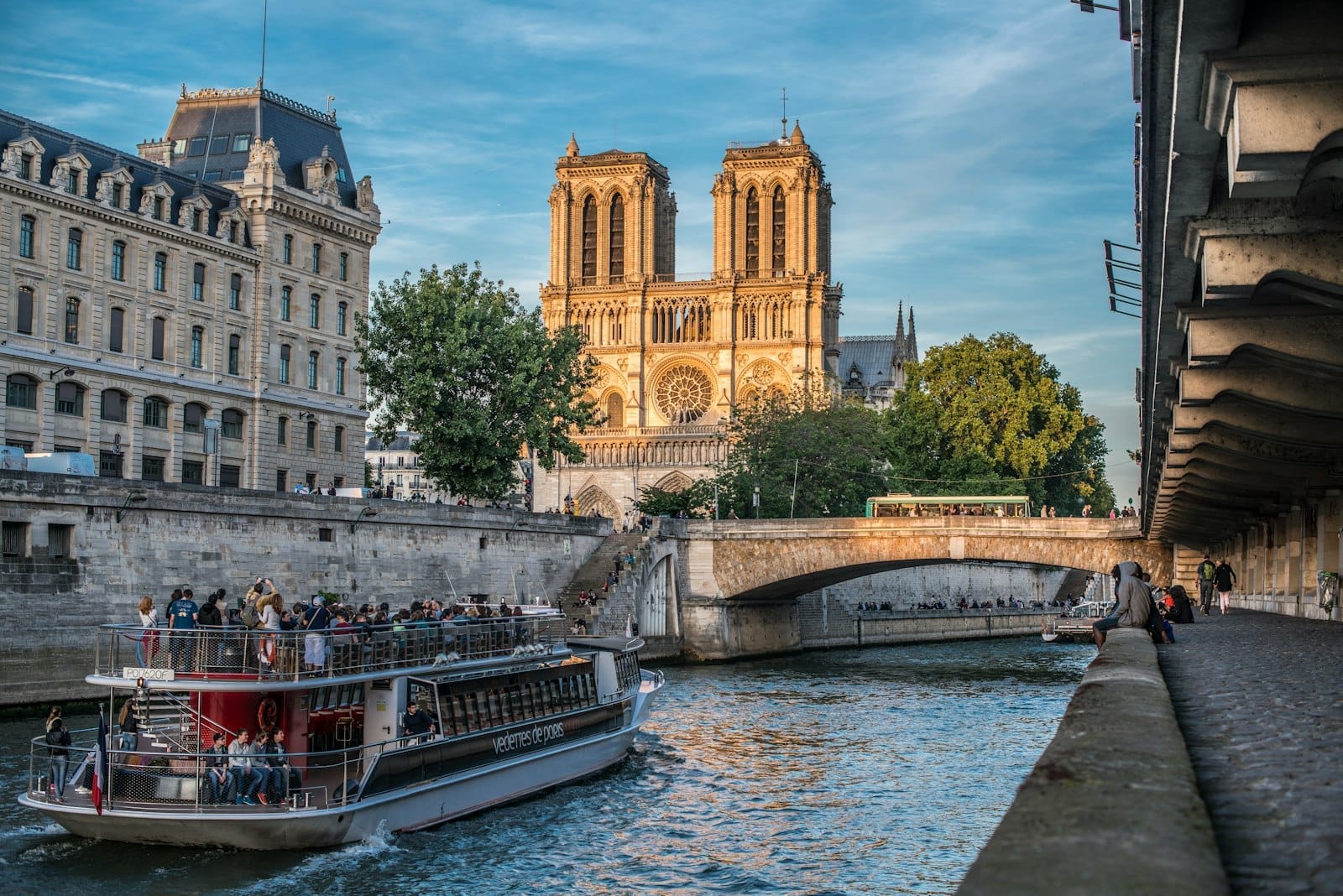
What Is the Latin Quarter?
The Latin Quarter (Quartier Latin) occupies the 5th arrondissement and edges into the 6th, on the Left Bank of the Seine. Its name comes from the Latin spoken by scholars at the medieval Sorbonne University, founded in the 13th century, but the neighborhood is older still: the streets follow the bones of Roman Lutetia, established here around the 1st century BCE. Fragments of that ancient city survive above ground at the Arènes de Lutèce, a Roman amphitheater a ten-minute walk from Place Saint-Michel. For a broader orientation, the Paris for first-timers guide covers how the Latin Quarter fits into the city's overall layout.
Place Saint-Michel: Arriving and Orienting
Most visitors arrive via Métro line 4 or the RER B and C at Saint-Michel Notre-Dame station, which deposits you directly at the square. The Fontaine Saint-Michel dominates the space: a neo-Renaissance fountain built between 1858 and 1860 by architect Gabriel Davioud, with a bronze Archangel Michael defeating Satan framed by pink marble columns. It is a set piece of the Haussmann-era transformation of Paris, theatrical and precise. The square also carries a serious political history: French Resistance fighters clashed with German forces here during the Liberation of Paris in August 1944, and in May 1968 students occupied the square and declared it an independent state during the uprisings that eventually paralyzed the country.
💡 Local tip
Arrive at Place Saint-Michel before 9:00 AM on a weekday to see the fountain with almost no one around. Morning light hits the bronze from the east, and the details in the ironwork are far easier to photograph without crowds in the foreground.
Tickets & tours
Hand-picked options from our booking partner. Prices are indicative; availability and final rates are confirmed when you complete your booking.
Paris Latin Quarter food tour with full meal
From 95 €Instant confirmationFree cancellationGourmet walking tour in Latin Quarter with tasting
From 109 €Instant confirmationFree cancellationParis Latin Quarter self-guided walking tour with audio app
From 5 €Instant confirmationParadis Latin show with optional dinner
From 80 €Instant confirmation
The Medieval Streets
Behind the fountain, the narrow streets preserve the original medieval plan almost intact. Rue de la Huchette, as little as 2 metres wide in places, has been a commercial street since the 13th century and now runs a corridor of Greek restaurants and crêperies. It is heavily tourist-oriented in the evening hours, but the architecture overhead — upper storeys of 17th and 18th-century buildings leaning slightly toward each other — is worth the walk-through. One block parallel, Rue Saint-Séverin is quieter. The Église Saint-Séverin at its head is a Gothic church rebuilt through the 15th century, notable for its twisted columns in the ambulatory and modern stained-glass windows by Jean René Bazaine installed in 1970. Entry is free and, on a weekday afternoon, the nave is nearly empty.
A short walk away, the Église Saint-Julien-le-Pauvre dates to the late 12th century and now serves the Melkite Greek Catholic community. Its iconostasis makes it look unlike any other church in Paris. From the small square in front, you have a clear sightline across the Seine to Notre-Dame Cathedral.
The Sorbonne, the Panthéon, and Upper Quarter
Walking up Boulevard Saint-Michel takes you into the academic core. The Sorbonne's neoclassical facade on Rue de la Sorbonne dates largely to 1897 but stands on foundations going back eight centuries. The building is a working university campus, not a tourist attraction, but the exterior courtyard is occasionally open. A ten-minute walk south and uphill brings you to the Panthéon, where the crypt holds Voltaire, Rousseau, Marie Curie, Victor Hugo, and others. The Foucault's Pendulum suspended from its dome is the most dramatic demonstration of Earth's rotation you are likely to encounter in a public building. Admission is charged; the Paris Museum Pass covers entry.
Books, Cafés, and the Literary Tradition
The neighborhood's association with intellectual life is not just atmosphere. Shakespeare and Company on Rue de la Bûcherie is an English-language bookshop that has operated in various forms since 1951, with narrow staircases, beds where writers slept in exchange for work, and notes left by passing readers on every surface. It is busy in the afternoons but calmer after 6:00 PM on weekdays. The Café de la Sorbonne on Place de la Sorbonne is the archetypal student café: strong espresso, affordable prices, tables packed with open books.
How the Quarter Changes Through the Day
Before 8:30 AM, the Latin Quarter belongs to residents and delivery trucks. The streets smell of bread from the boulangeries and cold stone from the night. By midday, the student lunch rush and peak tourist flow fill Rue de la Huchette and the riverfront blocks. Evening, from around 7:00 PM, is when the area recovers a genuine local energy: restaurant tables fill on the side streets off Rue Saint-André-des-Arts and around Place de la Contrescarpe, a cobblestone square in the upper 5th that feels neighborhood-scaled rather than staged.
⚠️ What to skip
The restaurants immediately around Place Saint-Michel and Rue de la Huchette have laminated picture menus and aggressive doormen aimed at tourists. Walk two blocks in any direction and the quality improves immediately.
Getting There and Practical Notes
The Latin Quarter is free to explore. Métro line 4 and RER B and C all stop at Saint-Michel Notre-Dame. From Île de la Cité it is under five minutes on foot across Petit Pont. Wear comfortable shoes: the cobbled medieval streets are uneven and any thorough walk will cover several kilometers. In wet weather the stones are slippery, and Paris's oceanic climate means rain is possible year-round. Accessibility is limited in the narrower streets like Rue de la Huchette, where uneven cobblestones and tight pedestrian traffic make wheelchair navigation difficult; the main boulevards and larger sites like the Panthéon have standard provisions.
The Latin Quarter rewards travelers who want to read a city rather than consume it. For those looking to see how the neighborhood connects to the broader Saint-Germain-des-Prés district, the quieter streets to the west offer a natural continuation with galleries, antique dealers, and the Jardin du Luxembourg.
Insider Tips
- Place de la Contrescarpe, near the top of Rue Mouffetard, is one of the most pleasant small squares in Paris for a late afternoon drink. Hemingway wrote about it in 'A Moveable Feast'; today it is ringed by low-key bar terraces that fill with students rather than tour groups.
- The Arènes de Lutèce, a 1st-century Roman amphitheater, is free to enter and usually occupied by elderly men playing pétanque. It sits behind apartment buildings on Rue Monge, ten minutes from Place Saint-Michel, and is one of the quietest spots in central Paris.
- Shakespeare and Company hosts free literary readings most weeks, typically on weekend evenings. No booking is required for many sessions. Check their website before visiting.
- For the best view of the Saint-Michel fountain without tourist density, stand on the Quai des Grands Augustins across the river. The angle looking back toward the fountain and Notre-Dame is better from the water's edge, and the crowd drops by half.
- Marché Maubert on Place Maubert runs Tuesday, Thursday, and Saturday mornings until roughly 1:00 PM. It is a functional neighborhood market rather than a tourist spectacle, with strong cheese stalls and seasonal produce.
Who Is Latin Quarter (Saint-Michel) For?
- First-time visitors building a mental map of Paris's history from Roman to Haussmannian
- Book lovers and anyone drawn to Paris's literary and philosophical tradition
- Architecture enthusiasts who want the full span from Romanesque church to neoclassical dome
- Evening walkers looking for a neighborhood that stays active without a heavy club scene
- Travelers combining a morning at Notre-Dame or Sainte-Chapelle with an afternoon on the Left Bank
Nearby Attractions
Other things to see while in Saint-Germain-des-Prés & the Latin Quarter:
- Catacombs of Paris
Twenty metres underground, the Catacombs of Paris hold the remains of more than six million people in a network of former limestone quarries beneath the 14th arrondissement. It is one of the most unusual historical sites in Europe, and one of the most crowded. Here is what visiting actually looks like.
- Jardin des Plantes
Founded in 1626 as a royal medicinal herb garden, the Jardin des Plantes is France's principal botanical garden and one of Paris's most underrated green spaces. Free to enter and open every day of the year, it combines formal flowerbeds, towering greenhouse pavilions, a zoo, and four natural history museums inside a single 28-hectare site on the left bank of the Seine.
- Jardin du Luxembourg
Spread across 25.72 hectares in the heart of the 6th arrondissement, Jardin du Luxembourg is Paris's most refined public garden. Created in 1612 by Marie de Médicis, it blends French formal geometry with wilder English-style landscaping, 102 statues, a working orchard, and the grand Luxembourg Palace. Entry is free and the atmosphere shifts completely depending on the hour.
- Musée de Cluny (Medieval Museum)
The Musée de Cluny — officially the Musée national du Moyen Âge — holds one of the world's most complete collections of medieval art inside a 15th-century mansion built over 1st-century Roman baths. Its crown jewel, the Lady and the Unicorn tapestry cycle, is alone worth the admission.